
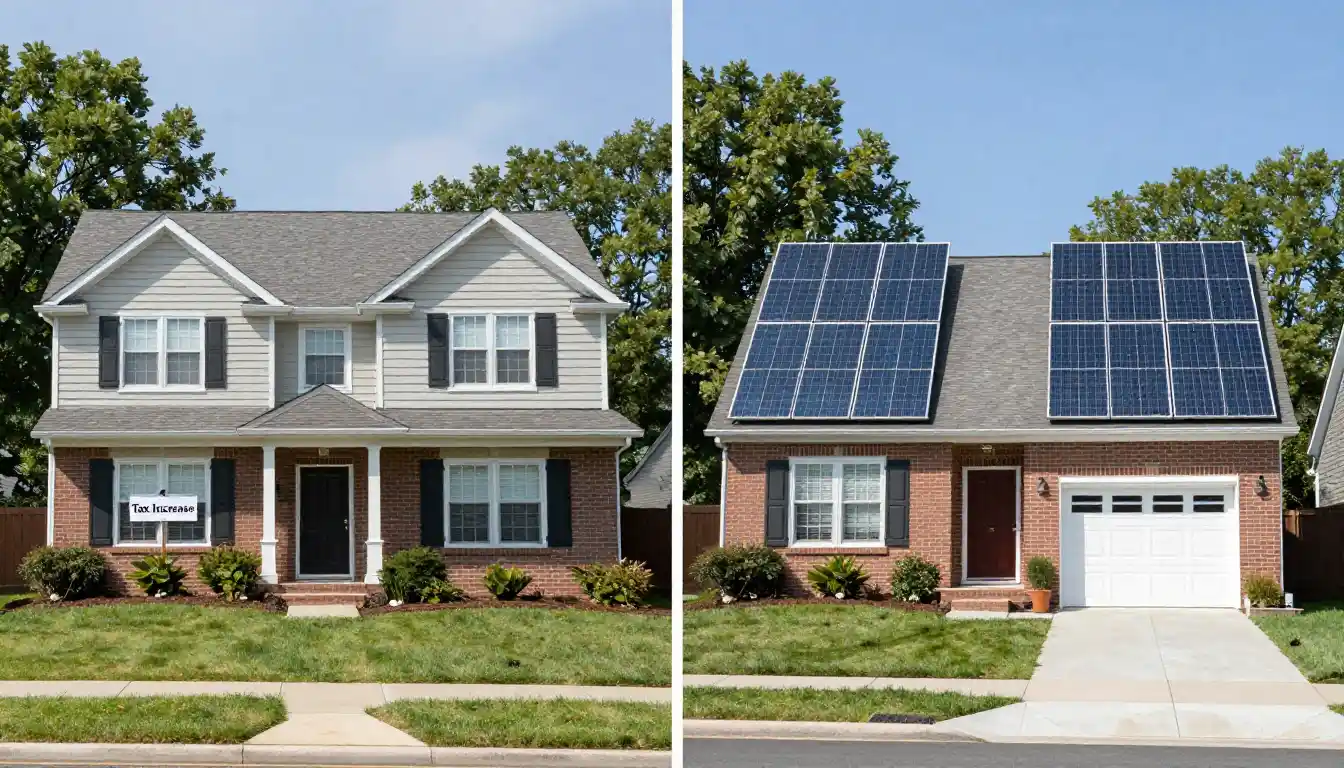
The average solar payback period New Jersey 2026 runs 6 to 8 years for a standard 8.6 kW system after the 30% federal Investment Tax Credit. Without the ITC, that window stretches to 9 to 12 years. Your actual number depends on your utility rate, your roof, and which part of the state you live in.
New Jersey homeowners pay some of the highest electricity rates on the East Coast. Jersey Central Power & Light (JCP&L) and PSE&G customers averaged 18.2 to 19.4 cents per kWh in early 2026, according to the U.S. Energy Information Administration. That rate is what makes solar math work here, and also what makes the payback period surprisingly reasonable compared to states with cheaper power.
The solar payback period New Jersey 2026 without ITC is a critical number to understand upfront. Not every homeowner qualifies for the federal tax credit. If you have no federal tax liability, retirees on fixed incomes, for example, the payback period calculation changes entirely.
Key Facts Before You Read Further
- Average NJ payback with 30% ITC: 6–8 years
- Average NJ payback without ITC: 9–12 years
- 8.6 kW system gross cost in 2026: $23,220–$27,000
- After 30% ITC: $16,250–$18,900
- PSE&G / JCP&L average rate: 18.2–19.4 cents/kWh
- NJ peak sun hours: 4.2–4.6 daily (varies by region)
- SREC II current price: $85–$91 per SREC (April 2026)
What Does “Payback Period” Actually Mean for NJ Homeowners?
The solar payback period is the number of years your system takes to recover its upfront cost through electricity savings and incentive income. After that breakeven point, every dollar the system generates is net profit. For an 8.6 kW system in New Jersey, that recovery happens faster than most installers tell you, but slower than the most optimistic sales presentations suggest.
Here is why New Jersey’s payback math is different from most other states:
- The state’s average electricity rate is 40% above the national average.
- The SREC II program pays you for every megawatt-hour your system produces, separate from your utility savings.
- New Jersey exempts solar systems from both property tax increases and state sales tax under the Solar Energy Sales Tax Exemption (N.J.S.A. 54:32B-8.32).
That combination, high rates, SREC income, and two tax exemptions, compresses the payback window in ways that don’t apply in lower-rate states. For a full breakdown of the state’s rebate programs, see this guide to New Jersey solar rebates and credits.
The 8.6 kW Scenario: Payback Period With and Without the Federal ITC
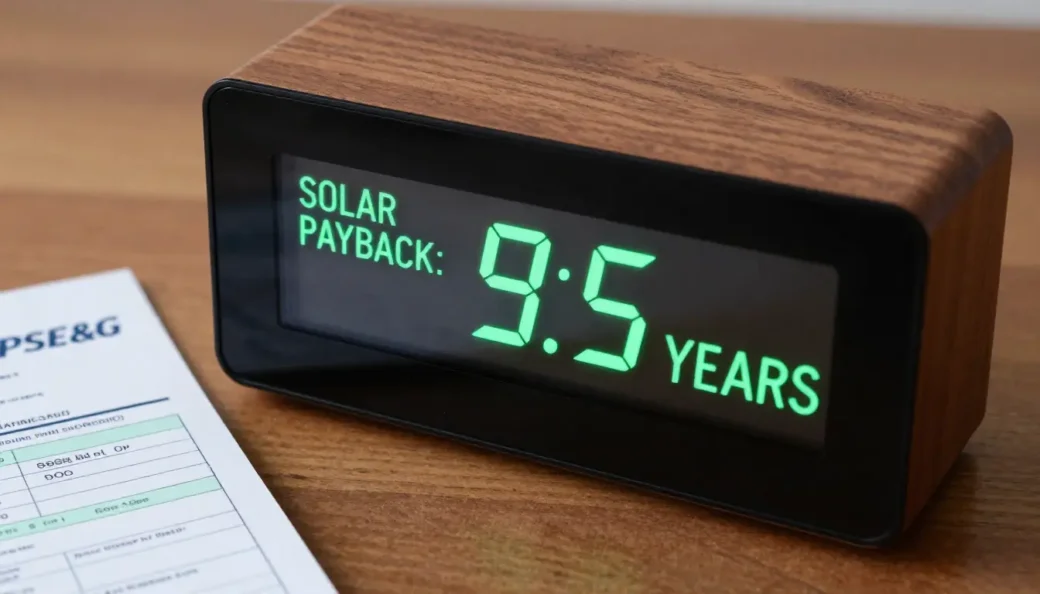
An 8.6 kW system in New Jersey costs between $23,220 and $27,000 before any incentives in 2026. The federal ITC at 30% reduces that out-of-pocket cost to roughly $16,250–$18,900 for homeowners who claim it.
With the 30% Federal ITC
Take a homeowner in Toms River paying JCP&L around $195 per month, roughly $2,340 per year. A south-facing 8.6 kW system in Ocean County gets about 4.4 peak sun hours daily, generating approximately 11,500–12,000 kWh per year.
That output offsets most of that $2,340 annual bill. Add in SREC II income of about $1,000–$1,100 per year (roughly 11–12 SRECs at current prices), and the combined annual benefit reaches $3,300–$3,400.
At $17,500 net system cost after the ITC, the payback period = 5.1 to 5.3 years.
That is one of the stronger payback windows on the East Coast.
Without the Federal ITC
The same homeowner, same system, same savings, but no ITC. Out-of-pocket cost stays at $25,000.
Annual benefit stays at $3,300–$3,400. Payback period without ITC = 7.3 to 7.6 years.
Still financially sound, but the timeline is meaningfully longer. For homeowners who cannot use the credit or who are considering a lease or PPA, understanding this gap matters. You can use the solar panel cost calculator for New Jersey to run your own numbers.
Solar Payback Period New Jersey 2026 Without ITC: Who Gets Hurt Most?
Homeowners who cannot claim the federal ITC face a payback period of 9–12 years on average in New Jersey, not 6–8. The ITC is a dollar-for-dollar reduction of your federal tax bill. If your tax liability is lower than the credit amount, you carry the remainder forward, but only if you own the system outright.
The situations where the ITC doesn’t help you:
- You have no federal tax liability (retired, low income).
- You lease the system, the installer takes the credit, not you.
- You finance through a PPA, same issue.
- Your tax liability is less than the credit value, and you’ve already used the carryforward.
A homeowner in Newark on a fixed income, paying PSE&G $160 a month, installs a 7 kW system for $21,000. No ITC claimed. Annual savings of $1,800 plus SREC II income of roughly $840 = $2,640 per year. Payback: 7.9 years without ITC at that bill level, not catastrophic, but it depends heavily on PSE&G rates staying where they are.
That’s the honest version. Most solar sales presentations skip it.
Solar ROI and IRR in New Jersey 2026: What the Numbers Look Like
The solar internal rate of return (IRR) in New Jersey in 2026 runs between 10% and 14% for owned systems with the ITC, and 7% to 10% without it. That IRR compares favorably to most fixed-income investment options.
How ROI and IRR are calculated for NJ solar
The Levelized Cost of Energy (LCOE) for a residential New Jersey solar system in 2026 runs about 7–9 cents per kWh over a 25-year system life. JCP&L’s current retail rate is nearly 19 cents. That 10-cent-per-kWh gap is your margin.
Solar ROI in New Jersey 2026 without the federal ITC is lower but still competitive:
| Scenario | System Cost (Net) | Annual Benefit | Simple Payback | 25-Year ROI |
| 8.6 kW with ITC | ~$17,500 | ~$3,300 | 5.3 years | 180%–210% |
| 8.6 kW without ITC | ~$25,000 | ~$3,300 | 7.6 years | 120%–145% |
| 8.6 kW, no SREC II | ~$17,500 | ~$2,300 | 7.6 years | 140%–160% |
The SREC II row matters. If New Jersey’s SREC II program ends or prices drop before your system reaches year 15, ROI slides. The program is currently funded through 2028, but renewals are never guaranteed. See the full breakdown of SREC II New Jersey 2026 for the latest program status.
Tesla Solar in New Jersey 2026: Does It Change the Payback?

Tesla solar in New Jersey 2026 carries a gross system cost roughly 10–18% below traditional installer pricing, which directly shortens the payback period, but with trade-offs. A Tesla 8.58 kW system (their closest standard size) runs approximately $21,000–$23,000 before incentives.
After the 30% ITC: approximately $14,700–$16,100.
At $15,400 net, with the same $3,300 annual benefit, payback period = 4.7 years. That is legitimately among the shortest in the market for New Jersey.
What the lower price reflects
Tesla achieves lower pricing through:
- Standardized roof assessments (no in-person visit).
- Equipment sourcing at scale.
- Limited customization options.
The honest limitation: Tesla’s installation timelines in New Jersey have run 4 to 6 months in 2026 due to grid interconnection queues with JCP&L and PSE&G. A faster installation from a local installer may cost $2,000–$3,000 more but avoids a half-year wait that delays the start of your savings.
Geographic Variation: Northern vs. Southern New Jersey
Your zip code in New Jersey changes your solar payback period by 1 to 2 years. This is a fact most statewide summaries ignore.
Northern New Jersey (Bergen, Passaic, Morris counties)
- Average daily peak sun hours: 4.2–4.4
- Primary utility: PSE&G
- Average 8.6 kW annual output: 10,900–11,400 kWh
- Payback range with ITC: 6.5–7.5 years
Bergen County homeowners also face higher property values, meaning installers sometimes charge a premium for permits and labour. A homeowner in Hackensack, paying PSE&G $210 a month with a steep, partially north-facing roof, saw their usable system size drop from 8.6 kW to 6.5 kW, pushing their payback out to 8 years even with the ITC. That’s the problem scenario no sales presentation leads with.
Southern New Jersey (Burlington, Camden, Atlantic counties)
- Average daily peak sun hours: 4.5–4.7
- Primary utilities: Atlantic City Electric, South Jersey Gas (electric from ACE)
- Average 8.6 kW annual output: 11,700–12,200 kWh
- Payback range with ITC: 5.0–6.0 years
Atlantic City Electric customers in Vineland or Cherry Hill consistently see the strongest NJ solar economics. Higher sun hours, competitive system pricing, and ACE’s net metering tariff under BPU Docket No. QO21020165, New Jersey’s current net metering framework, keeps credits competitive at roughly the full retail rate.
What struck me when I studied New Jersey’s regional data is how dramatically the Atlantic City Electric service territory outperforms the PSE&G northern corridor. The difference in peak sun hours seems small, 0.3 to 0.5 hours per day, but compounded over 25 years, it adds up to roughly $4,000–$6,000 in additional generation value.
Net Metering in New Jersey 2026: What You Actually Earn Back
New Jersey’s net metering policy in 2026 credits surplus solar energy at the full retail rate under the BPU’s current rules, but the state is reviewing a transition to a successor tariff. That review affects long-term ROI projections for systems installed after 2026.
For now, homeowners on JCP&L or PSE&G who generate more than they use in a given month receive a credit at 18–19 cents per kWh. That is one of the most generous net metering structures in the Northeast.
Why this matters for your payback calculation
Most 8.6 kW systems in New Jersey produce a significant surplus in spring and fall, months when air conditioning isn’t running, but the sun is strong. That surplus accumulates as a credit applied to winter bills. Net annualized, it reduces your effective utility spend significantly.
Systems sized correctly for your annual usage, not your peak summer usage, get the most out of this policy. Oversizing creates a surplus that earns retail credit rather than running your meter backward in real time. Understanding wastes the opportunity entirely. Understanding how tax equity structures interact with these incentives is relevant for homeowners exploring third-party financing. See how solar tax equity partnerships work for more context.
Solar IRR New Jersey 2026: The Investment Lens
Treating a New Jersey solar installation as an investment, the IRR runs 10%–14% for owned systems in 2026, outperforming most fixed-rate alternatives. This is the metric financial advisors use when comparing solar to a bond or CD.
The IRR math for a standard NJ homeowner
Assumptions:
- 8.6 kW system, net cost after ITC: $17,500
- Annual savings + SREC II income: $3,300 year one
- Utility rate escalation: 3.5% annually (NJ historical average)
- System degradation: 0.5% per year (photovoltaic degradation rate for tier-1 panels)
- System life: 25 years
Year 25 cumulative return: approximately $103,000 on a $17,500 investment.
IRR: 13.1%
Without ITC, the same calculation on a $25,000 investment yields an IRR of approximately 9.4%.
Both numbers are real. The 9.4% without the ITC is not a failure; it’s still a strong long-term return. But it changes the conversation about whether to wait for a higher-tax-liability year before installing, or whether to explore commercial structures if you’re a business owner in New Jersey. Commercial solar in New Jersey operates under different rules; see how commercial solar PPA laws apply in this market.
What This Means for New Jersey Homeowners in 2026
The bottom line for New Jersey solar payback in 2026: the economics are genuinely strong, but they are not uniform.
Here is how to read your own situation:
- If your monthly bill is above $150 with JCP&L or PSE&G, and you have a south- or west-facing roof with minimal shade, payback with the ITC runs 5–7 years. That is a legitimate return.
- If you cannot claim the ITC, budget for a 9–11 year payback and model SREC II income conservatively, the program has a 2028 funding horizon.
- If your bill is under $100 per month, solar in New Jersey is financially marginal. The payback stretches past 12 years, and the IRR drops below 7%. That’s not a compelling investment case.
- If you’re in southern New Jersey, Burlington County south, you have a natural advantage in sun hours and competitive ACE rates that tighten the payback meaningfully.
The state’s property tax exemption and sales tax exemption on solar equipment reduce your effective cost without showing up in payback calculators. Those two benefits alone save a typical homeowner $2,000–$4,000 over the system’s life.
The U.S. Department of Energy maintains updated state-level solar data that can help you cross-check any installer estimates you receive. Use it.
Final Verdict: Is the New Jersey Solar Payback Period Worth It in 2026?
The solar payback period New Jersey 2026 is 6–8 years with the federal ITC and 9–12 years without it for a standard 8.6 kW system. The solar ROI and IRR in New Jersey both rank in the top third of U.S. states. The combination of high utility rates, SREC II income, and strong net metering makes the math work.
The honest caveat: grid interconnection delays with JCP&L have added 3–6 months to installation timelines in 2026. A system you sign for in Q2 may not be live until Q4. That delay costs you a full season of savings; factor it into your timing decision.
Solar is worth it in New Jersey for homeowners who own their roof, have a bill above $130 a month, can claim the ITC, and are prepared to wait through the interconnection process. It is not worth it for homeowners who lease, have significant shading, or cannot use the federal tax credit in the year of installation.
The payback period numbers here are real. The scenarios are grounded. If an installer gives you a payback estimate that is shorter than 5 years without explaining exactly why, ask them to show you the math line by line.
Frequently Asked Questions
What is the average solar payback period New Jersey 2026?
6 to 8 years with the 30% federal ITC for a typical 8.6 kW system.
What is the solar payback period in New Jersey without the ITC?
9 to 12 years, depending on your utility rate and system size.
Does SREC II income change the payback period?
Yes. SREC II adds roughly $900–$1,100 per year for an 8.6 kW system, shortening payback by 1–2 years.
Is Tesla solar faster to pay back than other installers in NJ?
Often yes, Tesla’s lower gross system price produces a payback of 4.7–5.5 years with ITC, but installation timelines in NJ have been 4–6 months in 2026.
Which NJ utility has the best solar economics?
Atlantic City Electric customers in southern NJ typically see the strongest ROI due to higher sun hours and competitive net metering credits.
Is solar a good investment in New Jersey without the federal tax credit?
It can be, the IRR runs about 9–10%, which is competitive, but the case is weaker and depends heavily on the SREC II program continuity.
Does New Jersey exempt solar from property taxes?
Yes. Under N.J.S.A. 54:4-3.113a, solar systems are exempt from added property tax assessments state wide.
This article by SolarInfoPath (2026 research framework) is part of a comprehensive solar knowledge architecture covering all major high-value sectors including legal disputes (installation negligence, contracts, liability, fraud, lawsuits, liens, HOA and permitting disputes), financial structures (loans, PPA/lease agreements, DSCR financing, tax equity, investment and project finance), tax law (ITC, Section 48/25D, MACRS depreciation, bonus credits, IRS audits, recapture rules, domestic content and IRA/OBBBA compliance), insurance and risk (property damage, hail/wind/fire claims, bad faith insurance disputes, warranty coverage), policy and regulation (net metering, FERC interconnection, state utility rules, incentive programs and regulatory changes), commercial and utility-scale development (EPC contracts, construction delays, performance bonds, receivership, bankruptcy, asset sale and restructuring), real estate impacts (home value, solar leases, liens, title issues, HOA restrictions, easements), and emerging market structures such as battery storage, community solar, agrivoltaics, SRECs, yieldcos, and institutional investment funds. All content is based on publicly available regulatory, financial, and legal sources and is intended strictly for educational and informational purposes, not legal, tax, or financial advice. Readers should always verify current laws, utility policies, tax regulations, and contract terms with qualified licensed professionals before making decisions, as solar regulations, incentives, and financial structures frequently change across jurisdictions and time.

Solar Legal Analyst· Policy Researcher· Investigative Finance Writer Lead Analyst & Founder of SolarInfoPath
Morgan Lee is a solar legal analyst, policy researcher, and investigative finance writer with 12+ years of experience in U.S. renewable energy law, IRS tax credit compliance, and solar litigation. He is the founder of SolarInfoPath, a research-driven platform focused on primary-source analysis of solar contracts, tax law, regulatory policy, and industry disputes affecting homeowners and commercial developers.
His work is grounded in original legal and regulatory sources, including IRS notices, FERC and CPUC rulings, state court filings, PACER records, and UCC lien databases. He specializes in solar contract disputes, injury and workers’ compensation claims, PACE financing issues, tax equity structures, ITC recapture rules, MACRS depreciation, and federal and state solar policy frameworks.
Morgan’s analysis spans solar litigation, finance structures, and regulatory developments such as the IRA and OBBBA, interconnection reform, domestic content rules, and battery storage incentives. He also covers EPC contracts, PPAs, project financing, and utility-scale solar investment structures.