
A property owner near Valdosta started seeing muddy water cross his fence line after every heavy rain. A large solar farm had broken ground less than a quarter mile away three months before. His pasture grass was dying. His drainage ditch was filling with silt. The developer had not returned a single call.
That is when he searched for a solar farm runoff attorney Georgia.
He is not alone. Georgia added more large solar projects between 2022 and 2025 than almost any other south eastern state. That growth brought a wave of sediment damage litigation complaints, mostly in counties like Lowndes, Bibb, and Dougherty. Most property owners had no idea where to start.
On this page, we will discuss what causes solar farm runoff, when it becomes a legal claim in Georgia, and how to decide if your situation is worth pursuing.
What Actually Causes Solar Farm Runoff in Georgia
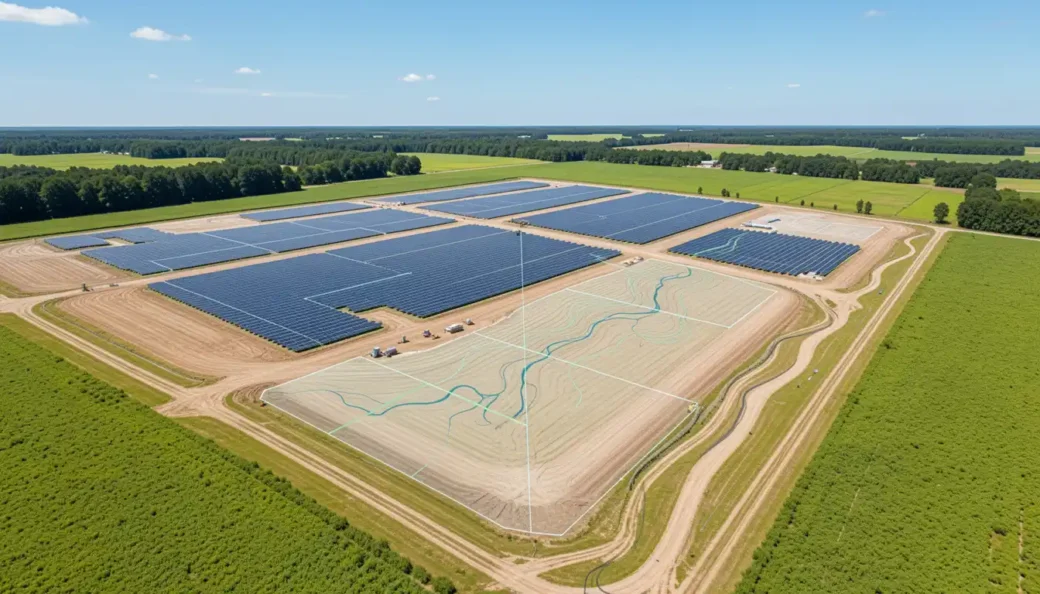
Solar construction clears large areas of land quickly. Grading and grubbing strip ground cover from 200 to 500 acres at a time.
Without stable grass or working erosion controls, Georgia’s heavy rains push loose topsoil downhill. That sediment lands on nearby properties, clogs drainage ditches, and flows into streams.
South Georgia’s flat land makes it worse. Water moves slowly there, so sediment spreads widely rather than staying in one channel.
Why Georgia’s Rain Pattern Matters
Georgia gets about 50 inches of rain per year. South Georgia counties like Lowndes and Dougherty see strong summer storms that can drop two or more inches in a single hour.
A construction site being actively graded has almost no erosion protection during those storms. Most silt fences and sediment basins are built for light rain, not the storms Georgia actually gets.
What Happens to Your Land Over Time
Sediment builds up and packs your soil down after each event.
Crops fail. Drainage backs up. Land that once drained in hours can sit flooded for days. In some Bibb County cases, repeated sediment floods cut soil output enough to lower land values.
What Georgia Law Requires Solar Developers to Do
Georgia has strong erosion laws on paper. The real question is whether they are being followed on your specific project.
The Georgia Erosion and Sedimentation Act (O.C.G.A. § 12-7-1 et seq.) requires any land clearing over one acre to have an approved Erosion, Sedimentation, and Pollution Control Plan. Solar farms covering hundreds of acres fall fully under this rule.
Developers must put erosion controls in place before grading starts. They must check those controls after every rain event. Problems must be fixed within 24 hours.
Many are not.
What the Clean Water Act solar violation lawyer Adds
Federal law adds a second layer. Under Clean Water Act Section 402, large construction sites must carry a National Pollutant Discharge Elimination System permit, known as an NPDES permit.
That permit requires a Stormwater Pollution Prevention Plan, called a SWPPP. The SWPPP maps out how runoff will be controlled from the first day of clearing to the last phase of construction.
If sediment from the site reaches a creek, stream, or wetland, that can be a federal permit violation. Understanding how commercial solar legal duties work under federal and state law helps property owners see why these permit rules carry real legal weight.
What Georgia EPD Is Supposed to Do
Georgia’s Environmental Protection Division enforces NPDES rules at the state level through an agreement with EPA Region 4 in Atlanta.
EPD can issue stop-work orders, demand fixes, and charge fines. But in many rural Georgia counties, EPD visits are complaint-driven. If no one files a report, many construction sites go unchecked for months.
Your complaint is often what starts the first official visit. Filing it early matters more than most property owners know.
Who Is Legally Responsible for the Damage
This is where most Georgia solar runoff cases get complicated fast.
Many parties are involved in every large solar project. The developer holds the permits. The EPC contractor manages construction. Grading subcontractors clear the site. The landowner who leased the land has a separate legal tie to all of them.
The Party Breakdown
| Party | What They Control |
| Solar developer | NPDES permit holder, project design |
| EPC contractor | Construction management, erosion control setup |
| Grading subcontractor | Site clearing, slope, and drainage changes |
| Landowner/lessor | Land access, pre-existing site conditions |
The EPC contractor usually carries the most direct construction liability. But the developer holds the NPDES permit, so federal compliance sits with them.
Your attorney figures out which party’s insurance and money are worth going after.
Why Solar Contracts Shift Responsibility Around
Most solar construction contracts include clauses that push legal blame between parties.
A developer may say the EPC contractor caused all erosion failures. The EPC contractor may say a subcontractor went off-plan. That kind of finger-pointing is common in these disputes.
A solar project finance attorney who handles large energy legal cases has seen these contract setups many times. Knowing where liability actually falls helps you avoid chasing the wrong party.
The Evidence You Need Before You Call Anyone
Do not wait for a perfect case before making that first call. But gather evidence before you do.
Good records are what separate cases that settle from cases that get thrown out.
What to Start Collecting Now
- Photos and videos after every rain event showing sediment moving from the solar site toward your land
- Date-stamped images of soil on your property before and after each event
- Rainfall records for your area on days you document damage, the National Weather Service keeps these by zip code
- County inspection records for the solar site, these are public records in Georgia
- Any written contact you have had with the developer, contractor, or county
What Makes Evidence Hold Up in Georgia Courts
Georgia Environmental tort solar claims require you to connect the damage directly to the source.
Photos of water flowing from the solar site are stronger than photos of your flooded field alone. EPD inspection reports showing permit violations at the site are stronger still.
What I noticed when studying Georgia runoff cases is that property owners with the strongest outcomes kept records over months, not just after one event. One photo proves one bad day. Six months of records prove a clear pattern.
Two Georgia Scenarios With Different Outcomes
Scenario 1: Lowndes County, Repeated Flooding, Strong Legal Footing
A cattle farmer near Valdosta recorded sediment covering 12 acres of his pasture across three rain events. He took photos with GPS data and matched the dates to National Weather Service records.
He filed a written complaint with Georgia EPD. An inspector visited the site and issued a violation notice citing several SWPPP failures. A correction order followed.
The farmer then contacted a solar farm runoff attorney Georgia. With the EPD notice already on file, the developer’s own permit history became part of the evidence. The case settled before trial, and the developer paid for drainage repairs and lost pasture productivity.
The EPD complaint did not end the case. It built the foundation that made everything else work.
Scenario 2: Bibb County, Small Damage, Harder Math
A homeowner near Macon had about a quarter of an acre of landscaping damaged by sediment from a nearby solar project.
Her repair costs came to roughly $4,200. She had photos and two months of records.
Her attorney laid it out clearly: filing a full legal claim for that amount would cost more in legal fees than she could realistically get back. Small claims court in Georgia caps at $15,000 but requires proof of cause without expert witnesses.
She sent a certified demand letter to the developer instead. They paid $3,000 to avoid more trouble. The case closed in about six weeks.
Decision Checkpoint
If your documented repair costs are under $10,000, a demand letter is often faster and cheaper than a lawsuit. If your losses include crop damage, soil cleanup, drainage repair, or lower land value, where costs reach tens of thousands, a formal legal claim makes financial sense.
How Georgia County Enforcement Differs by Region

Not all Georgia counties handle solar runoff complaints the same way.
Fulton County has active local erosion staff who check construction sites often. A complaint there usually gets a reply within days.
Rural South Georgia counties, where most new large solar projects are going in, often rely fully on state EPD for enforcement. Local staff in counties like Dougherty or Worth may not have the resources to inspect big solar sites on their own.
That gap matters. A project in a rural county may go months without a county visit, even after several complaints. The law still applies, but you may need to go straight to Georgia EPD’s district office rather than waiting for local action.
Environmental tort solar claims in Georgia, What Qualifies
Three legal theories cover most Georgia solar runoff cases.
Nuisance means the developer’s work unfairly disrupts your use of your property. Repeated sediment flooding that kills crops or stops normal land use qualifies.
Trespass means physical material, sediment, or anything crossed onto your land without your permission. Georgia courts have upheld trespass claims for sediment in past cases.
Negligence means the developer failed to follow Georgia law and their NPDES permit. Documented SWPPP failures support this theory directly.
You do not need all three. Your attorney picks the strongest path based on your evidence and damage type.
What Does Not Qualify as a Legal Claim
Not every runoff near a solar farm meets the legal standard.
If sediment came partly from your own land or another source, the link breaks. If your property had drainage problems before construction, the developer will use that against you.
Visible muddy water near a solar site does not automatically mean the developer is liable. The water must be traced, through hard evidence, specifically to the construction site.
Post-Construction Runoff: The Problem Most People Miss
Many property owners think runoff stops when construction ends. Often it does not.
Solar sites need grass and ground cover to hold soil in place beneath and around the panels. If that vegetation never takes hold, or if the developer cuts maintenance after the project starts producing power, erosion keeps going.
Post-construction runoff is harder to fight in some ways. The construction NPDES permit has expired. The site is now an active solar facility, which changes the rules that apply.
But nuisance and trespass claims still hold under Georgia law, whether the project is still being built or already running.
Most large Georgia solar farms are funded through tax equity structures that bring in outside investors. Understanding how solar tax equity partnerships divide long-term ownership and responsibility matters here; those investors stay financially connected to the project for years after construction ends. That means there are often well-funded parties you can still reach long after the original developer has moved on.
What Happens If You Do Nothing
Some property owners wait, hoping the sediment will stop once the site settles.
Sometimes it does, once the grass fully grows in. But sometimes the grading changed the drainage pattern for good. Water that once ran away from your property now runs across it because the slope was changed.
That kind of drainage change does not fix itself.
Georgia’s statute of limitations for property damage is generally four years. That sounds like a long time, until two years pass while you wait for the problem to go away, and another year goes by before you start collecting evidence.
Document now. Decide later. Waiting to document is the one mistake you cannot undo.
Federal vs. State Enforcement, Which Path Fits Your Situation
Georgia property owners have two enforcement routes, state and federal.
Georgia EPD handles state-level NPDES enforcement. The EPA handles federal Clean Water Act enforcement. In practice, EPD is the main enforcer for construction runoff in Georgia under its agreement with EPA Region 4 in Atlanta.
| Enforcement Path | Who Handles It | Typical Timeline |
| Georgia EPD complaint | EPD District Office | Weeks to months |
| Federal EPA complaint | EPA Region 4, Atlanta | Months or longer |
| Private legal claim | Your attorney | Depends on evidence |
Filing an EPD complaint does not stop you from also filing a private legal claim. EPD violation records often make private cases much stronger.
The National Renewable Energy Laboratory’s solar development data shows how fast large solar projects have grown in south eastern states, which explains why runoff complaints in Georgia counties have spiked sharply since 2022.
What Georgia Property Owners Near Solar Farms Should Also Know
Solar farm runoff is one piece of a bigger picture for Georgia landowners living near active solar development.
If you or a family member signed a land lease with a solar developer, understanding the legal risks and obligations inside solar land agreements is important before you take any action on damage claims, because lease terms can affect your legal standing as a neighbour or lessor.
Property value loss comes up in nearly every runoff case. Landowners in Georgia counties like Twiggs and Wilcox have raised concerns similar to those seen in solar-related property valuation and legal disputes in other states, providing useful background for understanding how Georgia courts and appraisers handle land value claims near large solar sites.
Final Verdict: Is Contacting a Solar Farm Runoff Attorney Georgia Worth It
A solar farm runoff attorney Georgia is worth contacting when your damage is on record, your losses are real, and you have evidence linking the sediment to the solar construction site.
You do not need a complete case before making that first call. Most environmental attorneys in Georgia offer a free first meeting for property damage matters. They will tell you quickly whether your situation has enough to move forward.
If your repair costs are under $10,000 and your records are thin, a certified demand letter is the faster and cheaper first step. If EPD has already issued a violation notice on the site, your legal position is stronger than most property owners know at that point.
The most important step right now is documentation. Georgia’s four-year limit sounds generous until you realize how fast it passes when you are waiting and hoping the problem fixes itself.
Frequently Asked Questions
What qualifies as solar farm runoff damage in Georgia?
Sediment from a solar site depositing on your land, blocking drainage, or cutting crop output can qualify, if you can document the direct link to that site.
How do I file a complaint about solar runoff in Georgia?
Contact Georgia EPD’s district office for your county, file a written complaint with photos and damage dates, and ask for written confirmation that it was received.
What is a SWPPP, and why does it matter to my case?
A Stormwater Pollution Prevention Plan is a required document under the NPDES permit that maps exactly how the developer controls runoff. Not following it creates direct legal liability.
How long do I have to file a solar runoff claim in Georgia?
Georgia’s property damage statute of limitations is generally four years. Start documenting damage right away; delays weaken your evidence and limit your options.
Can I sue the solar developer directly in Georgia?
Yes, under nuisance, trespass, or negligence theories under Georgia law. Which one fits depends on your damage type and the evidence you have.
Does an EPD violation notice help my private legal claim?
Yes. An official EPD notice confirms the developer broke their legal duties on record, and that record becomes direct supporting evidence in a private legal action.
This article by SolarInfoPath (2026 research framework) is part of a comprehensive solar knowledge architecture covering all major high-value sectors including legal disputes (installation negligence, contracts, liability, fraud, lawsuits, liens, HOA and permitting disputes), financial structures (loans, PPA/lease agreements, DSCR financing, tax equity, investment and project finance), tax law (ITC, Section 48/25D, MACRS depreciation, bonus credits, IRS audits, recapture rules, domestic content and IRA/OBBBA compliance), insurance and risk (property damage, hail/wind/fire claims, bad faith insurance disputes, warranty coverage), policy and regulation (net metering, FERC interconnection, state utility rules, incentive programs and regulatory changes), commercial and utility-scale development (EPC contracts, construction delays, performance bonds, receivership, bankruptcy, asset sale and restructuring), real estate impacts (home value, solar leases, liens, title issues, HOA restrictions, easements), and emerging market structures such as battery storage, community solar, agrivoltaics, SRECs, yieldcos, and institutional investment funds. All content is based on publicly available regulatory, financial, and legal sources and is intended strictly for educational and informational purposes, not legal, tax, or financial advice. Readers should always verify current laws, utility policies, tax regulations, and contract terms with qualified licensed professionals before making decisions, as solar regulations, incentives, and financial structures frequently change across jurisdictions and time.

Solar Legal Analyst· Policy Researcher· Investigative Finance Writer Lead Analyst & Founder of SolarInfoPath
Morgan Lee is a solar legal analyst, policy researcher, and investigative finance writer with 12+ years of experience in U.S. renewable energy law, IRS tax credit compliance, and solar litigation. He is the founder of SolarInfoPath, a research-driven platform focused on primary-source analysis of solar contracts, tax law, regulatory policy, and industry disputes affecting homeowners and commercial developers.
His work is grounded in original legal and regulatory sources, including IRS notices, FERC and CPUC rulings, state court filings, PACER records, and UCC lien databases. He specializes in solar contract disputes, injury and workers’ compensation claims, PACE financing issues, tax equity structures, ITC recapture rules, MACRS depreciation, and federal and state solar policy frameworks.
Morgan’s analysis spans solar litigation, finance structures, and regulatory developments such as the IRA and OBBBA, interconnection reform, domestic content rules, and battery storage incentives. He also covers EPC contracts, PPAs, project financing, and utility-scale solar investment structures.