
You did everything right when you went solar.
You hired a licensed installer. You got the permits. You watched the crew put panels on your roof. You signed the paperwork with FPL or APS.
The system passed inspection. Your electricity bill dropped. Everything felt fine.
So why is solar panel fire and safety litigation filling courtrooms across Florida and Arizona in 2026?
Because a system that passes inspection on day one can still fail in year three. It can fail in year five. It can fail silently, in a small part on the back of a panel, until one hot afternoon, it causes a fire.
Most homeowners in Tampa, Orlando, Chandler, and Scottsdale have no idea this can happen. Nobody told them what to watch for.
This article tells you exactly how these fires start. It explains what the law says about who pays for the damage. And it gives you a straight answer on what to do if this has already happened to you.
Is Your Solar System a Hidden Fire Risk You Do Not Know About Yet?
Most solar companies will not bring this up before you sign.
The national fire rate for solar systems is about 1 in 10,000 per year. That sounds very low.
But in Florida and Arizona, that number is climbing. It is climbing because of systems installed during the big growth years between 2018 and 2022.
Solar installations in Florida grew by over 40% between 2019 and 2022. Arizona grew even faster. Companies were signing up customers in Gilbert, Chandler, and Queen Creek faster than they could train crews properly.
Fast growth means rushed jobs. Rushed jobs mean skipped steps. Those skipped steps are exactly what cause fires years later.
Florida adds humidity on top of heat. A junction box that is not sealed properly will start to corrode inside within three to five years. That corrosion raises electrical resistance. High resistance creates heat. Heat inside a sealed box causes arc faults. Arc faults cause fires.
Arizona has a different problem. Rooftops in Mesa and Tempe can reach above 160°F in July. An inverter mounted too close to the roof runs too hot every single summer day for years. Parts wear out faster than they should. That is the root cause of the defective inverter fire risk cases now being heard in Maricopa County courts.
What struck me when I looked at Florida’s State Fire Marshal data was how often the same two or three shortcuts appeared in fire cases from completely different cities. These were not random events. They were the same preventable mistakes made over and over by different crews.
For a clear look at what the fire risk data shows and what you can check on your own system, the real solar panel fire risk data breaks it down without any guesswork.
How Does a Solar Junction Box Failure Actually Start a Fire?
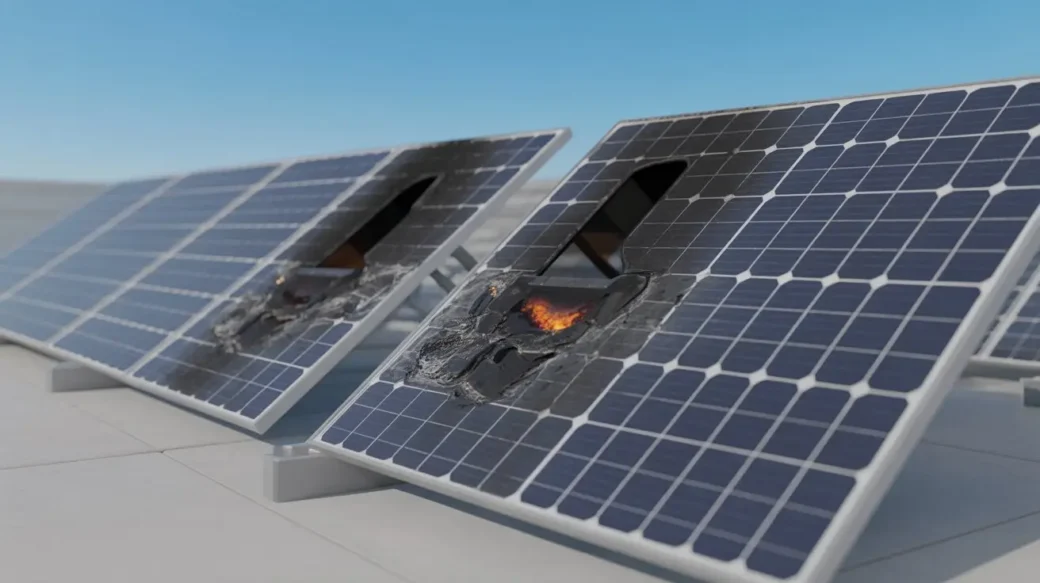
This part matters because the cause of the fire determines who is legally responsible.
There are three main ways solar systems cause fires. Each one points to a different person or company as the liable party.
The first cause is solar junction box failure.
The junction box sits on the back of each solar panel. Its job is to protect the electrical connections from heat and moisture.
In Florida, a box without the right waterproof rating lets moisture in over time. The moisture corrodes the metal contacts inside. Corroded contacts resist electricity. Resistance turns into heat. That heat builds up inside the sealed box until it ignites the roof material beneath it.
In Arizona, the same box fails from daily heat cycles instead. The plastic casing expands and contracts every day in extreme heat. Eventually, it cracks. Dust gets in. Dust traps heat. The result is the same: a slow-building arc fault that one day causes a fire.
The second cause is the defective inverter fire risk.
The inverter converts power from your panels into electricity that your home can use. It has internal parts that can overheat if the unit is mounted too close to the roof.
When those parts fail from heat stress, internal temperatures can reach the ignition point. This is not a rare theoretical risk. It is the documented cause of thermal runaway claims now in active litigation in both Hillsborough County, Florida, and Maricopa County, Arizona.
The third cause is a missing or broken rapid shutdown system.
Federal electrical code, updated in 2020 under NEC Article 690.12, requires all new residential solar systems to shut down to a safe voltage level within 30 seconds of a trigger. This protects firefighters who cannot work safely on a roof with live DC power running through it.
A system installed after January 2021 without this feature has a clear code violation. In both Florida and Arizona courts, a code violation like this often establishes legal negligence without needing a long expert debate.
If your system was installed between 2018 and 2021, ask your installer directly whether your system has a listed rapid shutdown device. If they cannot answer clearly, that tells you something important.
The solar installation standards guide explains what a complete and safe installation should include from start to finish.
What Fire Codes Cover Your System Under Florida and Arizona Law in 2026?
Both states have specific rules that go beyond the basic national electrical code. When installers ignore those rules, it becomes the foundation of a legal claim.
Florida follows the Florida Building Code 7th Edition, which uses NEC 2017 Article 690 for solar systems.
One rule most homeowners never hear about: every rooftop solar system in Florida must keep a clear 36-inch pathway along the roof ridge and along both hip and valley lines. That open space is not for aesthetics. It lets firefighters cut ventilation holes safely without touching energized wires.
A system that blocks those pathways has a documented code violation. If a fire happens and investigators find a violation, the installer bears a significant share of legal responsibility. FPL and Duke Energy Florida both require installers to certify code compliance at the time of utility interconnection. That certification is a written legal record.
Arizona uses A.R.S. § 32-1155 through the Arizona Registrar of Contractors.
This law holds licensed solar installers directly accountable when their work breaks building codes and causes property damage. APS and SRP require a utility inspection when the system is commissioned. A system that only got a paperwork review, without anyone physically checking the roof, can create shared liability for both the installer and the inspection contractor.
Non-compliance with the 2020 NEC rapid shutdown rule has become one of the most common issues in solar safety regulations 2026 enforcement actions that AZROC has taken against Phoenix area installers this year.
Three things you can confirm right now about your own system:
- Rapid shutdown compliance, get it in writing, not just a verbal yes
- Junction box waterproof rating, IP65 is the minimum for Florida; IP67 is better for Gulf Coast counties
- Inverter clearance from the roof, Arizona municipal codes require at least 12 inches
The solar panel safety facts for homeowners show you what to look for and what questions to ask.
When Is Your Installer Legally Responsible for Solar Fire Damage?
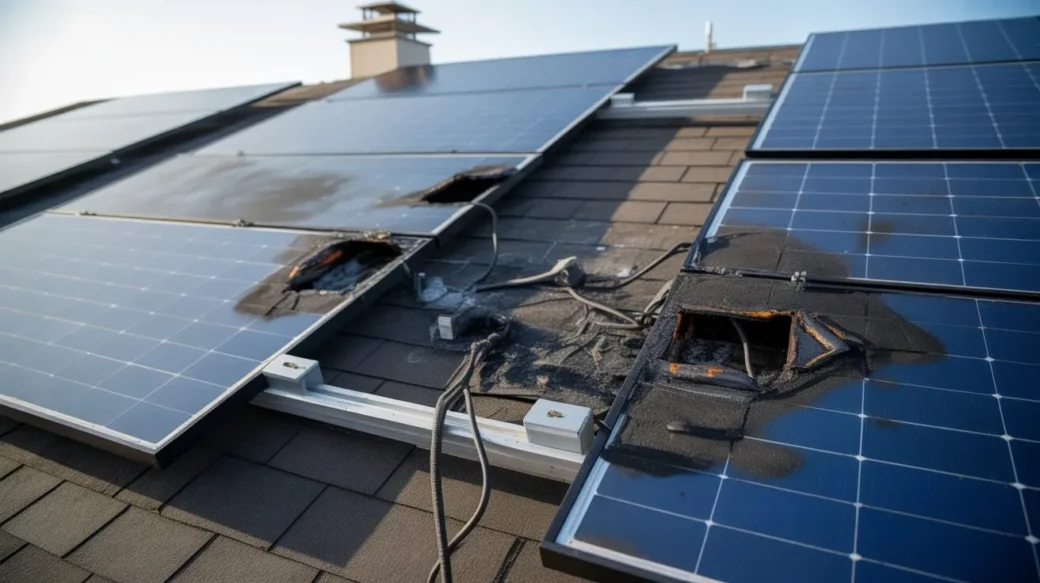
This is what most people actually want to know. Here is the plain answer for both states.
In Florida, your legal path starts with Chapter 558.
Before you can file a lawsuit, you must send the installer a written notice that describes the problem. The installer then has 45 days to inspect the damage and respond with a settlement offer or a plan to fix it.
Lawyers who handle lawsuits for fire damage cases in Tampa, Jacksonville, and Fort Lauderdale say that most installers respond with a settlement offer when they get this notice. They do not want to go to trial. Especially when the evidence clearly shows a wrongly rated junction box or a missing safety device.
If the installer does not settle, you can then file a negligence claim. The legal standard is simple. Did the installer do the job the way a competent, careful solar contractor would have done it? Skipping required safety parts, using the wrong-rated components, or ignoring torque specs on connections, these all fail that standard clearly.
In Arizona, you have an extra tool that Florida does not offer.
You can file a complaint with the Arizona Registrar of Contractors at the same time you pursue a civil claim. That complaint creates a government record of the code violation. It also puts the installer’s license at risk. That pressure often moves installers toward settlement faster than a lawsuit alone would.
Arizona also uses comparative fault rules. Even if you share some responsibility, say you stored items too close to the inverter, the installer may still carry 70% or more of the liability if their code violation was the main cause of the fire.
Product liability is the third legal avenue, and it does not involve the installer at all.
If the fire started because of a defect inside the inverter or junction box itself, not from how it was installed, the manufacturer is legally responsible. You do not need to prove they were careless. You only need to prove the product was defective and that the defect caused the fire.
This matters for homeowners whose systems used parts from manufacturers now named in the solar panel class action lawsuit 2026 cases.
Here is a real Florida scenario that shows what this actually looks like.
A homeowner in Cape Coral was paying FPL about $190 per month before going solar. They installed a 9kW system in 2020. In the summer of 2024, an arc fault inside a junction box on the south side of the array started a fire in the roof sheathing. The total damage came to about $68,000.
A forensic engineer found two clear problems. The junction box had an IP44 rating, far below the IP65 minimum required for that coastal location. The MC4 electrical connectors had been tightened to 2.5 Nm when the manufacturer required 4 Nm. That under-torqued connection created the resistance that built into an arc fault.
The homeowner served a Chapter 558 notice. The installer settled for $52,000 before the 45-day window closed. The insurance company covered the rest and then pursued the junction box manufacturer separately.
This is not a rare outcome. It is becoming the standard pattern in Florida solar fire cases that have clear code violations in the record.
What Does a Solar Fire Actually Cost You Beyond the Repair Bill?
Most homeowners focus on the fire damage itself. But the total financial hit is usually bigger than that.
There is the structural repair cost. There is your deductible. There is a premium increase that your insurer applies after you file a claim. There is the cost of replacing your solar system if the fire voids the installer’s workmanship warranty.
And then there is the federal tax issue that almost nobody knows about.
The 30% federal Investment Tax Credit gives homeowners in Florida and Arizona roughly $6,000 to $8,500 back on a standard installation. But the IRS applies a 5-year recapture rule under IRC Section 50. If your system is destroyed or made non-functional within that window, you may owe back part of the credit you already claimed.
In years one through three, that exposure can run between $1,200 and $2,500, depending on your original system cost. A fire in year two can cost you the repair, the system replacement, and a tax repayment, all at the same time.
The federal solar tax credit and recapture rules explain exactly how this works and what triggers the repayment.
Florida adds another layer on top of all this.
Carriers in Miami-Dade, Broward, and Palm Beach counties have tightened their policies significantly since 2022. Some now exclude solar equipment from standard coverage. Others require a separate endorsement that many homeowners never add. If your system was not installed to code and your insurer finds that out after a fire, they can deny part of your claim.
In Arizona, the issue is different but equally serious.
A 10-year workmanship warranty from a 2019 Chandler installation does not protect you from arc faults caused by heat damage that developed in year six. The warranty covers defects in the installation itself, not gradual thermal degradation from years of extreme heat cycles. Many homeowners only find out about this distinction when they need to make a claim.
Two things you can do right now to protect yourself.
First, call your installer and ask for the signed utility interconnection approval from FPL, Duke Energy Florida, APS, or SRP. If they cannot produce it, that is a compliance gap worth investigating now rather than after a fire.
Second, book a thermal imaging inspection with a licensed electrical contractor. Every three years in Arizona. Every four years in Florida. The infrared camera shows heat buildup at junction boxes and inverter connections that you cannot see with your eyes. It costs between $150 and $300 and creates a dated record of your system’s condition.
Is Pursuing Solar Panel Fire Litigation Actually Worth It for You?
Not always. That is the honest answer.
If your damage is under $15,000 and your homeowner’s insurance covered all of it, the cost of legal action may eat up more than you would recover. Even the Chapter 558 pre-suit process takes time, attorney hours, and documentation work.
But when the damage is significant, the legal tools in both states are strong.
Florida’s fee-shifting rules under Chapter 558 can require the losing contractor to pay your legal fees if the case goes to trial and you win. That makes the financial risk of litigation more manageable for larger claims. Arizona’s A.R.S. § 12-341.01 gives courts the ability to award attorney fees to the winning party in contractor disputes, which makes contingency representation easier to find in Arizona than in most states.
The solar panel fire and safety litigation cases that settle most favorably share three things in common. The fire damage is above $30,000. There is a documented code violation in the installation record. The installer is still licensed and insured and therefore has real assets and a motivated insurance carrier.
If your installer closed their LLC after finishing your job, the path gets harder. You would need to go through their old commercial insurance carrier, which takes longer and usually yields less. It is still worth pursuing when the damage is large. It becomes harder to justify for smaller losses.
The solar risks that installers do not mention upfront cover the factors that separate a well-done installation from one that creates ongoing liability problems for everyone involved.
Here is the bottom line for Florida and Arizona homeowners.
Solar still makes financial sense in both states. Florida gets 5.0 to 5.5 peak sun hours per day on average. Arizona gets 6.5 to 7.5 in the Phoenix metro. Electricity rates from FPL and APS sit around 13 cents per kWh. The math works when the system is installed correctly.
Solar panel fire and safety litigation is not a reason to avoid solar. It is a reason to know what your installer actually did on your roof, and to have the paperwork to back it up.
The homeowners who end up in court did not ignore their systems. They just did not know what questions to ask. Now you do.
FAQ
Can I sue my solar installer in Florida if my system caused a fire?
Yes. Florida Chapter 558 requires a written pre-suit notice before filing. But documented code violations and installer negligence give you a strong legal foundation in Florida courts.
What does A.R.S. § 32-1155 do for Arizona homeowners?
It holds licensed solar contractors responsible for property damage caused by work that breaks adopted building codes. Filing an AZROC complaint under this law creates a government record that supports both a license action and a civil lawsuit.
What is thermal runaway in a solar system?
It is a heat failure that feeds itself. A part inside the inverter gets too hot, which raises resistance, which creates more heat, which makes the part fail faster, until the temperature reaches a point where nearby materials can ignite.
Will my Florida homeowner’s insurance cover a solar fire?
It depends on your policy. Some Florida carriers now exclude solar equipment or apply sublimits. Check your excluded causes section and ask your agent directly whether solar component failures are covered.
What is an IP65 junction box rating, and why does it matter in Florida?
IP65 means the box is sealed against dust and protected from sustained water jets. It is the minimum rating for outdoor use in Florida. A box rated below IP65 installed in a coastal county is a clear building code violation.
Does Arizona require rapid shutdown systems on all solar installations?
Yes. Any system permitted after January 1, 2021, must meet NEC 2020 Article 690.12 rapid shutdown requirements under Arizona’s statewide building code.
How does a solar fire affect my federal tax credit?
The IRS recapture rule under IRC Section 50 can require you to repay part of the 30% credit if your system is destroyed within the 5-year recapture window. The amount decreases each year the system is in service.
My Arizona installer is no longer in business. Can I still recover damages?
Possibly. You can pursue their commercial insurance carrier directly or file a product liability claim against the component manufacturer if the fire came from a defective part rather than an installation error.
This article by SolarInfoPath (2026 research framework) is part of a comprehensive solar knowledge architecture covering all major high-value sectors including legal disputes (installation negligence, contracts, liability, fraud, lawsuits, liens, HOA and permitting disputes), financial structures (loans, PPA/lease agreements, DSCR financing, tax equity, investment and project finance), tax law (ITC, Section 48/25D, MACRS depreciation, bonus credits, IRS audits, recapture rules, domestic content and IRA/OBBBA compliance), insurance and risk (property damage, hail/wind/fire claims, bad faith insurance disputes, warranty coverage), policy and regulation (net metering, FERC interconnection, state utility rules, incentive programs and regulatory changes), commercial and utility-scale development (EPC contracts, construction delays, performance bonds, receivership, bankruptcy, asset sale and restructuring), real estate impacts (home value, solar leases, liens, title issues, HOA restrictions, easements), and emerging market structures such as battery storage, community solar, agrivoltaics, SRECs, yieldcos, and institutional investment funds. All content is based on publicly available regulatory, financial, and legal sources and is intended strictly for educational and informational purposes, not legal, tax, or financial advice. Readers should always verify current laws, utility policies, tax regulations, and contract terms with qualified licensed professionals before making decisions, as solar regulations, incentives, and financial structures frequently change across jurisdictions and time.

Solar Legal Analyst· Policy Researcher· Investigative Finance Writer Lead Analyst & Founder of SolarInfoPath
Morgan Lee is a solar legal analyst, policy researcher, and investigative finance writer with 12+ years of experience in U.S. renewable energy law, IRS tax credit compliance, and solar litigation. He is the founder of SolarInfoPath, a research-driven platform focused on primary-source analysis of solar contracts, tax law, regulatory policy, and industry disputes affecting homeowners and commercial developers.
His work is grounded in original legal and regulatory sources, including IRS notices, FERC and CPUC rulings, state court filings, PACER records, and UCC lien databases. He specializes in solar contract disputes, injury and workers’ compensation claims, PACE financing issues, tax equity structures, ITC recapture rules, MACRS depreciation, and federal and state solar policy frameworks.
Morgan’s analysis spans solar litigation, finance structures, and regulatory developments such as the IRA and OBBBA, interconnection reform, domestic content rules, and battery storage incentives. He also covers EPC contracts, PPAs, project financing, and utility-scale solar investment structures.