According to NEC safety standards, solar panels can cause fires, but the risk is extremely rare. Fewer than 1 in 10,000 installed systems are linked to a fire each year. The danger rarely comes from the panel itself. It comes from bad wiring, poor installation, or cheap parts that were never certified.
You just had a solar sales rep on your porch for 90 minutes. He showed you charts. He talked about savings. But he never once mentioned fire.
That silence is worth noticing.
Can solar panels cause fire? Yes, they can. But the fuller answer matters more than the yes. Most homeowners who ask this question are not looking for a reason to avoid solar. They’re looking for someone to tell them the truth before they sign a $30,000 contract.
That’s what this article does.
Quick Answer
Solar panels can cause fires, but it rarely happens with a properly installed system. The panels themselves don’t burn easily. The real risk lies in the wiring, connectors, and inverter, not the glass-covered modules on your roof.
The U.S. has more than 4.5 million residential solar systems running right now. Documented fire incidents tied directly to solar equipment number in the low hundreds per year. That works out to roughly 0.1 fires per 1,000 systems annually, far lower than the fire risk from the electrical wiring already inside your walls.
Here’s what most articles don’t say: some solar fires happen in homes where solar had nothing to do with starting the fire. Firefighters still face a different challenge in a solar home, because the panels keep producing electricity even when the house is on fire. That’s a separate issue from ignition risk, and it matters.
SolarInfoPath Reality Check: There is no centralized national database that tracks causes of solar-specific fires. Incidents are recorded at the state and local level. That means the real numbers are harder to pin down than most safety articles admit. What the available data consistently shows is that solar is not a high-risk technology, but incomplete installation records make exact figures difficult to verify for 2026.
How Do Solar Panel Fires Actually Happen?
Solar fires don’t start because sunlight hits a panel. They start because something in the electrical system fails. And that failure almost always has a specific cause you can trace.
Faulty Installation Is the Most Common Cause
Loose wire connections are behind more solar fires than any other single factor. When a DC connector is not fully seated, it creates resistance at the joint. Resistance creates heat. That heat slowly damages the wire insulation around it.
Over months, sometimes years, that damage becomes a fire risk.
This happens most often when:
- An installer rushes through the job to hit a quota
- A permit was skipped, so no inspector ever checked the work
- An unlicensed crew handled the electrical connections
If your installer couldn’t tell you the torque specification they use on their connectors, that’s a red flag worth taking seriously.
Electrical Arc Faults
An arc fault happens when electricity jumps across a gap, a cracked wire, a corroded terminal, a connector that wasn’t fully closed. The arc reaches temperatures above 5,000°F in less than a second.
Standard breakers don’t always stop this. Arc faults can run below the amperage threshold that trips a breaker, which means the arc keeps burning.
In solar systems, this is a bigger problem than in regular home wiring because of DC electricity. Unlike AC, which reverses direction 60 times per second and naturally breaks arcs, DC sustains them.
That’s why the National Electrical Code (NEC 2017) began requiring Arc Fault Circuit Interrupters (AFCIs) on new solar installations. Systems installed before that code cycle, or in states slow to adopt it, may not have this protection.
This is the part most homeowners overlook: a system installed in 2015 legally passed inspection under rules that no longer reflect current safety standards.
Low-Quality or Uncertified Parts
Not every solar product sold in the U.S. meets safety certification standards. Counterfeit MC4 connectors, off-brand microinverters, and panels that don’t carry IEC 61730 certification occasionally make it into residential installations, particularly through budget contractors who cut corners on materials.
Ask your installer to show you the UL certification number on the inverter. If they can’t, that’s not a minor detail.
Aging Systems and Physical Damage
Panels are designed to last 25 to 30 years. But the wiring and connectors can degrade faster, especially in climates with big temperature swings or heavy UV exposure.
Rodent damage is more common than most people realize. Squirrels and starlings nest under panel arrays, and they chew wiring. A 10-year-old system that’s never had a physical inspection is carrying unknown electrical conditions.
A crack in a panel’s back sheet doesn’t immediately start a fire. But it lets moisture into the electrical components, and moisture accelerates the kind of faults that do.
Can Solar Panels Catch Fire in Extreme Heat?
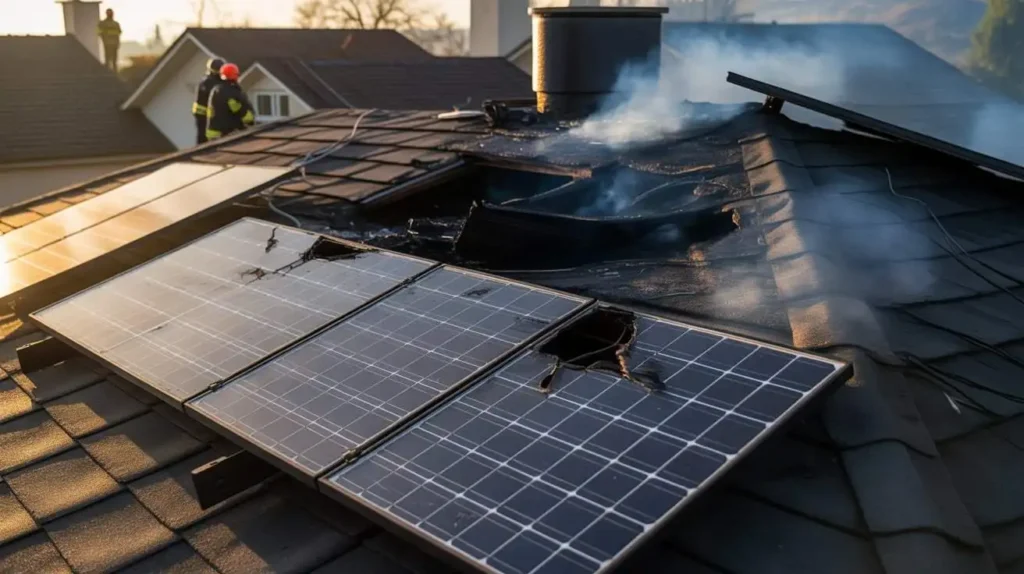
Extreme heat alone does not cause solar panel fires. This surprises homeowners in hot climates, but it’s accurate.
Standard residential panels are tested under IEC 61215, which includes thermal cycling and high-temperature exposure. Panel cells are rated to operate safely up to 85°C (185°F) on the cell surface. Air temperatures, even during heat waves, stay well below that.
What heat does do is speed up damage in parts that are already failing. A connector with slight corrosion degrades faster when it’s been baking at 110°F for six weeks straight.
Decision checkpoint: If you live in Arizona, Nevada, or Southern California, and your system is more than eight years old, a thermal imaging inspection is worth considering. These cost between $150 and $400. They catch hot spots that no visual check will find.
Can Solar Panels Overheat and Catch Fire?
There’s a difference between a panel running warm and a panel dangerously overheating. One is normal. The other is a sign that something is wrong.
Normal operating temperature sits 20 to 30°C above air temperature. On a 90°F day, that puts panel surfaces around 110 to 120°F. That’s expected. Nothing ignites at that temperature.
Dangerous overheating is different. It usually comes from a hot spot, a condition where one shaded section of a panel is forced to carry current it wasn’t designed for. The shaded cells heat up intensely while the rest of the panel operates normally.
Over time, a hot spot can crack the panel’s back sheet, degrade the laminate, and, in rare cases, ignite roofing material underneath.
Modern systems include bypass diodes to reduce this. Microinverter and DC optimizer setups handle it better than string inverters, because each panel operates independently rather than in a chain where one weak link affects the whole.
A small tree that grew to shade one corner of your array over the past three years isn’t just cutting your output. It’s also putting those panels through a repeated thermal stress cycle every sunny day.
How Often Do Solar Panels Catch Fire?
Solar panel fires are rare enough that they don’t represent a meaningful statistical risk for most homeowners.
A German study of roughly 100,000 solar installations found a fire incident rate of about 0.006%, 6 fires per 100,000 systems. Germany’s installation standards are comparable to those of the U.S., making this a reasonable reference point. U.S. safety requirements have strengthened further since that study.
Here’s how that compares to other household fire risks:
| Risk Category | Estimated Annual Fire Rate (U.S. Residential) |
| Home electrical wiring | ~6.8 per 1,000 homes |
| HVAC equipment | ~1.5 per 1,000 homes |
| Dryers and laundry | ~1.0 per 1,000 homes |
| Rooftop solar (any installation) | ~0.1 per 1,000 systems |
| Solar with AFCI + licensed install | ~0.03 per 1,000 systems |
The wiring inside the walls of your house was built with carries more annual fire risk than a code-compliant solar system added to it.
SolarInfoPath Reality Check: These solar figures are estimates, the honest caveat is that national tracking of solar-specific fire causes is still inconsistent in 2026. State fire marshals in California, New Jersey, and Massachusetts have begun improving their reporting systems, but there is no unified federal dataset yet. What the available data consistently supports is a risk profile below conventional electrical systems.
Are Solar Panels a Fire Risk Compared to Other Home Systems?
No, solar systems rank below most common home electrical systems in fire risk when installed correctly.
Your main electrical panel, your HVAC, your dryer, and your kitchen appliances collectively account for the large majority of home electrical fires. The National Fire Protection Association consistently lists home electrical distribution as the leading cause of structure fires, and that’s the original wiring, not anything you added.
Solar adds a relatively small amount of new electrical infrastructure. Like any electrical system, it can develop faults. But a properly installed solar setup does not introduce a new category of risk that wasn’t already there.
For homeowners who want to verify the federal safety data themselves, the U.S. Department of Energy’s solar safety resources provide current information on NEC requirements and equipment standards. If you’re also researching how solar compares to buying grid electricity over time, our breakdown of the difference between solar energy and electricity covers that in plain language.
Solar Panel Fires and Electrical Hazards Explained
DC vs. AC Electricity, Why It Matters
Your panels produce DC electricity. Your home runs on AC. The inverter converts between them, but the wiring between the panels and the inverter carries DC at 300 to 600 volts in most residential systems.
DC electricity creates two hazards that AC doesn’t:
- It sustains arcs rather than breaking them naturally
- It cannot be shut off at your breaker box; it stays live as long as sunlight hits the panels
This is why the NEC requires more robust protection for solar DC wiring than for regular home circuits.
Rapid Shutdown Systems
Starting with NEC 2017, new solar installations must include a Rapid Shutdown System (RSS). This reduces roof-level DC voltage to safe levels within 30 seconds when first responders activate the shutdown switch near your main panel.
Systems installed before NEC 2017 in your state may not have this. If your system was installed before 2020, it’s worth verifying.
This matters most if you’re planning to sell your home. Home inspectors in California, Florida, and New Jersey are increasingly flagging the absence of rapid shutdown as a code compliance issue during real estate transactions.
What Firefighters Face in a Solar Home
Here’s something almost no solar content addresses honestly: even when solar has nothing to do with starting a house fire, it changes how that fire is fought.
Roof panels block ventilation cuts. DC wiring from the panels stays live as long as sunlight is present, even after the utility meter is shut off. Firefighters cannot simply kill the power the way they can on a non-solar home.
RSS systems substantially reduce this hazard. But pre-2017 systems, or systems where the shutdown switch is not clearly labeled, create real operational complications for fire departments.
This is not a reason to avoid solar. It is a reason to make sure your system is up to current code and that your shutdown switch is clearly marked.
Warning Signs Your Solar System Could Be Unsafe
Electrical faults in solar systems rarely appear suddenly. They develop slowly and usually give warning signs first.
Watch for these:
- A burning smell near your inverter, even once, even faintly, is never normal
- Arc fault or ground fault error codes on your inverter display that repeat or persist
- Visible cracks, discoloration, or bubbling on the back surface of any panel
- A sudden drop in production of 15% or more compared to the same period last year
- Scorch marks or melted insulation on conduit, combiner boxes, or junction boxes
None of these are emergencies on their own. But every one of them is a reason to call a licensed solar electrician before your next quarterly monitoring check.
How to Prevent Solar Panel Fires
Choose Certified Installers
Licensing matters, not just a solar contractor license, but a state electrical contractor license. In most states, solar contractors can pull permits under a separate license category that has lower electrical requirements. Ask specifically whether the person doing your wiring holds a full electrical contractor license.
Also, check that your installer pulls permits for every job. A permit creates a mandatory inspection by a local electrical inspector, the only independent safety check in the entire installation process. If an installer offers to skip permits to save time or money, walk away. Understanding what a compliant installation process looks like, and how long it takes, is covered in our solar installation timeline guide for American homeowners.
Use Equipment with Verified Certifications
- Inverters should carry UL 1741 certification
- Panels should meet IEC 61215 and IEC 61730 standards
- Connectors (MC4 type) should show TÜV or UL markings
Ask your installer to provide the product data sheets for the inverter and panels before signing. If they can’t produce those, ask why.
Schedule Regular Inspections
Annual visual inspections are the minimum. A thermal imaging scan every five to seven years catches developing hot spots before they become structural risks. Thermal scans cost $150 to $400, depending on system size.
Most solar monitoring platforms will flag statistical production anomalies, but only if someone is watching the dashboard. Set a reminder to review your system’s monthly output against the same month in prior years.
Keep Panels and the Area Around Them Clean
Debris under panels, leaves, pine needles, and bird nesting materials are both a fire fuel source and a pest habitat. Annual cleaning that includes checking underneath the array is worth the $100 to $200 cost.
After any hail event, major storm, or roofing work, inspect visible panels for cracks before the next sunny day.
Are Rooftop Solar Panels Safe for Homes?
Yes. The evidence from millions of installed systems is clear on this.
More than 4.5 million U.S. homes have rooftop solar. Tens of millions more are operating in Europe, Australia, and Japan under comparable or stricter safety standards. The technology has been in widespread residential use for over 20 years. Safety codes covering it are regularly updated. The fire data, while imperfectly tracked, shows a risk profile well below conventional home electrical systems.
The accurate question is not “are solar panels safe?” It’s “Was my specific system installed correctly?”
That’s a question you can verify. Talk to your installer about certifications, pull the permit record, and check the inverter model against UL’s certified equipment database. These are concrete steps, not abstract reassurances.
For a full picture of what solar ownership actually costs and delivers over time, our analysis of whether solar panels are worth it in the USA walks through the real numbers.
Common Myths About Solar Panel Fires
Myth 1: “Solar Panels Easily Catch Fire”
False. The glass surface of a solar panel is not combustible. The backing materials are fire-resistant. Under standard operating temperatures, nothing on a panel approaches the heat needed to ignite roofing material. This myth usually comes from confusing photos of burned inverters or wiring, not burning panels.
Myth 2: “Heat Alone Can Start a Solar Fire”
Misleading. Ambient heat does not ignite a functioning system. What heat does is accelerate damage in parts that are already degrading. The distinction matters: a new, well-installed system in Phoenix is not more dangerous than one in Seattle because of temperature. An aging system with a failing connector is more dangerous everywhere, and heat makes it fail faster.
Myth 3: “Solar Is Dangerous for Homes”
Not accurate for code-compliant systems. Adding any electrical system to a home adds some small incremental risk. Solar is not different from that. The question is whether the incremental risk is managed properly, and in permitted, inspected installations with certified equipment, the data says it is.
Curious about other safety questions homeowners ask, like whether panels emit radiation? Our guide on solar panels and radiation covers that question with the same level of detail.
Projections vs. Reality: What Sales Presentations Skip
| Concern | What Sales Reps Say | SolarInfoPath Investigative Data |
| Fire risk (new system) | “Extremely safe” | ~0.03 per 1,000 systems/year with AFCI and licensed install |
| Fire risk (pre-2017 system) | Rarely discussed | Estimated 3–5× higher without AFCI protection |
| Rapid shutdown | “Standard on all systems” | Systems before the NEC 2017 adoption in your state may lack it |
| Firefighter impact | Never mentioned | DC voltage stays live during structure fires; RSS mitigates this |
| Thermal inspection cost | Not offered proactively | $150–$400 every 5–7 years; detects hot spots before failure |
| Rodent/debris risk | Not mentioned | Common beneath arrays in most U.S. climates; affects wiring |
Final Verdict
Can solar panels cause fire? Yes. Should that stop you from going solar? No, not if you approach it correctly.
The risk is real in the sense that any electrical system carries risk. It is not elevated compared to the wiring, appliances, and HVAC equipment already operating in your home. A code-compliant solar system, installed by a licensed electrical contractor, using certified components, with permits pulled and inspections completed, sits at the low end of residential electrical fire risk.
What actually matters:
- Who installs it, and whether they hold a full electrical contractor license
- Whether permits are pulled and an independent inspector signs off
- Whether the inverter and panels carry verified UL and IEC certifications
- Whether your system has AFCI protection and rapid shutdown capability
- Whether anyone reviews the system’s performance data annually
Those five factors determine your real risk. Not solar panels as a category, your specific system, your specific installer, your specific equipment. If 2026 tax credit timelines are affecting your installation decision, our breakdown of the solar tax credit situation in 2026explains what’s actually changing and what it means financially.
The sales process rarely covers what this article covers. That gap is intentional on their part. Now you know what questions to ask.
Frequently Asked Questions
Can solar panels cause fires?
Yes, but it’s rare. The cause is almost always an installation error, faulty wiring, or uncertified parts, not the panels themselves.
Do solar panels catch fire easily?
No. Panel surfaces are glass-covered and not combustible. Fire risk lives in the electrical components, not the modules.
How often do solar panels catch fire?
Roughly 0.1 per 1,000 systems annually, based on available data, significantly lower than conventional home electrical fires.
Can solar panels catch fire in extreme heat?
Extreme ambient heat alone does not cause fires. It can accelerate damage in already-degrading components, but it does not ignite a functioning system.
What causes solar panel fires?
Loose DC connectors, arc faults in systems without AFCI protection, uncertified components, and physical damage from aging or pests.
Are solar panels safe for residential use?
Yes, when installed by a licensed electrical contractor using certified equipment under current NEC standards.
This content is for educational purposes only and does not constitute electrical, fire safety, or legal advice. Verify all safety concerns with a licensed electrical contractor or your local authority having jurisdiction.
This article by SolarInfoPath (2026 research framework) is part of a comprehensive solar knowledge architecture covering all major high-value sectors including legal disputes (installation negligence, contracts, liability, fraud, lawsuits, liens, HOA and permitting disputes), financial structures (loans, PPA/lease agreements, DSCR financing, tax equity, investment and project finance), tax law (ITC, Section 48/25D, MACRS depreciation, bonus credits, IRS audits, recapture rules, domestic content and IRA/OBBBA compliance), insurance and risk (property damage, hail/wind/fire claims, bad faith insurance disputes, warranty coverage), policy and regulation (net metering, FERC interconnection, state utility rules, incentive programs and regulatory changes), commercial and utility-scale development (EPC contracts, construction delays, performance bonds, receivership, bankruptcy, asset sale and restructuring), real estate impacts (home value, solar leases, liens, title issues, HOA restrictions, easements), and emerging market structures such as battery storage, community solar, agrivoltaics, SRECs, yieldcos, and institutional investment funds. All content is based on publicly available regulatory, financial, and legal sources and is intended strictly for educational and informational purposes, not legal, tax, or financial advice. Readers should always verify current laws, utility policies, tax regulations, and contract terms with qualified licensed professionals before making decisions, as solar regulations, incentives, and financial structures frequently change across jurisdictions and time.

Solar Legal Analyst· Policy Researcher· Investigative Finance Writer Lead Analyst & Founder of SolarInfoPath
Morgan Lee is a solar legal analyst, policy researcher, and investigative finance writer with 12+ years of experience in U.S. renewable energy law, IRS tax credit compliance, and solar litigation. He is the founder of SolarInfoPath, a research-driven platform focused on primary-source analysis of solar contracts, tax law, regulatory policy, and industry disputes affecting homeowners and commercial developers.
His work is grounded in original legal and regulatory sources, including IRS notices, FERC and CPUC rulings, state court filings, PACER records, and UCC lien databases. He specializes in solar contract disputes, injury and workers’ compensation claims, PACE financing issues, tax equity structures, ITC recapture rules, MACRS depreciation, and federal and state solar policy frameworks.
Morgan’s analysis spans solar litigation, finance structures, and regulatory developments such as the IRA and OBBBA, interconnection reform, domestic content rules, and battery storage incentives. He also covers EPC contracts, PPAs, project financing, and utility-scale solar investment structures.