How Much Do Solar Panels Cost After Incentives in the USA? Real Numbers by State
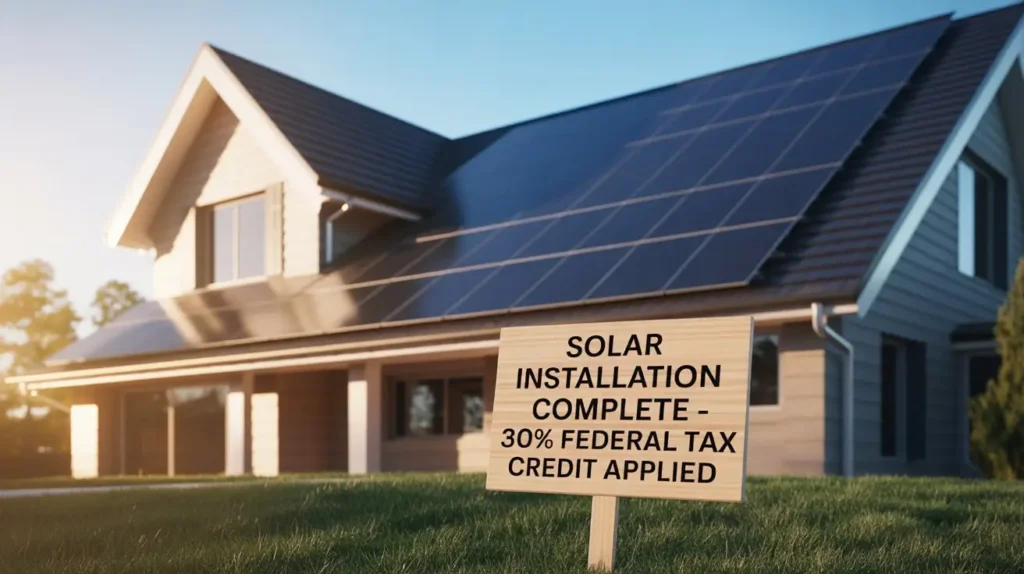
If you are trying to figure out how much do solar panels cost after incentives in the USA, the honest answer starts with one number that most articles bury: the federal Investment Tax Credit cuts 30 percent off your total installed system cost. On a $21,000 system, that is $6,300 back against your federal tax bill, bringing your real out-of-pocket cost to $14,700. That is the floor for most U.S. homeowners. State incentives, sales tax exemptions, and property tax protections push that number lower depending on where you live. The gap between what solar costs before incentives and what you actually pay after them can reach $10,000 or more in the right state.
What surprises most homeowners is how dramatically the after-incentive cost varies from state to state. Two neighbors with identical 7kW systems can end up paying very different amounts depending on whether their state offers a tax credit, a cash rebate, or nothing beyond the federal program. Massachusetts homeowners working with a combined federal and state credit stack end up with a meaningfully lower out-of-pocket cost than a Texas homeowner relying only on the federal credit. This article gives you the real numbers, state by state, so you can calculate your specific situation rather than guess.
What “After Incentives” Actually Means: The Full Cost Breakdown
The phrase “after incentives” means different things depending on which incentives apply to your home. There are four categories worth separating clearly because they work differently and arrive at different times.
The federal Investment Tax Credit reduces your federal income tax bill by 30 percent of your total qualified system cost in the year your installation is placed in service. It is not a rebate check. It does not reduce your monthly electricity bill. It appears on your tax return and reduces what you owe the IRS. If your credit is larger than your tax liability, the unused portion carries forward to the following year automatically.
State income tax credits work the same way as the federal credit, but apply to your state tax bill. Massachusetts offers a 15 percent state credit. New York offers 25 percent up to $5,000. Arizona offers 25 percent up to $1,000. These stack directly on top of the federal credit and reduce your out-of-pocket cost further.
Sales tax exemptions apply at the point of purchase in states that offer them. Florida, New York, New Jersey, and Arizona exempt solar equipment from state sales tax, which saves 4 to 7 percent of equipment cost upfront rather than through a tax filing later.
Property tax exemptions protect the added home value from reassessment. Solar panels increase your home’s market value, but states including California, Florida, New York, Massachusetts, and Arizona exempt that added value from property tax calculations. This is an ongoing annual benefit rather than a one-time savings.
Confirming who qualifies for solar incentives in the USA before you build a budget is essential because the federal credit is nonrefundable and requires sufficient tax liability to use in full.
The Real After-Incentive Cost by State: Actual Dollar Figures
Here is what a standard 7kW residential system actually costs after all available incentives in each major solar state. System costs before incentives are based on 2026 market pricing, including equipment, labor, and permitting.
| State | Cost Before Incentives | Federal Credit (30%) | State Incentives | Real Out-of-Pocket Cost |
| California | $21,700 | $6,510 | Sales tax varies by county | $15,190 |
| Massachusetts | $21,000 | $6,300 | $3,150 state credit (15%) | $11,550 |
| New York | $20,650 | $6,195 | $5,000 state credit cap | $9,455 |
| Florida | $18,900 | $5,670 | Sales tax is exempt on equipment | $12,600 |
| Arizona | $18,550 | $5,565 | $1,000 state credit | $11,985 |
| Texas | $18,200 | $5,460 | None beyond federal | $12,740 |
| Illinois | $19,600 | $5,880 | SREC program adds value | $13,720 |
| Kansas | $17,500 | $5,250 | None beyond federal | $12,250 |
New York homeowners have the lowest effective cost on this list despite not having the cheapest systems, entirely because the NY Sun cash incentive and the $5,000 state tax credit stack powerfully on top of the federal credit. Massachusetts produces a similar result through its 15 percent state credit. Texas and Kansas homeowners are working with only the federal credit, which is still substantial but leaves them paying roughly $1,000 to $3,000 more than comparable homeowners in incentive-rich states.
According to the IRS, the Residential Clean Energy Credit is claimed on Form 5695 and applies to the full installed system cost, including labour, permitting, and battery storage that charges primarily from solar.
City by City: After-Incentive Cost and Annual Savings
| City | Typical 7kW System Cost | After All Incentives | Est. Annual Savings | Key Notes |
| Los Angeles, CA | $21,700 | $15,190 | $1,900 | High rate offsets higher system cost; NEM 3.0 affects exports |
| Boston, MA | $21,000 | $11,550 | $1,700 | Best combined incentive package in the country |
| Albany, NY | $20,650 | $9,455 | $1,500 | NY Sun cash incentive plus state credit drives the lowest net cost |
| Phoenix, AZ | $18,550 | $11,985 | $1,350 | 6.5 peak sun hours per day; state credit adds a meaningful reduction |
| Austin, TX | $18,200 | $12,740 | $1,100 | Federal credit only; solid sun but modest electricity rate |
| Tampa, FL | $18,900 | $12,600 | $1,200 | Sales tax exempt; reliable year-round production |
What this table shows clearly is that Albany, New York, has the lowest after-incentive cost of any major city on the list, nearly $3,000 less than a comparable system in Austin, despite being a colder northern city with fewer annual sun hours. The stacked incentive structure in New York does more financial work than extra sunlight does.
How the Federal Credit Interacts With Your Tax Situation
The most common misunderstanding about how much do solar panels cost after incentives in the USA involves confusing the federal credit with guaranteed cash savings. The credit reduces what you owe in federal taxes. If you owe less than the credit amount, you carry the balance forward rather than losing it. But if your tax liability is consistently low across multiple years, capturing the full credit takes time.
A homeowner who owes $8,000 in federal taxes installs a $20,000 system and receives a $6,000 credit. Their tax bill drops to $2,000 for that year. The full credit is captured in year one. A homeowner who owes $3,000 installs the same system and receives the same $6,000 credit. Their tax bill drops to zero, and they carry $3,000 forward to year two. Both homeowners eventually capture the full credit, but the second homeowner waits an additional year to see the full benefit.
Retirees with low taxable income, self-employed homeowners with variable annual earnings, and households that took significant deductions in the installation year should calculate their expected federal tax liability for the next two to three years before assuming the full credit lands in year one.
How the average solar panel cost in the USA breaks down by state and system size gives you the gross cost figures that the federal credit is calculated against, which is the starting point for building your actual after-incentive budget.
State Incentives Worth Knowing Before You Budget
Three states stand out for offering the strongest after-incentive cost reductions in 2026.
Massachusetts combines the 30 percent federal credit with a 15 percent state income tax credit and the SMART program, which pays homeowners monthly based on solar production. A $21,000 system in Boston effectively costs around $11,550 after the federal and state credits, and then generates additional monthly income through SMART on top of regular bill savings.
New York combines the 30 percent federal credit with the NY Sun cash incentive program and a 25 percent state tax credit capped at $5,000. On a $20,650 system in Albany or Buffalo, the combined reductions bring the net cost below $9,500, which is the lowest effective out-of-pocket cost of any major state in 2026.
Florida does not have a state income tax, so there is no state tax credit. But Florida exempts solar equipment from the 6 percent state sales tax and completely shields the added home value from property tax reassessment. For a Tampa homeowner, the sales tax exemption alone saves roughly $700 to $900 on equipment cost at the point of purchase.
How solar energy benefits and costs play out differently by state covers which states offer the strongest combination of incentives and savings potential in 2026, and which require more careful financial planning before committing.
The Honest Limitation: Why After-Incentive Cost Still Varies Within the Same State
Two homes in the same Arizona city can end up with different effective after-incentive costs for reasons that have nothing to do with the incentive programs themselves.
Roof complexity drives installation cost variation more than most homeowners expect. A single-story home with a simple south-facing shingle roof costs significantly less to install than a two-story home with multiple roof planes or a tile roof. Tile roofs require careful removal and reinstallation of each tile during the solar mounting process, which adds $1,000 to $3,000 in labor cost. That higher gross system cost produces a higher credit value in dollar terms, but it also means a higher net cost after the credit is applied.
Shading changes system design in ways that add cost. A roof with partial afternoon shading requires power optimizers or microinverters rather than a standard string inverter, adding $800 to $2,000 to the system price. This is the right technical decision for that roof’s performance, but it affects your total cost and therefore your after-incentive number.
What drives the solar payback timeline across different U.S. states shows how your specific after-incentive cost and annual electricity savings combine to determine when your system reaches its financial break-even point.
Final Thoughts
How much do solar panels cost after incentives in the USA depends on three things working together: your gross system cost before any incentives, which federal and state programs you qualify for, and how much federal tax liability you have to absorb the credit fully in year one. In New York and Massachusetts, the combined incentive stack produces the lowest after-incentive costs in the country. In Texas and Kansas, the federal credit alone is what you are working with. The difference between those two scenarios on a comparable system is $3,000 to $5,000 out of pocket.
The after-incentive cost is the number that drives your payback period, and the payback period is what determines whether solar makes financial sense for your specific home. Getting that number right from the beginning, based on your actual state incentives and your real tax situation, is worth more than any estimate built on national averages. Before you commit to anything, confirm your state’s current programs, calculate your expected federal tax liability for the next two years, and use those two inputs together to build a budget that reflects your actual situation rather than a best-case scenario.
Frequently Asked Questions
How much do solar panels cost after incentives in the USA for a typical home?
For a standard 7kW system, after-incentive costs range from around $9,500 in New York to $15,000 in California, depending on which state programs apply. The federal 30 percent credit alone reduces most systems by $5,000 to $7,000.
Does the 30 percent federal solar credit apply to every U.S. homeowner?
It applies to homeowners who own their system and have sufficient federal tax liability to absorb the credit. Homeowners with very low annual tax bills may need two years to capture the full credit through the carry-forward provision.
Which U.S. states have the lowest after-incentive solar costs in 2026?
New York and Massachusetts consistently produce the lowest net costs due to strong state credit programs that stack on the federal credit. New York homeowners can reach effective costs below $9,500 on a standard 7kW system.
Does Florida offer any solar incentives beyond the federal credit?
Florida has no state income tax, so there is no state tax credit. However, Florida exempts solar equipment from state sales tax and protects the added home value from property tax reassessment, both of which reduce the effective cost.
Is the federal solar tax credit a cash refund or a tax reduction?
It is a tax reduction, not a refund. It reduces what you owe in federal income taxes for the year your system is placed in service. If your credit exceeds your tax liability, the unused balance carries forward to the next year automatically.
Can solar system costs vary within the same state?
Yes, significantly. Roof complexity, shading, local permitting fees, and utility interconnection costs all affect the final installed price before any incentives are applied. Two homes in the same city with the same system size can have gross costs that differ by $3,000 to $5,000.

Morgan Lee is a homeowner and solar energy researcher based in the United States. After installing a rooftop solar system in 2022 and spending months comparing quotes, incentives, and installer reviews, Morgan realized how confusing and overwhelming the process felt for most American families. That experience led to the creation of SolarInfoPath, a no-pressure, educational platform designed to help U.S. homeowners understand solar energy clearly and confidently. Morgan focuses on practical, research-backed information covering solar costs, installation timelines, federal tax credits, and long-term savings. All content on this site is written from a homeowner’s perspective with the goal of making solar energy simple and accessible for everyday Americans.