

The average American household now pays $162 per month for electricity according to the U.S. Energy Information Administration, and that number keeps climbing. Multiplying the national average electricity rate of $0.18 per kWh by the average household’s 10,791 kWh annual consumption brings the typical annual electricity bill to roughly $1,942. For most homeowners, that figure has grown noticeably over the past three years, and there is no credible projection suggesting it will reverse.
Solar energy is, at its core, a way to lock in a portion of your electricity cost and stop paying that increase year after year. But the cost and incentive landscape changed significantly at the end of 2025, and understanding what is available right now requires current, accurate information rather than outdated guides written under a different policy environment. This page explains exactly what residential solar costs, what incentives remain available in 2026, how they vary by state, and what honest expectations look like for homeowners thinking seriously about solar today.
What Solar Panel Installation Actually Costs in 2026
Most homeowners spend between $12,600 and $33,376 to install a complete residential solar system in 2026, with the national average at $19,873 before incentives. Systems average about $2.58 per watt before incentives based on current EnergySage Marketplace data, with a typical 12 kW installation coming in around $30,505.
The per watt figure is the most useful tool for comparing solar quotes, just as price per square foot helps compare real estate. Here is how that translates into total installed costs at different system sizes:
| System Size | Estimated Installed Cost | Typical Home That Needs It |
| 5 kW | $12,900 to $16,250 | Small home, low usage, mild climate |
| 7 kW | $18,060 to $22,750 | Medium home, moderate cooling loads |
| 9 kW | $23,220 to $29,250 | Average to large home, higher usage |
| 10 kW | $25,800 to $32,500 | Large home, EV charging, high loads |
| 12 kW | Approximately $30,505 | High consumption home, all electric appliances |
These figures are before any state incentives, rebates, or credits are applied.
Solar panels cost $2.20 to $3.35 per watt in 2026 depending on your state. Texas consistently posts the lowest installed costs at $2.20 per watt on the EnergySage marketplace, driven by high installer competition and strong solar irradiance. Tennessee runs among the highest at approximately $3.65 per watt, driven by fewer installers and more complex local permitting environments. Pennsylvania and Connecticut sit at $2.65 and $2.77 per watt respectively as among the more affordable Northeast options.
Solar panels themselves are just 12% of the total cost of a solar panel installation. The remaining 88% covers the inverter, racking hardware, labor, electrical work, permitting fees, interconnection costs, and installer overhead. Permit fees alone range from under $200 in rural areas to over $1,500 in dense metro markets. If your electrical panel is older and rated at 100 amps, upgrading to 200 amps before installation adds $1,500 to $3,000 to the total project cost and is one of the most frequently overlooked line items in early solar budgets.
Battery storage, if added, runs an additional $10,000 to $15,000 depending on capacity, and is quoted and contracted separately from the base solar system.
For a full breakdown of what solar costs after state level incentives, tax exemptions, and program credits are applied specifically in your state, see our detailed guide on solar panel costs after incentives for U.S. homeowners.
The Federal Solar Tax Credit in 2026: The Most Important Change Every Homeowner Must Understand
The federal 30% solar tax credit expired on December 31, 2025. The Residential Clean Energy Credit equals 30% of the costs of new, qualified clean energy property installed anytime from 2022 through December 31, 2025. The credit is not available for any property placed in service after December 31, 2025.
This is not a step down or a phase out. The credit is gone entirely for homeowner owned systems installed in 2026 and beyond under current law.
Here is what that means depending on your situation:
If you installed and owned your solar system before December 31, 2025: You can still claim the 30% credit on your 2025 federal tax return using IRS Form 5695. The credit is nonrefundable, so the credit amount you receive cannot exceed the amount you owe in tax. You can carry forward any excess unused credit, though, and apply it to reduce the tax you owe in future years.
If you are purchasing and owning a solar system in 2026: There is no federal residential tax credit available to you under current law. On a $25,000 system, that means you are paying $7,500 more in effective net cost than a homeowner who installed the same system in 2025.
If you go solar through a lease or power purchase agreement in 2026: Third party owned residential solar projects such as leases and power purchase agreements continue to qualify for tax credits if construction began before July 2026, because the commercial entity rather than the homeowner claims the credit. Leasing companies may pass some of that benefit to you through lower monthly rates, but you do not claim the credit directly.
This shift has made state level incentives more financially important in 2026 than they have been in two decades. Property tax exemptions, sales tax exemptions, performance based programs, and net metering policies now carry the primary financial weight for most homeowners considering solar.
State Solar Incentives That Still Matter in 2026
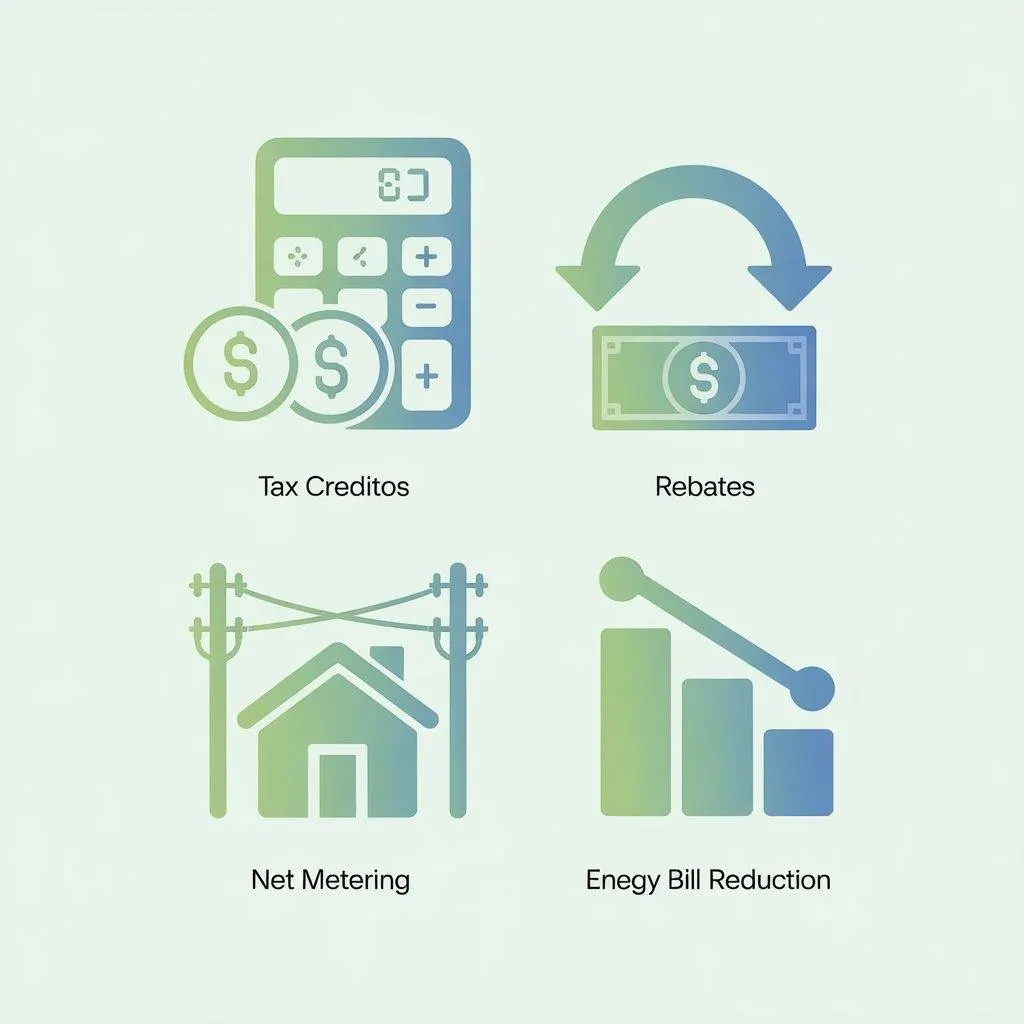
Even without the federal ITC, meaningful incentives remain available in many states. They vary significantly by location, program type, and eligibility, but they are real and worth understanding before making any decision.
State Income Tax Credits reduce what you owe when you file your state taxes. The New York State Tax credit lets you claim 25% off your rooftop solar system’s installation costs, up to $5,000. The Massachusetts State Tax Credit lets you claim 15% off the cost of your solar panels, up to $1,000. Arizona offers a 25% state income tax credit on solar system costs, capped at $1,000.
Property Tax Exemptions prevent your home’s taxable assessed value from rising because of a solar installation. This is important because solar systems add real value to a home. Without an exemption, that added value increases your annual property tax bill. States including New Jersey, Arizona, Nevada, Texas, Florida, Massachusetts, New York, and many others currently maintain property tax exemptions for residential solar systems.
Sales Tax Exemptions remove state sales tax from solar equipment purchases. Florida offers both state sales and property tax exemptions for installed solar systems. Colorado offers a 9% state sales tax exemption. Arizona, Nevada, Massachusetts, New York, and New Jersey also exempt solar equipment from state sales tax, producing immediate savings of several hundred to over a thousand dollars on a typical system.
Utility and State Rebates provide direct cash payments or bill credits, typically after installation is complete and the system is producing power. Rhode Island offers a grant worth $0.65 per watt, up to $5,000, and an additional $2,000 for battery installation. The Pennsylvania PECO rebate provides new solar owners a $500 rebate for systems installed after September 1, 2024. Maryland’s Residential Clean Energy Rebate Program offers $1,000 grants for qualifying systems. New York offers a rebate worth $200 per kW for systems up to 25 kW, with higher amounts for low to moderate income households.
Solar Renewable Energy Credits (SRECs) pay you for each megawatt hour of electricity your system generates, regardless of whether you use it or export it. The six states that have active SREC programs include New Jersey, Massachusetts, Pennsylvania, Maryland, Delaware, and Ohio. SRECs are also available in the District of Columbia. New Jersey’s SuSI SREC II program pays $85 per MWh for 15 years. A typical 7 kW New Jersey system generating 8,400 kWh per year earns approximately 8 SRECs worth $680 annually and roughly $10,200 over the full 15 year program term. Since one SREC is earned for every 1 MWh or 1,000 kWh, a homeowner in Pennsylvania with a solar system that generates 6 MWh yearly, and SRECs in that state selling for $31, could earn 6 times $31, equaling $186 in SRECs income each year.
Performance Based Incentives pay per kilowatt hour of solar electricity generated over time, with rates locked in at installation. Massachusetts’s Solar Massachusetts Renewable Target (SMART) program operates this way, providing a fixed payment per kWh for 10 years. The best performance based incentives are currently found in Delaware, Maryland, New Jersey, and Washington D.C.
Net Metering is not a rebate or a credit you apply for. It is a billing policy that determines how much you are compensated when your panels send excess electricity to the grid. States with full retail net metering including New Jersey and Florida credit exported solar at the same rate you pay for grid electricity. States with reduced export rates including Arizona at approximately 7.6 cents per kWh for APS customers, Nevada at 75% of retail, and California under NEM 3.0 at 2 to 5 cents per kWh for most daytime hours require more careful system sizing focused on maximizing direct self consumption. The U.S. Department of Energy‘s homeowner solar guide explains net metering policy and how it interacts with system design in straightforward terms.
Not every homeowner qualifies for every incentive. Eligibility depends on your state, your specific utility, your system ownership structure, your annual tax liability, and in some programs, your income level. For a complete guide to who actually qualifies for which programs across different states, see our detailed breakdown of who is eligible for solar incentives in the USA.
Why Solar Costs Vary So Much from State to State
Two homeowners with identical electricity consumption, identical roof orientation, and identical system sizes can face very different total costs and very different financial outcomes from solar. Understanding why is genuinely useful before comparing any numbers.
Installed price per watt varies by region. Labor costs differ significantly across the country. Union labor states like Massachusetts, New York, and New Jersey have higher crew rates at $85 per hour in Boston versus $55 per hour in Houston. Permitting complexity and fees vary by jurisdiction. Cambridge, Massachusetts charges $250 and requires four weeks for a solar permit. Rural Texas averages $75 and five days. These differences flow directly into your final installation price.
Electricity rates determine how much each kWh of solar is worth. If you live in a hot state and require a lot of air conditioning, you will probably need a lot of solar panels. But more importantly, a homeowner in California paying 31.91 cents per kWh earns nearly three times more value from each kilowatt hour of solar than a homeowner in Louisiana paying 12.44 cents per kWh. Higher electricity rates amplify the financial return from solar significantly, which is why high rate states in the Northeast and California consistently produce the shortest payback periods even with less sun.
Incentive availability differs dramatically. A homeowner in New Jersey with access to full retail net metering, the SuSI SREC II program at $85 per MWh, a property tax exemption, and a sales tax exemption is in a fundamentally different financial position than a homeowner in Tennessee with only a sales tax exemption and TVA’s 2 cents per kWh export credit. The same system, the same sun hours, the same electricity bill, but completely different economics depending on the state.
System ownership structure affects what you can claim. Homeowners who purchase their systems outright access state incentive programs directly. Homeowners who lease or enter a power purchase agreement hand access to most state incentives to the system owner, the leasing company, and may receive only a portion of those benefits passed through in the form of lower monthly rates.
How to Think About Solar Costs Over Time
Installing solar panels can save homeowners $37,000 to $154,000 over 25 years. The range is wide because it depends heavily on your electricity rate, your state’s incentive environment, and how well your system is sized for your actual consumption patterns.
Payback period is the most practically useful benchmark for evaluating a solar investment. It measures how many years of electricity savings it takes to recover your total net system cost. Solar panels pay for themselves in five to fifteen years depending on location and incentives. Without the federal ITC, the range in 2026 shifts toward the longer end of that spectrum in most states. High rate states with strong incentive programs including New Jersey, Massachusetts, and New York still achieve payback periods in the 8 to 11 year range for cash purchases. States with lower rates and minimal incentives including Tennessee and parts of the rural Southeast face payback periods of 14 to 17 years for cash buyers without battery storage.
Financing changes the picture materially. Solar specific loans typically include dealer fees averaging 15 to 20% embedded in the loan principal, meaning your effective system cost is meaningfully higher than the quoted installation price. Understanding the total amount you will pay over the loan term, not just the monthly payment, matters enormously when evaluating whether a financed solar installation makes financial sense.
For a complete, state by state breakdown of payback periods, how they are calculated, and what assumptions matter most for your specific home situation, see our full guide on solar payback periods for U.S. homeowners.
Common Misunderstandings About Solar Costs and Incentives
A few misconceptions about solar costs and incentives appear consistently, and they are worth addressing directly.
Incentives do not apply automatically. Most programs require registration, application, or specific system configurations before any benefit is paid. SREC programs require you to register your system with a program administrator before installation and maintain that registration actively. Net metering requires your utility to complete interconnection and install a bidirectional meter. Tax credits require you to file the correct IRS or state tax forms with documentation of your system cost.
Solar costs are not the same nationwide. A $2.20 per watt system in Texas and a $3.65 per watt system in Tennessee represent an 80% price difference for the same panels. National average figures are a useful reference but are not a substitute for getting actual quotes in your local market.
Incentives reduce costs, they do not eliminate them. Even in the most incentive rich state in the country, residential solar involves a real upfront financial commitment. The goal of incentive programs is to shorten payback periods and improve long term financial returns, not to make solar free.
The federal ITC is no longer available for homeowner owned systems installed in 2026. Any guide, article, or quote that references the 30% federal tax credit for a new system you would own and install this year is working from outdated information. The credit expired December 31, 2025.
Low sun hours do not necessarily mean poor solar economics. States with high electricity rates frequently produce better solar financial returns than sunnier states with lower rates. New Jersey averages 4.0 to 4.5 peak sun hours per day compared to Arizona’s 6.5, yet New Jersey’s combination of 23 cents per kWh electricity rates, full retail net metering, and the SuSI SREC program produces payback periods competitive with or better than most Arizona installations.
The Honest Limitations: When Solar May Not Be the Right Choice Right Now
The most trustworthy solar content acknowledges where the product falls short just as clearly as where it works well.
Heavily shaded roofs, roofs with less than 10 years of remaining life, and complex multi plane roof designs with limited unobstructed south facing space can make installation expensive or inefficient enough that the numbers do not justify it. A roof that needs replacement in 8 years means paying $3,000 to $5,000 to have panels removed and reinstalled mid system life.
Homeowners who are likely to move within four to five years face a weaker financial case for system ownership. Solar does add resale value, with research consistently showing U.S. homes with owned systems selling for approximately 4 to 7% more than comparable homes without, but a short time horizon compresses the return.
Homes in states where electricity rates sit consistently below 12 cents per kWh face materially longer payback periods in 2026 without the federal ITC. The financial case for solar in low rate states relies much more heavily on strong state incentive programs, and where those programs are weak or absent, the economics are genuinely challenging.
TVA served areas in Tennessee present the clearest example of a difficult solar environment. A retail rate of approximately 12 cents per kWh combined with a 2 cents per kWh export credit from TVA’s Dispersed Power Production program makes battery storage not optional but financially necessary for solar to produce a reasonable return. Systems installed without battery storage in TVA territory may face payback periods of 14 to 17 years under current conditions.
Explore Solar Costs and Incentives by State
Every state has its own electricity rate, net metering policy, available incentive programs, peak sun hour averages, and local installer pricing. The state specific guides on SolarInfoPath are built around exact figures, real utility names, real export credit rates, and honest payback estimates for homeowners in each state.
SolarInfoPath is an independent solar education resource written by Morgan Lee, a U.S. homeowner and independent energy researcher. All figures are sourced from the U.S. Energy Information Administration, National Renewable Energy Laboratory, Lawrence Berkeley National Laboratory, EnergySage Marketplace data, the IRS, and publicly available utility tariff filings. No solar products are sold on this site. No paid placements, affiliate links, or installer relationships of any kind exist. Cost and savings estimates are educational illustrations and vary by household, utility, location, and system configuration. This content is not financial or tax advice.