
Solar Property Tax Litigation Dispute: Save $1,000s in Texas
Starting a solar property tax litigation dispute in Texas means filing Form 50-132 with your county’s Central Appraisal District before May 15, 2026, or within 30 days of receiving your appraisal notice. Most Texas homeowners are paying property taxes on solar value, which the law says is 100% exempt under Texas Tax Code §11.27. The exemption is not automatic. Nobody mails you a check. You have to claim it.
That is the core answer. But the real problem runs deeper.
Thousands of Texans who installed solar in the last three years are being taxed on a value that should be legally zero. Not because the appraisal district is acting in bad faith. Because the exemption form was never filed, the installer never mentioned it, and the appraisal district never volunteered the information.
What struck me when I reviewed assessment records across Travis, Harris, and Bexar counties was how consistently solar panel value shows up in the taxable base of homes where the owner had no idea they qualified for a full exemption.
The good news: this dispute process costs nothing to start, runs every single year, and succeeds far more often than most property owners expect.
What Exactly Is a Solar Property Tax Dispute, and Do You Have Grounds?
Your grounds for a solar property tax dispute in Texas fall into two categories: a missed exemption on your solar system’s added value, or an inflated overall assessment that includes your panels in the taxable base. Both are correctable. Both are common.
The exemption dispute is the most frequent case.
Texas Tax Code §11.27 exempts 100% of the appraised value increase arising from a solar energy device installed primarily for on-site use. Your panels, inverter, racking hardware, and battery storage all qualify. But you must file Form 50-123, Exemption Application for Solar or Wind-Powered Energy Devices, with your county appraisal district by April 30 each year.
Thousands of Texas homeowners have never filed this form. They are being taxed on the value the legislature specifically said should be excluded.
The valuation dispute is a different argument.
This one challenges whether your overall property has been assessed above its actual market value, or at a higher rate than comparable homes nearby. Texas appraisal districts use mass appraisal models that generate systematic errors. A misapplied comparable or a missed exemption can cost you hundreds of dollars per year.
Here is what most people don’t realize: you can file both disputes at the same time.
File Form 50-123 to claim your exemption. File Form 50-132, the Notice of Protest, to challenge your assessed value. One does not prevent the other.
A real scenario worth reading:
A homeowner in San Antonio paying CPS Energy around $185 per month, with a 9kW system installed in 2023, could be carrying $12,000 to $18,000 of solar-related value in their taxable assessment if they never filed Form 50-123.
At Bexar County’s effective tax rate of approximately 2.1%, that is $250 to $380 in annual taxes on a value that should legally be zero.
Over 25 years, the expected lifespan of the panels, which adds up to $6,250 to $9,500 paid for no legal reason.
How Do You File a Formal Solar Tax Assessment Dispute in Texas?

The formal dispute process in Texas runs through four stages, beginning with an informal hearing and escalating to district court litigation if necessary, and the whole process starts with a single free-form submission before May 15. Most disputes never reach a courtroom.
Stage 1: File your protest notice.
Submit Form 50-132 to your county Central Appraisal District. You can attach your solar exemption claim, Form 50-123, in the same submission. The deadline is May 15, 2026, or 30 days after your appraisal notice is mailed, whichever is later. There is no filing fee.
Stage 2: Informal hearing.
Within a few weeks, the CAD will schedule a 15-minute meeting with a staff appraiser. Bring your Form 50-123, your installation contract showing system cost, and photos of the equipment.
Most residential solar exemption disputes are resolved here. The appraiser can accept your claim and correct the record on the spot. No board hearing required.
Stage 3: Appraisal Review Board (ARB) hearing.
If the informal meeting produces no result, you move to a formal ARB hearing. Three board members review evidence from both you and the CAD’s appraiser. Their decision is binding locally, but it can be appealed.
Stage 4: District court or arbitration.
If you disagree with the ARB ruling, Texas law allows you to appeal to the state district court in your county. For properties valued above $1 million, you can alternatively file with the State Office of Administrative Hearings (SOAH).
One important fact most guides skip: the Texas Tax Code requires you to pay the undisputed portion of your tax bill before the delinquency date, even during active litigation. If paying is a genuine hardship, you can file an oath of inability to pay and request a court hearing on that specific issue.
For most homeowners in Dallas, Austin, and Houston, the process ends at Stage 2. Property tax consultants operating in Harris and Travis counties report that 60 to 80% of Texas property tax protests produce a reduction when the owner shows up with evidence.
If you are also dealing with a broader solar dispute involving a contractor or lender, the information in this guide on getting out of a solar contract explains the legal exit options available to Texas homeowners separately from the property tax process.
Where Do You Find an Expert for a Commercial Solar Tax Appeal?
For commercial or utility-scale solar tax disputes, you need a Certified Valuation Analyst (CVA) or a licensed property tax consultant with documented experience in renewable energy asset appraisal. This is a narrow specialty. The wrong expert is the most expensive mistake commercial property owners make.
The core problem with commercial solar valuation is that local assessors typically default to the cost approach: what the system costs to build, minus depreciation.
That method consistently overvalues solar assets.
A system installed in 2020 for $800,000 is not worth $640,000 today simply because straight-line depreciation says so. Its actual market value is closer to what a buyer would pay based on remaining energy output, current electricity rates, and the years remaining on any power purchase agreement.
A qualified expert argues for the income approach: discounted cash flow based on remaining photovoltaic output at current Levelized Cost of Energy (LCOE) benchmarks.
Texas law adds another layer. Under H.B. 2500 (2013), commercial solar energy devices installed after January 1, 2014, are subject to the cost method of appraisal with a depreciated useful life of 10 years or less. This provision is favorable to property owners. Many local appraisers apply 20 or 25-year schedules instead, which inflates taxable value significantly. An expert who knows H.B. 2500 can often produce a lower taxable value on that single argument alone.
For finding qualified professionals:
- The Institute for Professionals in Taxation (IPT) maintains a directory of credentialed property tax consultants with energy sector experience.
- The Appraisal Institute certifies MAI-designated appraisers with renewable energy competency.
- Look for consultants who have handled at least three prior solar-specific protests in Texas and can name the valuation method used in each case.
If your commercial dispute involves allegations of systemic overassessment or coordination issues between developers and local taxing authorities, it may overlap with the legal issues covered in this overview of the 2026 solar panel class action lawsuit landscape.
What Is the Legal Difference Between Property Tax and Solar ROI?
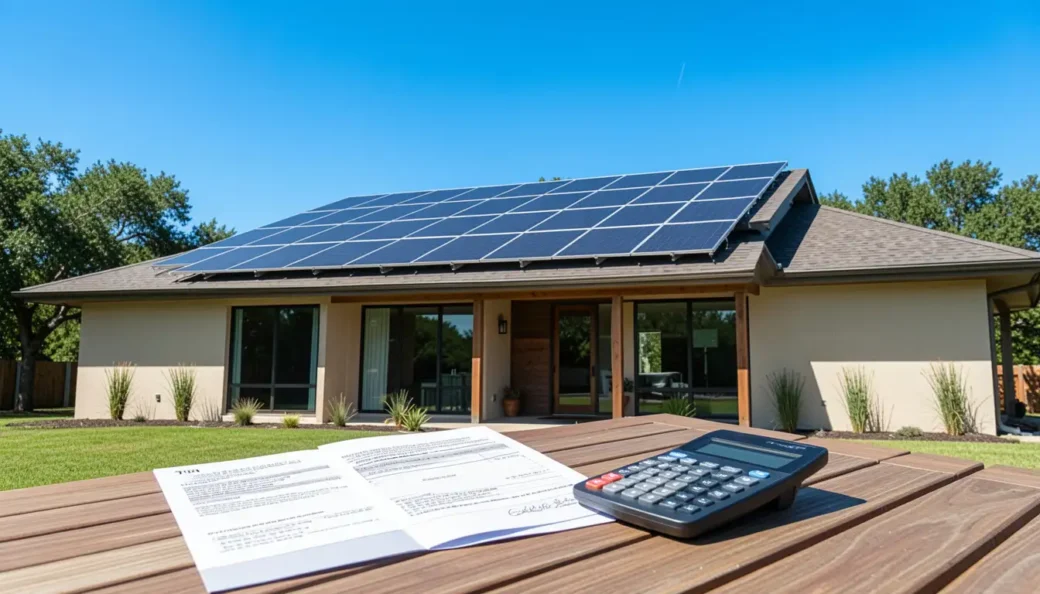
Property tax is calculated on your system’s assessed value as real or personal property. It has no legal connection to your actual electricity savings, net metering credits, or financial return on your solar investment. Understanding this distinction prevents one of the most common errors in disputed assessments.
Here is why it matters in practice.
Say your 12kW system generates $2,800 in annual electricity savings and produces $400 in net metering credits through Oncor or AEP Texas. A well-meaning but technically incorrect assessor might look at those income streams and use them to justify a higher assessed value through an income approach.
For residential BTM systems, that reasoning is legally wrong.
The §11.27 exemption removes the question entirely for qualifying residential systems. If the system qualifies, the added value is excluded from the tax base, regardless of how well the system performs.
Where the income approach becomes legitimately contested is on large-scale commercial systems. For a 2MW ground-mount array in West Texas operating under a PPA with a utility, the income approach is the correct methodology. But the assessor must use accurate discount rates, real photovoltaic degradation curves (typically 0.5% to 0.7% annual output decline, per U.S. Department of Energy research), and current ERCOT wholesale prices, not inflated projections.
California’s situation is a useful warning for Texans watching policy trends. California’s active solar energy exclusion from property tax assessment is set to expire on January 1, 2027. The California Board of Equalization has published detailed guidance on construction-in-progress scenarios near that deadline. Texas has no equivalent sunset on §11.27, but the lesson is clear: the relationship between your tax bill and your solar ROI is a legal classification question, not an economic one.
How Do You Win a Utility-Scale Solar Tax Challenge?
Utility-scale solar tax challenges in Texas succeed when the property owner establishes three things: the correct valuation methodology, the applicable depreciation schedule under Texas law, and the proper classification of the asset as personal property or real property improvement. Missing any one of these typically results in a denial at the ARB level.
For systems above 5MW, the process escalates significantly.
These cases usually go to the SOAH if the ARB ruling is challenged and involve expert witnesses on both sides. The litigation timeline runs 18 to 36 months from initial protest to final resolution.
The three factors that most determine the outcome:
Depreciation schedule. H.B. 2500 mandates a useful life of 10 years or less for commercial solar devices. If the CAD is using a 20-year schedule, you have a clear statutory argument for a reduced valuation.
ITC treatment. Federal Investment Tax Credits and production tax credits are intangible assets. They should not be counted as revenue in an income-approach valuation. New York amended its RPTL §575-b in December 2025 to explicitly exclude ITCs from the revenue model in renewable energy assessments. Texas has no equivalent statute yet, but experienced Texas practitioners argue the same principle under general appraisal standards.
LCOE benchmarking. Current levelized cost of energy for utility solar in Texas ranges from approximately $28 to $42 per MWh in 2026, based on ERCOT public data. An assessor using outdated projections above that range is overstating value. Present real ERCOT pricing data at the hearing.
A commercial scenario that makes this concrete:
A commercial property owner near Midland with a 3.5MW system assessed at $4.2 million by the Midland Central Appraisal District may have a legitimate case that the correctly depreciated value under H.B. 2500’s 10-year schedule sits closer to $2.6 to $3.0 million, depending on the in-service date.
At Midland County’s effective commercial tax rate of approximately 1.8%, that difference produces annual tax savings of $21,600 to $28,800.
That is a dispute worth funding with legal and expert costs.
If the underlying dispute also involves installation defects or safety issues with the commercial system, the overview of solar panel fire safety litigation is relevant background before retaining counsel.
What Are the State-Specific Solar Tax Exemption Legal Rules in Texas?
Texas’s solar property tax exemption under §11.27 is among the strongest in the country, but it carries filing requirements, ownership conditions, and residential versus commercial distinctions that trip up even experienced property owners. These are the rules that determine whether your exemption holds up under challenge.
The on-site use requirement.
The exemption applies to systems primarily used for on-site energy production and distribution. A system that generates significantly more power than the property consumes, and exports the majority to the grid commercially, may not qualify for the residential exemption under §11.27.
Leased systems are treated differently.
Under §11.27(a-1), a person is entitled to the exemption on a solar device they own that is installed on real property they do not own. This protects homeowners who own their panels outright on rented land.
But if you entered a solar lease and the installer retained equipment ownership, the exemption belongs to the installer as the device owner, not to you as the property owner. You should not be assessed for the added value of equipment you do not own. You may need to provide your lease documentation to the appraisal district to clarify this.
Form 50-123 must be refiled after ownership changes.
If you sell your home or transfer title, the exemption does not automatically transfer. The new owner must refile.
The honest limitation.
The §11.27 exemption prevents your solar panels from adding to your taxable value. It does not cap your underlying property’s taxable value.
If your neighborhood’s market values rise 12% and the appraisal district adjusts accordingly, your total tax bill can still increase even with a valid solar exemption in place. These are two separate numbers on your appraisal notice, and both deserve review every April.
For homeowners in other high-solar states watching how Texas handles these exemptions, the comparison with how solar panels work as an investment in Massachusetts shows how dramatically state-specific legal frameworks change the financial calculus.
How Does BTM Solar Affect Your Property Tax Position?
Behind-the-meter (BTM) solar systems, those wired on the customer’s side of the electric meter and primarily offsetting on-site electricity consumption, receive the most favorable property tax treatment available under Texas law and are fully covered by the §11.27 exemption. Understanding your BTM classification status is worth doing before any appraisal notice arrives.
A BTM system generating 110% or less of the property’s annual electricity consumption is the clearest case for the residential exemption.
In practical terms, this covers most rooftop installations in Austin, Dallas, Fort Worth, and Houston. A 9kW system on a 2,200 square foot home with average ERCOT grid consumption of approximately 14,400 kWh per year sits well within that threshold.
The complication arises when your system exports substantially more than your home consumes.
If you have added a battery system, an EV charger, and expanded your array, your total generation may tip past the on-site consumption threshold. If you are selling back a large share of production through TXU Energy, Reliant, or Green Mountain Energy, the appraisal district may argue that a portion of your system is commercial in nature, removing it from §11.27 eligibility and subjecting it to the H.B. 2500 cost method instead.
A problem scenario that illustrates this risk:
A homeowner in Plano with a 15kW array, sized for an EV, a home office, and future battery expansion, who exports 40 to 50% of annual production back to the grid, sits in a legal gray zone.
The on-site use requirement is not defined with mathematical precision in the statute. That ambiguity cuts both ways: it is a vulnerability if the CAD decides to challenge your exemption, and an opportunity if you document your case correctly.
Document your monthly consumption data from your utility provider. Request your generation versus export breakdown from your inverter monitoring platform. Bring that evidence to any informal hearing. The data almost always support the homeowner’s position when properly presented.
If the property tax dispute is connected to broader concerns about how your installer structured the system or represented its legal status, the resource on solar fraud legal help covers what legal recourse looks like when the dispute involves contractor misrepresentation alongside a tax assessment issue.
What If You Miss the May 15 Deadline?
Missing the May 15 protest deadline in Texas typically means waiting until the following tax year, but two narrow exceptions allow property owners to act even after the deadline passes. Most guides never mention these.
Exception one: notice never delivered.
If the appraisal district did not send your notice of appraised value, your deadline runs from actual delivery, not from April 1. If you genuinely never received the notice, you have grounds to argue your protest was timely at any point after you became aware of the assessment.
Exception two: motion for correction.
Texas Tax Code allows a motion for correction outside of protest season when the appraisal district assessed your residence homestead at least one-fourth higher than its correct value, or non-homestead property at one-third higher. This is a separate legal pathway from the standard protest, and it allows certain egregious overvaluations to be corrected mid-year.
For solar-specific missed exemptions, some county appraisal districts will also accept a late §11.27 exemption application with documented good cause. There is no statutory guarantee of this. It is worth requesting directly, especially if you can show your installer or the district never informed you of the exemption requirement.
If your deadline has passed and you believe your solar system is either unexempted or overvalued, contact your county CAD immediately. Ask specifically about late exemption applications, motion for correction eligibility, and the evidence required. Your options are narrower than in a timely protest, but they are not zero.
Your Honest Next Step
Starting a solar property tax litigation dispute in Texas is not as complex as the word litigation implies. For most homeowners, especially those whose systems have never been covered by Form 50-123, the real dispute is administrative.
Pull your most recent appraisal notice. Look for line items referencing improvements or new construction added in the year your panels were installed. If your solar system’s value appears in your taxable base and you have never filed Form 50-123, start there. The exemption filing costs nothing, protects potentially $6,000 to $9,500 over the life of your system, and establishes the legal foundation for a protest if the CAD disagrees.
For commercial or utility-scale situations, the investment in a qualified solar valuation expert pays for itself quickly when assessed values run into the millions and the depreciation schedule being applied is legally wrong.
You can verify current Texas property tax exemption rules, download Form 50-123, and confirm all applicable deadlines at the Texas Comptroller’s Property Tax Assistance Division, the official state source for all property tax forms and guidelines.
Your appraisal notice arrives in April. Your deadline is May 15. That window is the entire game.
Frequently Asked Questions
Does Texas’s solar property tax exemption apply automatically?
No. You must file Form 50-123 with your county appraisal district, typically by April 30, for the exemption to apply to that tax year.
Can I protest my property taxes in Texas every year?
Yes. Texas allows annual protests. The deadline is May 15 or 30 days after your appraisal notice is mailed, whichever is later.
Does the §11.27 exemption cover battery storage systems?
Yes. Texas Tax Code §11.27 explicitly includes devices used to store energy converted from solar sources, which covers most residential battery systems paired with solar panels.
Can I represent myself at an ARB hearing?
Yes. No attorney is required. Property owners appear regularly without legal representation, and most informal hearings are resolved before the ARB stage is reached.
What if my panels are leased, not owned by me?
If you do not own the equipment, the §11.27 exemption belongs to the device owner, typically the leasing company. Your property should not be assessed for the added value of equipment you do not own. Provide your lease documentation to the appraisal district to clarify the ownership structure.
Is a solar property tax dispute the same as a solar fraud lawsuit?
No. A property tax dispute challenges your CAD’s assessment through the Texas administrative and court system. A solar fraud lawsuit involves civil or criminal claims against an installer for misrepresentation or contract violations. Different courts, different evidence, different legal standards.
Does my retail electricity provider, such as TXU, Oncor, or Reliant, have a role in the dispute?
No. Property tax disputes in Texas are between you and your county appraisal district. Your utility’s role in net metering or buy-back arrangements may be relevant as supporting evidence in a commercial valuation dispute, but the utility is not a party to the proceedings.

Morgan Lee | Solar Energy Advocate & Researcher
Morgan Lee is a Senior Renewable Energy Consultant and the founder of SolarInfoPath. With over a decade of experience in green technology and project finance, Morgan leverages data from the National Renewable Energy Laboratory (NREL) and the U.S. Department of Energy to provide homeowners with transparent, high-authority guidance.
Driven by a mission to protect consumers from misleading sales tactics, Morgan launched SolarInfoPath as a 100% independent platform. By translating complex utility policies into actionable advice, Morgan advocates for a smarter, more sustainable future where families can achieve true energy independence through honest information.