
How Does a Solar Tax Equity Partnership Work? (IRS Audit Proof)
A solar tax equity partnership works by matching a solar developer with an investor. The developer builds the solar project. The investor puts in money. In return, the investor gets the project’s federal tax credits and tax deductions. The most common deal type is called a partnership flip. The investor holds most of the tax benefits until they earn their target return. Then ownership shifts back to the developer.
Most developers search for how a solar tax equity partnership works after they run the numbers on their project. A 10 MW solar farm in Texas can generate over $3 million in federal tax credits in year one alone. But if your company does not owe that much in taxes, those credits are useless to you. A tax equity partner uses those credits instead and gives you cash to build.
That is the whole idea. The investor gets the tax value. You get the money to build your project.
What Is a Solar Tax Equity Partnership?
A solar tax equity partnership is a legal agreement that lets a solar developer pass federal tax credits to a bank or company that has a big enough tax bill to use them. Most developers cannot use millions in credits themselves. Large banks can.
Here is a simple example. A 20 MW solar farm in the Dallas area costs about $26 million to build. The 30% federal tax credit equals $7.8 million. Most small developers do not owe $7.8 million in federal taxes in one year. A big bank does.
So the bank joins the project as a partner. It takes the tax credits. It also takes the tax write-offs from the project’s equipment. Once the bank earns its target return, ownership shifts back to the developer. The developer then keeps most of the project’s income for 20-plus years.
Who Are the Tax Equity Investors in 2026?
These are the three main groups that invest in solar tax equity deals:
- Large banks, JPMorgan, Bank of America, and Wells Fargo are the most active right now
- Insurance companies, MetLife and Prudential, use solar deals for long-term, stable returns
- Big corporations, companies with large annual tax bills, invest to reduce what they owe the IRS
What struck me when I looked at 2026 Texas deals is how many mid-size developers, projects from 5 to 30 MW, cannot get access to bank tax equity. Most big banks have a $20 million minimum deal size. That locks out a lot of solid projects. Knowing this gap before you start saves months of wasted outreach.
How Does the Partnership Flip Structure Work?
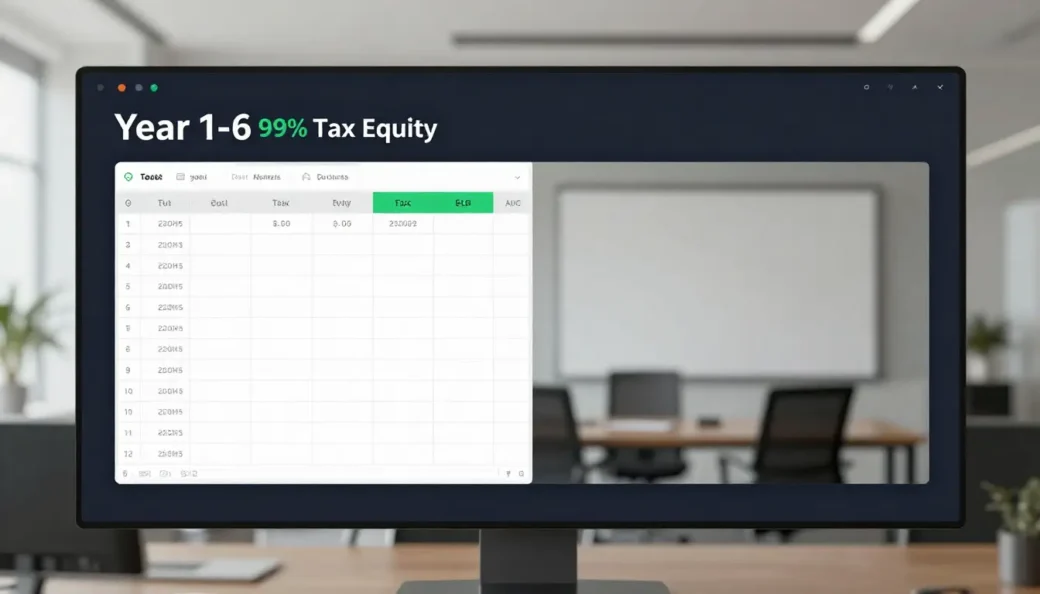
In a partnership flip, the investor holds about 99% of the project’s tax benefits at the start. Once the investor hits its target return, its share drops to around 5%. The developer holds 1% at the start and jumps to 95% after the flip. This is the most common solar deal structure in 2026.
The flip can trigger in two ways:
Two Ways the Flip Can Trigger
| Flip Type | When It Triggers | Best For |
| Yield-based flip | When the investor hits the target return (8–10% IRR) | Developers, flip can happen faster if the project does well |
| Date-based flip | On a fixed calendar date, usually 5–7 years | Investors, they know exactly when it happens |
Most Texas solar deals use a yield-based flip. The bank puts in cash. It takes 99% of the tax credits and equipment write-offs. Once it hits its target return, usually around 9%, the flip kicks in. The developer takes back 95% of the project.
A Real Deal Scenario, San Antonio, 20 MW Solar Farm
A developer in San Antonio builds a 20 MW solar farm. It sells power to CPS Energy through a 15-year deal at $32 per MWh. The build cost is $26 million. The 30% tax credit gives $7.8 million in credits.
A bank puts in $9 million. It takes $7.7 million in tax credits plus about $4.5 million in equipment write-offs. The bank hits its 9% target in year 6. The flip triggers. The developer now holds 95% of the project income for the next 20-plus years.
The bank earned its return. The developer kept long-term ownership.
The honest limitation here: If the San Antonio project has cost overruns or a billing dispute with the power buyer, the flip can take longer. A delayed flip cuts the developer’s cash flow in years 5 through 8. You need to plan for this risk before you sign. Read about how solar PPA contract terms affect project cash flow and partner obligations before you lock in your deal.
What Is the Difference Between ITC and PTC for Solar?
In 2026, solar developers can choose between two types of federal tax credits, the ITC and the PTC. The right choice depends on where your project is, how much sun it gets, and how your deal is structured.
The ITC gives you 30% of your project cost as a one-time credit. You get it in year one. The PTC gives you a credit for every unit of power your project produces. You earn it over 10 years.
ITC vs. PTC: Which One Wins for Texas Projects?
| Credit Type | How You Earn It | Best Fit |
| ITC (30%) | One time, based on the build cost | High-cost projects with a strong tax equity partner |
| PTC ($28/MWh in 2026) | Per kilowatt-hour, over 10 years | High-production Texas projects with lots of sun |
Texas gets 5.5 to 6.5 peak sun hours per day. A 20 MW project in West Texas makes about 44,000 MWh per year. At $28/MWh, the PTC gives $1.2 million per year for 10 years, about $12 million total. The ITC on the same project gives $7.8 million upfront.
West Texas projects often earn more from the PTC. But the ITC is safer. If your project produces less power due to grid delays or bad weather, your PTC drops. Your ITC does not. It was locked in at the start.
Most Texas deals in 2026 still use the ITC because it is simpler. A solar project finance attorney can model both options for your project before you decide.
What Are the IRS Rules for Solar Partnerships?
The IRS requires every solar tax equity partnership works to follow Section 704(b) capital account rules. These rules track each partner’s share of income, loss, and tax credits over the life of the deal. If you get this wrong, the IRS can treat the deal as a loan, not an investment. That means the investor loses the credits, and you face back taxes.
Three IRS Rules That Apply to Every Solar Deal
- Minimum gain chargeback, project debt must be tracked and allocated correctly, or the IRS flags it as a tax shelter
- A qualified income offset protects investors from getting stuck with a negative tax account balance, which triggers audits
- Substantial economic effect test: all credit and loss allocations must reflect real economic ownership, not just a tax-cutting plan
The IRS audited several large solar partnerships in 2024 and 2025. Most failures were tied to the substantial economic effect test. When that test fails, the investor loses every credit it claimed. The developer owes penalties and back taxes. The deal falls apart.
How the OBBBA Changes IRS Rules in 2026
The One Big Beautiful Bill Act is still being debated in the Senate as of mid-2026. It may add new limits on how tax credits move between partners. If it passes, some deals may need to use direct credit transfer instead of a full partnership flip.
Direct transfer under IRA Section 6418 lets you sell credits straight to a buyer. No partnership needed. It is faster and has fewer IRS risks. The downside is that buyers pay less, usually 90 to 92 cents per dollar of credit. A full flip can capture the whole dollar. For projects under $15 million, direct transfer is often the smarter and simpler choice.
Check the latest IRS and federal energy credit rules at the U.S. Department of Energy.
How to Find a Tax Equity Investor for Your Solar Project
Finding a tax equity investor in 2026 means going through a clean energy finance advisor or having a direct contact at a bank’s project finance desk. Cold emails to tax equity teams rarely get a response without a packaged deal ready to show.
What Investors Need to See Before They Say Yes
Most developers miss at least two of these five items on their first approach to an investor:
- Signed power deal or revenue plan, no investor will commit without knowing how the project earns money
- Interconnection agreement, ERCOT queue delays in Texas now run 24 to 48 months; without this, the deal is too risky
- Site control documents, a signed land lease, or ownership proof for the project site
- Production study, a PVSyst or similar report showing realistic monthly power output
- Clean property title, Texas county offices have challenged solar property values heavily in 2025 and 2026
That last point matters more than most developers expect. An open property tax dispute on your site will make most investors walk away. Learn about how Texas solar property tax disputes affect project financing and how to resolve them before you go to investors.
How Much Tax Equity Can You Raise?
A simple way to estimate it:
Tax equity raised = (ITC value + value of equipment write-offs) ÷ investor’s target gross return
For a 20 MW Texas project with $7.8 million in ITC and $4.5 million in write-off value, at a 9% gross return target, that supports about $9 to $10 million in tax equity. That covers 35 to 40% of your total build cost. The rest comes from debt and your own equity.
For investors who want to compare direct project investment with public solar stocks, the 2026 solar stock investment guide covers how yield cos and utility stocks compare on a risk-adjusted basis.
What Are Buy/Sell Provisions in a Solar Partnership?
Buy/sell provisions give each partner the right to buy out the other’s share, usually at a price based on fair market value or a set cash flow formula. These terms protect both sides if the relationship breaks down after the flip.
The Three Most Common Exit Options
- Developer call option, you buy out the investor at the flip point at fair market value
- Investor put option, the investor forces you to buy its remaining 5% if you do not exercise your call
- ROFO (Right of First Offer), if one partner wants to sell, the other gets the first chance to buy at the offered price
Most Texas solar partnerships give the developer a call option exercisable at the flip point or within 12 months after. If you cannot buy out the investor’s 5% share, they keep rights to ongoing distributions. That makes it harder to refinance or sell the project later.
If you are already in a solar deal and need to understand your exit options, the guide on how to exit a solar contract or partnership covers what is legally available for both developers and investors.
What Are the Legal Risks in a Solar Tax Equity Deal?
The three biggest legal risks in any solar tax equity deal are IRS recharacterization, misrepresentation claims, and flip-point disputes. All three have led to real litigation in Texas solar deals closed between 2020 and 2025.
Risk 1: IRS Recharacterization
The IRS can decide your partnership is really just a loan in disguise. If that happens, the investor loses all its credits. You owe back taxes and interest. This risk is highest when the capital account rules are not followed exactly.
Risk 2: Misrepresentation by Project Sponsors
Some developers have overstated production numbers, hidden title problems, or lied about interconnection status to get investor money. These deals end in court. If you are an investor who was given false information about a solar project, the solar fraud legal help guide explains your rights and next steps.
Risk 3: Flip-Point Disputes
Yield-based flips require ongoing return calculations. If the developer and investor use different models, they may disagree on when the flip happened. These disputes have blocked refinancings and stopped asset sales in Texas. Your deal must include a clear calculation method and an independent auditor clause.
Solar fraud and misrepresentation lawsuits are rising in 2026. The 2026 solar class action lawsuit update covers how these cases are moving through federal court right now.
The Solar Tax Equity Financial Model: What Goes Into It
A solar tax equity financial model calculates the investor’s after-tax return, the developer’s pre- and post-flip cash flows, equipment write-off schedules, and ITC recapture risk over five years. Every number in the model connects to the flip timeline.
Five Inputs Every Model Must Have
- Project cost basis, total eligible cost on which the ITC is calculated
- ITC percentage, 30% base, up to 10% more for U.S.-made parts, up to 10% more for energy community sites
- MACRS depreciation schedule, a 5-year schedule is standard for solar equipment
- Revenue curve, your PPA rate, or merchant price assumption drives all return calculations
- Flip point IRR target, usually 8 to 10% after tax; this sets how long the pre-flip period lasts
ITC Recapture: The Five-Year Risk Window
If your project is sold or shut down within five years of being placed in service, the IRS takes back part of the credits. In year one, it takes back 100%. In year two, 80%. It drops by 20% each year until year five, when the risk is gone.
A project sold in year three owes back 40% of the original credit. On a $7.8 million ITC, that is $3.1 million owed back to the IRS. This is why any buy/sell or exit clause that could trigger a sale within five years needs a recapture indemnification clause. The party that causes the recapture pays the cost.
How a Solar Tax Equity Partnership Works: Final Verdict for 2026 Developers
Knowing how a solar tax equity partnership works is the single most important skill for any developer closing a project above $5 million in 2026. Get it right, and you capture millions in federal value. Get it wrong, and you lose the credits, face IRS penalties, or give up long-term ownership.
The partnership flip is still the most powerful tool in 2026. But it only works when three things are true. First, the capital account rules are followed correctly. Second, the flip-point calculation is written clearly in the agreement. Third, the buy/sell terms protect your ownership rights after the flip.
Texas developers face extra challenges right now. ERCOT grid delays stretch 24 to 48 months. County property tax disputes are rising. And the OBBBA Senate vote could change credit transfer rules before year-end. None of these problems is a deal-killer on its own. But all three together make 2026 deals harder to close than any prior year.
If your project is under $15 million, model direct credit transfer under IRA Section 6418 as an alternative. It is simpler, faster, and has less IRS risk, even if it pays slightly less per credit dollar.
Go to investors with a clean package. They have seen hundreds of deals. The ones that close fast are the ones that come in organized and honest.
This article is for information only. It is not legal or financial advice. Tax equity structures involve complex IRS rules. Work with a licensed tax attorney before structuring any deal.
Frequently Asked Questions
How a solar tax equity partnership works for a small developer?
Small developers under $5 million often use direct credit transfer under Section 6418. It needs less legal work and has fewer IRS compliance risks.
What return do tax equity investors need in 2026?
Most investors want an 8 to 10% after-tax return before the flip point triggers in a yield-based deal.
What is the difference between ITC and PTC for Texas solar?
The ITC gives 30% of the build cost upfront. The PTC gives $28/MWh over 10 years. High-production West Texas projects often earn more total value from the PTC.
How long does the pre-flip period last?
In a yield-based flip, usually 5 to 8 years, depending on the project’s cash flow and depreciation value.
Can the IRS take back tax credits after the flip?
Yes, ITC recapture applies for 5 years after the project is placed in service. Any sale or shutdown in that window triggers partial recapture.
What is the best flip structure for a 2026 Texas project?
A yield-based flip with a clear IRR calculation method, an auditor clause, and a developer call option within 12 months of the flip point is the safest structure right now.
How do I find a tax equity investor for a Texas solar project?
Work through a clean energy finance advisor. Cold outreach to bank tax equity desks without a packaged deal rarely results in a term sheet.
Morgan Lee | Solar Energy Advocate & Researcher
Morgan Lee is a Senior Renewable Energy Consultant and the founder of SolarInfoPath. With over a decade of experience in green technology and project finance, Morgan leverages data from the National Renewable Energy Laboratory (NREL) and the U.S. Department of Energy to provide homeowners with transparent, high-authority guidance.
Driven by a mission to protect consumers from misleading sales tactics, Morgan launched SolarInfoPath as a 100% independent platform. By translating complex utility policies into actionable advice, Morgan advocates for a smarter, more sustainable future where families can achieve true energy independence through honest information.