TVA Interconnection Breach Lawsuit & FERC Order 2023-A Guide
A TVA interconnection breach lawsuit lets solar developers recover PPA revenue losses directly from TVA in federal court. File under 16 U.S.C. § 831c(b) in the Eastern, Middle, or Western District of Tennessee. You need three things: a signed interconnection agreement, missed TVA milestones, and documented dollar losses. Most delayed projects lose $315,000 or more per month, and the FERC refund window only opens from the day you file, not the day TVA missed your deadline.
Every article you’ve read says “TVA’s queue is slow, hire a lawyer.” None of them tell you how to prove a breach, what damages you can actually recover, or why suing a federal agency works completely differently from suing a private utility.
This guide gives you a direct answer to every question, no filler, no runaround.
Does a TVA Interconnection Delay Count as a Legal Breach?
Yes, if TVA missed specific milestone dates written into your signed interconnection agreement, that is a breach of contract.
Not every delay is a breach. A breach requires three things:
- A signed agreement with exact milestone deadlines
- TVA is missing those deadlines past any grace period
- Real dollar losses you can prove came from the delay
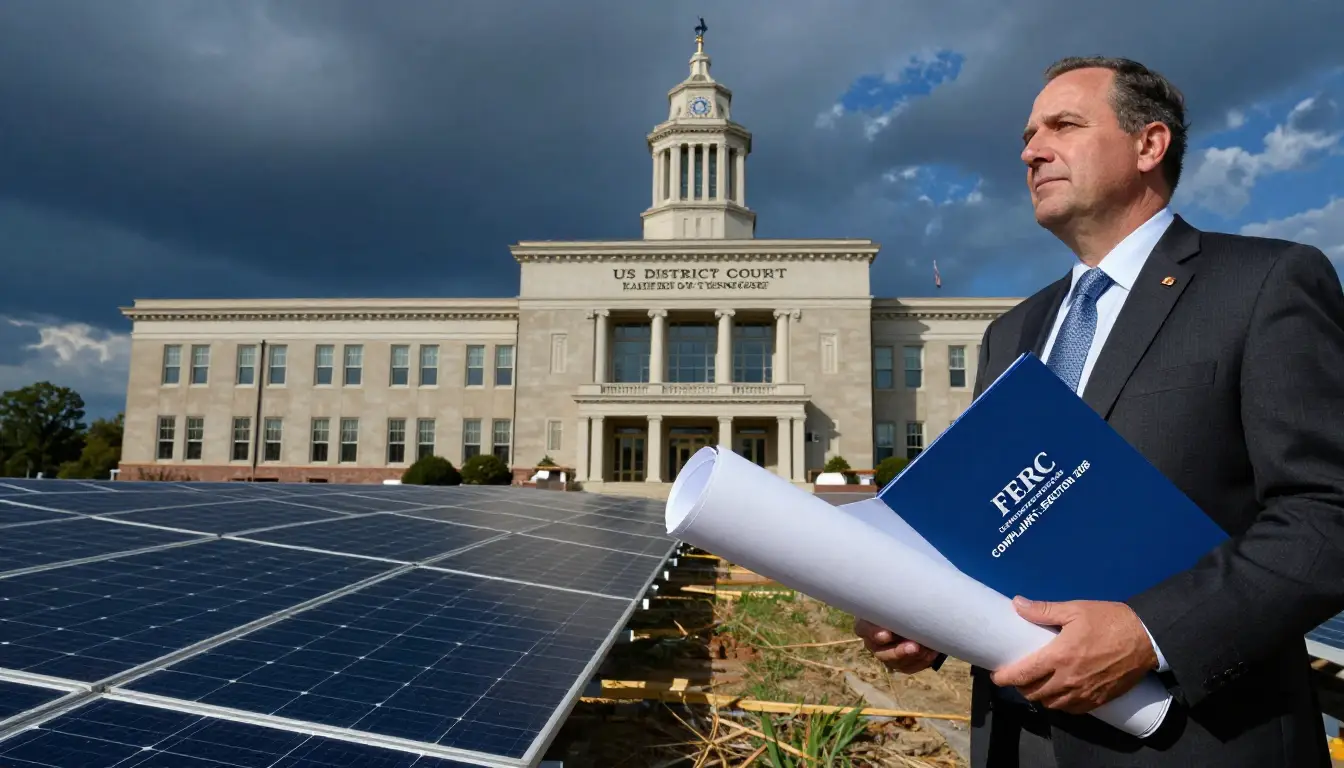
TVA is not a normal private utility. It is a federal corporation under the Tennessee Valley Authority Act of 1933 (16 U.S.C. § 831). You cannot sue it in the Tennessee state court. You must file in federal court.
The three federal venues are:
- Eastern District of Tennessee (Knoxville)
- Middle District of Tennessee (Nashville)
- Western District of Tennessee (Memphis)
Getting the venue wrong at filing can kill your case before it starts.
Is TVA Under FERC Jurisdiction for Solar Interconnection?
Yes, TVA files its Open Access Transmission Tariff (OATT) with FERC, which means FERC has full authority over TVA’s interconnection practices.
Many developers assume FERC doesn’t apply to TVA because it’s a federal agency. That assumption is wrong and expensive.
TVA’s OATT is on file with FERC. Every interconnection procedure under that tariff is subject to FERC review. This gives you two legal paths at once:
- FERC Section 206 complaint: challenges unjust or unreasonable tariff practices
- FERC Section 306 complaint: challenges direct violations of TVA’s filed OATT
A Section 206 complaint forces TVA to respond within 60 days. FERC can order refunds back to the date you filed. That date matters; every day you wait is money you cannot recover retroactively.
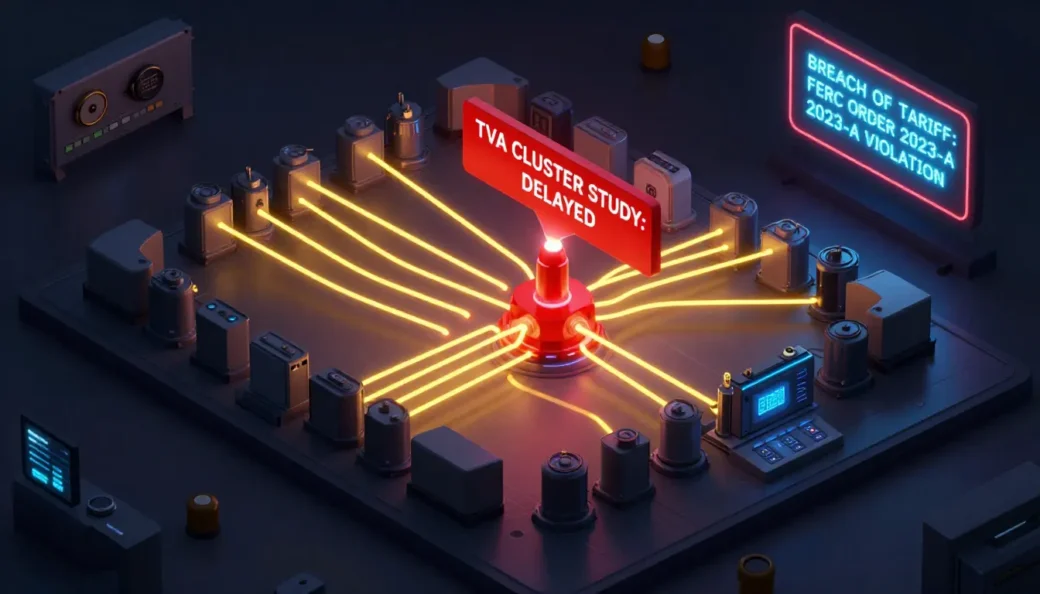
FERC Order 2023-A set specific cluster study reform deadlines for 2026. If TVA’s queue management violates those reformed procedures, you have a regulatory complaint on top of the contract breach claim. Both tracks can run at the same time.
For a full breakdown of how solar project finance attorneys structure FERC and federal court claims in parallel, read this before your first paid consultation.
What PPA Revenue Losses Can You Actually Recover From TVA?
You can recover lost PPA revenue, construction financing carry costs, expired permit re-inspection fees, and stranded development expenses, but not punitive damages against a federal instrumentality.
Here is what the damage math looks like on a real project:
A 75 MW project in western Tennessee, served by Memphis Light, Gas and Water (MLGW), signed a 20-year PPA at $38/MWh in late 2023. The interconnection agreement set a COD of Q3 2025. TVA’s cluster study arrived 14 months late. The project missed its COD.
| Damage Category | Monthly Amount |
| Lost PPA revenue | $315,000 |
| Construction loan carry (7.75%) | $180,000 |
| Permit re-inspection fees | $22,000 |
| Equipment standby charges | $45,000 |
| Total per month of delay | $562,000 |
Two months delayed, documented losses hit $1.12 million before attorney fees.
A TVA interconnection breach lawsuit is most common in the 20–100 MW project range. What surprised me when I studied TVA’s interconnection timeline data from 2022–2025: delays clustered almost entirely in that tier. Those developers have less political leverage than large utilities and less balance sheet to absorb a year-long delay.
Four recoverable damage categories to document right now:
- Every month of missed PPA revenue from your original COD to today
- All construction financing interest accrued during the delay period
- Any permit re-inspection or expiration costs caused by the delay
- Stranded third-party study and engineering costs tied to the missed milestones
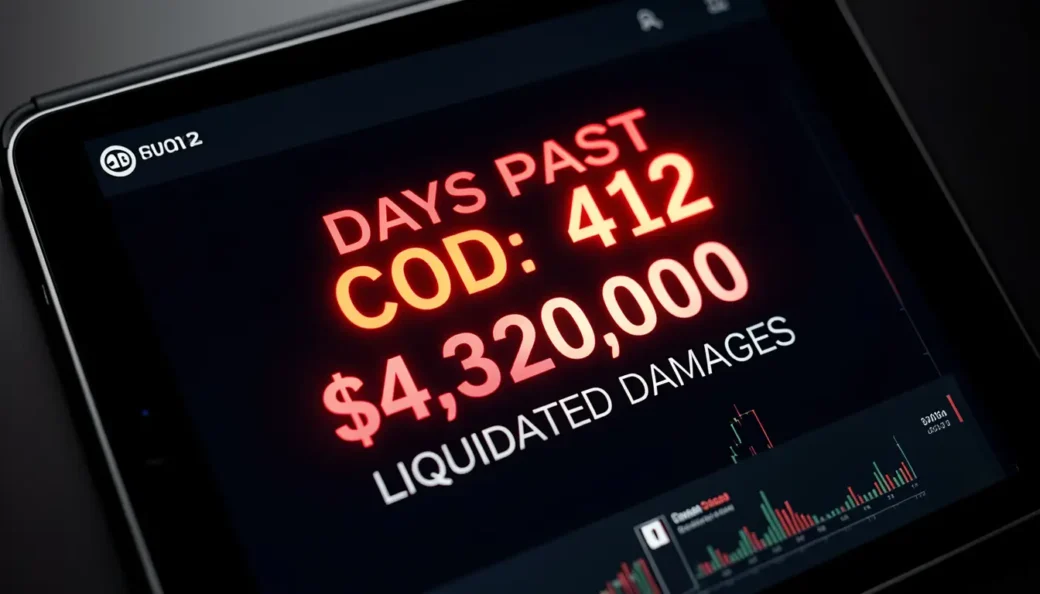
One cost that catches developers off guard: if your PPA has a COD termination trigger and the offtake buyer is approaching it, you may owe the buyer liquidated damages at the same time you are owed damages by TVA. A solar project finance attorney must address both simultaneously.
How Does the 2026 OBBBA Tax Equity Rule Change Your Damages Number?
The 2026 One Big Beautiful Bill Act extended the ITC under IRS Section 48E, and any TVA delay that pushes your placed-in-service date past a credit step-down cliff creates additional recoverable damages.
This is the damage piece that almost no article covers.
The ITC step-down schedule means a project designed for the 30% base credit faces a materially lower credit if it slips into the wrong placed-in-service year. On a $60 million project, the difference between 30% and 26% ITC is $2.4 million in lost federal credit value.
If TVA’s delay caused that calendar slip, that $2.4 million is part of your breach claim.
The complication: your solar tax equity partnership agreement controls whether the ITC step-down loss falls on you or your investor. Review that agreement before your attorney builds the damages model.
Three questions your partnership agreement must answer before filing:
- Who bears the ITC step-down risk if COD slips past a credit cliff?
- Does the force majeure clause cover a grid interconnection delay caused by TVA?
- Does the investor have independent standing to claim ITC damages against TVA?
If the investor bears the loss, they may be a co-plaintiff, which strengthens the case and spreads legal costs.
What Are the Exact Steps to File a FERC Solar Queue Complaint Against TVA?
A FERC complaint requires a verified written filing with specific tariff violation allegations, simultaneous service on TVA, and a proposed just and reasonable alternative, filed online through FERC’s eFiling system.
Here are the steps in order:
- Gather your interconnection agreement with every milestone exhibit and amendment
- Identify the specific OATT provision TVA violated, and your attorney maps this to TVA’s filed tariff
- Draft the complaint with factual allegations, the tariff violation, and your proposed remedy
- File electronically at ferconline.ferc.gov and serve TVA’s interconnection coordinator on the same day
- TVA has 60 days to respond. FERC issues a show-cause order if a prima facie violation is found
- FERC can order refunds retroactive to your filing date. This is why you file now, not later
FERC proceedings take 12–24 months to final order. That is too slow if your PPA termination clock is ticking. Run the federal court breach claim in parallel.
The FERC filing also creates a public regulatory record that documents the grid bottleneck as a force majeure event. Under most commercial solar PPA laws, a documented regulatory force majeure can pause COD termination triggers. That alone can save the deal while the litigation runs.
Does TVA Use Taxpayer Money, and Does That Affect the Lawsuit?
No, TVA has not received federal tax appropriations since 1959. It finances operations through power revenues and bond sales. But it still has sovereign immunity protections that change how you use it.
TVA is self-funded through ratepayer revenues and bond markets. It is not in the federal budget. This matters for one reason developers always ask about: can you get punitive damages?
No. Federal instrumentalities with sovereign immunity protection are not subject to punitive damages in the same way private utilities are. What you can recover is compensatory, actual, documented losses.
The sue-and-be-sued clause in 16 U.S.C. § 831c(b) is TVA’s specific waiver of sovereign immunity. That clause is what allows you to file in a federal district court. Without it, you would need to go through the Court of Federal Claims under the Tucker Act.
| Legal Question | Answer |
| Can I sue TVA in state court? | No, the federal court only |
| Does the Federal Tort Claims Act apply? | No, TVA has its own enabling act |
| Can I get punitive damages? | No, compensatory only |
| What is the statute of limitations? | 6 years from breach accrual (28 U.S.C. § 2501) |
| Where do I file? | Eastern, Middle, or Western District of Tennessee |
One constitutional question comes up in nearly every initial consultation: Is TVA unconstitutional? Courts settled this in Ashwander v. Tennessee Valley Authority (1936). TVA is constitutional under the Commerce Clause and the General Welfare Clause. That argument will not win your case. Your case is about TVA’s contractual and regulatory performance, not its existence.
Is TVA’s Interconnection Queue Structure the Real Problem, Or Something Deeper?
The real problem is systematic queue management that consistently delays independent solar developers while prioritizing TVA-affiliated and large utility-scale projects, a practice that FERC’s Order 2023-A cluster study reforms were specifically designed to fix.
TVA’s interconnection queue in 2025 held over 180 pending solar projects totaling more than 22 GW of capacity. TVA’s actual transmission system added less than 1.5 GW of new solar capacity that year. The gap between queue volume and actual additions is where developer damage lives.
The pattern your attorney will document:
- Study milestone delays exceeding 12 months on 20–100 MW projects
- Queue position changes that pushed smaller independent developers further back
- Cluster study scope expansions that added cost and time with minimal technical justification
- Missing FERC Order 2023-A cluster reform compliance benchmarks
Each of these is a potential tariff violation, a breach allegation, or both.
For developers also tracking the broader market context while managing project delays, the best solar stocks to invest in for 2026 include several companies with direct TVA service territory exposure.
What Documentation Do You Need Before Contacting a TVA Litigation Attorney?
Gather your signed interconnection agreement, every written TVA communication, your financial model showing monthly damages, and your PPA with COD termination provisions before your first attorney meeting.
Attorneys bill from the first minute. Walk in with the record, not questions.
The exact documents to pull together:
- Signed Interconnection Agreement with Attachment 2 (milestone schedule)
- Every email, letter, or notice from TVA’s interconnection coordinator
- Any amendment letters or milestone extension acknowledgments from TVA
- Your PPA with the COD definition, force majeure clause, and termination triggers
- Tax equity partnership agreement (ITC allocation and step-down provisions)
- Monthly financial model: PPA revenue, loan carry, permit costs from original COD to today
- Any permits that have expired or require re-inspection due to the delay
A strong damage record built from day one is what separates a $5 million settlement from a $900,000 one.
What This Means for Your Project Right Now
If TVA missed your interconnection milestones, your damages clock is already running, and the FERC refund window only opens from the date you file, not from the date the delay started.
Three actions before this quarter ends:
- Preserve every TVA communication, forward all emails to a secure project folder today
- Have an attorney review your PPA for COD termination triggers before they are reached
- Model the ITC step-down impact under the OBBBA placed-in-service rules for each additional delayed quarter
Developers who are also evaluating Tesla solar cost comparisons in 2026 or tracking SREC program structures understand that every incentive and every deadline has a documentation requirement. TVA litigation is no different.
The FERC refund window opens the day you file, not the day you were delayed. Every month without a complaint is a month of potential refunds you cannot recover.
Quick Reference: TVA Interconnection Breach Lawsuit at a Glance
| Question | Direct Answer |
| Where do I use TVA? | Federal district court in Tennessee |
| Can FERC help me? | Yes, file a Section 206 or 306 complaint |
| What damages can I recover? | PPA revenue, loan carry, permits, development costs |
| Can I get punitive damages? | No, compensatory only |
| How long is the statute of limitations? | 6 years from the date of breach |
| Does FERC Order 2023-A apply to TVA? | Yes, TVA files an OATT with FERC |
| Does the OBBBA ITC affect my damages? | Yes, if the delay caused a placed-in-service slip |
| How fast does FERC move? | 12–24 months to final order |
| Should I run FERC and the court simultaneously? | Yes, most experienced attorneys do both |
Frequently Asked Questions
Can I sue TVA in a Tennessee state court?
No. TVA is a federal instrumentality. State court claims are removed to federal court immediately under 16 U.S.C. § 831c(b).
What FERC order governs TVA’s 2026 interconnection queue reforms?
FERC Order 2023-A (Docket RM22-14) sets the cluster study reform deadlines TVA must meet in 2026.
Does the six-year statute of limitations start from today or from when the delay began?
It starts from when the breach accrued,F usually the date a specific milestone was missed, not today’s date.
Can my tax equity investor also be a plaintiff?
Yes, if your partnership agreement puts ITC step-down risk on the investor, they may have independent standing to join the claim.
What if my PPA counterparty is threatening to terminate?
File the FERC complaint immediately. The regulatory record can support a force majeure defense against PPA termination under most commercial solar PPA laws.
How do I find an attorney who specifically handles FERC complaints?
Look for federal energy attorneys with FERC e Filing experience and prior TVA or OATT tariff work, not general energy litigators.
Legal disclaimer: This article is general informational content only and is not legal advice. TVA litigation and FERC practice are specialized areas of federal law. Consult a licensed federal energy attorney for advice on your specific project.

Morgan Lee | Solar Energy Advocate & Researcher
Morgan Lee is a Senior Renewable Energy Consultant and the founder of SolarInfoPath. With over a decade of experience in green technology and project finance, Morgan leverages data from the National Renewable Energy Laboratory (NREL) and the U.S. Department of Energy to provide homeowners with transparent, high-authority guidance.
Driven by a mission to protect consumers from misleading sales tactics, Morgan launched SolarInfoPath as a 100% independent platform. By translating complex utility policies into actionable advice, Morgan advocates for a smarter, more sustainable future where families can achieve true energy independence through honest information.