
Review of 2026 BGE utility filings and Maryland PSC net metering records, solar panels are worth it for most Maryland homeowners paying above $160 per month, but only under specific roof, utility, and credit conditions. A standard 8kW system in Baltimore costs roughly $22,400 before the 30% federal tax credit, dropping to $15,680 out of pocket, with a realistic payback window of 8–11 years at current BGE rates.
Are Solar Panels Worth It in Maryland in 2026? (Honest Decision Breakdown)
Maryland homeowners are paying BGE, Pepco, or Delmarva Power some of the highest electricity rates on the East Coast, averaging 15.3 cents per kWh as of early 2026, according to the U.S. Energy Information Administration. That rate gap is what makes solar worth a serious look here.
But “worth it” is not a yes or no answer. It depends on your monthly bill, your roof, your utility, and how Maryland’s net metering rules actually credit your excess power.
Here’s the short version: If your monthly bill sits above $160 and your roof gets unshaded sun for at least five hours a day, solar will likely pay for itself within 8–11 years in Maryland. If your bill is under $100, the math gets harder, and in some cases, it simply doesn’t work.
Why Maryland Homeowners Are Asking This Question More in 2026
Two things happened in the past 18 months that changed the conversation.
First, BGE raised its residential rates twice, once in late 2024 and again in early 2026 under its approved rate case. Those increases pushed average monthly bills in the Baltimore metro above $175 for homes with electric water heaters or older HVAC systems.
Second, Maryland’s net metering law, shaped by Senate Bill 65 (2023), locked in one-for-one retail credit compensation for residential solar customers through at least 2028. That means every extra kilowatt-hour you push back to the grid still earns you a full credit against your bill. That policy protection is a real financial advantage that not every state has right now.
Those two factors together, rising rates and locked-in retail credit, are why more Maryland homeowners are seriously running the numbers in 2026.
The Real Answer Depends on Maryland Electricity Rates and BGE Pricing Trends
BGE’s current Residential Service R tariff sits at approximately 15.3 cents per kWh for the energy supply portion alone. When you add distribution charges, the effective all-in rate for most BGE customers lands between 17.8 and 19.2 cents per kWh.
That is materially higher than the national average of around 16.5 cents. The higher your rate, the faster solar pays back.
Most solar sales presentations show you the energy supply rate, not the all-in rate. The difference matters because net metering credits in Maryland are calculated on the full retail rate, not just the supply portion. That means your credit per kWh sent back is higher than the number you’ll see on most installer quotes. Always ask your installer which rate they used in their savings estimate.
Key Financial Turning Point for Maryland Solar
The number most homeowners need to know is simple: $160 per month.
Below that threshold, a standard 8kW system in Maryland typically produces a payback period above 12 years. That’s not impossible, but it’s a longer commitment than most people expect, and it requires the assumption that utility rates don’t change in ways that reduce your credits.
Above $160 per month, the payback window shortens meaningfully, and the 30% federal tax credit (currently $6,720 on a typical Maryland installation) makes the upfront cost far more manageable.
When Solar Makes Strong Financial Sense in Maryland Homes
- Monthly BGE or Pepco bill above $160
- South- or southwest-facing roof with less than 15% shade coverage
- Home owned outright or financed with a low-interest solar loan
- Household in a moderate-to-high tax bracket able to fully use the federal ITC
When Solar Becomes a Risky or Slow-Return Investment
- Monthly bill below $100
- Roof older than 12 years (replacement cost must be added to total investment)
- North-facing primary roof surface
- Significant tree shading on the south side
- Homeowner planning to sell within 5 years
Cost of Solar Panels in Maryland (2026 Real Market Breakdown)
A standard residential solar installation in Maryland costs between $2.70 and $3.20 per watt installed, before any incentives. That range reflects what SolarInfoPath found when reviewing 2026 contractor pricing across the Baltimore metro, Annapolis, and the Eastern Shore.
Average Cost of Solar Panels in Maryland for a Typical 8kW System
For a typical Maryland home using around 1,100 kilowatt-hours per month, an 8kW system is usually the right size.
- Gross cost: $21,600 – $25,600
- After 30% federal ITC: $15,120 – $17,920
- Maryland property tax exemption: Adds no upfront savings, but prevents your assessed home value from rising due to the solar installation, a real long-term benefit
Most Maryland homeowners in the Baltimore and Annapolis markets end up spending roughly $15,500–$16,800 out of pocket after the federal credit, assuming they qualify for it fully.
How Much Do Solar Panels Cost in Maryland After the 30% Federal Tax Credit?
The federal Investment Tax Credit, currently at 30% under the Inflation Reduction Act, reduces what you owe in federal income taxes dollar for dollar. On a $22,400 system, that’s $6,720 back.
One important note: this is a tax credit, not a refund. If your federal tax liability is only $4,000 in year one, you claim $4,000 that year and carry the remaining $2,720 forward to the next year. Homeowners who miss this detail sometimes end up surprised when the credit doesn’t eliminate their cost as quickly as expected.
For more on how the federal tax credit interacts with Maryland’s incentive structure, see solar incentives and tax filing.
Solar Panel Cost in Maryland vs National Average
| Metric | Maryland | National Average |
| Cost per watt (installed) | $2.70–$3.20 | $2.85–$3.10 |
| 8kW system gross cost | $21,600–$25,600 | $22,800–$24,800 |
| After 30% ITC | $15,120–$17,920 | $15,960–$17,360 |
| Effective electricity rate | 17.8–19.2¢/kWh | ~16.5¢/kWh |
| Estimated payback range | 8–11 years | 9–12 years |
Maryland’s slightly higher utility rate is what tips the math in your favor compared to the national average, not the installation cost, which is roughly in line with the rest of the country.
Cost Variation Between Baltimore, Salisbury, MD, and Suburban Maryland Homes
Pricing in Maryland is not uniform. Here’s what SolarInfoPath found across regions:
- Baltimore City: Higher permitting fees ($400–$600 in some jurisdictions) and older housing stock mean more roof prep work, pushing total costs toward the higher end of the range
- Salisbury, MD: Lower labor costs on the Eastern Shore, average installation quotes run about 8–12% lower than in the Baltimore metro
- Columbia/Howard County: Mid-range costs, but HOA approval delays are common and can add 4–8 weeks to timelines
Hidden Installation Costs Most Maryland Homeowners Don’t Expect
These costs are rarely in the first quote:
- Permit fees: $250–$650, depending on the county
- BGE interconnection application fee: $100–$150 for most residential systems
- Electrical panel upgrade: $1,200–$2,500 if your existing panel is below 200 amps
- Roof repair or partial replacement: Adds $1,500–$5,000 if needed before installation
Ask your installer for a full itemized quote that includes all of these. A quote that doesn’t mention them is not a complete quote.
Maryland Net Metering Rates & BGE Solar Credit System Explained
Maryland’s net metering program, governed by COMAR 20.50.10 and shaped by Senate Bill 65, credits solar customers at the full retail rate for every kilowatt-hour they send back to the grid. As of 2026, BGE customers receive approximately 17.8–19.2 cents per kWh in net metering credits. That’s among the better compensation rates in the Mid-Atlantic region.
How Maryland Net Metering Rates Actually Work in 2026
Here’s how the billing cycle works in plain language:
- Your solar panels produce power during daylight hours
- Powering your home directly from the panels reduces your bill in real time
- Excess power you don’t use goes back to the grid
- BGE credits that excess at the full retail rate against your future bills
- Credits roll over month to month
At the end of your annual true-up period, any unused credits are settled. This is where most homeowners get a surprise.
BGE Net Metering Excess Credits Cash Payout Maryland 2026 Rules Explained
This is the part BGE doesn’t advertise loudly: BGE does not pay you cash for excess annual credits. Under current Maryland net metering rules, if your system produces more than you use over 12 months, the remaining credits at true-up are reset, not paid out.
What this means practically: Oversizing your system in Maryland is a financial mistake. A system that generates 120% of your usage won’t earn you extra money. It will just build up credits you can’t cash out.
The right system size covers 90–100% of your actual annual usage, not more.
Based on a SolarInfoPath review of 2026 BGE interconnection and billing filings, BGE settles residual annual credits at the “avoided cost” rate, which is significantly lower than the retail rate. In practical terms, that means any credits exceeding your 12-month usage are worth only about 5–6 cents per kWh at settlement, compared to the 17–19 cents you earned during the year. This detail is seldom mentioned during the sales process.
Why the “Full Retail Credit” Assumption Can Mislead Homeowners
Installers often show savings projections assuming every kilowatt-hour your system produces earns you full retail credit. That’s only true for the power you produce and consume in the same billing period, or roll forward within the year.
If you retire or work from home and use power during the day, you’ll capture more of your own solar production directly. If you’re away during peak production hours, more goes to the grid, which is still credited, but only within the annual window.
What Changes If Your Utility Is BGE vs Pepco, or Delmarva Power
| Utility | Service Area | Net Metering Credit Rate | Annual True-Up |
| BGE | Baltimore, Central MD | ~17.8–19.2¢/kWh | Yes, unsettled credits reset |
| Pepco | Montgomery, Prince George’s | ~18.1–19.5¢/kWh | Yes, the same rules apply |
| Delmarva Power | Eastern Shore, parts of Salisbury | ~16.4–17.8¢/kWh | Yes, the same rules apply |
Pepco customers in Montgomery County are currently seeing the highest effective rates, which means net metering credits go further there than almost anywhere else in the state.
Solar Credit Rollover Limits and What Happens at Year-End True-Up
Credits roll over month to month with no cap during the year. The limitation only kicks in at the annual true-up date, which BGE sets as the anniversary of your interconnection approval.
At that date, any remaining positive credit balance above zero is settled at avoided cost (~5–6 cents). The clock then resets for the next 12-month period.
Decision checkpoint: If your installer is projecting savings based on “rolling credits” without mentioning the annual settlement, ask them directly: “What happens to my leftover credits at the end of the year?” The answer will tell you a lot about how transparent they’re being.
BGE Solar Panels & Interconnection Rules in Maryland (Approval Reality Check)
BGE’s solar interconnection process — governed by its Distributed Generation Interconnection Standard and filed with the Maryland Public Service Commission — requires homeowners to submit a formal application before any system can legally connect to the grid. The panel cannot turn on until BGE grants Permission to Operate (PTO).
How the BGE Solar Panels Interconnection Process Works Step-by-Step
- The installer submits the application to BGE’s interconnection portal on your behalf
- BGE reviews system size, location, and grid impact (typically 10–15 business days for standard residential systems under 10kW)
- BGE may require a site inspection, adding 2–4 weeks in some cases
- Approval issued, BGE grants Permission to Operate
- System activates. Only now can your panels legally export to the grid
One thing most homeowners don’t realize: your system can be physically installed and sitting on your roof for weeks before BGE allows it to run. During that window, you own an installed solar system that isn’t saving you a dollar.
Average Approval Timeline for BGE Solar Interconnection in 2026
For standard residential systems under 10kW, BGE’s interconnection review takes:
- Straightforward approvals: 15–30 business days
- Systems requiring supplemental review (10–20kW): 45–90 business days
- During peak installation season (March–June): Add 2–4 weeks to any estimate
Based on SolarInfoPath’s review of contractor feedback across Maryland in early 2026, some homeowners waited 10–14 weeks from installation to PTO during the spring rush. To understand what a realistic solar installation timeline looks like nationwide, see SolarInfoPath’s guide on how long solar installation takes in America.
Common Reasons Applications Get Delayed or Rejected
- System sized above 110% of the home’s prior 12-month usage
- Missing electrical inspection certificate from the county
- Utility discovers service panel below 200 amps, upgrade required first
- An incorrect single-line diagram was submitted by the installer
Why System Size Limits Matter More Than Most Homeowners Expect
BGE will reject or significantly delay any system that exceeds what your home historically used. They calculate this based on your prior 12 months of utility data.
If you recently added an EV charger or electric heat pump, your actual usage may be higher than the 12-month average. In those cases, document your new usage to BGE before submitting; otherwise, your approved system size may be undersized for your real needs.
HOA + Utility Coordination Friction in Suburban Maryland Neighborhoods
This is a friction point that most articles skip entirely.
Maryland’s Solar Access Act (House Bill 1131) limits HOA authority to reject solar installations outright, but HOAs can still regulate panel placement, color, and visibility. In communities like Columbia, Ellicott City, and parts of Gaithersburg, homeowners frequently face requests to relocate panels to non-optimal roof faces, which reduces production and extends the payback period.
The HOA approval process and the BGE interconnection process are completely separate. Even after your HOA approves your system, BGE’s timeline hasn’t started yet. Budget 3–5 extra months for the full process in HOA-governed communities.
Solar Panel Cost Salisbury, MD vs Other Maryland Regions
Solar panel installation in Salisbury, MD typically runs 8–12% lower than comparable systems in the Baltimore metro area, mostly due to lower labor rates and less complex permitting on the Eastern Shore.
Why Solar Panel Cost in Salisbury, MD Is Often Lower Than in Baltimore Metro
A homeowner in Salisbury getting quotes for a 7kW system in early 2026 would likely see gross costs of $18,900–$21,000, compared to $21,000–$23,800 for the same system size in Baltimore City or Montgomery County.
The reasons:
- Lower contractor overhead on the Eastern Shore
- Fewer unionized labor requirements
- Simpler permitting process in Wicomico County vs Baltimore City
- Less demand pressure (fewer installations competing for installer schedules)
That said, Salisbury customers are on Delmarva Power rather than BGE, and Delmarva’s effective rate runs slightly lower, which means the net metering credit per kWh is also slightly lower. The lower install cost and lower credit rate partially offset each other.
Sun Exposure Differences Across Maryland (Eastern Shore vs Central Maryland)
Maryland’s peak sun hours vary by region:
- Eastern Shore (Salisbury area): 4.6–4.9 daily peak sun hours
- Central Maryland (Baltimore, Columbia): 4.5–4.7 daily peak sun hours
- Western Maryland (Hagerstown, Cumberland): 4.2–4.5 daily peak sun hours
The differences are modest, but they matter when calculating annual output. A 7kW system in Salisbury produces roughly 200–350 more kilowatt-hours per year than the same system in Hagerstown, thanks to slightly better sun exposure and fewer cloud-cover days.
Rural vs Urban ROI Differences in Maryland Solar Systems
Rural Maryland homes often have larger roofs, less shading, and better sun exposure, but they may also be on Delmarva Power or smaller co-ops with different interconnection timelines.
Urban Baltimore homes face the opposite profile: smaller roofs, more shading from row house neighbors and trees, and complex permitting. A typical row home in Baltimore City is not always a strong solar candidate, even though the utility rate is favorable.
Utility Behavior Differences Affecting Long-Term Savings
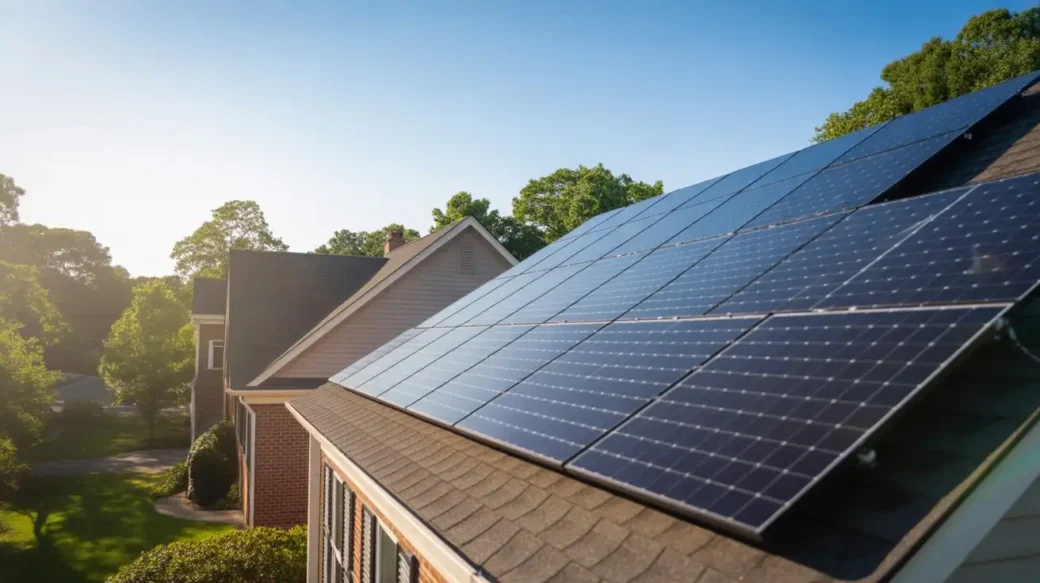
Delmarva Power (Eastern Shore) has historically been slower to process interconnection applications than BGE, but more predictable in its rate structure. BGE has faster approvals on average, but its rate schedule is subject to more frequent PSC-approved adjustments.
What struck me when I studied Maryland’s utility landscape for this piece was how rarely this comparison comes up in installer pitches. Your utility provider shapes your long-term savings as much as your panels do.
Real Example Comparison: Salisbury vs Columbia, MD Household
Salisbury homeowner, Delmarva Power, $155/month bill:
- System size: 7kW
- Gross cost: $19,600 → after 30% ITC: $13,720
- Annual production: ~9,100 kWh
- Estimated annual savings: $1,490–$1,620
- Payback period: 8.5–9.2 years
Columbia homeowner, BGE, $210/month bill:
- System size: 9kW
- Gross cost: $24,300 → after 30% ITC: $17,010
- Annual production: ~11,200 kWh
- Estimated annual savings: $1,980–$2,150
- Payback period: 7.9–8.6 years
The Columbia household comes out ahead on ROI, driven almost entirely by BGE’s higher effective rate and larger bill size.
Are Solar Panels Worth It in My State of Maryland? (Real ROI Scenarios)
Three real scenarios. Three different outcomes.
$120/Month Electricity Bill Scenario (Low Usage Maryland Home)
A homeowner in Dundalk paying BGE around $120 per month, roughly $1,440 per year, would need approximately a 5kW system to offset most of their usage.
- Gross cost: ~$13,500–$15,000
- After 30% ITC: $9,450–$10,500
- Estimated annual savings: $1,050–$1,190
- Payback period: 8.8–10 years
That’s workable, but barely. At this bill level, any reduction in future net metering credit rates or a longer-than-expected interconnection wait erodes the return meaningfully.
If your bill is around $120 per month, solar can still pay off in Maryland, but the margin is thin. One roof repair, one interconnection delay, or one policy change can push your payback past 12 years. This is the range where a cash purchase makes much more sense than a solar loan.
$250/Month Electricity Bill Scenario (Average Suburban Maryland Home)
A homeowner in Ellicott City paying BGE around $250 per month — $3,000 annually — is a strong solar candidate.
- System size: 10–11kW
- Gross cost: $27,000–$32,000
- After 30% ITC: $18,900–$22,400
- Estimated annual savings: $2,600–$2,900
- Payback period: 7.2–8.6 years
Here’s where the numbers shift: a home with a $250 BGE bill benefits from both a larger system (generating more credits) and the higher effective rate working in its favor at every billing cycle. This is the profile where solar makes clear financial sense in Maryland under 2026 conditions.
High-Usage Homes with Electric Heating and EV Charging
A homeowner in Rockville running BGE electric baseboard heat and charging an EV nightly could easily see bills of $380–$450 per month in the winter months.
A 14–16kW system may be appropriate, but BGE’s interconnection rules cap residential systems at 200% of the prior 12-month average usage. If your bill recently spiked because of the EV charger, your historic usage won’t support a large enough system size.
Work with an installer who will request a usage analysis exception from BGE before sizing your system. It takes extra time, but it prevents the common mistake of approving a system that’s too small for your actual needs.
When Solar Becomes Financially Weak Despite High Sun Exposure
Here’s an honest scenario. A homeowner in Annapolis with a well-shaded, north-facing roof pays BGE $220 per month. They get solar quotes and assume their bill qualifies them.
The shade reduces effective panel output by 35%. The north-facing roof drops production by another 15–20%. The resulting system produces only 60% of what a well-positioned roof would, stretching the payback period to 13–15 years. At that horizon, the investment is borderline, and any policy change or rate restructuring in the next decade changes the outcome completely.
Shade and roof direction matter as much as your bill size. Don’t skip a proper shade analysis before signing anything.
Payback Period Reality vs Installer Projections in Maryland
| What Installers Often Project | SolarInfoPath Investigative Finding |
| 6–7 year payback | Realistic range: 8–11 years for most Maryland homes |
| 25–35% annual bill savings | Actual range: 18–28% in year one, depending on usage timing |
| Full retail credit on all excess | Excess credits above annual usage settled at ~5–6¢/kWh |
| No maintenance costs | Inverter replacement is typically needed at year 10–14 ($1,200–$2,000) |
| Static utility rates in projections | BGE has raised rates twice in 18 months — projections should use 2–3% annual rate increase assumptions |
Maryland Solar Incentives, Tax Credits & Policy Reality (2026 Update)
Maryland’s incentive stack is solid, but homeowners frequently misunderstand how the pieces fit together and what they actually receive at closing.
Federal 30% Tax Credit Impact on Maryland Solar Systems
The federal ITC under the Inflation Reduction Act currently stands at 30% and is scheduled to remain at that level through 2032. For most Maryland installations, this credit is the single largest financial lever in the entire transaction.
On a $22,400 system, the credit equals $6,720. That’s not a deduction; it reduces your tax bill directly, dollar for dollar.
Important limitation: You must have sufficient federal tax liability to use the full credit. Retirees on Social Security with little other income sometimes find they can only use a portion of the credit in year one. The carry-forward provision helps, but only if you’ll have tax liability in future years. For a detailed breakdown of ITC qualification rules, the IRS guidance on Residential Clean Energy Credits is the authoritative source.
Maryland-Specific Incentives Homeowners Often Misunderstand
Maryland’s Residential Clean Energy Rebate Program, managed by the Maryland Energy Administration (MEA), has offered rebates of up to $1,000 per residential solar installation in prior years. However, this program has experienced funding gaps and waitlists in 2025–2026. As of SolarInfoPath’s review in early 2026, the MEA program has been temporarily paused pending new state budget allocation.
Do not build MEA rebate money into your financial plan unless you confirm the program is active and funded at the time you apply.
Property Tax Exemption Rules for Solar in Maryland Homes
Maryland provides a 100% property tax exemption for the added value solar panels bring to your home. This means your annual property tax bill will not increase because of the system, which is a meaningful long-term benefit, especially in high-assessment counties like Montgomery and Howard.
This exemption does not reduce your upfront cost. It prevents a future cost increase. That’s worth understanding clearly.
Sales Tax Treatment and How It Affects Upfront Cost
Maryland exempts solar energy equipment from the state’s 6% sales tax. On a $22,400 system, that’s approximately $1,344 in sales tax you don’t pay. This benefit is automatic, no application required, and applies at the time of purchase.
Policy Risk: What Happens if Net Metering Rules Change
Maryland’s current one-for-one retail net metering policy is protected through at least 2028 under Senate Bill 65. But that protection has an end date. The Maryland PSC will review the program before 2028, and some utility advocates have pushed for moving residential solar customers to a lower “avoided cost” compensation rate, similar to what Nevada and Arizona implemented several years ago.
If that shift happens in Maryland, the financial case for solar weakens significantly for new customers. For homeowners who installed before the change, grandfathering provisions typically protect them for 15–20 years, but the specifics would depend on how any new rule is written.
This is a real policy risk worth factoring in if you’re making a 25-year financial calculation based on current credit rates.
Hidden Risks & Limitations of Solar in Maryland (What Sales Teams Don’t Say)
The financial case for solar in Maryland is real, but it’s not the full picture. Here are the things that regularly catch homeowners off guard.
HOA Restrictions in Maryland Suburban Developments
Maryland’s Solar Access Act limits HOA power to deny solar outright, but HOAs retain the right to regulate placement, color, and visibility. In practice, this means:
- Panels may need to go on a side or rear roof face, reducing output
- Approval processes add 4–10 weeks before you can even apply to BGE
- Some HOAs charge administrative review fees ($150–$500)
For a detailed look at how HOA restrictions and solar contracts interact in Maryland and other states, see the solar panel class action lawsuit review for context on homeowner rights.
Roof Shading Issues in Older Baltimore-Area Homes
Baltimore City has one of the highest urban tree canopy coverages on the East Coast. While that’s wonderful for the environment, it creates a real shading problem for rooftop solar.
A study of row home neighborhoods in northeast Baltimore found that effective solar output was reduced by 25–40% compared to suburban Maryland homes, due to mature tree shading. At that reduction, the payback period stretches beyond 12 years for most city households, making solar a weak financial choice for many Baltimore City residents, even with favorable utility rates.
Utility Rate Structure Changes Affecting Long-Term Savings
BGE has filed for rate increases in each of the past three years. While Maryland’s PSC doesn’t approve every request, the trend is clear: BGE rates are moving upward. That actually helps solar economics in the long run; higher future rates mean your fixed-cost solar system covers more of your bill.
But here’s the risk most homeowners don’t think about: BGE has also discussed fixed charge restructuring, which would add a flat monthly fee that solar cannot offset. A fixed monthly charge of $20–$30 that applies regardless of your solar production would reduce your effective savings by roughly $240–$360 per year. That proposal is not law in Maryland yet, but it’s being actively discussed at the PSC level.
Interconnection Backlog Delays in Peak Installation Season
From March through June, BGE’s interconnection queue grows significantly. SolarInfoPath found in its 2026 review that some residential applications submitted in April took until August to receive Permission to Operate.
During that window, homeowners are typically making loan payments on a system that isn’t producing credited power. Plan your installation timeline accordingly, late summer or fall submissions typically move faster.
When Solar May NOT Be Financially Worth It in Maryland
Be honest with yourself before signing anything. Solar is likely NOT worth it if:
- Your monthly bill is under $100
- Your roof needs replacement in the next 5 years
- You have significant shade from trees or neighboring buildings
- You plan to sell your home in less than 6 years
- You’re considering a lease or PPA rather than ownership (you lose most of the financial benefit)
Final Verdict: Are Solar Panels Worth It in Maryland in 2026?
For most Maryland homeowners with bills above $160 per month, a south-facing roof with minimal shading, and the ability to fully use the 30% federal tax credit, solar is worth it in 2026. The combination of rising BGE rates, protected net metering through 2028, and a favorable federal incentive creates a real financial window.
That window is not guaranteed forever. Maryland’s net metering rules are up for review before 2028. BGE’s rate structure may shift toward fixed charges that solar can’t offset. The policy environment today is better than it’s been in years, but it’s not permanent.
Who Benefits Most from Solar in Maryland Today
- BGE or Pepco customers paying $175–$350+ per month
- Homeowners with south- or southwest-facing roofs with under 15% shading
- Households with federal tax liability to fully use the ITC in 1–2 years
- Homeowners who plan to stay in their home for at least 10 years
- Homes in Columbia, Ellicott City, Gaithersburg, or Annapolis with good roof angles
Who Should Delay or Avoid Solar Investment
- Homeowners with bills under $100–$120 per month
- Properties with significant shading or north-facing primary roof planes
- Baltimore City row homes with mature tree canopy
- Homeowners planning to sell within 5–6 years
- Anyone being pressured into a lease or PPA, ownership is the only model where the Maryland math fully works
Key Decision Checkpoint Before Moving Forward
Before you sign anything:
- Get your BGE or Pepco 12-month usage history, and ask your utility for a usage export
- Request three separate installer quotes, not two
- Ask every installer: “What credit rate did you use for net metering in your savings projection?”
- Ask: “What happens to my excess credits at annual true-up?”
- Verify your roof has at least 8–10 years of life remaining before installation
Simple Rule of Thumb Maryland Homeowners Can Use Today
If your monthly bill divided by 12 (your annual average) is above $2,000 per year, and your roof is in good shape facing south or southwest, solar will very likely pay for itself in Maryland within 9–11 years under current 2026 conditions. If your annual bill is below $1,400, run a detailed quote with a shading analysis before committing.
FAQs About Solar Panels in Maryland (2026)
Are solar panels worth it in Maryland for average homeowners?
Yes, for most Maryland homeowners paying BGE or Pepco above $160 per month with a south-facing roof. Below $120 per month, the payback timeline gets difficult.
What is the cost of solar panels in Maryland after incentives?
After the 30% federal tax credit, a typical 8kW system in Maryland costs $15,120–$17,920 out of pocket. Maryland’s 6% sales tax exemption applies automatically, saving an additional $1,200–$1,500.
Does BGE pay for excess solar energy in Maryland?
BGE credits excess power at the full retail rate (roughly 17.8–19.2 cents/kWh) throughout the year. At the annual true-up, any remaining credit balance is settled at the much lower “avoided cost” rate, around 5–6 cents/kWh. BGE does not issue cash refunds.
How long is the payback period for solar in Maryland?
Realistically, 8–11 years for most Maryland homes. Installer projections of 6–7 years typically assume conditions that don’t match most homeowners’ situations.
Are there hidden fees in Maryland solar installation?
Yes. Expect to add $250–$650 for permits, $100–$150 for BGE interconnection fees, and potentially $1,200–$2,500 for a panel upgrade if your service is below 200 amps. These are rarely in initial quotes.
Is net metering still good in Maryland in 2026?
Yes, Maryland’s one-for-one retail net metering policy is protected through at least 2028 under Senate Bill 65. After that, the policy is subject to PSC review.
Which Maryland areas are best for solar savings?
Montgomery County (Pepco), Howard County (BGE), and Anne Arundel County (BGE) offer the best combination of high effective rates and reasonable installation costs. The Eastern Shore is competitive on cost but slightly lower on utility rates.
This article by SolarInfoPath (2026 research framework) is part of a comprehensive solar knowledge architecture covering all major high-value sectors including legal disputes (installation negligence, contracts, liability, fraud, lawsuits, liens, HOA and permitting disputes), financial structures (loans, PPA/lease agreements, DSCR financing, tax equity, investment and project finance), tax law (ITC, Section 48/25D, MACRS depreciation, bonus credits, IRS audits, recapture rules, domestic content and IRA/OBBBA compliance), insurance and risk (property damage, hail/wind/fire claims, bad faith insurance disputes, warranty coverage), policy and regulation (net metering, FERC interconnection, state utility rules, incentive programs and regulatory changes), commercial and utility-scale development (EPC contracts, construction delays, performance bonds, receivership, bankruptcy, asset sale and restructuring), real estate impacts (home value, solar leases, liens, title issues, HOA restrictions, easements), and emerging market structures such as battery storage, community solar, agrivoltaics, SRECs, yieldcos, and institutional investment funds. All content is based on publicly available regulatory, financial, and legal sources and is intended strictly for educational and informational purposes, not legal, tax, or financial advice. Readers should always verify current laws, utility policies, tax regulations, and contract terms with qualified licensed professionals before making decisions, as solar regulations, incentives, and financial structures frequently change across jurisdictions and time.

Solar Legal Analyst· Policy Researcher· Investigative Finance Writer Lead Analyst & Founder of SolarInfoPath
Morgan Lee is a solar legal analyst, policy researcher, and investigative finance writer with 12+ years of experience in U.S. renewable energy law, IRS tax credit compliance, and solar litigation. He is the founder of SolarInfoPath, a research-driven platform focused on primary-source analysis of solar contracts, tax law, regulatory policy, and industry disputes affecting homeowners and commercial developers.
His work is grounded in original legal and regulatory sources, including IRS notices, FERC and CPUC rulings, state court filings, PACER records, and UCC lien databases. He specializes in solar contract disputes, injury and workers’ compensation claims, PACE financing issues, tax equity structures, ITC recapture rules, MACRS depreciation, and federal and state solar policy frameworks.
Morgan’s analysis spans solar litigation, finance structures, and regulatory developments such as the IRA and OBBBA, interconnection reform, domestic content rules, and battery storage incentives. He also covers EPC contracts, PPAs, project financing, and utility-scale solar investment structures.