How Does the Federal Solar Tax Credit Work in the USA? A Clear, Honest Breakdown
If you are trying to figure out how does the federal solar tax credit work in the USA, most of what you find online either oversimplifies it into “you get 30 percent back” or buries the details in language built for accountants. The credit is genuinely valuable, but only when you understand exactly what it does before you sign a contract and file your taxes, expecting a result that does not match reality. Getting this wrong is expensive, and it happens more often than it should.
The federal Investment Tax Credit is not a rebate. It is not a check that the government mails to your house. It is a dollar-for-dollar reduction in the federal income taxes you owe for the year your system is placed in service. That single clarification resolves most of the confusion homeowners run into. Electricity rates in high-cost states like California and Massachusetts make the credit particularly powerful, but the mechanics are identical for every qualifying homeowner across the country.
What the Credit Actually Does: Plain Numbers, No Vague Descriptions
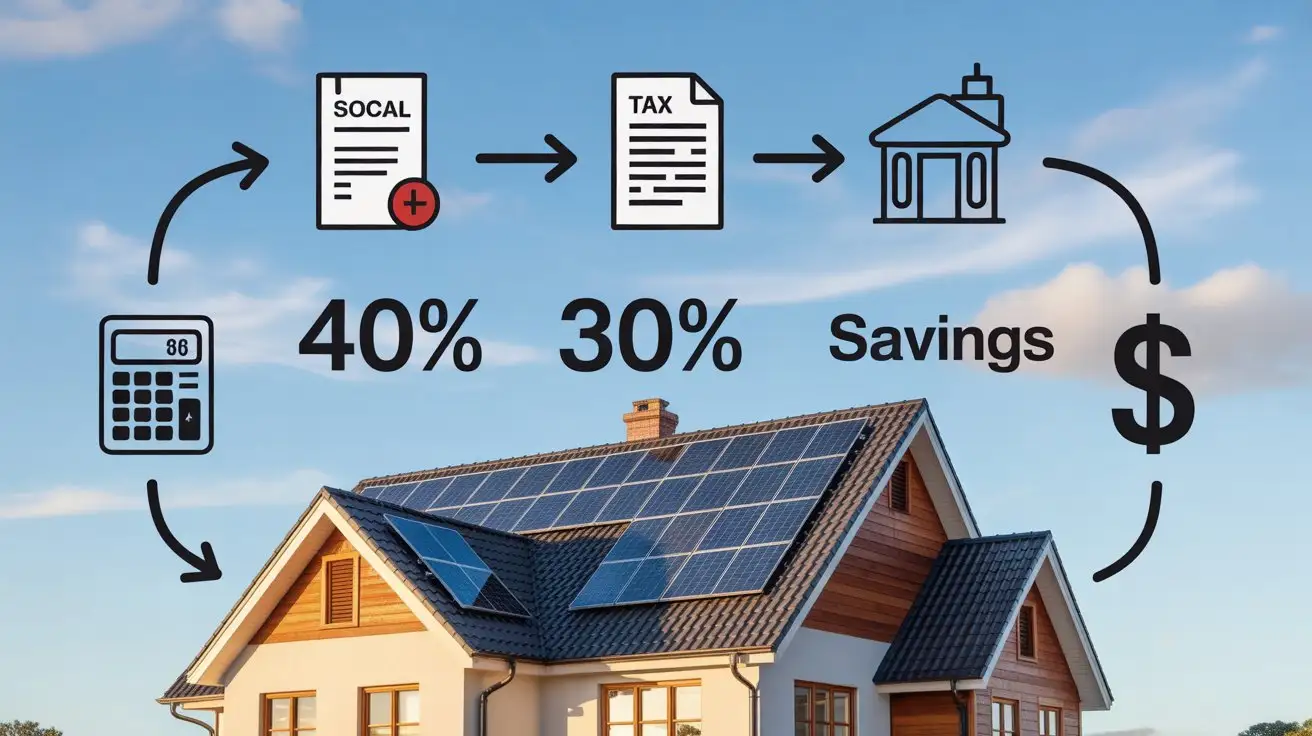
The federal Investment Tax Credit reduces your federal income tax liability by 30 percent of your total qualified solar system cost. If your system costs $22,000, you receive a $6,600 reduction in the federal taxes you owe that year. That is not 30 percent of your electricity bill, not 30 percent of annual savings, and not a deposit into your bank account. It reduces your tax bill, dollar for dollar.
Here is how that plays out on a real return. You owe $8,000 in federal income taxes for the year. Your solar credit is $6,600. Your tax bill drops to $1,400. If you owe $4,000 and your credit is $6,600, your bill drops to zero, and the remaining $2,600 carries forward to the following tax year automatically. You do not lose unused amounts.
The credit is nonrefundable. If you owe $0 in federal taxes, the credit does not generate a payment to you. It only reduces what you owe. For most working homeowners, this is straightforward, but retirees with low taxable income or anyone who had an unusually low-income year should calculate their actual federal tax liability before assuming the full credit lands in year one.
The real cost of a home solar system before and after incentives shows you what 30 percent of your specific system cost will translate to as a credit before you make any commitments.
What Costs Qualify for the 30 Percent Credit
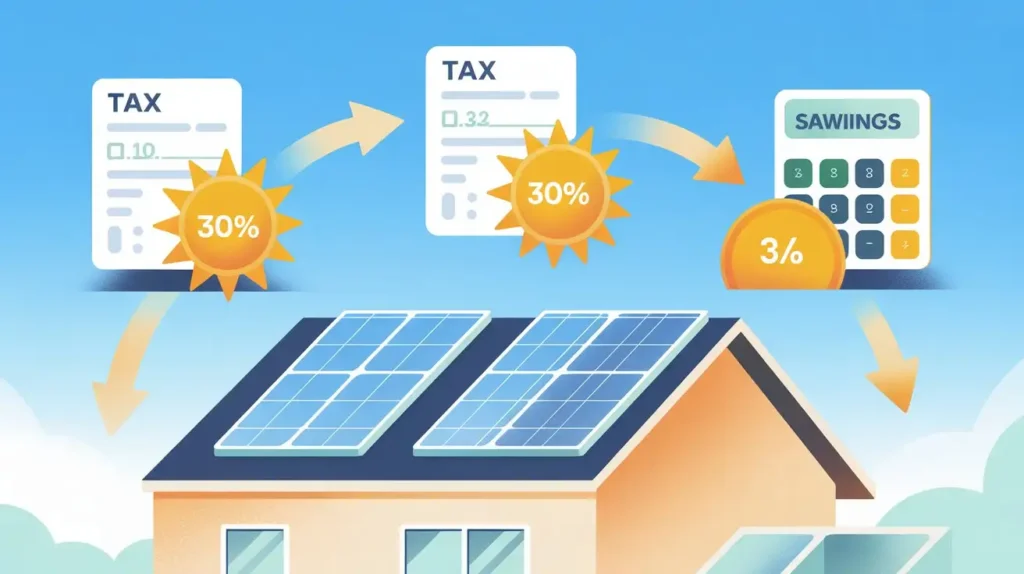
The credit applies to your total qualified installation cost, which covers more than just the panels. Every dollar that qualifies raises your credit amount.
Costs that typically qualify include:
- Solar panels and mounting hardware for rooftop or ground-mount systems.
- Inverters, wiring, and all electrical components are directly required for the installation.
- Installation labor, permitting fees, and inspection costs are tied to the solar project.
- Battery storage systems that charge primarily from solar energy even if added in a later year as a standalone upgrade.
- Structural roof work is required specifically to support the solar array, though routine roof repairs do not qualify.
General home improvements, roof replacements that would have happened regardless of solar, and standalone batteries that charge from the grid do not qualify. The costs that most solar quotes leave out include several line items that do count toward your credit, which is why reviewing your full installer invoice before filing matters.
According to the IRS, homeowners claim the Residential Clean Energy Credit using Form 5695, which calculates the credit amount based on qualified costs and applies it against your federal tax liability for the year the system is placed in service.
How the Credit Shortens Your Payback Period — Real Scenarios
The 30 percent credit does not change your monthly electricity savings. What it changes is how quickly you recover your upfront investment.
A homeowner in Texas installs a 7.5kW system for $21,000. The federal credit is $6,300, bringing out of pocket cost to $14,700. Without the credit, recovering $21,000 at $1,100 in annual savings takes nearly 19 years. With the credit reducing the recovery amount to $14,700, payback arrives in about 13 years. The credit shortens the timeline by six years in a modest-savings state.
In California, a comparable system costs $24,000, and annual savings run around $1,900. The $7,200 credit reduces the recovery cost from $24,000 to $16,800. At $1,900 per year, payback takes about 8.8 years instead of 12.6 years without the credit. The credit shortens the timeline by nearly four years in a high-savings state.
The solar payback describes, broken down state by state, shows exactly how the credit interacts with your electricity rate and system cost to determine when solar starts generating net profit for your household.
How the Credit Looks Across U.S. Cities
| City | System Cost (7kW) | 30% Credit Value | Annual Savings | Est. Payback After Credit |
| Los Angeles, CA | $24,000 | $7,200 | $1,900 | 8 to 9 years |
| Boston, MA | $23,500 | $7,050 | $1,700 | 9 to 10 years |
| Albany, NY | $22,500 | $6,750 | $1,500 | 10 to 11 years |
| Phoenix, AZ | $21,000 | $6,300 | $1,350 | 10 to 11 years |
| Austin, TX | $20,500 | $6,150 | $1,100 | 13 to 14 years |
| Tampa, FL | $20,000 | $6,000 | $1,200 | 11 to 12 years |
The credit value follows system cost, not sun hours or savings potential. Los Angeles homeowners receive the largest credit because systems there cost more. Austin homeowners receive a smaller credit on a lower-cost system and carry a longer payback because the Texas electricity rate is modest. The credit improves the financial case in every market, but it provides more absolute dollar relief where installation costs are higher.
State Incentives That Stack on Top of the Federal Credit
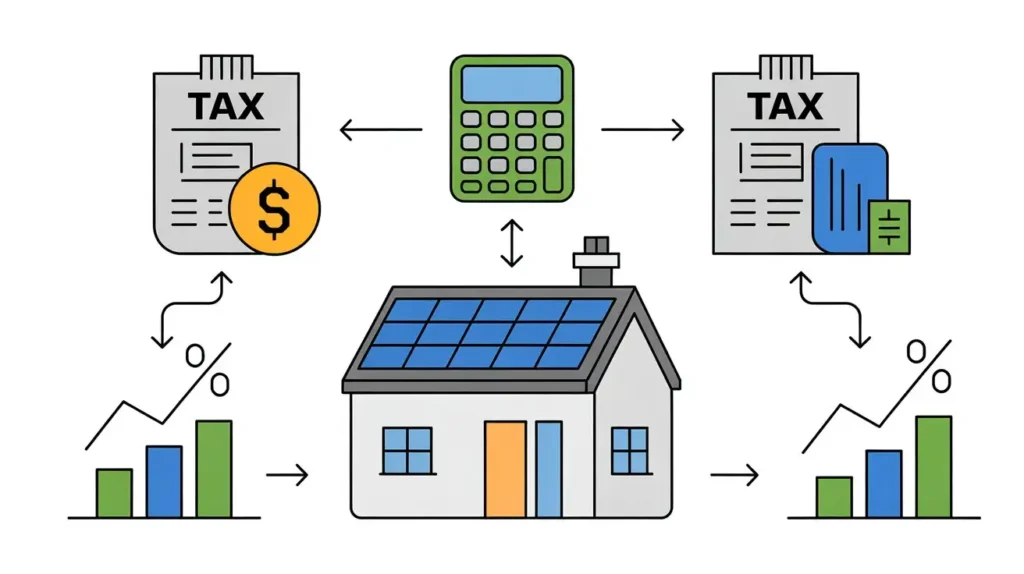
Several states offer programs that combine with the federal credit to reduce out of pocket cost even further.
Massachusetts offers a 15 percent state income tax credit stacked on the federal 30 percent. On a $23,500 system, the federal credit is $7,050 and the state credit adds $3,525, bringing the combined incentive to $10,575. New York’s NY Sun program provides cash incentives based on system size that reduce upfront cost before the federal credit is applied. Florida exempts solar equipment from state sales tax and protects added home value from property tax reassessment. Arizona offers a 25 percent state income tax credit capped at $1,000. Texas and Kansas offer little at the state level.
The gap between high-incentive states and low-incentive states is significant. Whether solar costs less than grid electricity in your state depends heavily on how these stacked incentives reduce your net cost and how that compares to your current utility rate over time.
The Honest Limitations Every Homeowner Should Know
The carry-forward provision is useful but not without risk. If your federal tax liability is low for multiple consecutive years, carrying a large credit forward takes time and creates exposure to future legislative changes. The credit is written into law through 2032, but tax law can change. A credit you are carrying into year four carries more policy risk than one fully used in year one.
The system must also be fully installed, inspected, and placed in service before December 31 of the year you plan to claim it. Permitting and utility interconnection timelines vary significantly. Los Angeles and San Francisco permit approvals can take 6 to 10 weeks. Utility interconnection adds additional weeks on top. Starting the process in October and expecting a December claim date carries real risk of a calendar-year miss, which pushes the credit to the following year’s return.
The full financial case for home solar in the USA requires placing the federal credit correctly within a realistic calculation of your savings, tax situation, and state policy environment, not treating it as a standalone justification for going solar.
Final Thoughts
How does the federal solar tax credit work in the USA? It reduces your federal tax bill by 30 percent of your qualified system cost in the year your installation is completed and placed in service. Unused amounts carry forward. It is claimed on Form 5695 when you file your federal return. It is not a rebate, not a refund, and not automatic.
At SolarInfoPath, the goal is to give homeowners accurate information about how solar financing actually works, so nothing about this process comes as a surprise. The federal credit is one of the most valuable tools available to U.S. homeowners right now, and it works best when you go into it knowing exactly what to expect from your tax return, your payback timeline, and the state incentives that may stack on top of it.
FAQs
Does the federal solar tax credit lower my upfront solar cost?
In my experience, it doesn’t reduce what you pay at the start. The credit usually applies when you file your federal taxes and lowers the amount you owe. You may notice the benefit later, not immediately.
What happens if I don’t owe enough federal taxes to use the full credit?
One thing people often miss is that unused credit amounts can generally carry forward. From my point of view, this makes the credit more flexible for households with lower tax bills.
Does my electricity usage affect the tax credit amount?
No, the credit is based on qualified system costs, not energy production. You may notice your electricity habits affect savings, but they don’t change the credit itself.
Are seasonal changes important when claiming the credit?
Seasonal output doesn’t impact the tax credit calculation. In my experience, it mainly affects your electricity bill, especially during the summer or winter months.
Is paperwork important for claiming the federal solar tax credit?
Yes, it matters more than people expect. I’ve seen proper records make tax filing smoother if verification is ever needed by the IRS.
Can the federal solar tax credit be combined with other incentives?
Often, yes, depending on where you live. From my point of view, combining incentives can improve overall solar tax savings without changing the federal rules.

Morgan Lee is a homeowner and solar energy researcher based in the United States. After installing a rooftop solar system in 2022 and spending months comparing quotes, incentives, and installer reviews, Morgan realized how confusing and overwhelming the process felt for most American families. That experience led to the creation of SolarInfoPath, a no-pressure, educational platform designed to help U.S. homeowners understand solar energy clearly and confidently. Morgan focuses on practical, research-backed information covering solar costs, installation timelines, federal tax credits, and long-term savings. All content on this site is written from a homeowner’s perspective with the goal of making solar energy simple and accessible for everyday Americans.