Tesla Solar Cost NJ 2026: $175 SREC-II Income Analysis
Tesla solar cost New Jersey 2026 runs $25,000–$35,000 before incentives. After the 30% federal tax credit, most homeowners pay $17,500–$24,500 out of pocket. An 8.6 kW system, the right size for most NJ homes, costs about $29,000 before credits and drops to roughly $20,300 after the ITC.
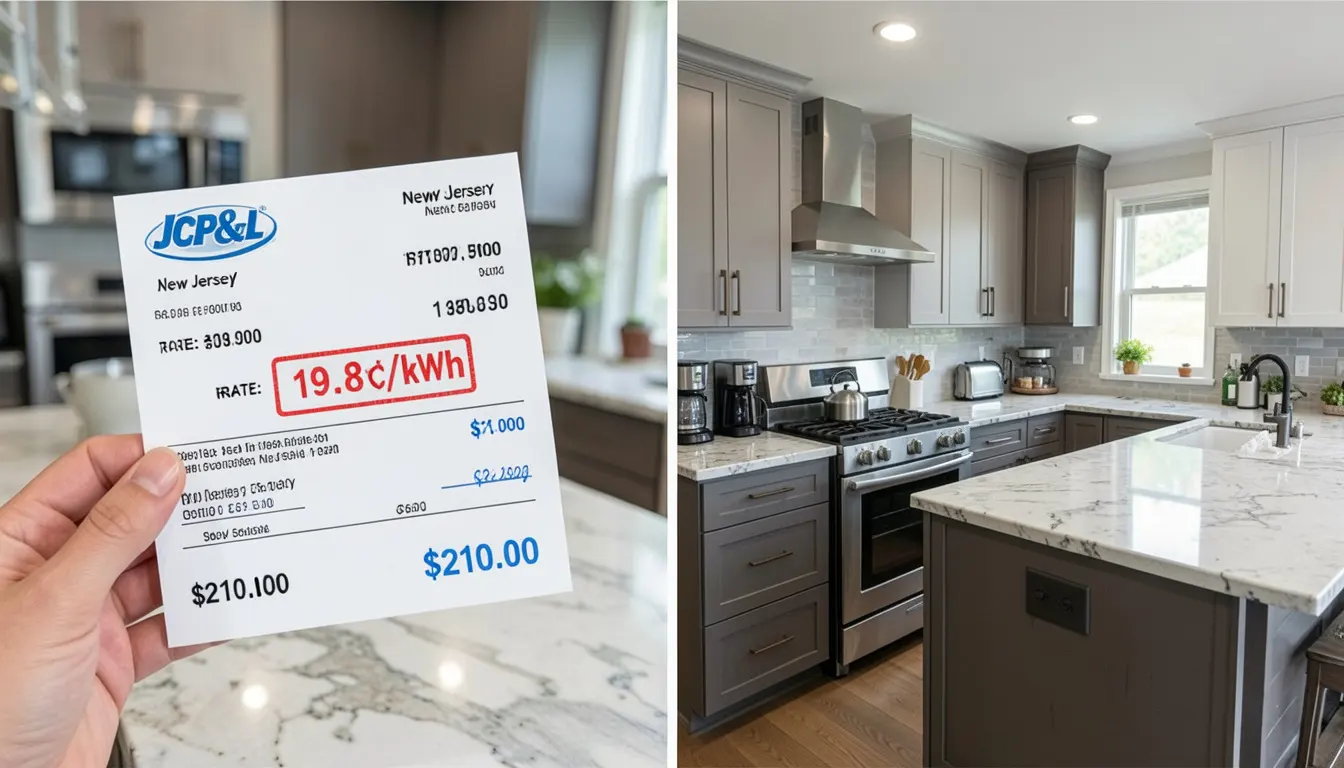
New Jersey’s average electricity rate is 19.8 cents per kWh in 2026. If you pay PSE&G, JCP&L, or Atlantic City Electric, that number hits your wallet every month. Solar starts making real sense when your bill runs over $130 a month.
Some Important Points
- 8.6 kW Tesla system cost in NJ: ~$29,000 before incentives
- After 30% federal tax credit: ~$20,300
- Typical payback period: 7–10 years
- NJ net metering: Full retail rate, still one of the best in the US
- SREC-II program: Active in 2026, earns you extra money on top of savings
Tesla Solar Cost Per Watt New Jersey 2026
Tesla charges $2.85–$3.40 per watt in New Jersey in 2026. For an 8.6 kW system, your total before incentives ranges from $24,500 to $29,200.
Local NJ installers often quote $2.50–$2.90 per watt for similar panels. You pay a bit more with Tesla for the brand name and Powerwall pairing, not for better power output.
Here is how the cost breaks down by system size:
Tesla Solar System Cost by Size: New Jersey 2026
| System | Before Credits | After 30% ITC |
| 4 kW | ~$12,400 | ~$8,680 |
| 6 kW | ~$18,600 | ~$13,020 |
| 8.6 kW | ~$29,000 | ~$20,300 |
| 10 kW | ~$33,500 | ~$23,450 |
| 12 kW | ~$40,200 | ~$28,140 |
Based on Tesla’s 2026 NJ pricing. Final quote depends on roof type and permit complexity.
Tesla uses its own 400W monocrystalline panels. They work well. But they are not much better than what local NJ installers offer at a lower price per watt.
Tesla Solar System Cost 8.6 kW New Jersey 2026: Full Breakdown
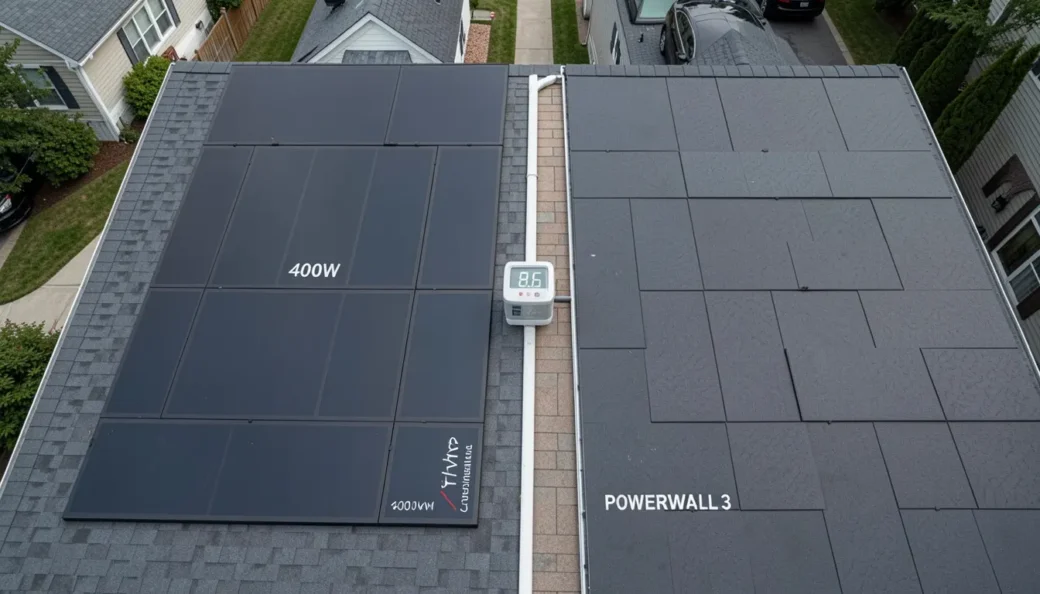
A Tesla solar system cost 8.6 kW in New Jersey, which comes to about $29,000 installed in 2026. After the 30% ITC, that drops to roughly $20,300.
But the sticker price is only part of the story.
What the Base Price Covers
- Tesla 400W solar panels
- Tesla inverter
- Permits and utility connection fees
- Installation labor
- App-based monitoring
What Costs Extra
- Powerwall 3 battery: $11,500–$12,000 installed
- Roof repairs: Required if your roof is damaged or older
- Panel upgrade: Needed if your electrical panel is under 200 amps
- HOA variance fees: Common in parts of Bergen and Monmouth County
Here is a real NJ example. A homeowner in Cherry Hill pays PSE&G about $175 a month, around $2,100 a year. With an 8.6 kW system on a south-facing roof, they could offset 90–100% of their usage. Southern NJ gets about 4.4 peak sun hours daily, so that system produces roughly 13,800 kWh per year. After the $8,700 federal tax credit, the out-of-pocket cost is about $20,300. At current rates, the payback window is 8–10 years.
That is a real estimate, not a sales pitch.
Tesla Solar Payback Period New Jersey 2026
The Tesla solar payback period in New Jersey runs 7–10 years in 2026. That range depends on your utility, your roof direction, and where in the state you live.
Here is what changes your number most:
- Your utility rate: PSE&G customers in the north pay more per kWh than ACE customers in the south. That gap alone shifts payback by 1–2 years.
- Net metering: NJ credits you at the full retail rate for power you send back to the grid. PSE&G customers get 19.8 cents per kWh in credits, far better than what California offers after NEM 3.0.
- SREC-II income: New Jersey’s SREC-II program pays you for every megawatt-hour your system produces. In 2026, payments average $85–$95 per MWh. An 8.6 kW system earns roughly $1,100–$1,300 per year from SREC-II alone, on top of your bill savings.
- Panel wear over time: Tesla panels lose about 0.5% output per year. By year 10, your system makes roughly 5% less than on day one. Build that into any long-term savings estimate.
North NJ vs. South NJ: Real Payback Difference
A homeowner in Montclair (Essex County) on JCP&L pays around $210 a month. A homeowner in Vineland (Cumberland County) on ACE pays around $140 a month. Same Tesla system. Very different results.
Montclair has a higher bill, more savings per year, and a faster payback. Vineland has a lower bill, slower payback, and relies more on SREC-II credits. The 8.6 kW system might be too big for Vineland and not big enough for Montclair.
System size matters as much as price per watt. A solar panel cost calculator for New Jersey gives you a size estimate based on your real usage, not a national average.
New Jersey Solar Incentives That Cut Your Tesla Cost
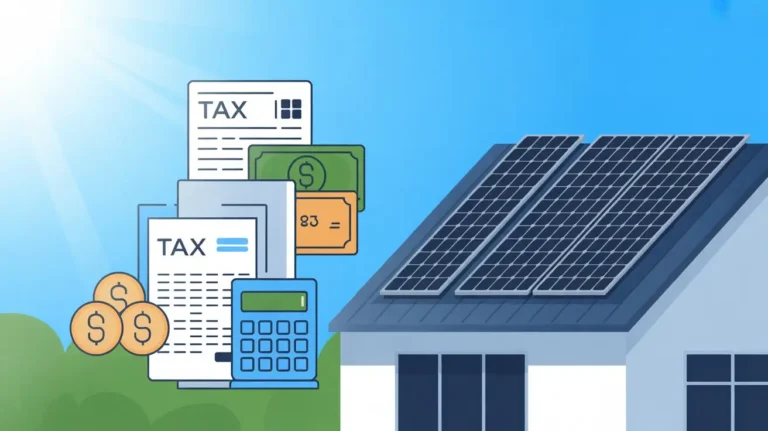
Most homeowners can reduce their total Tesla solar cost New Jersey 2026 by $10,000–$15,000 through federal, state, and utility programs in 2026. Most people only hear about one or two of these.
Federal Investment Tax Credit (ITC)
The 30% ITC applies to your full installed Tesla system, including Powerwall if you buy it with solar. On a $29,000 system, that is $8,700 off your federal taxes. You need to owe at least that much in taxes to use the full credit.
Property Tax Exemption
New Jersey exempts solar from property tax assessments. Your home’s value goes up when you go solar, but your tax bill does not. That adds up to a lot over 25 years.
Sales Tax Exemption
NJ charges no sales tax on solar equipment. On a $29,000 system, that saves you about $2,175 at the state’s 6.625% rate.
SREC-II Production Credit
New Jersey’s solar rebates and credits page covers the SREC-II program in full. It pays you for 15 years from your install date, whether you use the power yourself or send it to the grid.
Net Metering at Full Retail Rate
NJ still uses full retail rate net metering in 2026. Every extra kWh your Tesla system produces earns credits at the same rate you pay to buy power. This policy is why the payback period here beats most other states.
Tesla Powerwall Incentives New Jersey 2026
Tesla Powerwall incentives in New Jersey include the 30% federal ITC when the battery is installed with a new solar system. That cuts the $11,500–$12,000 Powerwall cost down to about $8,050–$8,400 after the credit.
What You Need to Know for 2026
The Inflation Reduction Act allows battery storage to claim the ITC on its own, not just as part of a new solar install. That rule is still being reviewed under the 2026 federal budget process. Check with a tax professional before assuming a standalone Powerwall qualifies. The U.S. Department of Energy updates battery incentive guidance as rules change.
Who Actually Needs a Powerwall in NJ
New Jersey’s grid is more stable than Texas or parts of California. But outages happen, especially in wooded areas of Morris and Warren counties, and along the Shore after storms.
If your power goes out two or three times a year for hours at a time, a Powerwall earns its cost in backup value. If you live in urban Bergen or Hudson County, where outages are rare, the payback on a battery is slower.
What surprised me when I studied NJ Powerwall adoption data was this: many homeowners added storage not for backup but to store cheap off-peak power and avoid PSE&G’s peak-rate hours. Most salespeople never explain that use case upfront.
How Your Location in NJ Changes Tesla Solar ROI
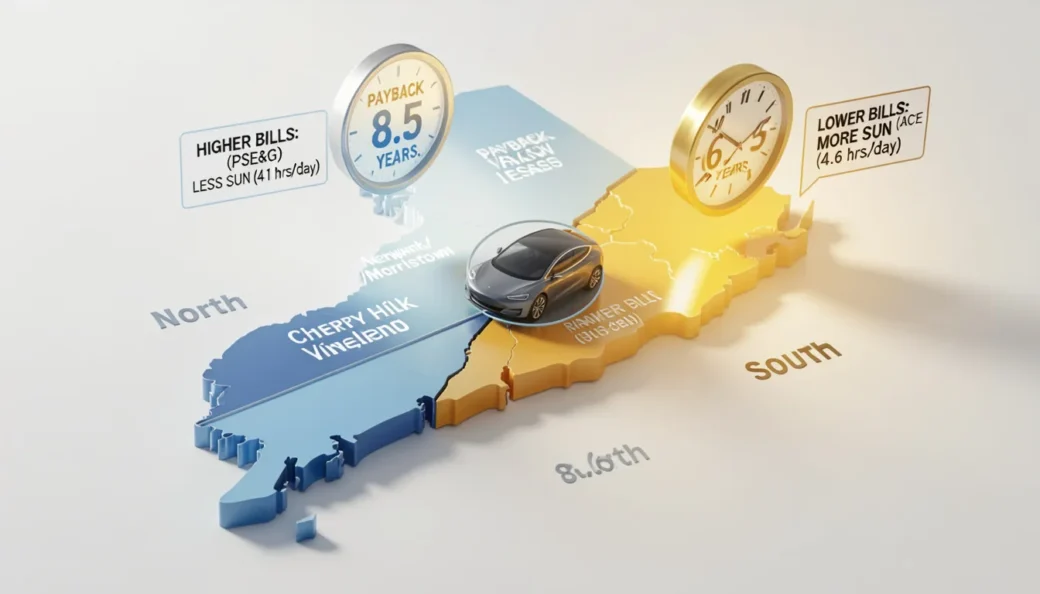
Southern New Jersey gets 4.4 peak sun hours per day. Northern NJ gets 4.0–4.2. That gap means 500–700 fewer kWh per year on the same Tesla system.
Over 10 years, that is thousands of dollars in missed production.
Northern NJ: Less Sun, Higher Bills
JCP&L customers in Morristown, Parsippany, and northern Bergen County pay some of the highest rates in the state. Even with fewer sun hours, the higher per-kWh savings often push payback into the same range as the south.
Southern NJ: More Sun, Lower Bills
ACE customers in Atlantic City, Vineland, and Bridgeton pay lower rates. More sun helps, but each kWh saves less money. SREC-II credits often matter more here than net metering alone.
Shore Towns: Two Extra Problems
Homeowners in Cape May and Ocean County deal with salt air corrosion, which can shorten panel life without proper coastal-rated equipment. Many Shore communities also have HOA restrictions on panel placement.
The New Jersey Solar Access Act (P.L. 2007, c.105) stops HOAs from blocking solar entirely. They can ask for placement changes, but they cannot say no. Know this law before you sign anything.
Financing and Tax Equity: What NJ Homeowners Should Understand
If you are looking at a larger system or a commercial property in NJ, it helps to know how solar tax equity partnerships work. These structures let investors claim ITC credits in exchange for financing the project. For homeowners, the key point is this: if Tesla offers you a lease or PPA, the tax credit may go to the finance company, not to you.
For anyone weighing a commercial solar PPA agreement, the contract terms matter a lot. If you own your system outright or use a personal loan, none of this affects you. But if Tesla offers a lease, ask directly who claims the ITC.
The simple rule: if you do not own the system, you do not get the credit.
When Tesla Solar in NJ Does Not Make Sense
Not every New Jersey home fits a Tesla system. Some situations just do not work out.
A homeowner in Hackensack with a north-facing roof, heavy tree shade, and a $95 JCP&L bill would likely see an 8.6 kW system produce 30–40% less than expected. Payback stretches to 12–14 years. At that point, Tesla’s price premium over local NJ installers is very hard to justify.
Three situations where Tesla may not be the right call:
- Your bill is under $100 a month, not enough savings to justify a $20,000+ investment.
- Your roof is over 15 years old; Tesla requires a good roof first. A replacement adds $8,000–$20,000 to your total.
- You want to compare prices; Tesla’s pricing is fixed by zip code. Local NJ installers will negotiate. Tesla will not.
These are not reasons to skip solar. There are reasons to compare before you sign.
Final Verdict: Is Tesla Solar Worth It in New Jersey in 2026?
Tesla solar cost New Jersey 2026 is a solid investment in 2026 for most homeowners paying over $130 a month to PSE&G, JCP&L, or Atlantic City Electric. The 7–10 year payback period is real. NJ’s full retail net metering and SREC-II program make the numbers work better here than in most other states.
The Tesla solar system cost 8.6 kW lands at roughly $20,300 after the 30% ITC. That is a fair price at today’s NJ utility rates. Tesla costs more per watt than most local installers; you are paying for brand integration and Powerwall compatibility, not better output.
Your honest next step: check SREC-II eligibility for your zip code at the NJ Board of Public Utilities, then run your bill through a New Jersey solar cost calculator to get a system size based on what you actually use.
New Jersey’s solar incentive stack is strong right now. That may not last.
Frequently Asked Questions
What is the Tesla solar cost per watt in New Jersey in 2026?
Tesla charges $2.85–$3.40 per watt in NJ. For an 8.6 kW system, that is $24,500–$29,200 before incentives.
What does a Tesla solar system cost, 8.6 kW in New Jersey after tax credits?
After the 30% ITC, the out-of-pocket cost drops to roughly $20,300. Your exact quote depends on roof type and local permit fees.
What is the Tesla solar payback period in New Jersey in 2026?
Most NJ homeowners see 7–10 years. Higher bills and south-facing roofs push it closer to 7–8 years.
What are the Tesla Powerwall incentives in New Jersey in 2026?
The Powerwall 3 qualifies for the 30% federal ITC when installed with a new solar system. Confirm current rules with a tax professional for standalone battery installs.
Does New Jersey offer solar incentives beyond the federal credit?
Yes. NJ offers full retail net metering, the SREC-II program, a property tax exemption, and a sales tax exemption.
Can my NJ HOA block a Tesla solar installation?
No. The New Jersey Solar Access Act (P.L. 2007, c.105) prevents HOAs from banning solar. They can require placement changes, but cannot deny it.
Is Tesla solar cheaper than local NJ installers?
Usually no. Tesla runs $0.20–$0.50 per watt higher than local competitors. Local installers will negotiate on price. Tesla will not.
This article is for informational purposes only. Cost estimates reflect 2026 New Jersey market data. Actual costs, savings, and payback periods vary by home, roof, utility, and tax situation. Consult a licensed NJ solar installer and a qualified tax professional before making any financial decisions.
Morgan Lee | Solar Energy Advocate & Researcher
Morgan Lee is a Senior Renewable Energy Consultant and the founder of SolarInfoPath. With over a decade of experience in green technology and project finance, Morgan leverages data from the National Renewable Energy Laboratory (NREL) and the U.S. Department of Energy to provide homeowners with transparent, high-authority guidance.
Driven by a mission to protect consumers from misleading sales tactics, Morgan launched SolarInfoPath as a 100% independent platform. By translating complex utility policies into actionable advice, Morgan advocates for a smarter, more sustainable future where families can achieve true energy independence through honest information.