Why Solar Panels Are Worth It in Colorado (What the Numbers Actually Show)
Colorado homeowners have something most of the country genuinely envies: roughly 300 sunny days a year and a state-level policy framework that actually supports putting those days to work. Whether your home is in Denver, Fort Collins, Pueblo, or Grand Junction, understanding why solar panels are worth it in Colorado comes down to three things working together: a stronger-than-average sun resource, meaningful financial incentives, and an active net metering policy that makes the math add up over time. With Xcel Energy’s residential electricity rates sitting around 13.5 cents per kWh and climbing gradually each year, more Colorado homeowners are running the numbers and finding it hard to ignore.
What surprised me when I started digging into Colorado’s solar situation, specifically, is how altitude changes the equation. A thinner atmosphere at 5,000-plus feet means less filtration of solar radiation before it reaches your panels. That’s a real, state-specific advantage, not something that shows up in generic solar guides, but something that measurably improves performance on a Colorado roof versus the same system installed at sea level. The benefits of solar panels for Colorado homeowners start before you even factor in a single incentive.
Colorado’s Altitude and Climate Give Solar a Performance Edge Most States Can’t Match
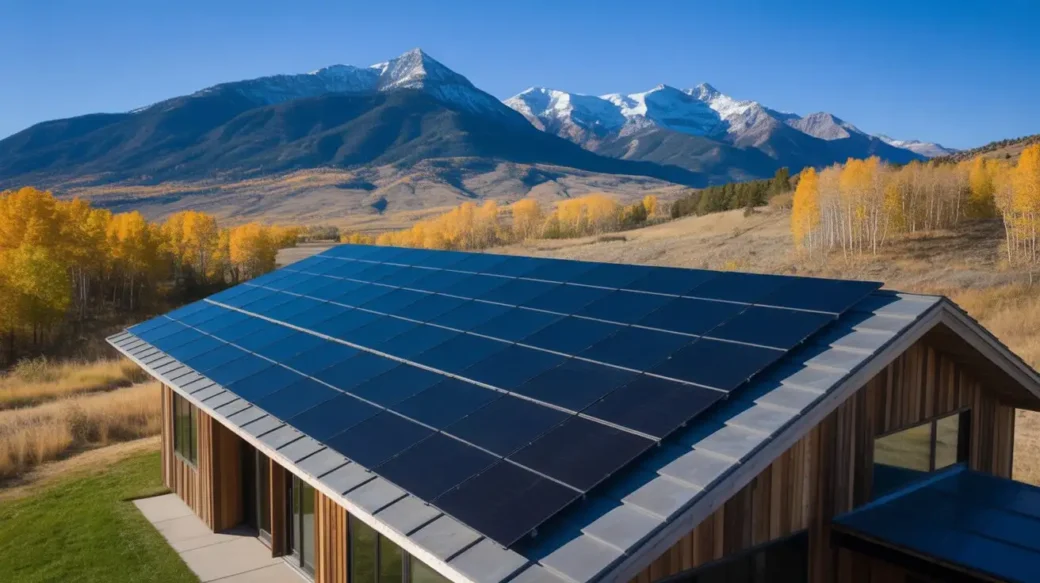
Denver averages 5.7 peak sun hours per day. Grand Junction pushes to 6.2. Pueblo and Colorado Springs consistently land around 5.6 to 5.8. These are above-average numbers for the continental U.S., but raw sun hours only tell part of the story.
The National Renewable Energy Laboratory, headquartered in Golden, Colorado, has documented that high-altitude installations generate more power per installed watt than comparable systems at lower elevations. Less atmospheric scattering means more direct irradiance reaches your panels. Combined with Colorado’s characteristically low humidity, panels operate closer to their rated efficiency than they would in a humid Southeast climate. It’s a meaningful contrast; homeowners researching why solar panels are worth it in North Carolina will notice how much policy structure has to compensate there for what Colorado gets from altitude and dry air alone.
Colorado’s seasonal solar behavior also works in favor of year-round production in ways that aren’t obvious at first glance:
- Spring and fall deliver the best output; full sun combined with cool air keeps panels running close to peak rated efficiency.
- Summer brings longer days and strong direct irradiance, though panel efficiency dips slightly on the hottest afternoons across the Eastern Plains.
- Winter performs better than most homeowners expect; a clear January day in Denver still produces solid output, and the Front Range typically clears snow quickly after storms.
What Solar Panels Could Actually Save a Colorado Homeowner: Real Numbers
Let’s use real figures. A typical Colorado household consumes around 700 kWh per month. At Xcel Energy’s current residential rate of roughly 13.5 cents per kWh, that’s approximately $94 per month, about $1,130 per year in electricity costs. Colorado Springs Utilities customers operate on a tiered rate structure that falls in a similar 12 to 14 cent range, depending on usage level.
A 6-kilowatt solar system installed in Denver, generating between 8,200 and 9,500 kWh annually depending on roof orientation and shading, can offset most or all of a typical household’s annual electricity use. Before incentives, installed system costs in Colorado typically run $16,000 to $18,000. After applying the federal tax credit that covers 30% of system costs through at least 2032 per IRS guidance, the net out-of-pocket cost drops to roughly $11,200 to $12,600.
That’s before two additional Colorado-specific benefits. The state’s sales tax exemption removes Colorado’s 2.9% state sales tax from solar equipment purchases — saving over $520 on an $18,000 system. The state’s property tax exemption means the added home value from your solar installation, typically 3% to 4% of home value per Department of Energy research, doesn’t raise your annual property tax bill. With estimated annual savings of $1,100 to $1,300, the payback period for a typical Denver-area system lands somewhere in the 9 to 11 year range — and panels carry 25-year performance warranties.
Colorado Solar by City: How Location Affects Your Return
Your savings aren’t identical whether you’re in Fort Collins or Pueblo. Here’s how the numbers break down across five real Colorado cities:
| City | Avg Sun Hours/Day | Est. Annual Savings (6kW System) | Key Solar Notes |
| Denver | 5.7 hrs | $1,100 – $1,300 | Xcel Energy territory; strong net metering access |
| Grand Junction | 6.2 hrs | $1,250 – $1,450 | Highest sun hours in CO; Black Hills Energy service area |
| Pueblo | 5.8 hrs | $1,100 – $1,250 | Hot summers boost production; Black Hills territory |
| Fort Collins | 5.5 hrs | $1,000 – $1,200 | Fort Collins Utilities runs periodic rebate programs for solar |
| Colorado Springs | 5.6 hrs | $1,050 – $1,200 | Colorado Springs Utilities: tiered rate structure applies |
Estimates based on Colorado’s average residential rate of 13.5¢/kWh. Actual savings vary by roof pitch, orientation, shading, and utility policy.
There’s real geographic variation worth understanding. Northern Colorado communities near Fort Collins tend to see slightly lower sun hours than the southern Front Range and Western Slope. Rural areas in the San Luis Valley or Eastern Plains often have excellent solar access but may be served by smaller electric cooperatives with their own net metering terms — understanding how your specific utility handles net metering credits matters more than you might think when building out a realistic savings estimate.
Colorado Solar Incentives That Reduce Your Upfront Cost
Colorado doesn’t offer a state income tax credit the way some states do — homeowners exploring why solar is worth it in Ohio will find a different incentive landscape where state-level credits play a larger role in the overall math. In Colorado, the value lies in quiet but effective exemptions that reduce your real out-of-pocket cost from day one.
Here’s what Colorado homeowners currently have access to:
- Federal Investment Tax Credit (30%): Claimed on your federal return in the year your system is placed in service: the sales tax exemption on residential solar equipment compounds on top of this, removing Colorado’s 2.9% state sales tax from your panel purchase entirely.
- Property tax exemption: The increased home value your panels create is fully exempt from property tax reassessment for the life of the system: no higher tax bill for improving your home.
- Fort Collins Utilities rebates: Fort Collins Utilities periodically offers rebates for solar-connected residential customers, worth verifying directly through their portal before finalizing any estimate.
For the federal side, Energy.gov maintains current guidance on clean energy credits that’s worth bookmarking, as policy details can shift. For a $17,000 system, the 30% credit alone represents a $5,100 reduction in your federal tax liability, which is your single largest financial lever in Colorado’s incentive stack.
How Net Metering Works in Colorado: And Why It Matters to Your Payback
Colorado has an active net metering policy, and it’s one of the clearest reasons why solar panels are worth it in Colorado for grid-tied homeowners. When your system produces more power than your home uses, common on sunny spring and fall afternoons, the surplus flows to the grid, and your utility credits your account at or near the retail electricity rate.
Xcel Energy currently compensates excess solar generation close to its retail rate, which makes each kilowatt-hour your panels produce worth roughly what you’d otherwise pay to buy it. That near-1:1 credit structure is what makes your savings estimates reliable. If Xcel were to shift to a lower avoided-cost rate, something that has come up in regulatory proceedings, the payback timeline would extend noticeably.
Rural co-op customers should verify their specific cooperative’s net metering policy before assuming they’ll receive the same terms as Xcel customers. Some cooperatives in Colorado have favourable policies; others restrict system size or reduce compensation rates. Knowing how net metering policies shape your long-term solar return, specifically for your utility, closes the biggest uncertainty in your savings projection.
The Honest Limitation Colorado Homeowners in Mountain Areas Need to Know
I wouldn’t say solar is equally worth it everywhere in Colorado. Mountain and foothill communities, Durango, Steamboat Springs, and mountain-adjacent suburbs along the I-70 corridor, face real challenges that Front Range homeowners don’t. A few of the most common ones worth knowing upfront:
- Steep roof pitches complicate installation and can push labor costs higher than typical Front Range quotes reflect.
- Terrain shading from surrounding ridgelines and tree canopy can cut real-world output by 20% to 30% compared to state averages — valley homes with southern horizon obstruction are especially affected.
- Heavy spring snowpack at higher elevations reduces annual production more than the widely cited 300-sunny-days figure suggests.
This doesn’t make solar impossible in these areas — it makes proper site evaluation critical before you accept any savings estimate. Understanding what factors affect your solar panel output is a step that too many homeowners skip, and it’s where unrealistic expectations typically come from.
Xcel Energy’s net metering structure is also worth monitoring. Regulatory discussions around how excess solar is compensated are ongoing, and future changes could affect the value of daytime surplus generation for new installations. Homeowners who carefully calculate their solar payback period before committing are better positioned to evaluate whether the current policy environment meets their financial goals.
Final Thoughts
For most Colorado homeowners on the Front Range — Xcel Energy customers in Denver, Colorado Springs, Pueblo, and nearby communities — the case for rooftop solar is genuinely strong. Solid sun hours, high-altitude performance advantages, the 30% federal tax credit, Colorado’s sales and property tax exemptions, and an active net metering policy combine to make this one of the more favorable solar environments in the country. That’s why solar panels are worth it in Colorado for a meaningful number of households who go in with the right roof and the right expectations.
From my point of view, Colorado solar rewards homeowners who treat it as a long-horizon investment rather than an immediate return. Payback periods in the 9 to 11 year range are realistic, and 25 years of reduced electricity bills after that is where the real value accumulates. For homeowners who want to keep researching, SolarInfoPath covers solar costs, incentives, and state-by-state policy in depth, all built around real numbers, not sales pitches.
Frequently Asked Questions
What is the typical solar payback period for Colorado homeowners?
For most Front Range homeowners using Xcel Energy, the payback period typically falls between 9 and 11 years, depending on system size, roof orientation, and net metering credit rates.
Does Colorado offer a state tax credit for solar installations?
No, Colorado does not currently have a state income tax credit for solar. However, Colorado provides a sales tax exemption on solar equipment and a property tax exemption on the added home value from panels.
Which utilities in Colorado offer net metering for solar?
Xcel Energy, Black Hills Energy, and Colorado Springs Utilities all offer residential net metering programs, though credit rates and system size limits may vary between them.
Are solar panels effective during Colorado winters? Yes. Colorado’s frequent clear winter days allow panels to produce year-round. Temporary snow cover reduces output briefly, but the Front Range typically sees quick clearing, making winter production more reliable than most homeowners expect.
What is Colorado’s property tax exemption for solar?
Colorado law exempts the increased home value attributable to a residential solar installation from property tax assessment for the life of the system — a benefit that compounds over time as home values rise.
Is Grand Junction better for solar than Denver in Colorado?
Grand Junction’s 6.2 daily peak sun hours outperform Denver’s 5.7, giving it a measurable production edge. Denver homeowners, though, benefit from Xcel Energy’s well-established net metering structure and broader installer competition, which can reduce installation costs.

Morgan Lee is a homeowner and solar energy researcher based in the United States. After installing a rooftop solar system in 2022 and spending months comparing quotes, incentives, and installer reviews, Morgan realized how confusing and overwhelming the process felt for most American families. That experience led to the creation of SolarInfoPath, a no-pressure, educational platform designed to help U.S. homeowners understand solar energy clearly and confidently. Morgan focuses on practical, research-backed information covering solar costs, installation timelines, federal tax credits, and long-term savings. All content on this site is written from a homeowner’s perspective with the goal of making solar energy simple and accessible for everyday Americans.