Solar financing describes any method of paying for a solar energy system other than full upfront cash. The four main structures are solar loans, solar leases, power purchase agreements, and home equity products. The advertised monthly payment is rarely the right number to compare. APR, dealer fees, loan term, and total repayment determine your actual cost. In 2026, the federal residential solar tax credit under IRS Section 25D is no longer available for systems placed in service after December 31, 2025, which changes the financial math for every financing structure.
Most homeowners researching solar financing start with one question: what will my monthly payment be? That is the wrong question. A $150 monthly payment on a 25-year loan may cost you $20,000 more in total interest than a $175 monthly payment on a 15-year loan at a slightly higher rate. The monthly number is what salespeople show you. The total repayment number is what you need.
The EIA reported the average U.S. residential electricity price at 18.34 cents per kilowatt-hour in June 2026, up 5.0% from the same month in 2025. That rising rate trend is what makes solar financially attractive for many households. But attractive economics do not automatically make a specific financing structure the right choice for your situation.
This guide covers every major solar financing structure, the cost factors most homeowners miss, and what changed in 2026 that directly affects how you should evaluate any financing proposal.
What Is Solar Financing and How Does It Work?
Solar financing is any arrangement that allows a homeowner to pay for a solar energy system over time rather than upfront. Most U.S. residential installations cost $20,000 to $40,000. Most homeowners do not pay that amount in cash. Solar financing structures that spread that cost create a monthly obligation in exchange for electricity savings that offset part or all of that payment.
The key distinction that most articles skip is this: not all solar financing structures result in you owning the system. Ownership affects your tax treatment, your ability to sell the home, and whether you benefit from rising electricity rates over time.
How Does Financing Solar Panels Actually Work?
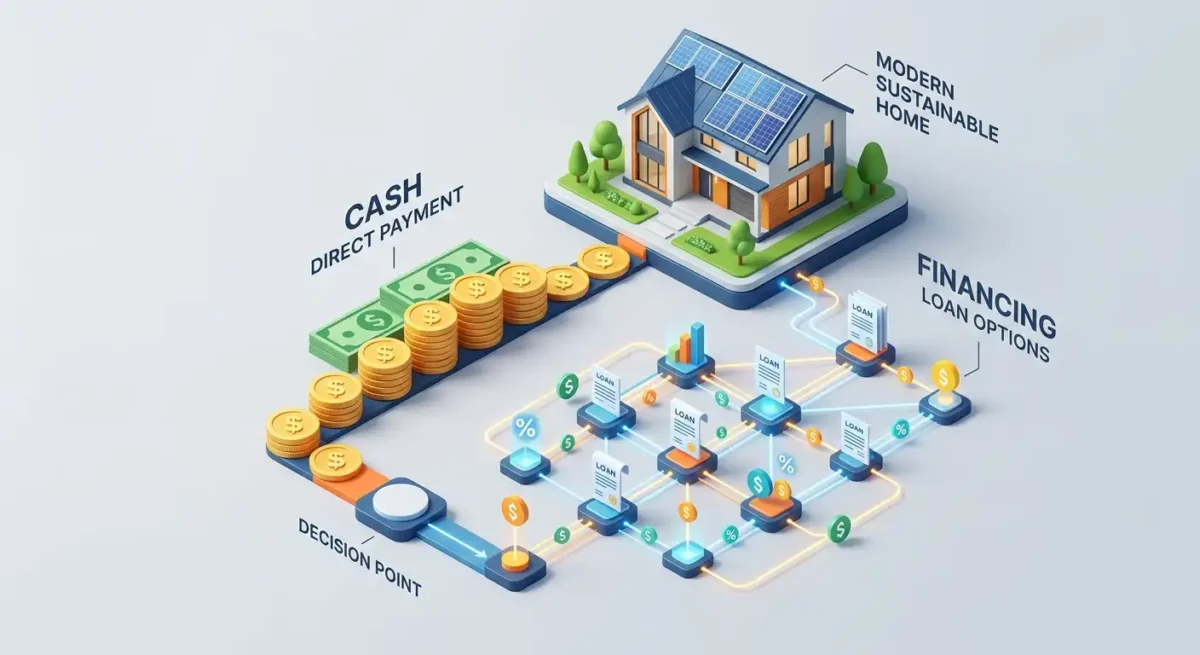
Financing solar panels works differently depending on the structure you choose. A solar loan gives you ownership. You borrow money, pay interest, and own the system when the loan ends. A lease or PPA gives the company ownership. You pay a monthly fee for the electricity or the use of the equipment without ever owning the panels on your roof.
The practical difference shows up when you sell your home. An owned system, whether paid in cash or through a loan, generally transfers with the property as a standard home improvement. A leased system comes with a contract obligation that the buyer must agree to assume or that you must pay off at closing.
What Does a Solar Loan Payment Include?
A solar loan payment includes principal and interest at minimum. Some solar loans also include an origination fee rolled into the principal, a dealer fee the installer built into the loan amount, or both. Those fees are often not visible as separate line items on the monthly statement. They appear in the total principal you owe.
This is the part most homeowners do not find out until after they sign. Your loan principal may be materially higher than the cash price of the system. That gap is the dealer fee, and it increases both the total interest you pay and the total amount you repay over the loan term.
How Are Principal and Interest Calculated?
Principal is the amount borrowed. Interest is the lender’s charge for lending it. On a fixed-rate solar loan, each monthly payment covers a portion of the principal and a portion of the interest. Early payments are mostly interest. Later payments are mostly principal. This is standard loan amortization.
On a $28,000 loan at 7.5% over 25 years, the monthly payment runs approximately $207. Total repayment over 25 years is roughly $62,100. That means the interest alone costs about $34,100. The monthly payment figure tells you almost nothing about that total.
Why Does the Loan Term Change Your Total Cost?
The loan term is the number of years you have to repay the loan. Longer terms lower the monthly payment but significantly increase total interest paid. EnergySage Marketplace data from the second half of 2025 showed a median quoted solar loan rate of 7.5% and a median loan term of 25 years. Those are median figures from one marketplace and should not be treated as universal national benchmarks.
A 7.5% loan over 25 years costs significantly more in total interest than a 7.5% loan over 15 years, even though the rate is identical. The only difference is time.
What Are the Main Solar Financing Options in 2026?
The main solar financing options in 2026 are cash purchase, solar loan, solar lease, power purchase agreement, and home equity products. Each creates a different ownership structure, monthly cost, and long-term financial obligation. Understanding the differences before comparing quotes makes a material difference in your ability to evaluate what you are actually being offered.
| Financing Method | Upfront Cost | Ownership | Monthly Payment | Main Cost Factor |
| Cash | High | Homeowner | None | Opportunity cost |
| Solar loan | Low or variable | Homeowner | Yes | Interest plus fees |
| Lease | Usually low | Provider | Yes | Contract payment |
| PPA | Usually low | Provider | Based on production | Energy rate |
| HELOC | Variable | Homeowner | Yes | Interest plus home collateral |
Is a Solar Loan Different From Paying Cash?
A solar loan and a cash purchase result in the same outcome: you own the system. The difference is cost and timing. A cash purchase has no interest cost. A solar loan adds interest and potentially dealer fees on top of the system’s cash price. Over a 20- to 25-year loan term, that difference can reach tens of thousands of dollars.
The tradeoff is liquidity. A homeowner who does not want to deplete savings or investments may choose a loan even knowing it costs more in total, because the opportunity cost of tying up $28,000 in a solar system may exceed the loan interest in their specific situation.
How Does a Solar Lease Work?
A solar lease is a monthly payment to use equipment the company owns. The panels are on your roof, but the company retains ownership and is responsible for maintenance. Your payment is fixed or subject to an annual escalator clause, typically 2% to 3% per year, that increases your monthly bill automatically over the lease term.
Review the detailed breakdown of solar lease buyout structures before signing any lease agreement. The buyout amount matters significantly when you plan to sell your home before the lease ends.
How Does a Power Purchase Agreement Work?
A power purchase agreement, commonly called a PPA, charges you for the electricity the system produces rather than for use of the equipment. You pay a per-kilowatt-hour rate that is typically below your utility’s current rate. The company still owns the system.
PPAs also include escalator clauses in most cases. Your rate may start below your utility rate but increase annually. Depending on how your utility rate changes over time, the gap between your PPA rate and your utility rate may narrow or close entirely before the contract ends.
Can You Use a Personal Loan, Home Equity Loan, or HELOC?
Yes. Personal loans, home equity loans, and HELOCs are all valid solar financing options. They are not solar-specific products, which means they typically do not carry dealer fees. The trade-off is that rates may differ from solar-specific loan products, and home equity products use your home as collateral.
A HELOC secured by your home equity creates a lien against your property. That lien must be addressed when you sell or refinance. A personal loan is typically unsecured, which means your home is not at risk, but interest rates for unsecured personal loans often run higher than secured solar loan products.
Are Solar Financing Rates the Most Important Number?
Solar financing rates are not the most important number. The total repayment amount is. A lower rate can and does cost more in total when paired with a large dealer fee, a longer loan term, or both. The CFPB has specifically identified solar loan dealer fees as a consumer risk, reporting that these fees commonly range from 10% to 30% of the cash price, with some exceeding 50%.
That means a system with a cash price of $25,000 could be financed at a principal of $30,000 to $37,500 after a dealer fee is applied. That additional principal accrues interest over the full loan term. A lower advertised rate on a higher principal often costs more than a higher rate on the cash price alone.
| Factor | Loan A | Loan B |
| Interest rate | Lower | Higher |
| Dealer fee | Higher | Lower |
| Amount financed | Higher | Lower |
| Monthly payment | Lower initially | Higher initially |
| Total repayment | Must calculate | Must calculate |
| Better based on rate alone? | No | No |
What Is the Difference Between an Interest Rate and APR?
The interest rate is the cost of borrowing the principal. The APR, or annual percentage rate, includes the interest rate plus any fees expressed as a yearly percentage. The APR is a better comparison number because it reflects more of the actual borrowing cost.
Two loans at the same interest rate can have different APRs if one carries origination fees and the other does not. Always compare APRs, not just interest rates, when evaluating solar loan offers.
Why Can a Lower Solar Financing Rate Cost More?
A lower solar financing rate costs more when the loan principal is artificially higher due to an embedded dealer fee. Here is how that works in practice.
A solar system has a cash price of $28,000. Installer A offers financing at 5.99% on a principal of $36,000 because a $8,000 dealer fee has been added to the loan. Installer B offers 8.49% on a principal of $28,000 with no dealer fee. The lower rate on the inflated principal produces a higher total repayment than the higher rate on the actual cash price.
This is the central consumer protection issue that the CFPB flagged in its solar financing research.
How Do Dealer Fees Change the Amount Financed?
Dealer fees are paid by the lender to the installer when the loan is originated. The lender then passes that cost to the borrower by adding it to the loan principal. The fee does not appear as a separate line item in many solar loan agreements. It shows up as the difference between the system’s cash price and the loan principal.
Ask for the cash price of the system in writing before reviewing any financing proposal. Compare it to the amount financed on the loan disclosure. If they differ, ask for a written explanation of the difference.
How Should You Compare Two Solar Loan Offers?
Compare two solar loan offers using three numbers: the amount financed, the APR, and the total repayment. Do not compare monthly payments in isolation.
- Ask each lender for the amount financed and the total of all payments
- Ask each installer for the cash price of the system
- Calculate the difference between the cash price and the amount financed for each offer
- That difference is the effective dealer fee
If total repayment for Loan A is $62,000 and for Loan B is $54,000, Loan B costs less even if Loan A has a lower monthly payment.
How Do Solar Financing Companies Structure Their Loans?
Solar financing companies structure their loans in two primary ways. Some offer direct-to-consumer loans through a digital application process. Others work exclusively through installer networks, with the installer arranging financing on your behalf. The two distribution channels create different fee structures and different levels of transparency.
What Types of Companies Offer Solar Financing?
Several distinct categories of solar financing companies exist in the U.S. market. Understanding which type you are dealing with affects what fees to look for and how to compare offers.
- Specialty solar lenders focus exclusively on residential solar and work through installer networks. Dealer fees are common in this category.
- Banks and credit unions offer solar loans as part of a broader consumer loan portfolio. Dealer fees are less common but not absent.
- Home equity lenders provide HELOCs and home equity loans secured by the property. No dealer fees, but your home serves as collateral.
- Installer-arranged financing is set up by the installer on your behalf, often through a specialty lender. The installer typically receives a dealer fee from the lender.
- Government or public programs such as PACE financing exist in some states. These programs have different structures and different risks.
Do Banks and Credit Unions Offer Solar Loans?
Yes, banks and credit unions offer solar loans. Credit union rates are sometimes more competitive than specialty solar lenders because credit unions are member-owned and operate on lower margins. Banks vary widely by institution.
One meaningful advantage of using a bank or credit union rather than installer-arranged financing is transparency. The loan is separate from the installation transaction, which makes it easier to compare the cash price of the system against the loan principal without dealer fee confusion.
How Is Installer-Arranged Financing Different?
Installer-arranged financing bundles the sales process and the lending process into one transaction. That convenience comes at a potential cost. The installer may have a financial relationship with the lender and may be compensated through the dealer fee when you accept the loan. That structure creates an incentive for the installer to recommend financing over cash, and to recommend lenders who pay higher dealer fees.
This does not make installer-arranged financing automatically wrong. It means you should ask the installer for the cash price of the system and compare it to the financed amount before accepting any loan offered through that channel.
How Do Solar Financing Companies Differ From Banks and Credit Unions?
Solar financing companies differ from banks and credit unions primarily in how they distribute their products and how they earn revenue. Specialty solar financing companies typically earn revenue through dealer fees paid by the installer. Banks and credit unions typically earn revenue through interest alone.
That structural difference explains why specialty solar loans sometimes carry lower advertised rates than bank loans. The lower rate attracts borrowers. The dealer fee, which the borrower pays through the inflated principal, compensates the lender for offering the discounted rate.
What Should You Check Before Accepting Lender Terms?
Before comparing any financing provider, verify these items in writing:
- APR, not just the interest rate
- Total loan principal and how it compares to the system’s cash price
- Dealer or origination fees, if any
- Loan term in years
- Monthly payment amount
- Total repayment over the full term
- Whether the rate is fixed or variable
- Whether the loan is secured by the home
- Prepayment terms and any penalties
- What happens to the loan obligation when the home is sold
Can You Finance Solar Panels Without Paying Cash Upfront?
You can finance solar panels with no money down through a solar loan, lease, or PPA. Zero down options are widely available in 2026. Zero down does not mean solar costs less. It means the total cost, including all interest and fees, is spread across monthly payments rather than paid upfront.
How Does a $0-Down Solar Loan Work?
A zero-down solar loan finances 100% of the system cost. Some zero-down loans also finance dealer fees, bringing the total principal above the system’s cash price. You make monthly payments for the loan term, typically 10 to 25 years, and own the system when the loan ends.
Zero down financing makes solar accessible to homeowners who do not have $25,000 to $35,000 in liquid savings. It is a real benefit. The trade-off is the total interest cost, which can be substantial on a 25-year term.
Does $0 Down Mean Solar Costs Less?
No. Zero down means no money is required at signing. The total cost of the system is the same or higher because interest and fees are added. A homeowner who pays $28,000 cash for a system pays $28,000 total. A homeowner who finances that same system at 7.5% over 25 years pays approximately $62,000 in total, depending on fees.
What you need to know before signing: ask for the total repayment figure, not just the monthly payment. That number tells you what the system actually costs under your financing structure.
What Credit Score Affects Solar Financing?
Most solar loan lenders require a minimum credit score in the 580 to 650 range for approval, with better rates typically available above 700. Credit unions and banks may have higher minimums. Specialty solar lenders who work through installer networks often have more flexible qualification criteria because the loan is secured by the system.
A homeowner in Phoenix, Arizona, paying Arizona Public Service $185 per month who qualifies for a solar loan at 8.5% rather than 6.5% due to a 640 credit score will pay a meaningfully higher total amount over the loan term. On a $28,000 loan, a 2 percentage point rate difference over 20 years adds approximately $7,200 in additional interest. Credit score improvement before applying is worth the time investment if you are not in an urgent situation.
How Does Debt to Income Ratio Affect Qualification?
Lenders calculate your debt-to-income ratio by dividing your monthly debt obligations by your gross monthly income. Most solar lenders look for a ratio below 40% to 45%. A homeowner whose existing mortgage, car payment, and credit cards already total 38% of gross income may struggle to qualify for a solar loan that adds another $200 per month, depending on the lender’s threshold.
What Happens If You Have Less Than Perfect Credit?
Less than perfect credit typically results in a higher interest rate rather than outright denial, depending on the lender. Some specialty solar lenders accept borrowers with scores in the 580 to 620 range at higher rates. Leases and PPAs may also be accessible to borrowers who do not qualify for loans, since the equipment company owns the asset and the credit risk profile is different.
What Hidden Costs Should You Check Before Choosing Solar Financing?
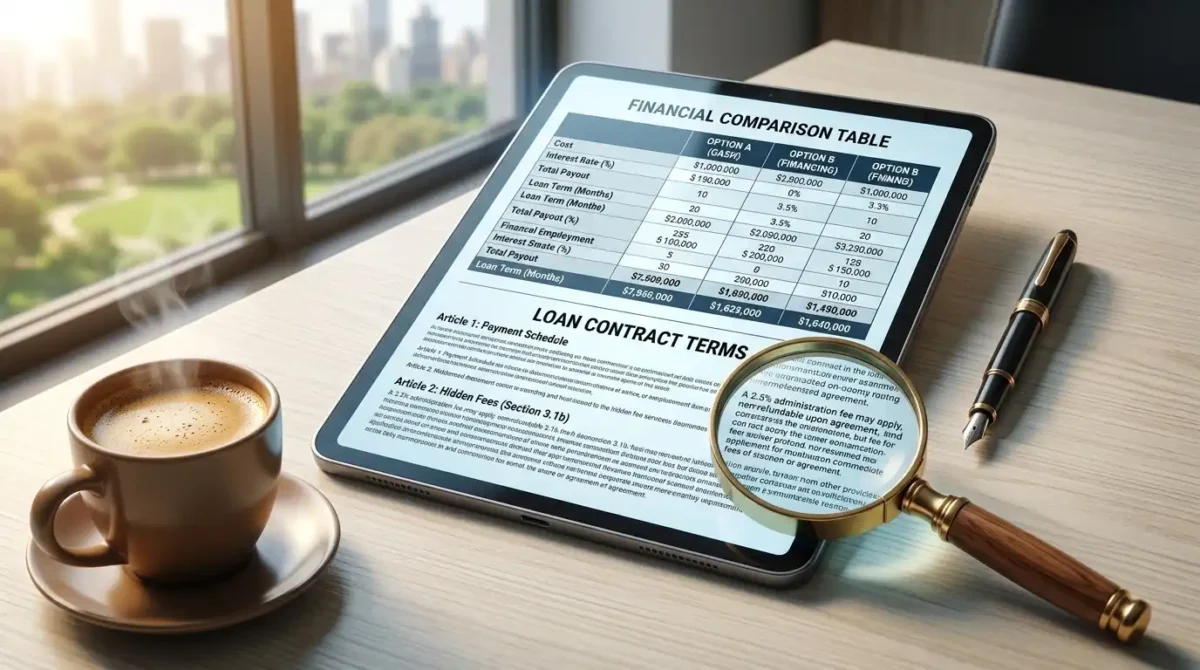
Hidden costs in solar financing fall into three main categories: dealer fees embedded in the loan principal, re-amortization events that change the monthly payment, and contract obligations that affect the home sale. The CFPB specifically identified dealer fees as a consumer risk in solar financing, noting that fees can commonly range from 10% to 30% of the cash price.
What Is a Solar Dealer Fee?
A solar dealer fee is a payment made by the lender to the installer when a solar loan is originated. The lender recovers that fee by adding it to the borrower’s loan principal. On a $28,000 system with a 25% dealer fee, the loan principal becomes $35,000. The borrower pays interest on $35,000, not $28,000, for the full loan term.
The CFPB reported that in some cases dealer fees have exceeded 50% of the cash price. That would mean a $28,000 system financed with a principal of over $42,000. That is not an extreme edge case. It is a documented pattern in the solar lending market.
Can Financing Fees Increase the System’s Financed Price?
Yes. This is one of the most important facts in solar financing. The amount financed can significantly exceed the system’s cash price when dealer fees are added. The only way to identify this is to ask the installer for the cash price in writing and compare it to the loan principal shown on the financing disclosure.
Review what to watch for in solar contracts before signing to understand how financing terms and contract terms interact, since both documents affect your total obligation.
What Is Re Amortization?
Re-amortization is a recalculation of your monthly payment that some solar loans trigger under specific conditions. The most common trigger is the failure to apply the federal tax credit to the loan principal within a defined window, often 12 to 18 months after installation.
Some solar loan products are structured with a promotional period and a lower initial monthly payment that assumes you will apply a large lump sum, such as a tax credit, to reduce the principal in year one. If that lump sum is not applied, the loan reamortizes at a higher monthly payment for the remaining term. This catches homeowners off guard when the tax credit turns out to be smaller than projected or unavailable entirely.
Can the Monthly Payment Change?
Yes, in several circumstances. Variable rate loans change with market interest rates. Re-amortization events on structured loans can increase the payment permanently. Lease and PPA agreements with escalator clauses increase the payment by a defined percentage annually.
Fixed-rate solar loans with no re-amortization trigger are the most predictable option. Verify the rate type in writing before signing.
What Happens to a Solar Loan When You Sell Your Home?
A solar loan that is secured by the home, such as a UCC-1 lien or a PACE loan, must be paid off or transferred at closing. A buyer cannot typically assume a solar-specific loan the way they might assume a mortgage. The payoff amount comes out of the home sale proceeds.
An unsecured personal loan is not tied to the property and remains the seller’s obligation regardless of the home sale. You keep making payments on it after the sale.
Leases and PPAs create a different problem. The buyer must agree to assume the contract or the seller must buy out the lease at closing. Not all buyers will accept a 15-year lease obligation, which can complicate or delay a sale.
Why Should You Compare the Cash Price With the Financed Price?
Comparing the cash price with the financed price reveals the dealer fee immediately. If the cash price is $27,500 and the loan principal is $34,000, the effective dealer fee is $6,500 or about 24%. That $6,500 accrues interest over the full loan term.
On a 25-year loan at 7.5%, that extra $6,500 in principal adds approximately $11,500 in additional interest. The total extra cost of the dealer fee is roughly $18,000, not $6,500.
What Changed for Solar Financing in 2026?
The most significant change affecting solar financing in 2026 is the status of the federal residential solar tax credit. Many solar financing projections from 2024 and early 2025 assumed the 30% federal Investment Tax Credit under Internal Revenue Code Section 25D would be available to offset upfront costs or reduce the loan principal.
That assumption is no longer valid for systems placed in service after December 31, 2025.
Does the Federal Residential Solar Tax Credit Still Apply in 2026?
The IRS states that the Section 25D Residential Clean Energy Credit is unavailable for property placed in service after December 31, 2025. Systems installed and connected to the grid in 2026 do not qualify for this credit under current law.
This is a material change. The 30% credit on a $28,000 system was worth $8,400. Financing projections and payback period estimates that assumed this credit must be recalculated without it for any 2026 installation.
Verify the current status directly with the IRS before making any financing decision that depends on a tax credit assumption. Tax law changes, and your installer or lender is not a qualified source for tax advice.
How Does the End of the Residential Clean Energy Credit Affect Financing?
The credit directly affected the economics of solar loans in two ways. First, it reduced the effective net cost of the system. Second, many structured solar loan products were designed with the assumption that the borrower would apply the credit to the principal in year one, which would prevent a re-amortization event and keep the monthly payment low.
Without the credit, borrowers who signed these structured loans in 2025 or earlier face the re-amortization risk described above. Borrowers evaluating new financing in 2026 should not use the 30% credit in their payback period calculations unless a qualified tax professional confirms the credit applies to their specific situation.
What I noticed when reviewing 2026 solar financing proposals is that some installers and lenders have not updated their savings projections to remove the credit. If your sales presentation still shows a 30% federal credit reducing your net cost, ask the installer to confirm that applies under current IRS rules.
Why Should 2026 Financing Calculations Use Current Tax Rules?
Financing calculations built on expired or unavailable incentives produce payback periods and monthly savings estimates that do not reflect reality. An overoptimistic projection is not just misleading. It directly affects whether your monthly solar payment is less than, equal to, or more than your current electricity bill.
The U.S. Department of Energy’s residential solar resources provide independent guidance on federal incentives and can help you verify which programs are currently active before finalizing any financing decision.
What Should Homeowners Verify With the IRS?
Verify directly with the IRS or a qualified tax professional whether any solar credit or deduction applies to your specific installation date, system type, and tax situation. Do not rely on an installer or lender’s representation of tax benefits. Their financial interest in closing the sale creates a conflict that makes them an unreliable source for tax guidance.
Which Solar Financing Options Offer the Lowest Total Cost?
A cash purchase offers the lowest total cost in nearly every scenario because it eliminates interest and dealer fees. A homeowner who pays $28,000 cash for a system that generates $1,800 in annual electricity savings reaches break-even in roughly 15 to 16 years, depending on local utility rates. A homeowner who finances that same system and repays $55,000 to $65,000 over 25 years may never fully break even at the same savings rate.
That said, cash purchase is not the right answer for every homeowner. The right structure depends on your savings, your tax situation, how long you plan to stay in the home, and your local electricity rate trajectory.
When Can Paying Cash Make Financial Sense?
Cash makes the most financial sense when you have liquid savings that are not generating returns exceeding the solar loan interest rate. If your savings account earns 4% and a solar loan costs 7.5%, deploying cash for solar produces a better net financial outcome than keeping the savings and paying loan interest.
The National Renewable Energy Laboratory’s solar financial research provides context on how cash versus loan decisions affect long-term solar returns under different rate scenarios.
When Can a Solar Loan Make Sense?
A solar loan makes sense when the monthly payment is materially lower than your current electricity bill, and the total repayment over the loan term is less than what you would have paid for grid electricity over the same period. That calculation requires your actual electricity usage data, your local utility rate, and an honest projection of how that rate will change.
A homeowner in Atlanta, Georgia paying Georgia Power $160 per month faces an annual electricity cost of $1,920. A solar loan with a $140 monthly payment produces immediate positive cash flow. But that comparison only holds if the $140 payment does not re-amortize upward due to a missed tax credit contribution and if the system produces at the projected level.
When Might a Lease or PPA Be Preferable?
A lease or PPA may be preferable for homeowners who do not qualify for a loan, who expect to move within 5 to 7 years, or who strongly prefer to avoid maintenance responsibility. The system owner handles equipment repairs under most lease and PPA contracts.
The trade-off is that you do not benefit from the full electricity savings, you cannot claim any federal tax credits, and the escalator clause may erode the rate advantage over time. Review how predatory lease terms affect your legal rights if your lease agreement contains provisions that were not explained during the sales process.
When Might Financing Solar Be a Poor Fit?
Solar financing is a poor fit when your monthly electricity bill is too low to cover the loan payment. If your bill averages $70 per month, a $150 monthly solar loan payment produces negative cash flow from day one, regardless of how long you stay in the home.
It is also a poor fit when you plan to move within a few years, and the loan or lease would require payoff or transfer at closing. The financial benefit of solar compounds over years. A short holding period reduces or eliminates that benefit.
What Monthly Electricity Bill Makes the Financing Math Difficult?
A monthly electricity bill below $100 typically makes solar financing math difficult in most U.S. markets. At that bill level, a loan payment that exceeds your current electricity cost creates immediate negative cash flow, and the long payback period extends beyond most homeowners’ planning horizons.
This is a decision checkpoint worth stopping on. If your average monthly bill across the last 12 months is below $100, evaluate your total savings projection carefully before committing to any solar financing structure.
What Should You Compare Before Signing Solar Financing?
Before signing any solar financing agreement, you need three specific numbers: the cash price of the system, the total amount financed, and the total repayment over the loan term. The gap between the first and second reveals hidden fees. The third tells you what the system actually costs.
| Question | Why It Matters |
| What is the cash price? | Establishes the baseline system cost |
| What is the amount financed? | Reveals any financing markup or dealer fee |
| What is the APR? | Enables accurate comparison of borrowing costs |
| What is the loan term? | Determines the repayment period and total interest |
| Are there dealer fees? | Can materially increase the principal |
| Is the rate fixed? | Protects against future payment increases |
| Is the loan secured? | Determines whether your home is collateral |
| Can I prepay without penalty? | Affects future interest costs |
| What happens if I sell? | Critical for property transfer planning |
Can You Compare the Cash Price and Financed Price?
Yes, and you should always do this before accepting any solar financing. Ask for both numbers in writing from the installer before reviewing the loan disclosure. Any gap between the cash price and the financed amount represents either a dealer fee, an origination fee, or both.
If the installer cannot or will not provide the cash price in writing, that is a clear signal to pause the transaction.
Can You Calculate the Total Repayment?
Yes. Ask the lender to provide the total of all payments over the full loan term. That number appears on the Truth in Lending disclosure the lender is required to provide. It is not the same as the loan principal plus one year of interest. It is the full sum of every monthly payment you will make over the loan’s life.
If the lender cannot provide this number before signing, do not sign.
Can You Identify Every Financing Fee?
Review the loan disclosure for every fee. Common fee names include dealer fee, program fee, lending fee, origination fee, and documentation fee. Some of these appear as separate line items. Others are embedded in the principal without a label.
If you need help identifying what these fees mean in a specific contract, review how solar financing disputes are handled legally to understand what consumer protection options exist when fees were not disclosed before signing.
Can You Understand What Happens If You Sell the Property?
Get a written explanation of how the solar financing obligation transfers or is handled at property sale. Ask whether the loan is secured by the home, whether a UCC-1 lien exists, and whether a buyer can assume the loan. For leases and PPAs, ask specifically what the buyout amount would be today and how it changes over time.
This question is especially important for homeowners who may sell within 10 years. It is not a hypothetical. People sell homes unexpectedly due to job changes, family situations, and financial circumstances. Understanding the exit before you sign is the right approach.
For situations where a loan or contract obligation has become a problem after signing, the solar project debt resolution guide covers the options available once a financing dispute is underway.
Solar Financing FAQs
What is solar financing?
Solar financing is any method of paying for a residential solar energy system over time rather than upfront. The main structures are solar loans, solar leases, and power purchase agreements.
What are the main solar financing options?
The main solar financing options are cash purchase, solar loan, solar lease, power purchase agreement, personal loan, home equity loan, and HELOC. Each creates different ownership rights, monthly costs, and long-term obligations.
What are typical solar financing rates?
EnergySage Marketplace data from the second half of 2025 showed a median quoted solar loan rate of 7.5%. That figure is a marketplace median, not a universal benchmark. Your rate depends on credit score, lender, loan term, and whether the loan is secured.
Are solar financing rates fixed or variable?
Both fixed and variable rate solar loans exist. Fixed-rate loans maintain the same payment throughout the term. Variable rate loans change with an index rate, which can increase your payment. Always confirm which type your loan offers before signing.
What is a solar dealer fee?
A solar dealer fee is a payment from the lender to the installer, recovered by adding it to the borrower’s loan principal. The CFPB found these fees commonly range from 10% to 30% of the cash price, with some exceeding 50%.
What credit score is needed for solar financing?
Most solar loan lenders require a minimum credit score in the 580 to 650 range for approval. Better rates are typically available above 700. Credit unions may have different thresholds than specialty solar lenders.
Is financing solar panels better than paying cash?
Financing solar panels costs more in total than paying cash due to interest and fees. Cash is financially superior if you have the liquidity. Financing makes sense when the monthly payment is lower than your current electricity bill, and you prefer to preserve savings.
What happens to a solar loan if you sell your house?
It depends on whether the loan is secured by the home. A secured solar loan or PACE loan typically requires payoff at closing. An unsecured personal loan stays with the borrower. A lease or PPA requires the buyer to assume the contract or the seller to buy it out.
This article by SolarInfoPath (2026 research framework) is part of a comprehensive solar knowledge architecture covering all major high-value sectors including legal disputes (installation negligence, contracts, liability, fraud, lawsuits, liens, HOA and permitting disputes), financial structures (loans, PPA/lease agreements, DSCR financing, tax equity, investment and project finance), tax law (ITC, Section 48/25D, MACRS depreciation, bonus credits, IRS audits, recapture rules, domestic content and IRA/OBBBA compliance), insurance and risk (property damage, hail/wind/fire claims, bad faith insurance disputes, warranty coverage), policy and regulation (net metering, FERC interconnection, state utility rules, incentive programs and regulatory changes), commercial and utility-scale development (EPC contracts, construction delays, performance bonds, receivership, bankruptcy, asset sale and restructuring), real estate impacts (home value, solar leases, liens, title issues, HOA restrictions, easements), and emerging market structures such as battery storage, community solar, agrivoltaics, SRECs, yieldcos, and institutional investment funds. All content is based on publicly available regulatory, financial, and legal sources and is intended strictly for educational and informational purposes, not legal, tax, or financial advice. Readers should always verify current laws, utility policies, tax regulations, and contract terms with qualified licensed professionals before making decisions, as solar regulations, incentives, and financial structures frequently change across jurisdictions and time.

Solar Legal Analyst· Policy Researcher· Investigative Finance Writer Lead Analyst & Founder of SolarInfoPath
Morgan Lee is a solar legal analyst, policy researcher, and investigative finance writer with 12+ years of experience in U.S. renewable energy law, IRS tax credit compliance, and solar litigation. He is the founder of SolarInfoPath, a research-driven platform focused on primary-source analysis of solar contracts, tax law, regulatory policy, and industry disputes affecting homeowners and commercial developers.
His work is grounded in original legal and regulatory sources, including IRS notices, FERC and CPUC rulings, state court filings, PACER records, and UCC lien databases. He specializes in solar contract disputes, injury and workers’ compensation claims, PACE financing issues, tax equity structures, ITC recapture rules, MACRS depreciation, and federal and state solar policy frameworks.
Morgan’s analysis spans solar litigation, finance structures, and regulatory developments such as the IRA and OBBBA, interconnection reform, domestic content rules, and battery storage incentives. He also covers EPC contracts, PPAs, project financing, and utility-scale solar investment structures.