Is Solar Panels Good Investment in Massachusetts? 2026 Analysis
Eversource customers in Boston, Worcester, and Lowell pay about 29 to 31 cents per kWh in 2026. That rate is nearly double the U.S. average. It is the single biggest reason solar panels Massachusetts for most homes in the state right now.
Are solar panels worth it in Massachusetts? The honest answer depends on your roof, your roof direction, and how much power your home uses. Most MA homeowners pay Eversource or National Grid rates. Five layers of credits and programs stack together for them. The result is one of the fastest payback timelines in the country. This guide gives you the real numbers. You can judge for yourself.
Key Takeaways
- Eversource and National Grid MA customers pay 29–31¢/kWh, nearly twice the U.S. average in 2026.
- A $22,000 MA solar system drops to about $13,025 after the federal credit, state credit, and sales tax break.
- Most MA homes with a good south-facing roof pay off their system in 5 to 7 years after all credits apply.
- The SMART program adds $425 to $765 per year in extra income for 10 years on top of your bill savings.
Are Solar Panels Worth It in Massachusetts? What the Numbers Say
Are solar panels worth it in Massachusetts when you look at the actual math? For most homes in the state, the answer is yes, but only when you include all five available credits, not just the federal one.
Here is the full stack on a real MA system. Take a $22,000 install in Worcester. The 30% federal tax credit brings the cost down to $15,400. The MA 15% state credit adds another $1,000 off. The full sales tax exemption saves $1,375 at checkout. Your net real cost lands at about $13,025. That is a very different number from the $22,000 sticker price most homeowners see first.
At 29 cents per kWh with Eversource, an 8kW system saves about $2,465 per year in power costs. Add the SMART program income of about $595 per year, and your total annual return is about $3,060. At that rate, the $13,025 net cost pays off in about 4.3 years. After that, your power is nearly free for the rest of the system’s life.
For a complete breakdown of every MA incentive and how each one works, read Massachusetts solar rebates and credits explained.
Solar Panel Cost Massachusetts: What You Actually Pay After Credits
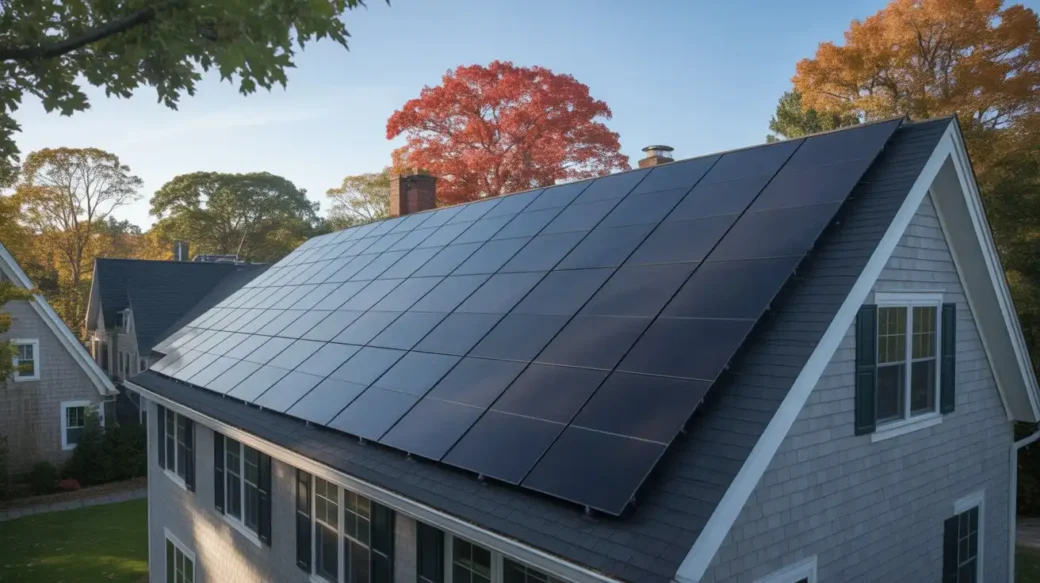
Solar panel cost in Massachusetts runs about $20,000 to $25,000 for a fully installed 8kW system before any credits apply. The system size you need depends on how much power your home uses each month. A home using 900 kWh per month needs roughly an 8kW system in MA, given the state’s average sun hours.
The per-watt price in Massachusetts runs about $2.75 to $3.10. That is slightly above the national average because MA has higher labor costs than most states. Boston, Cambridge, and Newton tend to have the highest installation prices. Springfield and Pittsfield in western MA typically come in at the lower end of the range.
Federal and state credits reduce the cost significantly. The 30% federal credit applies first. The 15% state credit follows. The sales tax exemption adds more savings. After all, the three most MA homeowners pay between $12,000 and $15,500. System size and install complexity affect the final number. Your roof condition matters here, too. A roof that needs work before installation adds $8,000 to $18,000 and changes your payback math significantly.
To see how MA install prices compare to other states, read the average solar panel cost per kW in the USA. And for the clearest picture of what you actually pay after every credit, read your real cost after all solar credits apply.
What the SMART Program Adds to Your Return
The SMART program is a feature of MA Solar that most homeowners outside the state have never heard of. It pays you a fixed rate per kWh your system produces for 10 full years. The rate in 2026 runs about $0.05 to $0.09 per kWh, depending on your utility and your program block.
An 8kW system in MA makes about 8,500 kWh per year. At $0.07 per kWh, that is $595 per year in SMART income. Over 10 years, that is $5,950 in total added income on top of your normal bill savings. Eversource, National Grid, and Unitil all participate in the SMART program. Your SMART rate locks in when your system is approved and does not change for the full 10 years.
Are Solar Panels Worth It in My State Compared to Massachusetts?
Are solar panels worth it in my state if I do not live in Massachusetts? That is a fair question. MA sits near the top of the national solar investment ranking because of its rate structure, not its sun. Many states get far more sun than MA but deliver slower payback because their power rates are lower.
A home in Phoenix, Arizona gets 6.5 sun hours per day, nearly 55% more than Boston’s 4.2. But APS charges about 13 cents per kWh. Boston pays about 29 cents. That means every kWh a MA panel makes is worth more than twice what the same kWh is worth in Phoenix. The higher rate more than compensates for the lower sun.
Few states compete with Massachusetts for fastest payback. California is one. New York is another. Connecticut is the third. All have high power rates. Each exceeds 20 cents per kWh.. In lower-rate states like Kansas, Tennessee, or Louisiana, solar still works. It just takes 12 to 15 years to pay back instead of 5 to 7.
For a side-by-side look at payback times by state, read how long solar takes to pay off across the USA.
Solar Panels Good Investment in Massachusetts: City-by-City Data
Solar panels are a good investment in Massachusetts at different speeds depending on which city you live in. Here is what the numbers look like across five MA cities in 2026.
| City | Avg Sun Hours/Day | Est. Annual Savings (8kW) | Key Solar Notes |
| Boston | 4.2 hrs | $1,900–$2,400 | Eversource territory; high rate drives strong savings |
| Worcester | 4.3 hrs | $1,950–$2,450 | Eversource area; slightly more sun than coastal cities |
| Springfield | 4.4 hrs | $1,900–$2,400 | Best sun in western MA; Eversource territory |
| New Bedford | 4.1 hrs | $1,800–$2,300 | National Grid area; coastal clouds reduce output slightly |
| Lowell | 4.2 hrs | $1,900–$2,350 | Eversource; SMART program active; strong net metering |
Western MA cities like Springfield and Pittsfield get about 4.3 to 4.5 peak sun hours per day. Eastern and coastal cities like New Bedford and Plymouth get about 4.0 to 4.2 hours. The difference adds roughly 300 to 500 kWh per year to a western MA system. That shortens payback by 3 to 5 months.
Northern MA near the New Hampshire border gets shorter winter days, about 3.5 to 3.8 peak sun hours from November through January. That is not a dealbreaker. MA net metering lets you roll summer credits forward to offset winter bills. So the seasonal drop in output does not mean higher winter bills for most net-metered homes.
Massachusetts had the 4th-highest residential power rate in 2024. The U.S. Energy Information Administration reported this. It ranked among the highest in the country. You can check the current MA rate data at the EIA electricity data browser.
For more on how net metering credits roll forward in MA, read about whether net metering is worth it in the USA.
One Honest Limitation MA Homeowners Need to Know Before They Decide
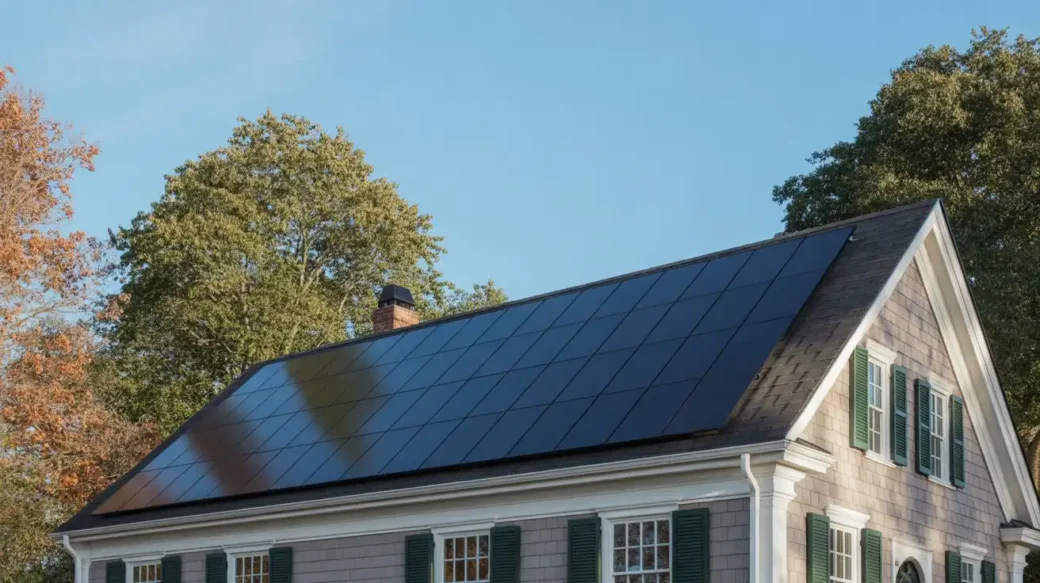
In my experience, surprised homeowners share one thing. They did not check their roof first. Massachusetts has a lot of older housing stock. Triple-deckers in Boston. Wood-frame colonials in Worcester. Victorian-era homes in Springfield. Many of those roofs are 15 to 25 years old. A roof in that condition often needs repair. Sometimes it needs a full replacement. Solar cannot go on before that.
A new roof in MA runs $10,000 to $20,000, depending on size and pitch. Adding that to a $13,025 net system cost changes your all-in price to $23,025 or more. At $3,060 per year in return, that pushes payback to about 7.5 years instead of 4.3. Still a solid investment, but very different from what the headline numbers suggest.
Heavy shade is the other real limit. A roof under thick tree cover for most of the day loses 25% to 40% of its solar output. A shaded roof in Cambridge can easily produce 30% less than an open roof in Natick even though both homes are in the same utility territory. Always get a shade report before you commit to any system size or price.
For a clear list of what often gets left out of the first installer quote, read hidden costs most solar quotes leave out.
Is Solar Worth It for Your Massachusetts Home Right Now?
Most MA homeowners are surprised to learn that solar works well in the state despite the cold winters. Cold temperatures actually help panels run slightly more efficiently on clear days. A crisp January day in Worcester with full sun can produce nearly as much power per hour as a hot July day. The issue in winter is not cold, it is shorter days and more cloud cover. Those two factors do reduce your winter output.
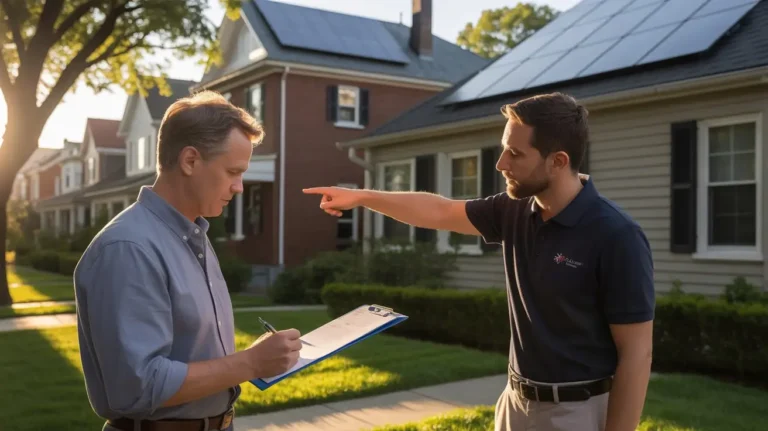
The right question to ask is not whether MA gets enough sun. The right question is whether your specific roof gets enough sun. A south-facing roof with no shade at a 20-to-35 degree pitch in MA is one of the strongest investment cases in the country. A north-facing roof under mature oaks is a different story entirely.
For the full honest case on whether MA solar works for your home, read why solar panels are worth it in Massachusetts. And to see how MA compares to other strong solar states, read whether solar panels are worth it in the USA.
Final Thoughts
Solar panels Massachusetts: most homes qualify with two basic conditions. First, a south or west-facing roof with no heavy shade. Second, a power bill above $150 per month. When both are true, the five-layer MA incentive stack produces payback times that most other states simply cannot match.
Your next step is a practical one. Pull out your last 12 months of Eversource or National Grid bills. Add them up. Then walk outside and look at your roof. If it faces south or west and gets direct sun for most of the day, the numbers in this guide very likely apply to your home. Check your roof age, look up your SMART program block availability with your utility, and go in with the real figures before you talk to anyone.
Frequently Asked Questions
Are solar panels a good investment in Massachusetts 2026, given the high installation costs?
Yes, for most well-suited homes. The 30-cent electricity rate, federal and state tax credits, and SMART income together produce payback periods of 4 to 6 years for many Massachusetts homeowners.
What is the solar panels financial return in Massachusetts over a full system lifetime?
A well-sized Massachusetts system typically generates $40,000 to $65,000 in total savings and SMART income over 25 years. Actual returns vary by utility rate tier and SMART block rate.
Are solar panels a wise investment in Massachusetts for homes on National Grid? Yes. National Grid customers in New Bedford and Lowell qualify for the same federal credit, state credit, sales tax exemption, and SMART program as Eversource customers on the same retail rate net metering structure.
What is the SMART program, and how does it affect investing in solar panels in Massachusetts?
SMART pays a fixed rate per kilowatt hour your system generates for 10 years. Current rates run $0.03 to $0.15 per kWh, depending on your utility’s current block, adding $225 to $1,125 per year to your return.
Does Massachusetts offer a state income tax credit for residential solar in 2026?
Yes. Massachusetts provides a 15% state income tax credit capped at $1,000, claimed on your state return in the year your system is placed in service. It can be carried forward if needed.
Are solar panels the best investment in Massachusetts for homes in Western Massachusetts, like Springfield?
Springfield averages 4.3 peak sun hours per day in Eversource territory with full incentive access. Fewer shading complications than Boston make it a strong candidate, with estimated annual savings of $2,100 to $2,500 on a 6-kilowatt system.

Morgan Lee is a homeowner and solar energy researcher based in the United States. After installing a rooftop solar system in 2022 and spending months comparing quotes, incentives, and installer reviews, Morgan realized how confusing and overwhelming the process felt for most American families. That experience led to the creation of SolarInfoPath, a no-pressure, educational platform designed to help U.S. homeowners understand solar energy clearly and confidently. Morgan focuses on practical, research-backed information covering solar costs, installation timelines, federal tax credits, and long-term savings. All content on this site is written from a homeowner’s perspective with the goal of making solar energy simple and accessible for everyday Americans.