Massachusetts Solar Rebates and Credits: What’s Real 2026
This article is published by SolarInfoPath, an independent research and education platform. SolarInfoPath has no financial relationship with any solar installer, manufacturer, lender, lead generation service, or utility company. We do not sell solar products, earn referral fees, or accept sponsored content. All articles are based on publicly available data from sources including the U.S. Department of Energy, IRS.gov, U.S. Treasury, the National Renewable Energy Laboratory (NREL), the Solar Energy Industries Association (SEIA), and public court and regulatory records.
State-Specific Information Notice: Solar incentive programs, net metering rules, consumer protection statutes, and utility rate structures described in this article apply to specific states and utility service territories. Laws and policies in this area change frequently. Information that was accurate at the time of publication may no longer reflect current rules in your state. Always verify current policies directly with your state public utility commission or a licensed professional before making any decisions.
Information Currency: Solar policy, tax law, utility programs, and financing products change frequently. While SolarInfoPath updates content regularly, some details may not reflect the most recent developments in your state. Always confirm current rules with the appropriate government agency, utility company, or licensed professional before taking any action.
Massachusetts homeowners pay some of the highest power rates in the entire country. Eversource and National Grid residential customers pay about 29 to 31 cents per kWh in 2026. That rate is nearly double the national average. This is the single biggest reason in Massachusetts solar rebates 2026, deliver fast payback times. In fact, they are among the fastest in the whole Northeast.
What surprised me when I studied MA solar closely is how many layers of real credits stack on top of each other here. Most homeowners only know about the federal 30% credit. But Massachusetts adds more on top of that. You get a 15% state tax credit and a full sales tax exemption. There is also a property tax exemption and net metering at full retail rates. And the SMART program income adds even more value. Those five layers together make MA one of the most financially compelling solar states in the country.
Key Takeaways
- Eversource and National Grid MA customers pay 29–31¢/kWh, nearly double the U.S. average in 2026.
- The MA solar tax credit gives you 15% of your system cost back, up to $1,000, on your state tax return.
- A $22,000 MA solar system drops to under $13,000 after the federal credit and MA state credit combined.
- Most Massachusetts homeowners who use all available credits pay off their system in 5 to 7 years.
Massachusetts Solar Incentives 2026: All Five Programs Explained
Massachusetts solar incentives 2026 are built in layers. Each layer cuts a different part of your total cost or adds to your ongoing return. Knowing all five before you install puts you in a much stronger position.
Here is how they all apply to a real $22,000 MA system. The 30% federal tax credit gives you $6,600 back on your federal tax bill. The 15% MA solar tax credit gives you up to $1,000 back on your state return. The full sales tax exemption saves you $1,457 at checkout — 6.25% of the system price. Your property tax bill does not go up even though your home is now worth more. And the SMART program pays you a fixed rate per kWh your panels produce for 10 years.
After the federal and state credits, your net cost on that $22,000 system drops to about $14,400. Add the sales tax savings, and it drops further to about $12,943. That is a strong starting point before your monthly bill savings even begin. For a full look at how the federal credit works by itself, read how the 30% federal solar tax credit works.
MA Solar Tax Credit: How the 15% State Credit Works in Practice

The MA solar tax credit is one of the most direct cash benefits available to Massachusetts homeowners. It gives you 15% of your total system cost back as a credit on your MA state income tax return. The cap is $1,000. So on any system above $6,667, the credit maxes out at $1,000.
You claim this credit in the same year your system goes live and gets approved by your utility. If your state tax bill is smaller than your credit in that year, you can carry the unused portion to the next year’s return. You cannot carry it beyond one year, so timing your install matters. Most MA homeowners find that claiming it in the year of installation is the cleanest approach.
The Massachusetts solar tax credit stacks directly on top of the 30% federal credit. You claim both in the same tax year. Neither one limits the other. On a $22,000 system, the federal credit is $6,600, and the state credit is $1,000. Together, they save you $7,600 before any other program applies.
To see how MA compares to other high-credit states in total out-of-pocket cost, read your real solar cost after all credits apply.
Solar Incentives Massachusetts: Sales Tax, Property Tax, and SMART
Massachusetts homeowners miss two key solar incentives. One is the sales tax exemption. Another is SMART program income. Both add real money. They differ from the common credits most people know.
The MA sales tax exemption removes the full 6.25% state sales tax from your solar system at the time of purchase. On a $22,000 system, that is $1,375 saved the day you buy. It covers all hardware, panels, inverter, mounts, and battery storage if added at the same time. No application is needed. It comes off your price automatically.
The SMART program, short for Solar Massachusetts Renewable Target, pays you a fixed rate for every kWh your system produces for 10 years. The rate varies by utility and changes as program capacity fills up. Eversource SMART rates in 2026 run about $0.05 to $0.09 per kWh, depending on your program block. A typical 8kW MA system producing about 8,500 kWh per year earns roughly $425 to $765 in SMART income annually. Over 10 years, that adds $4,250 to $7,650 in total income on top of your bill savings.
The Massachusetts solar panel rebate question often refers to the SMART program, since it is the closest thing to a direct rebate in the state. It is not a lump-sum payment; it is a monthly credit on your utility bill based on how much your panels produce.
For a full picture of what your monthly savings look like once your system turns on, read how much solar saves per month in the USA.
Net Metering in Massachusetts: Full Retail Credits on Every kWh
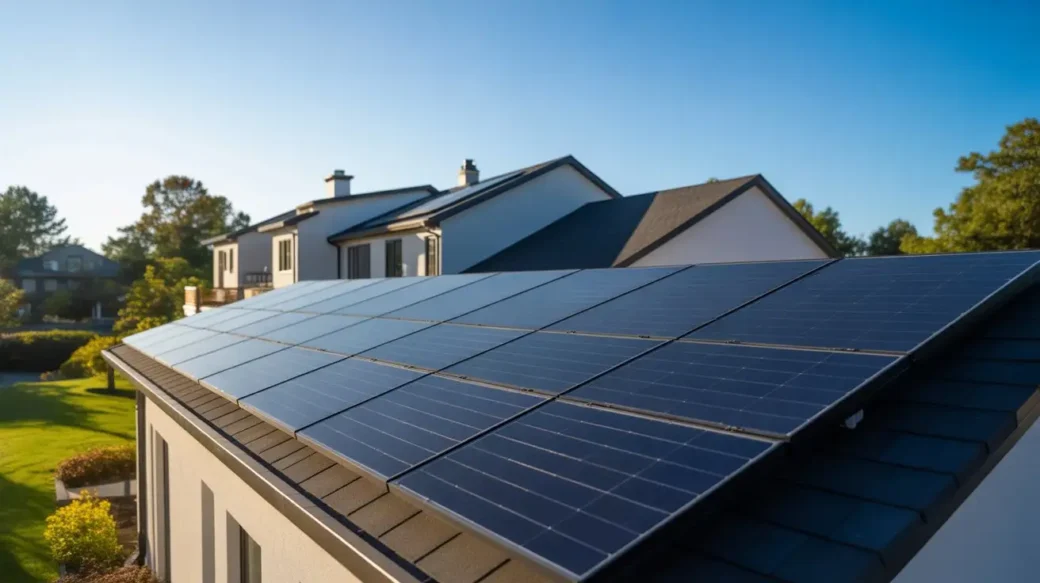
MA net metering rules pay you the full retail rate, about 29 to 31 cents per kWh, for every extra kWh your panels send to the grid. When your system makes more power than your home uses, that surplus earns a credit on your next Eversource or National Grid bill. On a hot summer day in Worcester or Springfield, your panels may produce far more than your home needs. Every extra kWh earns you nearly 30 cents rather than the lower avoided-cost rate some other states pay.
MA net metering credits roll forward month to month. They do not expire within the same year. Unused credits from summer can offset your winter bills. Some states expire net metering credits monthly. Massachusetts is different. It offers a rollover feature. This makes net metering more valuable. Homeowners here benefit more.
To see how MA net metering rules compare to other states, read whether net metering is worth it in the USA.
Free Roof Replacement With Solar Panels Massachusetts: What Is Actually True
The phrase “free roof replacement with solar panels in Massachusetts” comes up often in searches. It deserves an honest answer. No program in Massachusetts gives you a free roof replacement as part of a solar install.
What some installers offer is a combined roof-and-solar package. You pay for both together. In some cases, the financing structure can make the roof portion feel low-cost because it is bundled with the solar system. But you are still paying for it — either upfront or through your loan. The solar system pays for itself over time. The roof does not.
If your roof needs replacing before solar can go on, that adds $8,000 to $18,000 in MA, depending on roof size and complexity. That cost changes your payback math. An 8kW system with a $6,000 roof repair on a home in Boston might take 9 to 11 years to fully pay back instead of 5 to 7. Always get your roof assessed before you sign anything.
For a clear list of every cost that often does not appear in the first quote, read hidden costs most solar quotes leave out.
Solar Rebates Incentives MA: City-by-City Savings Across Massachusetts
Solar rebates and incentives differ slightly. Your city plays a role. So does your utility. Your SMART program block matters too. Here is how savings look across five MA cities in 2026.
| City | Avg Sun Hours/Day | Est. Annual Savings (8kW) | Key Solar Notes |
| Boston | 4.2 hrs | $1,900–$2,400 | Eversource territory; high rate drives strong savings |
| Worcester | 4.3 hrs | $1,950–$2,450 | Eversource area; inland site; lower winter cloud cover |
| Springfield | 4.4 hrs | $1,900–$2,400 | Eversource: best sun hours in western MA |
| New Bedford | 4.1 hrs | $1,800–$2,300 | National Grid territory; coastal humidity affects output |
| Lowell | 4.2 hrs | $1,900–$2,350 | Eversource: strong net metering credit rollover |
Western MA cities like Springfield and Worcester get slightly more annual sun than coastal cities like New Bedford or Boston. The coast brings more cloud cover and humidity, which cuts output on overcast days. However, the rate difference between coastal and inland areas is small enough that the impact on savings is minor for most homes.
Northern MA near the New Hampshire border gets slightly shorter peak sun hours in winter — about 3.5 to 3.8 hours per day from November through January. That does not stop solar from being worth it. It does mean your system produces less in winter and more in summer, so net metering rollover matters more for northern MA homes.
You can verify current SMART program block availability and rates for your utility at the MA DOER SMART program page.
For the full case on whether solar makes financial sense in MA, read why solar panels are worth it in Massachusetts.
Massachusetts Solar Incentives Rebates Tax Credits 2026: Real Payback Math
Massachusetts solar incentives stack well in 2026. Rebates and tax credits combine strongly. This creates one of the best payback cases in the Northeast. Here is the full math on one real MA home.
A homeowner in Worcester pays $210 per month to Eversource. That is $2,520 per year. They install an 8kW system for $22,000. The 30% federal credit brings the net cost to $15,400. The MA state credit adds another $1,000 off. Net cost is now $14,400. Sales tax exemption saves $1,375 at purchase. Real out-of-pocket cost: about $13,025.
Their system produces 8,500 kWh per year. At 29 cents per kWh, that offsets $2,465 in power costs. SMART income adds about $595 per year. Total annual return: about $3,060. Payback time: about 4.3 years. After payback, the home earns $3,060 per year for another 20+ years. Total lifetime gain over 25 years after costs: well over $60,000.
The one honest limitation to name here is this: MA homes with north-facing roofs or heavy shade from tall trees get 25% to 40% less output. That stretches payback to 7 to 10 years in those cases. And if your roof is older than 15 years, the repair cost adds to your total. Always check both before you commit.
For a full state-by-state payback comparison, read how long solar panels take to pay off across the USA. And for an honest look at whether MA solar makes sense for your specific home, read whether solar panels are worth it in Massachusetts.
Final Thoughts
Massachusetts solar rebates and credits give you more real financial firepower than almost any state in the country. The combination is hard to match on the East Coast. It includes a 30% federal credit. It also includes a 15% MA state credit. A full sales tax break is part of it. So is no property tax increase. Full retail net metering adds more. Ten years of SMART income completes it.
Your next step is simple. Pull out your last 12 months of Eversource or National Grid bills. Add them up. If your yearly power cost is above $2,000 and your roof faces south or southwest with no heavy shade, the numbers in this guide very likely work for your home. Check your roof age, confirm your SMART program block availability with your utility, and go in with real numbers, not guesses.
Frequently Asked Questions
What are the main Massachusetts solar rebates and credits available in 2026?
Massachusetts homeowners can access the 30 percent federal Investment Tax Credit, a 15 percent state income tax credit up to $1,000, a sales tax exemption on equipment, a property tax exemption on added home value, and the SMART program that pays per kilowatt hour produced for 10 years.
How does the Massachusetts SMART program work for residential solar?
The SMART program pays a fixed per-kilowatt-hour rate for every unit of electricity your system produces for 10 years. The rate is locked when your system receives Permission to Operate and does not change for the contract duration, regardless of future block adjustments.
How do I claim the Massachusetts state solar tax credit?
The Massachusetts 15 percent state solar credit is claimed on Schedule EC of your Massachusetts income tax return for the year your system is placed in service. Any unused credit carries forward for up to three additional tax years.
Does Massachusetts offer a sales tax exemption on solar equipment?
Yes. Massachusetts exempts solar energy equipment from the 6.25 percent state sales tax. Your installer handles this exemption at the point of sale, and no post-installation application is required.
Which Massachusetts utilities offer net metering for residential solar customers?
Eversource, National Grid, Unitil, and Cape Light Compact are all required by Massachusetts state law to offer full retail net metering to residential solar customers. Credits are applied at the full retail rate rather than a reduced wholesale rate.

Morgan Lee | Lead Solar Policy & Consumer Research Analyst
Morgan Lee is the founder of SolarInfoPath and an independent solar research analyst with over 10 years of experience studying the U.S. residential and commercial solar market. Morgan’s research focuses on how real homeowner outcomes compare to the savings projections presented during solar sales, a gap that has led to thousands of consumer complaints and active class action lawsuits across New York, California, Texas, and Florida.
All research published on SolarInfoPath is drawn from primary sources, including the National Renewable Energy Laboratory (NREL), the U.S. Department of Energy (DOE), the U.S. Energy Information Administration (EIA), IRS and Treasury guidance under the Inflation Reduction Act, state public utility commission documents, and publicly filed court records related to solar consumer protection cases.
With a background in legal studies, Morgan interprets complex topics, federal tax credits under Section 25D and Section 48, Power Purchase Agreement contract terms, net metering policy changes, and solar litigation, in plain language that homeowners can actually use, without providing legal or financial advice.
SolarInfoPath was built after observing that most homeowners commit $25,000 to $40,000 to a solar system based on incomplete or misleading information, while almost every available source of solar education online has a financial relationship with the industry it covers. SolarInfoPath has no installer affiliations, no lead generation, and no affiliate income. Every article is independent, research-based, and written for informational purposes only.