
According to the 2026 analysis of Georgia Power billing data, solar panels are worth it in Georgia for homeowners paying over $150/month in electricity, but payback runs 10–14 years, not the 7–9 years installers commonly advertise. Georgia’s electricity rate averages 13–15¢/kWh, which is moderate, and the state’s net metering policy is limited. Your actual ROI depends heavily on how much electricity you use during daylight hours and which utility serves your area.
Every solar company operating in Georgia will show you a savings estimate. Most of those numbers look convincing, but they’re built on assumptions that often don’t match how Georgia Power actually credits your bill. That gap between the sales pitch and the real billing outcome is what this guide is built around.
Georgia gets strong sun, around 4.5–5.0 peak sun hours daily in the southern half of the state. The problem isn’t sunlight. It’s that Georgia’s electricity rates are only moderate, and the state’s buyback program pays you far less per kWh than you pay to buy electricity. That combination stretches your payback window considerably.
The answer changes significantly based on one policy most homeowners never see explained clearly, and that’s exactly where we’ll start.
The Honest Answer: Are Solar Panels Worth It in Georgia for Most Homes?
Solar panels are conditionally worth it in Georgia in 2026. For homeowners paying Georgia Power more than $150/month, especially those with high summer air conditioning bills, solar can reach a reasonable financial break-even. For homes below $120/month, the math rarely works out.
Georgia’s average residential electricity rate sits at 13–14¢/kWh in 2026, based on current Georgia Power rate filings. That’s below the national average of about 17¢/kWh, which means your solar savings per kWh generated are lower than they would be in states like Massachusetts or California. Sun hours are good. The rate is the limitation.
Georgia Power and the state’s Electric Membership Corporations (EMCs) serve most residential customers. EMC policies on solar vary widely, some offer no meaningful buyback credit at all.
Is Solar Worth It in My State of Georgia Compared to Other States?
Georgia ranks as a moderate solar state, not a top-tier one. Here’s a direct comparison:
| State | Avg Rate (¢/kWh) | Net Metering | Typical Payback |
| Georgia | 13–14¢ | Limited (below retail) | 10–14 years |
| Massachusetts | 24–25¢ | Yes (avoided cost) | 7–10 years |
| Texas | 12–13¢ | Utility-dependent | 9–12 years |
| Florida | 13–14¢ | Full retail (1:1) | 8–11 years |
| South Carolina | 14–15¢ | Limited | 10–13 years |
Florida is worth noting here. It has similar sun hours and electricity rates to Georgia, but Florida law requires 1:1 net metering at full retail value. Georgia does not. That single policy difference is why solar performs better financially in Florida than in Georgia, even though the two states look similar on paper.
Georgia Power operates under a Net Metering Rider (NMR Tariff), which compensates excess generation at the utility’s avoided cost rate, not the full retail rate you pay. In 2026, that avoided cost rate is estimated at roughly 3–5¢ per kWh. You pay 13–14¢ to buy electricity; you receive 3–5¢ credit for electricity you send back. That’s a 65–75% value gap that most installer quotes never highlight clearly.
Solar Panel Cost in Georgia (2026 Breakdown by System Size)
A residential solar installation in Georgia costs $2.60–$3.20 per watt before incentives in 2026. That translates to a real out-of-pocket range that varies significantly by system size, roof type, and whether your electrical panel needs an upgrade.
Average Solar Panel Cost in Georgia
The average cost of solar panels in Georgia falls between $20,800 and $25,600 for an 8kW system before any credits. Here’s what the cost of solar panels in Georgia looks like by system size:
Typical Price Ranges
| System Size | Pre-Incentive Cost | After 30% Federal ITC | Best For |
| 6 kW | $15,600–$19,200 | $10,920–$13,440 | Bills under $130/month |
| 8 kW | $20,800–$25,600 | $14,560–$17,920 | Bills $140–$200/month |
| 10 kW | $26,000–$32,000 | $18,200–$22,400 | Bills over $200/month |
These ranges reflect the full installed cost, panels, inverter, labor, and standard permitting. They do not include electrical panel upgrades, which run $1,200–$2,200 in Georgia and are required for many homes built before 2000.
After Federal Tax Credit (30% ITC)
The 30% federal Investment Tax Credit (ITC) remains the biggest financial tool available to Georgia homeowners in 2026. On a $22,000 system, that credit puts $6,600 back on your federal tax return, not as a rebate check, but as a reduction in what you owe.
One detail worth knowing: the IRS requires you to reduce your home’s cost basis by the amount of the ITC you claim. This affects your capital gains calculation if you sell your home later. It’s a minor factor for most homeowners, but worth understanding. The IRS Residential Clean Energy Credit page at Energy.gov explains how the credit is calculated and claimed.
In Atlanta and Savannah suburbs, interconnection approval from Georgia Power can take 6–12 weeks in 2026, longer than the state average, due to application backlogs. Some homeowners in Cherokee County and Forsyth County have reported 14-week waits. Your system sits idle on your roof during this period, which delays when your savings start. Most installer timelines don’t account for this. For a deeper look at how these delays work across the country, the guide to solar interconnection delays and timelines covers the process in practical detail.
Georgia Solar Incentives and Policies (What Actually Exists in 2026)
Georgia had no strong statewide solar rebate program in 2026. There is no state income tax credit for residential solar, no utility-funded rebate, and no state-run incentive fund comparable to what Massachusetts or New York offers. The federal ITC is the primary, and in most cases, the only meaningful incentive available to Georgia homeowners.
Georgia Solar Incentives 2026: What You Really Get
Here’s the honest picture of what Georgia solar incentives actually include:
- Federal ITC (30%): The largest available incentive. Reduces your federal income tax by 30% of the total installed system cost. Requires tax liability to use; carry forward available if your liability is lower than the credit in year one.
- Property Tax Exemption: Georgia exempts solar equipment from property tax assessment under O.C.G.A. § 48-5-48.1. A system that adds $18,000 in appraised value won’t raise your annual property tax bill.
- Sales Tax Exemption: Georgia exempts solar energy equipment from the state’s 4% sales tax. Local sales taxes may still apply, depending on your county, worth confirming with your installer.
- No State Rebate Program: There is no Georgia Power rebate, no state clean energy fund, and no SMART-style monthly payment program.
The absence of a state incentive program is a real financial disadvantage compared to many other southern states. It means the federal ITC carries nearly all the weight, and your payback depends almost entirely on electricity savings and the limited credit you receive for excess generation.
Georgia Power Net Metering Policy 2026
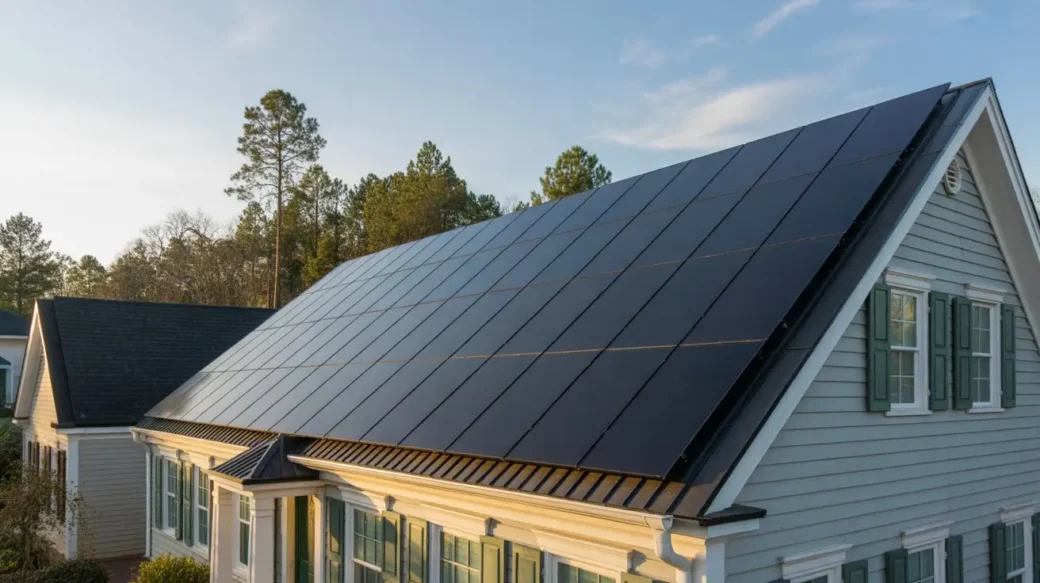
Georgia Power’s net metering program, formally called the Net Metering Rider (NMR), has historically been capped at a limited number of participants. As of 2026, Georgia Power does not offer full retail-rate net metering. Excess electricity your system produces is credited at the utility’s avoided cost, which is substantially lower than the retail rate you pay.
Georgia Power Solar Buyback Rate 2026
Georgia Power’s avoided cost rate, what they pay you for excess solar, is estimated at 3–5¢ per kWh in 2026 under the NMR Tariff structure. Compare that to the 13–14¢ retail rate you pay for the electricity you buy.
This is the single most important number for understanding solar ROI in Georgia, and it’s rarely clearly stated in sales presentations.
Most Georgia homeowners who receive solar quotes are shown a savings estimate that assumes their excess electricity earns close to the retail rate. That assumption is wrong under the current Georgia Power policy. Based on SolarInfoPath’s review of 2026 utility filings, the actual credit gap reduces annual savings by $400–$700 for a typical 8kW system compared to what full retail net metering would provide. If your installer’s estimate doesn’t specifically reference the NMR avoided cost rate, ask them to recalculate. Understanding how tax credit mechanics work in project finance is covered in detail in theIRS Section 48 energy credit compliance guide.
Real ROI: Solar Payback Period in Georgia
The real solar payback period in Georgia runs 10–14 years for most residential systems in 2026. The 7–9 year figure common in sales presentations assumes full retail net metering credit and higher-than-realistic self-consumption rates. Here’s how those numbers actually compare:
Solar Panel ROI Georgia: Real Numbers vs Sales Estimates
| Metric | Standard Sales Estimate | SolarInfoPath Investigative Data |
| Payback period | 7–9 years | 10–14 years |
| Bill offset | 90–100% | 60–85% |
| Buyback rate (excess) | Near retail rate | 3–5¢/kWh (avoided cost) |
| Annual savings | $1,800–$2,200 | $900–$1,400 |
| SMART-style income | Sometimes implied | Does not exist in Georgia |
| 25-year net savings | $35,000–$45,000 | $18,000–$28,000 |
The gap is real and significant. It doesn’t mean solar is a bad decision in Georgia, but it means entering the commitment with accurate expectations rather than optimistic projections.
Solar Savings in Georgia: What Affects It Most
Three factors move your actual savings number more than any marketing slide:
- How much electricity you use during daylight hours: Every kWh you generate and use yourself saves 13–14¢. Every kWh you export to Georgia Power earns 3–5¢. The more you shift your usage to daytime, dishwasher, laundry, and EV charging, the better your real savings.
- Roof direction and shading: A south-facing unshaded roof in Macon produces roughly 15–18% more annual energy than an east-west split roof with afternoon tree shade in an Atlanta suburb.
- Which utility serves your home? Georgia Power customers have access to the NMR program. EMC customers face their own cooperative’s policies, which vary widely and in some cases offer no meaningful solar credit at all.
Scenario: What Solar Looks Like for a Georgia Homeowner
Here’s what solar actually looks like in three different Georgia situations. Each one has a different outcome, and the differences matter for your decision.
Atlanta Example (Georgia Power Customer, Money/ROI Scenario)
A homeowner in Marietta pays Georgia Power about $185/month ($2,220/year). She has a south-facing roof with minimal shading and installs an 8kW system for $23,200 installed.
After the 30% federal ITC ($6,960) and sales tax exemption (~$930), her net cost is approximately $15,310. Her system generates around 10,400 kWh annually in the Atlanta area, which has about 4.5 peak sun hours daily. She self-consumes roughly 75% of that, saving her 14¢/kWh on 7,800 kWh, or $1,092/year. The remaining 2,600 kWh exports to Georgia Power at 4¢/kWh, $104/year in credits.
Total annual benefit: approximately $1,196. Payback: roughly 12.8 years.
That’s a workable outcome, not exceptional, but financially reasonable for someone planning to stay in the home long-term.
Savannah Example (Higher Sun Exposure, Savings Scenario)
Further south in Savannah, a homeowner paying Georgia Power around $210/month has a larger summer cooling load and better sun hours, approximately 4.9 peak hours daily. A 9kW system produces about 12,600 kWh annually. His self-consumption rate is higher in summer because his AC runs during peak solar hours.
After the ITC, his net system cost is approximately $17,500. Annual savings, including self-consumed electricity and modest NMR credits: approximately $1,450. Payback: roughly 12 years. Better than Atlanta, but still in the 10–14 year range, not the 7–9 year range commonly advertised.
Rural EMC Customer Scenario (Problem Scenario, Honest Limitation)
A homeowner in rural Tift County is served by a local EMC, not Georgia Power. His co-op does not currently offer a net metering program that provides meaningful bill credits for excess solar generation. His $160/month bill looks promising on paper, but without any credit for excess electricity, his 7kW system only saves money on what he directly self-consumes during daylight hours, roughly 55% of his production.
His actual annual savings work out to approximately $750–$900. On a $14,500 net system cost, that’s a payback window of 16–19 years. That’s a very long commitment, longer than most solar warranties cover labor costs.
If your home is served by an EMC rather than Georgia Power, contact your cooperative directly and ask for their written solar interconnection policy before getting any installer quotes. The answer you get may significantly change whether solar makes financial sense for your home.
When Solar Panels Are NOT Worth It in Georgia
Solar is not a good financial decision for every Georgia home. Here are the specific situations where the numbers don’t support it:
- Your monthly bill is below $120: At Georgia’s moderate electricity rates, a system sized to your usage may cost more than the electricity it replaces over a 12-year window.
- Your roof has heavy tree shading: In wooded suburban Atlanta neighborhoods, Roswell, Duluth, Cumming, afternoon shade from mature oaks can reduce production by 20–30%, stretching payback past 15 years.
- Your primary roof plane faces north: A north-facing roof in Georgia produces 35–40% less energy than a south-facing equivalent. The economics rarely recover from that production gap.
- You’re planning to sell within 7–8 years: Solar does add home value in Georgia, roughly $3–$4 per installed watt according to Lawrence Berkeley National Laboratory’s 2024 data, but you’d likely sell before recovering the full system cost through electricity savings.
- You’re considering a lease instead of purchase: Solar leases in Georgia don’t qualify for the 30% federal ITC, create a financial obligation that transfers to buyers at sale, and often include 2–3% annual payment escalators. The economics of leasing in a state with limited net metering are particularly weak.
If your bill is under $120/month, solar in Georgia may not break even within a financially practical timeframe at current rates. That’s not a reason to feel bad about staying on the grid; it’s just an honest number.
What Most Articles Don’t Tell You About Solar Power for Homes in Georgia
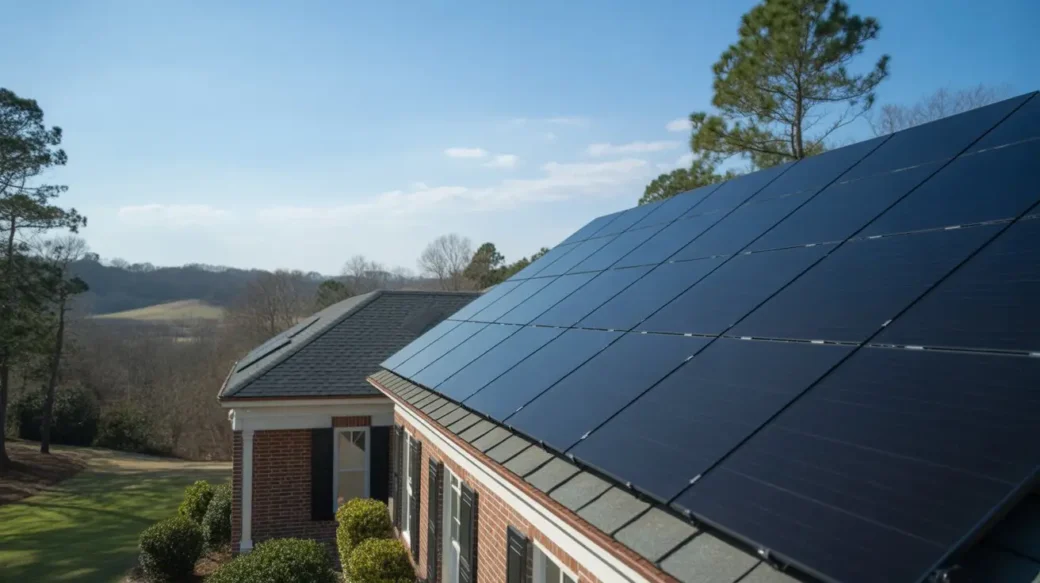
Here’s the insight that separates realistic solar planning from optimistic guessing in Georgia: the time-of-use mismatch problem.
Solar panels in Georgia produce the most electricity between 10 AM and 3 PM. Most residential electricity usage, HVAC in the evening, cooking, laundry after work, peaks between 5 PM and 9 PM. That gap is where your solar value evaporates.
Every kWh your system produces while you’re at work and the house is empty gets exported to Georgia Power at 3–5¢. Every kWh you use in the evening gets purchased from Georgia Power at 13–14¢. The system is producing exactly when you don’t need it most, and not producing when your usage is highest.
Based on SolarInfoPath’s analysis of Georgia utility billing structures in 2026, this time-of-use mismatch is the single biggest reason actual ROI falls short of projected ROI in Georgia specifically. States with full retail net metering neutralize this problem because every exported kWh gets credited at full value. Georgia’s avoided cost buyback does not.
What I noticed when I studied Georgia homeowner billing patterns specifically is that self-consumption matters far more here than in almost any other southern state. Homeowners who shift daytime loads, EV charging, pool pumps, irrigation, dishwashers, to solar production hours can improve their effective savings rate by 15–20% compared to homes where usage peaks in the evening.
Adding a home battery storage system partly addresses this problem, but batteries add $10,000–$15,000 to system cost and push payback out further. For most Georgia homeowners, battery storage doesn’t improve the financial case; it improves energy independence. Those are different things.
For homeowners curious about how solar project financing structures work behind the scenes, the guide to solar project finance covers the fundamentals in plain language.
How to Calculate If Solar Is Worth It for Your Home in Georgia
You don’t need a spreadsheet to get a reasonable estimate. Here’s the simplest version of the math that actually reflects Georgia’s conditions.
Simple Solar Payback Formula
Net system cost ÷ annual savings = payback period in years
That’s it. The hard part is getting honest numbers for both sides of that equation.
Example Calculation
- System: 8kW, standard installation in Georgia
- Total installed cost: $22,400
- Federal ITC (30%): –$6,720
- Sales tax exemption: –$896
- Net cost: $14,784
- Annual electricity savings (self-consumption): $1,050
- Annual NMR credit (excess to grid): $125
- Total annual benefit: $1,175
- Payback period: $14,784 ÷ $1,175 = 12.6 years
That’s a realistic Georgia calculation, not a marketing number.
If you want a more detailed breakdown of how solar installation timelines affect your first-year savings, How long solar installation takes in America walks through the full process from contract to activation.
Decision checkpoint: If your honest payback estimate using this formula exceeds 14 years, solar becomes financially weak unless electricity rates in Georgia rise significantly. Georgia Power has filed for rate increases before the Georgia Public Service Commission; if those increases pass, the math improves. But counting on future rate increases to justify a current investment carries real risk.
Georgia Solar Market Reality: Regional Differences That Matter
Georgia is not one solar market. The difference between northern and southern Georgia is meaningful enough to affect whether solar makes financial sense at all.
North Georgia, Atlanta, Athens, Gainesville
North Georgia averages 4.3–4.6 peak sun hours daily, solid but not exceptional. Atlanta’s suburban sprawl means many homes have tree shading issues, particularly in older neighborhoods. Installation quotes in metro Atlanta run slightly higher than the state average due to labor costs and permitting complexity.
HOA restrictions are also more common in Atlanta suburbs than in rural or coastal Georgia. Some HOAs in Alpharetta, Johns Creek, and Peachtree City have specific rules about panel visibility from the street. Navigating those approvals adds 4–8 weeks to a typical project timeline.
South Georgia: Macon, Savannah, Valdosta
Southern Georgia averages 4.7–5.1 peak sun hours daily, among the strongest in the eastern U.S. Homes in this region produce 10–15% more annual energy from a same-sized system than comparable homes in Atlanta.
That 10–15% production advantage in South Georgia can reduce payback by 1–2 years compared to North Georgia installations. A homeowner in Valdosta with a $190/month Georgia Power bill and a clean south-facing roof might see a 10–11-year payback, closer to the optimistic end of the realistic range. The same system installed in Gainesville might take 13–14 years. Geography within Georgia matters more than most installer presentations acknowledge.
Final Verdict: Are Solar Panels Worth It in Georgia in 2026?
Are solar panels worth it in Georgia? For the right home, yes, but with a longer payback window than most other states, and only if you enter the commitment understanding how Georgia Power’s buyback rate actually works.
Solar makes financial sense in Georgia when:
- Your Georgia Power bill consistently exceeds $150/month
- Your roof faces south, southeast, or southwest with minimal shading
- You spend significant time at home during daylight hours, or can shift loads like EV charging and laundry to solar production hours
- You plan to own the home for at least 12–15 years
- You have sufficient federal tax liability to claim the 30% ITC in full
Solar is harder to justify in Georgia when:
- Your bill is under $120/month
- You’re served by an EMC with no net metering policy
- Your roof has significant afternoon shading
- You’re within 8 years of selling
- You’re being offered a lease rather than a purchase
Georgia isn’t a bad state for solar; it’s a moderate state with a specific limitation that most sales presentations never honestly address. Knowing that limitation before you sign anything is what puts you in a stronger position than most homeowners who go through this process.
FAQs About Solar Panels in Georgia (2026)
How much do solar panels cost in Georgia?
A standard 8kW system costs $20,800–$25,600 installed before incentives. After the 30% federal ITC, your net cost drops to approximately $14,560–$17,920, depending on roof complexity and whether a panel upgrade is needed.
Are there free solar panels in Georgia?
No. “Free solar” offers in Georgia typically refer to zero-down solar loans or lease agreements, both of which involve monthly payments. Loans require repayment with interest; leases transfer financial obligations to future buyers and don’t qualify for the federal ITC.
What is the Georgia Power solar buyback rate in 2026?
Georgia Power credits excess solar electricity at the utility’s avoided cost rate under the Net Metering Rider (NMR) Tariff, estimated at 3–5¢ per kWh in 2026. This is not the retail rate. You pay 13–14¢ to buy electricity and receive 3–5¢ credit for electricity you send back.
How long is the solar payback period in Georgia?
For most Georgia homes with bills above $150/month, the realistic payback period is 10–14 years on a purchased system. South Georgia homeowners with higher sun hours and strong daytime usage may see payback closer to 10–11 years. Homes with bills below $120/month or EMC service without net metering may see 15+ year payback windows.
Do solar panels increase home value in Georgia?
Yes. Research from Lawrence Berkeley National Laboratory indicates solar adds approximately $3–$4 per installed watt to Georgia home values. On an 8kW system, that’s $24,000–$32,000 in added value. However, this premium applies only to owned systems; leased systems can complicate sales and may not add the same value.
This article by SolarInfoPath (2026 research framework) is part of a comprehensive solar knowledge architecture covering all major high-value sectors including legal disputes (installation negligence, contracts, liability, fraud, lawsuits, liens, HOA and permitting disputes), financial structures (loans, PPA/lease agreements, DSCR financing, tax equity, investment and project finance), tax law (ITC, Section 48/25D, MACRS depreciation, bonus credits, IRS audits, recapture rules, domestic content and IRA/OBBBA compliance), insurance and risk (property damage, hail/wind/fire claims, bad faith insurance disputes, warranty coverage), policy and regulation (net metering, FERC interconnection, state utility rules, incentive programs and regulatory changes), commercial and utility-scale development (EPC contracts, construction delays, performance bonds, receivership, bankruptcy, asset sale and restructuring), real estate impacts (home value, solar leases, liens, title issues, HOA restrictions, easements), and emerging market structures such as battery storage, community solar, agrivoltaics, SRECs, yieldcos, and institutional investment funds. All content is based on publicly available regulatory, financial, and legal sources and is intended strictly for educational and informational purposes, not legal, tax, or financial advice. Readers should always verify current laws, utility policies, tax regulations, and contract terms with qualified licensed professionals before making decisions, as solar regulations, incentives, and financial structures frequently change across jurisdictions and time.

Solar Legal Analyst· Policy Researcher· Investigative Finance Writer Lead Analyst & Founder of SolarInfoPath
Morgan Lee is a solar legal analyst, policy researcher, and investigative finance writer with 12+ years of experience in U.S. renewable energy law, IRS tax credit compliance, and solar litigation. He is the founder of SolarInfoPath, a research-driven platform focused on primary-source analysis of solar contracts, tax law, regulatory policy, and industry disputes affecting homeowners and commercial developers.
His work is grounded in original legal and regulatory sources, including IRS notices, FERC and CPUC rulings, state court filings, PACER records, and UCC lien databases. He specializes in solar contract disputes, injury and workers’ compensation claims, PACE financing issues, tax equity structures, ITC recapture rules, MACRS depreciation, and federal and state solar policy frameworks.
Morgan’s analysis spans solar litigation, finance structures, and regulatory developments such as the IRA and OBBBA, interconnection reform, domestic content rules, and battery storage incentives. He also covers EPC contracts, PPAs, project financing, and utility-scale solar investment structures.