
A PACE loan solar attorney California that homeowners hire can review three things: authorization, disclosure, and affordability. Repayment is collected through property taxes and attaches to the home. A costly agreement is not automatically fraud or unlawful. Outcomes are never guaranteed and depend on the documents, the transaction date, and the law.
Many PACE solar disputes start with a surprise. A homeowner sees a higher property tax bill and cannot recall agreeing to it. Others understood the deal but felt misled about savings, interest, or the risk to their home. This guide separates those situations so you can see which one fits.
The article covers how PACE and HERO financing work and the signs of unauthorized or misleading agreements. It also covers senior homeowner concerns and lien and foreclosure risks. Later sections explain California and federal rules, the Andrade case, Riverside resources, and the evidence worth keeping.
What Is California PACE Solar Financing and Why Do Homeowners Dispute It?
California PACE solar financing pays for a solar system through an assessment on your property. You repay it through your property tax bill, usually for many years. Disputes arise when homeowners say they never agreed, never understood the cost, or could not afford the payments.
The California Department of Financial Protection and Innovation (DFPI) states that PACE is not a free government program. Homeowners repay it through increased assessments on the annual property tax bill. That single fact explains most of the confusion.
How Property Assessed Clean Energy Financing Works
Property Assessed Clean Energy financing lets a homeowner fund eligible improvements without a separate loan payment. A program administrator arranges the assessment agreement. The assessment is recorded against the property and collected with taxes.
The agreement has a principal amount, finance charges, a term, and an annual installment. The Consumer Financial Protection Bureau (CFPB) describes covered PACE transactions as voluntary and repaid through the property tax system. The obligation follows the property, not only the person who signed.
Contractors often present the paperwork, sometimes on a tablet. That is why signature records and sales statements matter so much later.
How the HERO Solar Financing Program Worked
HERO was a California PACE program. Renovate America administered it, and the Western Riverside Council of Governments (WRCOG) and other public agencies took part. It financed solar, energy, and water improvements in many communities.
The name now points to history. Not every California PACE assessment is a HERO assessment. Do not assume the old arrangements still apply to your agreement.
PACE Financing vs. Traditional Solar Loans
A PACE assessment differs from an ordinary solar loan in how it is repaid and secured. The table shows the main contrasts. Always check your own documents.
| Feature | PACE financing | Traditional solar loan |
| Repayment | Property tax assessment | Loan payment to a lender |
| Property link | Assessment tied to the property | Depends on loan security |
| Tax bill | Assessment may appear on it | Generally separate |
| Sale of home | Needs assessment-specific review | Needs loan-specific review |
| Mortgage impact | Possible lien priority concerns | Depends on loan terms |
Leases and power purchase agreements are different again. This article stays focused on PACE.
Illustrative PACE Cost Example
The figures below are hypothetical. They are not an actual PACE offer or a market average. They show how finance charges change the true cost.
| Item | Amount |
| Financed solar project | $25,000 |
| Illustrative finance charges over the term | $12,000 |
| Total repayment | $37,000 |
| Illustrative term | 20 years |
| Average annual repayment | $1,850 |
| Average monthly equivalent | $154.17 |
Real schedules can differ. The assessment is billed annually, not in even monthly amounts. The example also leaves out any extra charges.
Salespeople sometimes mention federal incentives such as the IRS Section 48 energy credit. Tax treatment depends on who owns the system, the year, and current law. A tax professional can confirm what applies to you.
When Should Homeowners Contact a PACE Loan Solar Attorney California?
Contact a lawyer when you suspect the assessment was unauthorized, misrepresented, or unaffordable, or when a tax delinquency notice arrives. Early review protects deadlines. You do not need proof of fraud to ask for a legal opinion.
A lawyer reads the actual agreement and evidence before offering a view. No one can promise an outcome before that review.
Signs of Potential PACE Financing Fraud
Certain warning signs justify a closer look. They do not prove fraud on their own. Each needs documents behind it.
- You never signed, or the signature does not look like yours
- The agreement lists the wrong owner or property details
- You were told the project was free or government-funded
- Interest, fees, or tax bill effects were not explained
- You received no complete copy of the paperwork
- Work started before your ability to pay was reviewed
DFPI says to be cautious with promised energy savings, since savings can be overestimated. Written promises help most. Keep texts, emails, and proposals. Work that began without regard to solar panel permit requirements may also raise questions.
California PACE Loan Fraud Lawyer: Potential Legal Issues
A lawyer may evaluate several theories, depending on the facts. These can include fraud, misrepresentation, and breach of contract. Unfair competition and unauthorized assessment claims may also come up.
Each theory has its own elements and proof. A forged signature raises different issues than a misleading sales pitch. Remedies might include cancelling an assessment, restitution, or damages, but none is certain.
Homeowners sometimes ask whether to look for a California PACE loan fraud lawyer or a general consumer attorney. The better fit is a lawyer who handles real estate, lending, and consumer disputes in your county.
The contractor may be a separate target from the administrator. A solar fraud attorney may review the sales conduct, while another claim may concern the assessment itself. Ask how a firm would divide those issues.
When a Solar Financing Agreement May Be Challenged
An agreement may be challenged on several grounds. Common ones include no real authorization, wrong ownership information, and missing disclosures. Qualification problems and contract violations can also matter.
A challenge is not the same as a win. Courts look at the evidence, the contract, and the law in force when you signed. Time limits may apply.
Another owner’s consent can matter if title is shared. If a spouse or co-owner never knew, say so early.
What an Attorney May Need to Investigate
An attorney usually starts with the paper trail. The aim is to learn who did what, and when. These items come first:
- The original agreement and all disclosures
- Signature and electronic signing records
- Recorded assessment documents
- Contractor license status
- County property tax records
- Payment history
- Sales messages and promises
If the install damaged your roof or home, a solar panel property damage attorney may handle that part. That claim runs separately from the assessment. Photos and repair quotes help.
PACE Loan Senior Citizen Fraud Lawyer: Protections for Older California Homeowners
Older homeowners may have added protections, but age alone does not prove fraud. California law looks at consent, understanding, and exploitation. A PACE loan senior citizen fraud lawyer can explain which rules fit a given case.
Fixed incomes make higher tax bills hard to absorb. That is why senior cases get close attention from regulators and advocates.
Why PACE Financing Can Create Problems for Senior Homeowners
PACE obligations can last decades. A retiree may face a tax bill increase for years. Pressure at the door or at the kitchen table can add to the risk.
Common problems include confusing explanations, rushed signing, and claims that the project would pay for itself. A family member may not learn of the assessment until a bill arrives.
None of this applies to every senior or every agreement. Many older homeowners understood and chose PACE. The question is what happened in your case.
Elderly PACE Loan Predatory Lending Lawyer: What Conduct Should Be Investigated?
Investigators look at conduct, not just outcomes. A lawyer may examine undue influence, misrepresentation, and unauthorized signatures. Missing disclosures and ability-to-repay concerns are also reviewed.
Some families begin by searching for an elderly PACE loan predatory lending lawyer after finding a surprise lien. The search term matters less than the paperwork. Bring everything you can find.
Ask whether the homeowner could read and understand the documents. Language access can matter. Health, memory, and who attended the signing may also be relevant.
California Financial Elder Abuse and PACE Financing
These situations can look alike but differ in law. An unsuitable deal is not the same as a misleading pitch. A misleading pitch is not the same as a forged agreement.
California’s elder abuse laws cover certain financial exploitation of older or dependent adults. Whether a PACE transaction meets the elements depends on specific facts. Do not assume it does. Do not assume it cannot.
Evidence Seniors and Families Should Preserve
Families can help by gathering records early. Useful items include the following:
- The financing agreement and tax bills
- Sales papers and written messages
- Electronic signature records
- Payment statements
- Contractor names and license numbers
Write down who was present at signing and what was said. Dates matter. Keep notes factual.
HERO Program Solar Loan Fraud Attorney: Understanding Historical California Disputes
HERO disputes are historical but still shape how people think about PACE claims. A HERO program solar loan fraud attorney would look at the specific agreement, administrator, and date. Past cases do not decide your claim.
Two separate developments get mixed up often. One is the Renovate America class litigation. The other is the Andrade appeal.
What Happened in the Renovate America HERO Financing Cases?
The Renovate America Finance Cases involved claims about disclosure of certain interest and fees in HERO financing. The settlement received final approval on March 4, 2022. Settlement terms and limits are on the official settlement website.
Riverside County District Attorney information warns that assistance payments tied to the settlement were suspended after the company’s bankruptcy. Check that office for the current status. Do not treat the settlement as a compensation fund open today.
Some homeowners ask whether a solar panel class action lawsuit exists for their problem. Class cases cover shared claims, such as one set of disclosures. They do not replace an individual review of your contract.
Andrade v. Western Riverside Council of Governments
This 2024 California appellate case involved a homeowner who said contractors forged her signature on PACE agreements. She alleged a lien and higher tax assessments she had not agreed to. The Fourth Appellate District decided it on February 20, 2024.
The issue on appeal was attorney fees under Civil Code section 1717. The trial court had denied fees because the contract clause covered only a judicial foreclosure action. The appeals court reversed and sent the case back to decide whether she was the prevailing party.
It did not hold that all PACE assessments are invalid. It also does not promise fees to other homeowners.
What These Historical Cases Mean for Other Homeowners
A past ruling does not prove another person’s claim. Outcomes turn on evidence and contract wording. The transaction date and the administrator also matter.
Think of these cases as examples of the questions courts ask. They show that forgery allegations, fee clauses, and disclosures all get examined. They are not predictions.
A second look at HERO history also helps avoid outdated hopes. Some programs ended or changed. Verify what is still available.
Riverside Solar PACE Loan Attorney: Local California Financing Disputes
Riverside County homeowners face the same legal issues as others, with local records and resources. A Riverside solar PACE loan attorney would need county tax and recorder documents. The history of HERO in this region explains why Riverside searches are common.
Local details change, so confirm contact points with the county.
Western Riverside Council of Governments and Historical HERO Financing
WRCOG was a public agency participant in the historical HERO program. Its role is part of the regional history. Some disputes, including Andrade, name WRCOG.
Many assessment disputes begin with a tax bill line item. Identify which program and administrator appear on your records. That tells you where to send questions.
Riverside County Consumer Protection Resources
Several offices accept PACE questions. The Riverside County District Attorney posts consumer fraud and PACE information. DFPI takes complaints about PACE administrators, and the Contractors State License Board handles licensing issues.
Historical assistance arrangements may no longer be available. Verify current availability before relying on them. DFPI’s phone number and complaint steps are on its PACE page.
How Riverside Homeowners Can Review a Disputed Assessment
Start with county records. Request your tax bill details and the recorded assessment documents. Compare them with your copy of the agreement.
Then check the contractor’s license and the administrator named on your papers. Gather payment statements. Note any mismatch between the records and what you remember.
PACE Solar Tax Lien Foreclosure Attorney: Understanding Property and Mortgage Risks
A PACE assessment attaches to the property, so unpaid amounts can lead to serious consequences. A PACE solar tax lien foreclosure attorney can explain how collection works in your county. The risk is real but not automatic.
Do not ignore notices. Read every deadline.
Does a PACE Assessment Create a Lien Against a California Property?
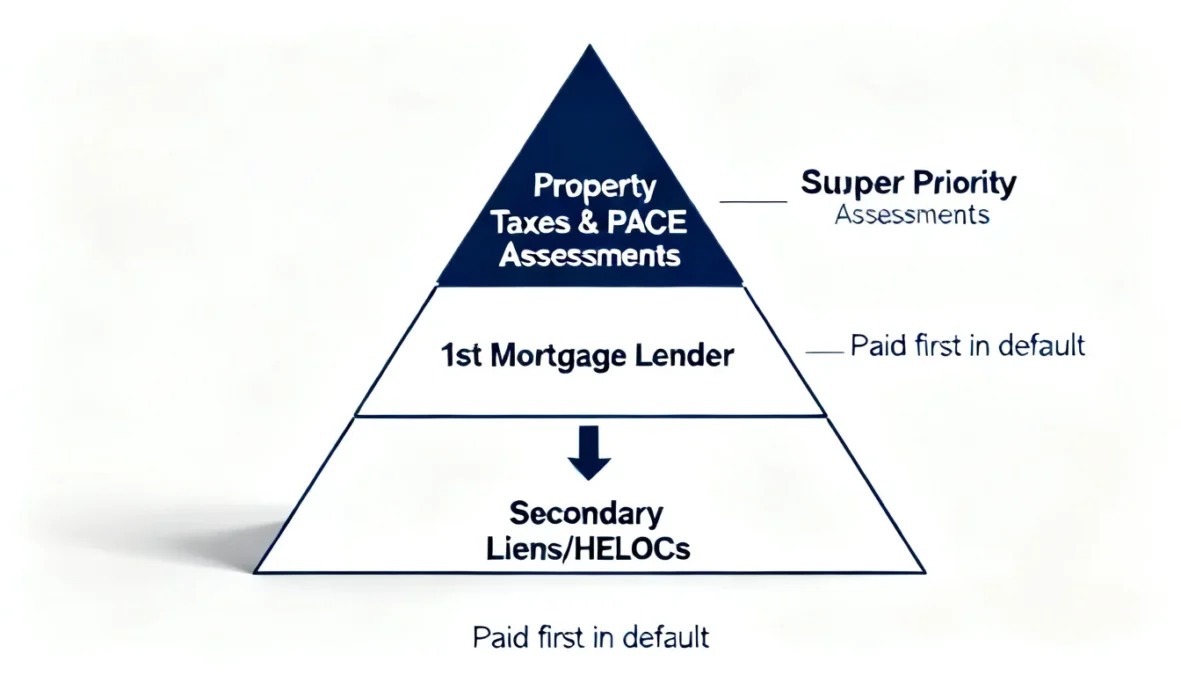
Yes, a PACE assessment is generally recorded and collected as a lien on the property. The California Treasurer’s Office says PACE assessments can have priority over other property-based debts in foreclosure. Priority rules are technical, so ask about your own record.
PACE is not just another unsecured loan. That is the key difference when mortgage and foreclosure questions arise.
PACE Solar Lien Priority Mortgage Lawsuit: What Homeowners Should Understand
Lien priority is the order in which debts are paid if a property is sold or foreclosed. Mortgage lenders pay attention to PACE assessments for that reason. A homeowner might see a PACE solar lien priority mortgage lawsuit mentioned online and assume every case is alike.
It is not. Each dispute depends on the documents, the lender, and the date. Servicers may also raise the escrow payment when taxes rise.
PACE Solar Loan Foreclosure Defense: What Happens When Assessments Become Delinquent?
Delinquent PACE assessments are handled through the property tax collection process. Penalties and tax-default procedures can follow. Some counties describe a multi-year path before a tax sale, so check your county.
Anyone researching PACE solar loan foreclosure defense should act before deadlines pass. A lawyer can read notices and explain options. Not every lien leads to foreclosure.
Ask the tax collector about payment plans and exact dates. Keep proof of every payment.
Can a Homeowner Sell or Refinance a Property With a PACE Assessment?
Often yes, but the assessment needs attention. A buyer or lender may require payoff or special handling. Title review will show the recorded assessment.
Refinancing can be harder if the lender objects to the lien. Contact your servicer early. Ask for written requirements.
If you belong to an association, also review HOA solar panel restrictions. Those rules concern installation and appearance, not the assessment. They can still affect a sale or a dispute over the system.
California PACE Financing Consumer Protection and Ability-to-Repay Rules
California and federal rules both regulate PACE. Which ones apply depends on the date of your agreement. Read both layers before drawing conclusions.
Consumer protection laws in the USA range from federal credit statutes to state licensing rules. PACE sits across several of them.
California Financial Code Requirements for PACE Assessments
California Financial Code sections 22686 and 22687 address ability to pay. A program administrator must make a reasonable, good-faith determination that the owner can pay the annual obligations. The review looks at income, assets, and current debt.
Limited exceptions exist, so read the statute. DFPI also describes AB 2063. It bars an administrator from executing an agreement before the ability-to-pay determination. It also bars a contractor from starting work first. Do not treat this as automatic voiding of older agreements.
Federal PACE Rules Under Regulation Z
The CFPB issued its residential PACE final rule on December 17, 2024. It became effective March 1, 2026. The rule brings PACE under the Truth in Lending Act and Regulation Z.
It adds ability-to-repay requirements and PACE-specific Loan Estimate and Closing Disclosure forms. It also addresses certain escrow considerations. The rule does not apply to every earlier transaction in the same way. Check coverage, exceptions, and the current status of the rule before relying on it.
Contractor Licensing and PACE Administrator Verification
You can verify a contractor’s license with the Contractors State License Board. DFPI offers information on PACE program administrators. Check both before and after signing.
Look at program documents too. They name the administrator and the assessment terms. A mismatch is worth raising with a lawyer.
PACE Solar Financing Consumer Protection: Which Rules May Apply?
Several layers may apply to one transaction. State financial rules cover administrators. Federal credit rules may apply by date. Contractor and unfair practices laws can reach sales conduct.
Understanding PACE solar financing consumer protection means separating those layers. A disclosure issue and a licensing issue are different claims. Consumer protection laws in the USA also vary by state, so California rules control here.
Homeowners with a fresh contractor deal sometimes ask how to get out of solar contract terms. The installer agreement may have its own cancellation rights, separate from the assessment. Check both documents.
What Evidence Should Homeowners Collect Before Challenging a PACE Assessment?
Collect the agreement, tax records, and contractor papers before taking action. Organized evidence makes every consultation more useful. It also protects you if deadlines approach.
Financing and Contract Documents
Gather the PACE agreement and disclosures. Add financing schedules and electronic signature records. Include the contractor agreement.
If you only have a link or email, save it now. Electronic records can vanish.
Property Tax and Mortgage Records
Pull your recent property tax statements and assessment history. Add mortgage escrow statements and any recorded liens. Keep all delinquency notices.
Compare each year’s bill with the year before. Note when the assessment first appeared.
Solar Installation and Contractor Records
Save invoices, system specifications, inspection records, and warranties. Note the contractor’s license number. Keep messages about promised savings.
Check whether local solar panel permit requirements were met, since missing permits can signal a problem. Also keep any HOA approval, since HOA solar panel restrictions sometimes apply.
Missing work, defects, or contractor disappearance may support separate claims. Some homeowners search for a sue a solar company lawyer at this stage. A consumer attorney can tell you whether the claim belongs against the contractor, the administrator, or both.
Questions to Ask When Evaluating a Potential Legal Claim
Use these questions to organize your review:
- Was the financing actually authorized?
- Were required disclosures provided?
- Was ability to repay assessed?
- Was the assessment recorded correctly?
- Did the contractor make misleading statements?
- Are any deadlines close?
If you cannot answer one, write that down. The gap itself is useful information. Also verify any tax-credit claims, such as the IRS Section 48 energy credit, with a tax professional.
Homeowners who type “sue a solar company lawyer” into search should bring these answers to the first call. Ask whether the firm has handled PACE matters. Defective work may call for a solar panel property damage attorney. Deceptive sales conduct may call for a solar fraud attorney.
Ask again how to get out of solar contract terms in the installer agreement. A group claim, such as a solar panel class action lawsuit, depends on whether others share your facts.
Final Considerations for Homeowners Seeking a PACE Loan Solar Attorney California
Authorization and disclosure documents decide most PACE disputes. Tax and mortgage effects need their own review. Senior homeowners may need added consumer-protection analysis.
Check legal deadlines promptly. Historical settlements do not guarantee compensation today. Preserve county records, tax bills, and payment history.
An attorney’s review should rest on your actual contract and evidence. Verify current rules with DFPI, the CFPB, and your county before acting.
Frequently Asked Questions About California PACE Solar Financing and Legal Disputes
What is a PACE solar loan in California?
It is financing for a solar system repaid through your property tax bill. The assessment is tied to your property. It is not a free government program.
Can a homeowner challenge a PACE assessment?
Sometimes. Grounds can include lack of authorization, misrepresentation, or disclosure problems. Results depend on evidence and the law at signing.
Is the HERO program still operating?
HERO is a historical program name tied to Renovate America. Check current program status with official sources. Do not assume old arrangements remain.
Can an unauthorized PACE assessment be removed?
It may be possible in some cases. The path depends on proof, the administrator, and the county. Nothing is automatic.
Can a PACE lien affect a mortgage?
Yes, it can. PACE assessments may have priority over certain other debts. Lenders may also adjust escrow payments.
Can an unpaid PACE assessment cause foreclosure?
Unpaid assessments can lead to tax-default procedures. Not every delinquency ends in foreclosure. Act on notices quickly.
Are senior homeowners protected against PACE financing fraud?
Some protections exist, including ability-to-pay rules and elder abuse laws. Age alone does not prove wrongdoing. Individual facts decide.
What is California’s PACE ability-to-repay requirement?
An administrator must reasonably determine you can pay the annual obligations. It reviews income, assets, and current debts. Limited exceptions may apply.
Can a homeowner sell a property with an outstanding assessment?
Often yes, with payoff or transfer steps. Title and lender requirements vary. Review them before listing.
What happened in the Andrade v. WRCOG case?
A homeowner alleged forged signatures on PACE agreements. An appeals court reviewed a fee denial and sent it back. It was not a ruling on all PACE assessments.
Does the March 2026 federal PACE rule apply to older agreements?
Not automatically. Coverage depends on the transaction and the rule’s terms. Have a lawyer check your date.
Where can homeowners report PACE financing concerns?
Start with DFPI for administrator complaints. Contractor issues go to the Contractors State License Board. The Attorney General and county offices also take consumer reports. For the official state overview, see the DFPI PACE page.
This article by SolarInfoPath (2026 research framework) is part of a comprehensive solar knowledge architecture covering all major high-value sectors including legal disputes (installation negligence, contracts, liability, fraud, lawsuits, liens, HOA and permitting disputes), financial structures (loans, PPA/lease agreements, DSCR financing, tax equity, investment and project finance), tax law (ITC, Section 48/25D, MACRS depreciation, bonus credits, IRS audits, recapture rules, domestic content and IRA/OBBBA compliance), insurance and risk (property damage, hail/wind/fire claims, bad faith insurance disputes, warranty coverage), policy and regulation (net metering, FERC interconnection, state utility rules, incentive programs and regulatory changes), commercial and utility-scale development (EPC contracts, construction delays, performance bonds, receivership, bankruptcy, asset sale and restructuring), real estate impacts (home value, solar leases, liens, title issues, HOA restrictions, easements), and emerging market structures such as battery storage, community solar, agrivoltaics, SRECs, yieldcos, and institutional investment funds. All content is based on publicly available regulatory, financial, and legal sources and is intended strictly for educational and informational purposes, not legal, tax, or financial advice. Readers should always verify current laws, utility policies, tax regulations, and contract terms with qualified licensed professionals before making decisions, as solar regulations, incentives, and financial structures frequently change across jurisdictions and time.

Solar Legal Analyst· Policy Researcher· Investigative Finance Writer Lead Analyst & Founder of SolarInfoPath
Morgan Lee is a solar legal analyst, policy researcher, and investigative finance writer with 12+ years of experience in U.S. renewable energy law, IRS tax credit compliance, and solar litigation. He is the founder of SolarInfoPath, a research-driven platform focused on primary-source analysis of solar contracts, tax law, regulatory policy, and industry disputes affecting homeowners and commercial developers.
His work is grounded in original legal and regulatory sources, including IRS notices, FERC and CPUC rulings, state court filings, PACER records, and UCC lien databases. He specializes in solar contract disputes, injury and workers’ compensation claims, PACE financing issues, tax equity structures, ITC recapture rules, MACRS depreciation, and federal and state solar policy frameworks.
Morgan’s analysis spans solar litigation, finance structures, and regulatory developments such as the IRA and OBBBA, interconnection reform, domestic content rules, and battery storage incentives. He also covers EPC contracts, PPAs, project financing, and utility-scale solar investment structures.