
Solar Installation Permit Manual Tasks Pain Points 2026 come down to one reality: going solar involves a local application, technical drawings, plan review, inspections, and, usually, a separate utility interconnection process. Requirements, fees, and timing depend on your jurisdiction and project type, and most delays start with missing or inconsistent paperwork.
Whether you’re a homeowner planning rooftop panels, an installer juggling paperwork, or a landowner exploring a larger project, the approval path follows the same basic order:
- Find your authority: the city or county office that approves work at your address.
- Build the package: forms, drawings, and equipment documents.
- Clear plan review: answer comments and correction notices.
- Pass inspection: the installed system must match the approved plans.
- Connect to the grid: the utility reviews interconnection and grants permission to operate (PTO).
Rules vary by location. The U.S. Department of Energy notes that local governments generally require permits for rooftop solar, inspections help verify code compliance, and utility interconnection is a separate step. NLR (the National Laboratory of the Rockies, formerly NREL) describes about 20,000 jurisdictions and thousands of utilities in its research. That’s why no single national checklist fits every home.
1. Who Approves What in the Approval Process?
Several groups play a role, and each approval is separate. Your local authority approves construction, inspectors check the finished work, and the utility approves the grid connection. One approval never replaces another.
Most confusion starts here. People mix up building and electrical permits, assume one approval covers everything, or treat utility approval as part of the building permit.
Find the Authority Having Jurisdiction
Your Authority Having Jurisdiction (AHJ) is the office that enforces building, electrical and fire codes at your property. It’s usually your city, but homes in unincorporated areas fall under the county.
To find yours:
- Search your city or county’s official .gov website for “residential PV permit” or “solar application.”
- Check whether the property sits inside city limits.
- Call the building department to confirm before submitting.
- Ask whether planning, fire, or historic reviews also apply.
Separate Permits, Inspections and Utility Approval
Think of these as four checkpoints run by different offices:
- Permit review: the local AHJ approves the proposed work under its rules.
- Inspection: the local inspection authority checks the installed work.
- Interconnection: the utility, or the relevant authority, approves the grid connection.
- Permission to operate: the utility confirms the system may run.
The order isn’t fixed everywhere. NLR notes that local permits and utility approvals can sometimes run in parallel, and interconnection rules are often set at the state level. Follow your own AHJ and utility instructions.
Who Does What
A typical residential project involves these roles:
- Property owner: provides property details and signs authorizations.
- Solar installer: prepares system documents and usually submits the application.
- Licensed electrician: handles electrical design and work where required.
- Professional engineer or registered design professional: prepares structural calculations or stamps when needed.
- Plan reviewer and building official: review the application and structural safety.
- Electrical inspector: checks electrical code compliance.
- Fire marshal: reviews fire-safety items such as access pathways.
- Planning department and county planning commission: handle zoning and land use.
- Historic preservation office: adds review in historic districts.
- HOA: private approval, separate from any government permit.
- State energy office: may publish guidance or standard forms.
- Utility: manages interconnection, the meter, and PTO.
2. Solar Permit Paperwork: Documents to Prepare Before Applying
A complete, consistent package prevents most delays. A typical solar permit application may ask for several documents, but your AHJ’s own checklist decides the final list.
Common frustrations at this stage include not finding the current form, conflicting instructions on government websites, unclear drawing-scale or file-naming rules, and rejections over a single missing page.
What Each Document Does
These items may be requested, depending on your location:
- Application form: identifies the property, applicant, contractor, and project.
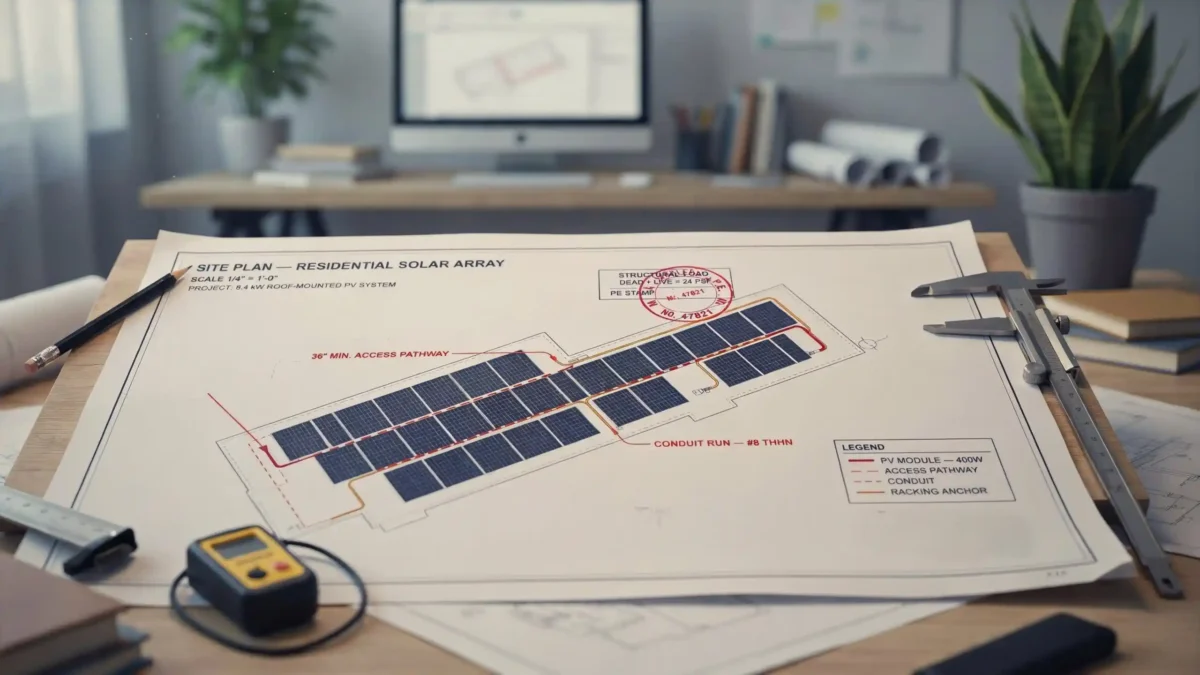
- Site plan: shows where equipment sits on the property.
- Roof or array plan: shows panel placement, layout, and setbacks.
- Electrical single-line diagram: shows how the system connects electrically.
- Module and inverter specifications: identify panel characteristics and electrical ratings.
- Structural calculations: support review when the roof or design requires it.
- Roof attachment details: show how racking connects to the structure.
- Contractor credentials: prove required licenses.
- Battery documents: needed when storage is included.
2026 reference: the September 2026 second edition of the National Simplified Residential PV and Energy Storage Permit Guidelines, from the Sustainable Energy Action Committee, offers current guidance on residential solar and battery documentation. Use it alongside your local checklist, not instead of it.
Pre-Submission Consistency Audit
Run through this list before you submit:
- ☐ The property address matches on every page.
- ☐ Owner and contractor names are spelled the same everywhere.
- ☐ Module and inverter models match across forms and drawings.
- ☐ System size (kW DC) and inverter capacity (kW AC) agree everywhere.
- ☐ Every drawing is the latest version and dated.
- ☐ Signatures and any engineering stamps are present.
- ☐ Files follow the required format and naming rules.
- ☐ Local, jurisdiction-specific forms are attached.
- ☐ The contractor license is current.
- ☐ Fees come from the current official schedule.
Who Usually Files?
In most projects, the installer submits the application, prepares drawings (sometimes with a design firm or engineer), answers corrections, and schedules inspections. Permit fees are often included in the installer’s quote, but confirm that in writing.
Some AHJs let homeowners file their own applications. Even then, the homeowner may need to sign forms and provide site access. Utility interconnection may be handled by either party, depending on the utility.
Real local examples show how much processes differ. San Diego published a dedicated PV permit bulletin in May 2026. Philadelphia and Montgomery County, Maryland, each publish their own online process, and Washoe County and New York City route reviews in their own ways.
3. Solar Panel Permit Requirements: Why Applications Get Returned
Most returned applications come from preventable mistakes, not from failed technical reviews. Learning your local solar panel permit requirements before you submit is the surest way to avoid a correction loop.
People most often fear that one small error will restart the entire process. Usually it doesn’t, but each correction round adds days.
Common Paperwork and Coordination Mistakes
Here’s what tends to go wrong, and how to prevent it:
- Missing attachment: compare your package with the current official checklist.
- Conflicting equipment details: check models and ratings across every document.
- Outdated plan version: keep a revision log and label the current version clearly.
- Unanswered review comment: respond to each comment individually.
- Wrong form or file format: follow the jurisdiction’s submission instructions exactly.
- Unclear responsibility: record who prepares, submits, and revises each item.
- Expired contractor credential: verify license status before filing.
- Wrong code edition: confirm which edition your AHJ has adopted.
Decode the Correction Notice
Sort every comment into one of three types:
- Missing document, such as “provide inverter specification sheet.” Upload the file.
- Technical revision, such as “show the disconnect on the single-line diagram.” Update the drawing and log the change.
- Administrative correction, such as “contractor name doesn’t match license.” Fix the form or the credential record.
How to Respond to a Correction Notice
- Read every comment and note which department wrote it.
- Assign each comment to the right person.
- Update only the affected documents.
- Record each change in a revision log.
- Write a short reply for each comment.
- Resubmit through the official channel.
- Save the resubmission receipt and date.
A simple correction log helps. For each comment, note the department, the issue, who owns the fix, the date it was fixed, and the date it was resubmitted. In a fictional example, an address typo might be fixed on day one, a missing disconnect label on day three, and an unclear attachment detail on day five.
For a homeowner-focused overview, see our homeowner guide to rooftop permit rules.
Ask your AHJ whether a resubmission restarts the review clock or continues the existing review.
Solar Installation Permit Manual Tasks Pain Points 2026: Where Delays Begin
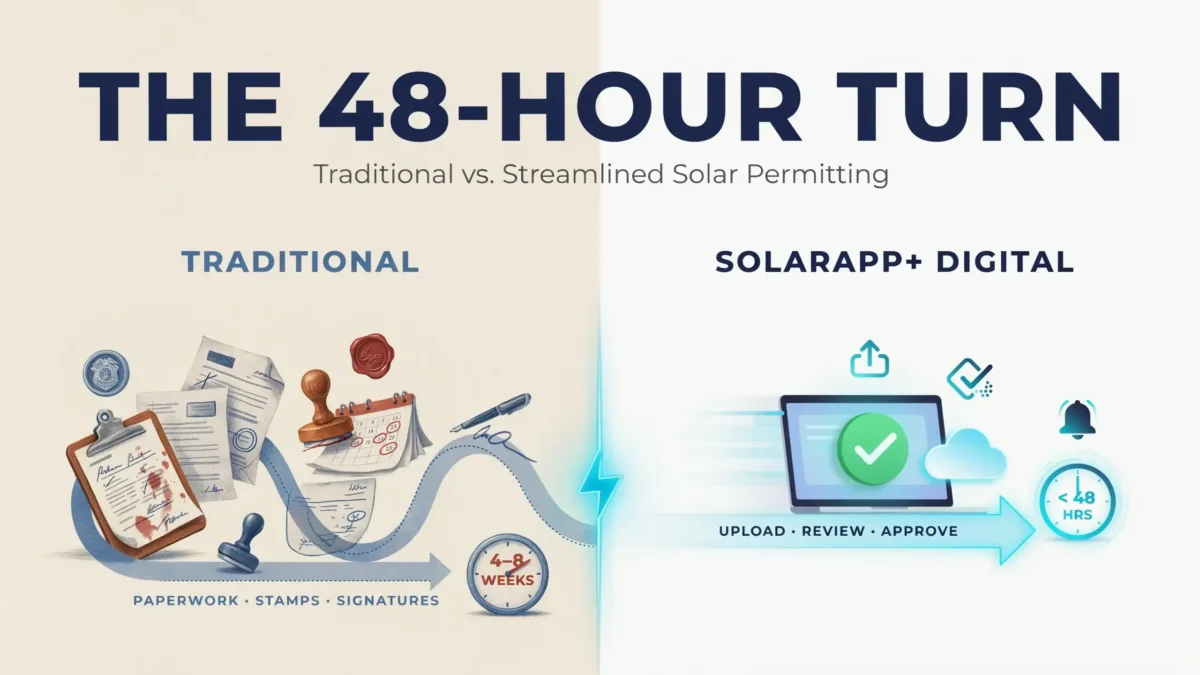
Most delays begin before a reviewer opens the file. Incomplete forms, mismatched drawings, repeated data entry, correction cycles, unclear ownership, and separate utility approvals all add time.
DOE identifies permitting, inspection, and interconnection inefficiencies as contributors to solar “soft costs,” the non-hardware costs of going solar. They show up as staff hours, rework, and waiting.
What surprised me while researching this guide was how often a delay traced back to one mismatched detail, such as an inverter model on the drawing that didn’t correspond to its spec sheet. A single typo can cost a full review cycle.
The six most common bottlenecks are:
- Incomplete forms: missing fields or attachments
- Inconsistent drawings: mismatched equipment or system size
- Repeated data entry: the same details typed into several portals
- Correction cycles: multiple rounds of comments
- Unclear responsibilities: nobody owns the next step
- Separate utility approvals: interconnection treated as an afterthought
4. Manual Permit Tasks That Create Administrative Friction
The real friction comes from handoffs, duplicate uploads, version confusion, and poor status visibility, not just from having permits.
Map the Manual Work
Each manual task carries a risk, and each risk has a simple control:
- Re-entering project details creates inconsistent data. Keep one verified project record and copy from it.
- Uploading files to several portals leads to missing or duplicate files. Use a submission checklist.
- Revising drawings risks outdated versions. Maintain a revision log.
- Checking application status leaves the next step unclear. Record dates and open items.
- Coordinating inspection risks missed milestones. Track prerequisites and confirmations.
- Managing utility paperwork blurs separate approvals. Keep a separate interconnection checklist.
- Swapping equipment after approval creates mismatches. Submit revised specs before installing.
- Tracking permit expiration prevents lapses. Note the expiration date on day one.
Where Permitting Automation May Help
Standard forms, automated checks and digital tracking reduce repetitive work, but only where your jurisdiction uses them.
- SolarAPP+ automates review of eligible residential solar applications in participating jurisdictions. Check SolarAPP+ to see whether your AHJ participates.
- SolarTRACE helps estimate permitting, inspection, and interconnection cycle times. It can’t predict your exact approval date.
- Online portals let applicants upload documents and track progress.
- Unified forms, such as New York’s Unified Solar Permit, standardize paperwork for qualifying projects.
Automation doesn’t remove local requirements, technical review, or inspection, and it never guarantees approval.
5. How Long Does Approval Take?
It varies widely by jurisdiction, application type, and how complete your package is. No national timeline is reliable, so rely on your AHJ’s published targets and track your own milestones.
Review backlogs at busy offices, unclear start dates, and quotes that can’t be checked against local data are the main frustrations here.
Initial Review Versus Total Approval Time
An initial-review target isn’t the whole timeline. The full path can include initial review, correction comments, resubmission review, permit issuance, installation, inspection (and reinspection if needed), utility interconnection, and, finally, PTO.
Montgomery County, Maryland, and other jurisdictions publish their own procedures and processing claims. Check those dated pages rather than trusting a national average.
Business Days Versus Calendar Days
Always ask which one your AHJ means. A “5-day review” that starts Monday ends the following Monday in business days, but Saturday in calendar days. A holiday adds another business day.
Project Timeline Tracker
Keep a simple running list with dates and notes for each milestone:
- ☐ Application submitted (tracking number: ____)
- ☐ First review comments received
- ☐ Corrections resubmitted
- ☐ Permit issued (expiration date: ____)
- ☐ Installation completed
- ☐ Inspection scheduled
- ☐ Inspection result: pass or correction
- ☐ Interconnection application submitted
- ☐ PTO granted
For realistic overall timing, see how long solar installation takes in America.
6. Do I Need a Building Permit to Add Solar Panels to My Home?
Usually yes. DOE says local governments generally require permits for rooftop solar, but which permits apply depends on where you live and what work you’re doing. The answer to “do i need a building permit to add solar panels to my home?” always depends on your property’s jurisdiction and the project scope.
Homeowners often aren’t sure whether they’re exempt, whether structural review applies, or whether a battery or panel upgrade adds permits. HOA approval also gets mistaken for a government permit.
Which Permits May Apply
Depending on your AHJ and project, you may need:
- A building permit for roof-mounted systems and structural attachments
- An electrical permit for PV wiring and connections
- Structural review for roof loading, attachments, or modifications
- Fire review for access pathways, rapid shutdown, or batteries
- Battery review when energy storage is added
- A main-panel upgrade permit when service capacity changes
- Historic review in historic districts
- Zoning review for some ground-mounted systems
What Changes When You Add a Battery
Adding storage usually brings extra steps. You’ll typically need battery specification sheets, the AHJ will check battery placement and clearances, fire review becomes more likely, and electrical review expands to cover storage connections. For storage planning, see choosing home battery storage.
How to Confirm Your Local Requirements
- Identify the city or county authority for the property.
- Find its official residential PV page.
- Download the current application and checklist.
- Confirm building, electrical, structural, and battery requirements.
- Ask about any uncertain exemption before starting work.
Never begin installation before the permit is issued, and never skip inspection.
7. Solar Farm Permits: Zoning, Site Development and Additional Reviews
Large projects face far more reviews than rooftop systems. Depending on the site, solar farm permits can include land-use approval, special-use permits, environmental screening, stormwater plans, access-road approvals, electrical approvals, and interconnection.
Developers and landowners often underestimate how many authorities are involved. Zoning approval gets confused with building permits, and public hearings or stormwater requirements surface late.
How Large Projects Differ From Rooftop Solar
A residential rooftop system usually needs only building and electrical permits, with planning review rare and environmental review rarer still. A utility-scale solar farm commonly needs land-use or zoning approval and a site plan. It may need environmental review, a stormwater plan, access-road approval, a public hearing, and a decommissioning plan. Its interconnection is also typically larger and more complex.
NYSERDA’s guidance shows how larger New York projects can need zoning or special-use approvals and local environmental review. Not every project needs every category.
Pre-Application Coordination Checklist
- ☐ Local planning authority and zoning rules
- ☐ Special-use permit requirements
- ☐ Environmental agencies with jurisdiction
- ☐ Stormwater management authority
- ☐ Access road and site work approvals
- ☐ Utility interconnection process and queue
- ☐ Project engineer and site plans
- ☐ Landowner documents and lease
- ☐ Public hearing schedule, if required
- ☐ Decommissioning plan requirements
For land and cost context, see utility-scale solar cost and land rules. Contact the county planning department early, because land-use rules shape every later step.
8. Permit Fees and Administrative Delay Costs
Official permit fees are only part of the cost. Plan preparation, engineering, inspections, reinspections, and staff time add up, and no single national fee is representative.
People often don’t know how fees are calculated, get charged again after revisions or reinspection, or can’t tell whether fees are in their installer’s quote.
Separate Official Fees From Other Costs
Verify each cost from the right source:
- Permit fee: the official local fee schedule
- Plan preparation: a written scope and quote
- Engineering: a project-specific estimate
- Inspection or reinspection: the local fee schedule
- Administrative labor: documented time or contractor scope
- Delay-related cost: your own explicit assumptions, since there’s no universal rate
When you check fees, write down each amount and the date you checked the source. Add the building, electrical, plan-review, and any reinspection fees for your official total.
Optional Delay-Cost Calculation
Estimated delay cost = daily cost assumption × delay days
Hypothetical example: if a delay costs a project $150 a day in rescheduling and staff time, a 14-day correction cycle equals $2,100. That’s an illustration only, not a typical U.S. cost or a guaranteed loss. For broader pricing context, see average U.S. residential solar prices.
9. How Permitting Software and Standardized Workflows Help
Digital portals, standard forms, and tracking tools reduce repetitive work and improve visibility, but they don’t remove local rules or guarantee approval.
In a manual process, reviewers read every item, details are retyped across forms, status comes through phone calls and emails, and timelines are guesswork. In a standardized or automated workflow, completeness checks run automatically, one verified record is reused, status shows on a dashboard, eligible projects may be auto-reviewed, and cycle-time data replaces guesswork.
Key tools to know:
- SolarAPP+: automated review for eligible residential projects in participating areas.
- SolarTRACE: timeline research for permitting, inspection, and interconnection.
- Unified Solar Permit (New York): a standard form for qualifying small residential systems. NYSERDA describes its scope as systems of 25 kW DC and under, though local adoption varies. NYSERDA has also noted New York’s 1,607 municipalities, which shows how fragmented local permitting can be. Verify that figure before quoting it as current.
Commercial permitting software, plan preparation services, and permit expediters also exist. Judge them neutrally on scope, cost, and whether your AHJ accepts their output.
10. Inspection, Interconnection and Closeout
After installation, the system must pass inspection and then go through the utility’s separate interconnection and PTO process. A permit alone doesn’t let you switch the system on.
Hard-to-schedule inspections, failures because equipment differs from the approved plans, and long waits for meter changes are the usual pain points.
Inspection-Day Checklist
- ☐ Approved plans on site
- ☐ Permit card posted, if required
- ☐ Equipment matches approved specifications
- ☐ Labels and disconnects in place
- ☐ Clear access to the roof and electrical panel
- ☐ Someone present to provide access
If the Inspection Fails
- Read the inspector’s correction notes.
- Fix the listed items.
- Update documents if equipment changed.
- Request a reinspection.
- Check whether a reinspection fee applies.
Utility Interconnection Checklist
- ☐ Interconnection application submitted
- ☐ Required technical documents provided
- ☐ Inspection approval sent to the utility
- ☐ Meter replacement scheduled, if needed
- ☐ Export limits or net-metering terms confirmed
- ☐ PTO received in writing
Interconnection delays are common. See why interconnection delays stretch project timelines.
Closeout Records to Save
Keep the final permit, inspection approval, PTO letter, as-built drawings, equipment warranties, and your correction log. You may need them for warranty claims, insurance, or a future home sale. If delays turn into a contract dispute, review what your solar contract says about delays.
Final Permit-Readiness Checklist and Next Steps
Solar Installation Permit Manual Tasks Pain Points 2026 are manageable when you organize your paperwork, track every milestone, and verify local rules early. Use this checklist to finish strong.
Before submission:
- ☐ Identify the correct local authority
- ☐ Download the current application and checklist
- ☐ Confirm which permit types apply
- ☐ Check document and drawing requirements
- ☐ Confirm the fee schedule and submission method
- ☐ Assign responsibility for each document
After submission:
- ☐ Save the application receipt and tracking number
- ☐ Record review dates and comments
- ☐ Maintain a correction and revision log
- ☐ Schedule inspections through the official process
- ☐ Track utility interconnection separately
- ☐ Save final approvals and closeout records
Quick readiness check: Have you identified your authority, downloaded current forms, checked that documents are consistent, verified fees, assigned responsibilities, and started interconnection planning? Six yeses mean you’re as prepared as paperwork allows. Any “no” is where your next delay is most likely to start.
Quick Answers
Which permits may a residential system need?
Often a building permit and an electrical permit, plus structural, fire, or battery review where relevant. Your AHJ decides the exact list.
How do I find my local permitting authority?
Search your city or county’s official website, or call the building department. Unincorporated areas usually fall under the county.
What documents are commonly required?
An application form, site plan, roof plan, electrical diagram, equipment specifications, and sometimes structural calculations. Always check your AHJ’s current checklist.
Why might an application be returned?
Usually missing attachments, mismatched equipment details, outdated drawings, or unanswered comments. A pre-submission audit catches most of these.
How long does approval take?
It varies by jurisdiction and completeness. Use your AHJ’s published targets, and remember that initial review isn’t final approval.
Is a permit the same as utility interconnection approval?
No. The local authority approves construction, while the utility separately approves the grid connection and grants PTO.
What happens if an inspection fails?
You fix the listed items and request a reinspection, which may carry a fee. Update documents if equipment changed.
Does adding a battery change the process?
Often, yes. Batteries can add equipment, location, fire, and electrical review requirements.
What approvals might a large solar project need?
Possibly zoning, special-use, environmental, stormwater, access-road, electrical, and interconnection approvals, depending on the site.
Can automated permitting guarantee approval?
No. Tools like SolarAPP+ only apply to eligible projects in participating areas, and inspection and utility approval still apply.
This article by SolarInfoPath (2026 research framework) is part of a comprehensive solar knowledge architecture covering all major high-value sectors including legal disputes (installation negligence, contracts, liability, fraud, lawsuits, liens, HOA and permitting disputes), financial structures (loans, PPA/lease agreements, DSCR financing, tax equity, investment and project finance), tax law (ITC, Section 48/25D, MACRS depreciation, bonus credits, IRS audits, recapture rules, domestic content and IRA/OBBBA compliance), insurance and risk (property damage, hail/wind/fire claims, bad faith insurance disputes, warranty coverage), policy and regulation (net metering, FERC interconnection, state utility rules, incentive programs and regulatory changes), commercial and utility-scale development (EPC contracts, construction delays, performance bonds, receivership, bankruptcy, asset sale and restructuring), real estate impacts (home value, solar leases, liens, title issues, HOA restrictions, easements), and emerging market structures such as battery storage, community solar, agrivoltaics, SRECs, yieldcos, and institutional investment funds. All content is based on publicly available regulatory, financial, and legal sources and is intended strictly for educational and informational purposes, not legal, tax, or financial advice. Readers should always verify current laws, utility policies, tax regulations, and contract terms with qualified licensed professionals before making decisions, as solar regulations, incentives, and financial structures frequently change across jurisdictions and time.

Solar Legal Analyst· Policy Researcher· Investigative Finance Writer Lead Analyst & Founder of SolarInfoPath
Morgan Lee is a solar legal analyst, policy researcher, and investigative finance writer with 12+ years of experience in U.S. renewable energy law, IRS tax credit compliance, and solar litigation. He is the founder of SolarInfoPath, a research-driven platform focused on primary-source analysis of solar contracts, tax law, regulatory policy, and industry disputes affecting homeowners and commercial developers.
His work is grounded in original legal and regulatory sources, including IRS notices, FERC and CPUC rulings, state court filings, PACER records, and UCC lien databases. He specializes in solar contract disputes, injury and workers’ compensation claims, PACE financing issues, tax equity structures, ITC recapture rules, MACRS depreciation, and federal and state solar policy frameworks.
Morgan’s analysis spans solar litigation, finance structures, and regulatory developments such as the IRA and OBBBA, interconnection reform, domestic content rules, and battery storage incentives. He also covers EPC contracts, PPAs, project financing, and utility-scale solar investment structures.