
Texas law gives residential solar customers a 5-business-day right to cancel under the Residential Solar Retailer Regulatory Act, Texas Occupations Code Chapter 1806. If your salesperson misrepresented savings, buried fees in your financing, or skipped required disclosures, a cancel solar panel contract lawyer Texas homeowners can consult can identify additional remedies under the Texas Deceptive Trade Practices Act, including treble damages and mandatory attorney fees.
Solar complaints in Texas have climbed steadily since 2022. Door-to-door sales teams swept through neighborhoods across Houston, Dallas, San Antonio, and Lubbock. Homeowners signed $25,000 to $40,000 agreements based on utility savings projections that assumed REP rates, buyback credits, and sun exposure numbers that never fully matched their actual situation.
If you signed a solar contract and something feels wrong, this guide explains your cancellation rights, the legal grounds available to you, what the process looks like from the first document review to a resolved case, and exactly when you need an attorney versus when you can act on your own.
How to Cancel Solar Contract Within 3 Days Texas?
Texas solar law actually gives you more than three days. Under Occupations Code Chapter 1806, the Residential Solar Retailer Regulatory Act, you have 5 full business days to cancel a residential solar contract. The federal FTC Cooling Off Rule sets a 3 business day floor for door-to-door sales. Texas solar law exceeds that federal minimum.
Most homeowners who search for how to cancel solar contracts within 3 days in Texas are actually entitled to more time than they realize. That distinction matters, especially if a salesperson told you the window had already closed.
To cancel within that period, your notice must be in writing. It must be sent to the address listed in the contract for cancellations. You do not need to give a reason. Certified mail with a return receipt creates the documentation trail you may need later.
What Happens If You Miss the Cancellation Window?
Missing the cancellation window does not end your options. It shifts the legal pathway. Once the window closes, you move from a simple statutory cancellation into breach of contract or consumer protection claims. Both are still viable. They require more documentation and in most cases, the support of an attorney.
The most common mistake homeowners make is waiting. A Texas homeowner in Dallas who signed a solar loan contract in June, realized the savings were wrong by August, and did nothing until December has a harder legal position than one who acted in August. Documentation does not expire, but remedies have timelines.
Does Texas Law Give Homeowners Longer Than 3 Days to Cancel?

Yes. Texas gives solar customers 5 business days under Chapter 1806. Separately, the Home Solicitation Transactions Act, Chapter 601, provides a 3 business day right to cancel for any door-to-door sale. Solar contracts signed at your home after an unsolicited sales visit may qualify under both statutes.
Here is the part most Texas homeowners do not find out until after they have already signed. If the contract does not include the required cancellation notice, the address to send it to, or the language explaining your right to cancel, the cancellation period may not have legally started yet. An attorney can examine your contract and determine whether that window is still technically open regardless of how long ago you signed.
What Must a Solar Contract Include for the Cancellation Period to Start?
Under Chapter 1806, the contract must include a written notice of your right to cancel, the name and mailing address of the solar retailer designated to receive cancellation notices, and the specific deadline. If any of those elements are missing or inaccurate, the cancellation window has not started and may remain open.
This is not a technicality. It is a consumer protection rule designed to ensure you had genuine notice of your rights before the clock started.
Do You Need a Texas Solar Contract Cancellation Lawyer?
Not every situation requires an attorney. Some situations do. Understanding the difference saves you time and protects your legal position.
When Can You Cancel a Solar Contract Without Hiring an Attorney?
You can often act on your own if all of these conditions apply:
- You are still within the 5 business day cancellation window
- The contract includes the required cancellation address and notice language
- The company is reachable and has not gone bankrupt
- No lender has already funded the loan or placed a UCC filing
In that window, a written cancellation notice sent via certified mail to the address listed in the contract is your primary tool. You do not need an attorney to exercise a statutory right you are clearly within.
If the issue involves a permit problem or an interconnection failure, a complaint to the Texas Department of Licensing and Regulation covers TDLR-registered solar retailers. That complaint is free and creates a formal record. Read more about how permit requirements affect your solar contract rights before assuming the cancellation window is your only option.
When Should You Hire a Solar Panel Contract Lawyer Texas Homeowners Trust?
You need legal representation when any of the following apply:
- The cancellation window has passed, and you still want to exit the contract
- A UCC-1 lien has already been filed against your property
- The financing agreement contains disclosures that differ from what you were told verbally
- The solar company has stopped responding or filed for bankruptcy
- You are a senior homeowner who was sold under high-pressure conditions
- Your loan total is significantly higher than the system price quoted to you
A solar fraud attorney with consumer protection experience reviews your specific contract language, identifies which Texas and federal statutes apply, and can often resolve disputes faster through a properly drafted demand letter than through months of informal negotiation.
What Qualifies as Breach of Contract Solar Installer Texas Claims?
A breach of contract solar installer Texas claim arises when the installer failed to deliver what the contract specifically promised. That includes production levels, installation timelines, permit completion, system activation, or warranty responses. Texas contract law does not require fraud. It requires a documented failure to perform a contractual obligation.
What Are the Most Common Breaches of Contract Violations in Solar Installs?
These four categories appear most frequently in Texas solar breach of contract cases:
- System underproduction where actual annual output falls significantly below the contracted performance estimate
- Interconnection failure where the system was never activated due to incomplete permit applications or utility queue errors caused by the installer
- Missed installation timelines where the contract specified a completion date the installer did not meet
- Unresolved warranty claims where the installer acknowledged a defect but failed to repair or replace within the warranty period
Texas homeowners on Oncor service in the Dallas area and CenterPoint Energy customers in the Houston metro area have filed the highest volume of complaints, based on TDLR records reviewed through early 2026. Oncor and CenterPoint handle electricity delivery, not generation, but interconnection approvals run through them, and installer errors in that process are common.
How Do You Prove a Breach of Contract Against a Solar Installer?
Proof of a breach of contract solar installer Texas claim requires documentation in four areas. First, the signed contract showing the specific obligation that was not met. Second, written communications showing the installer was notified and did not respond adequately. Third, utility bill data or monitoring system data showing the performance gap. Fourth, records showing the installation timeline relative to what the contract specified.
A homeowner in San Antonio with CPS Energy service who paid $290 per month before installation and $240 per month after, against a contracted projection of $160 per month, has a documentable gap of roughly $960 per year. Over a 25-year loan term, that shortfall compounds significantly. That documented performance gap can support a strong breach-of-warranty claim.
If your system caused roof damage in addition to underperforming, that opens a separate track. Read how solar panel property damage claims work before combining it with a contract dispute, since they are handled under different legal theories and may need to be separated.
How Does a Solar Panel Scam Lawyer Houston TX Identify Fraud?
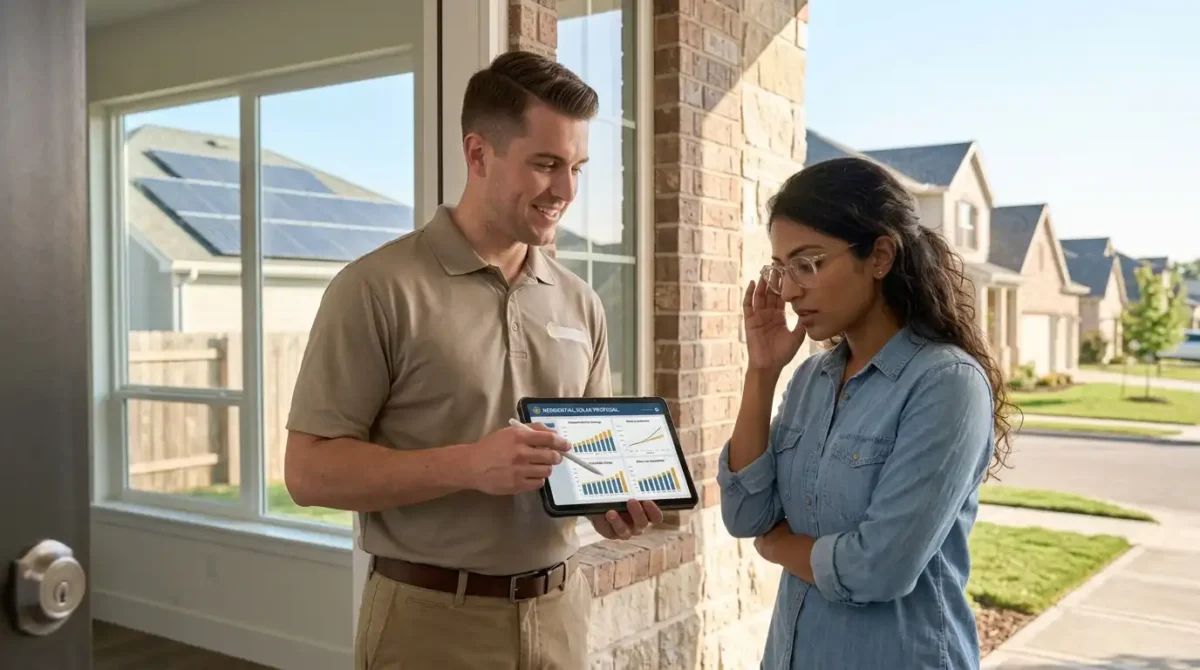
A solar panel scam lawyer Houston TX evaluates cases by looking for the gap between what was promised and what was disclosed in writing. Fraud in solar sales is not always obvious. It does not always involve forged signatures. It often involves statements made verbally during a sales visit that were never put in writing, and projections that left out material assumptions.
Houston’s electricity market is deregulated. Homeowners choose their own Retail Electric Provider. A solar savings projection for a Houston homeowner on one REP plan does not automatically apply to a different REP plan. Sales teams regularly used a single rate assumption without disclosing that your savings depend on which REP you use and what buyback rate they offer. That omission is legally significant.
What Are the Warning Signs of a Solar Sales Scam?
These are the patterns a solar panel scam lawyer Houston TX looks for first:
- Salesperson claimed the system would be free or would eliminate your bill entirely
- Written savings projection did not disclose the electricity rate assumption behind it
- Tax credit was described as a cash rebate rather than a credit against your tax liability
- Loan total on the signed agreement is higher than the system price discussed verbally
- Cancellation rights were not explained or were described as having already expired
- Salesperson claimed an affiliation with Oncor, CenterPoint Energy, or a state government program
If your experience matches two or more of these patterns, the situation likely warrants at minimum a contract review.
What Should Houston Homeowners Know Before Contacting a Solar Panel Scam Lawyer Houston TX?
Gather your documents before any consultation. An attorney reviewing your case with no documentation can give you a general assessment. An attorney reviewing your full contract, loan disclosure, sales projection, and utility bills can give you a specific legal opinion on your available remedies.
What I noticed when reviewing Houston area solar complaints from 2022 through 2024 is that the strongest cases all had one thing in common. The homeowner had saved the original sales email or text, which often contained savings promises that differed significantly from the written contract. Screenshots and texts are evidence. Save everything.
What Texas and Federal Laws Protect Homeowners From Predatory Solar Contracts?
Texas has one of the more complete consumer protection frameworks for solar disputes in the country. Multiple statutes can apply simultaneously to a single situation, which gives an experienced attorney several pathways depending on the strength of your documentation.
What Does the Texas Deceptive Trade Practices Act Cover?
The Texas Deceptive Trade Practices Act, Business and Commerce Code Sections 17.46(b), 17.50, and 17.505, prohibits false, misleading, or deceptive acts in consumer transactions. A successful DTPA claim allows recovery of actual damages, plus up to three times actual damages if the conduct was knowing or intentional. The court also has authority to award attorney fees to the winning plaintiff.
One procedural requirement matters significantly. Before filing a DTPA lawsuit, you must send a written 60-day pre-suit notice to the defendant. That notice must describe the specific acts you claim were deceptive and the amount of damages you seek. Skipping that step does not kill your case, but it can delay it and may affect your ability to recover certain damages.
What Is the Home Solicitation Transactions Act?
The Home Solicitation Transactions Act, Texas Business and Commerce Code Chapter 601, applies to contracts signed at your home following a door-to-door sales visit. It provides a 3-business-day right to cancel without penalty. The seller is required to give you a written notice of that right at the time of signing.
If you received no such notice, your cancellation right may still be active. This applies regardless of when the signing occurred.
How Does the Truth in Lending Act Apply to Solar Financing?
The Truth in Lending Act requires that your lender disclose the annual percentage rate, total finance charges, and total amount of all payments before you sign a financing agreement. If those disclosures were missing, inaccurate, or buried in a way that made them difficult to understand, TILA provides a right of rescission.
TILA rescission is technically demanding. The notice must be sent to the correct party within the applicable window. Attempting a TILA rescission without attorney guidance significantly increases the risk of losing the right entirely.
What Is a UCC-1 Lien and How Does It Affect Your Home?
A UCC-1 financing statement is a public filing a lender makes to establish a security interest in the solar equipment, and sometimes in your property itself. Many Texas homeowners do not know a UCC-1 has been filed until they are in the middle of selling or refinancing their home, when it appears on a title report.
Clearing a UCC-1 requires a formal release from the lender. If the original installer went out of business, tracking down the current lien holder can take weeks. An attorney experienced in solar project debt and lien matters can accelerate that process significantly.
One detail worth noting: if you signed a solar lease rather than a loan, the leasing company holds a security interest in the equipment. A leased system does not qualify for the Texas property tax exemption under Tax Code Section 11.27. That exemption applies only to systems the homeowner owns outright. Installers rarely disclose this during the sales visit.
Can a Breach of Contract Solar Installer Texas Claim Be Combined With a DTPA Claim?
Yes. A breach of contract solar installer Texas claim and a DTPA claim can be filed together in Texas courts. They address different aspects of the same situation. The breach of contract claim addresses a specific obligation the installer failed to meet. The DTPA claim addresses the deceptive conduct that induced you to sign in the first place.
When both claims are viable, the combined case is stronger. The DTPA’s treble damages provision also increases the potential recovery beyond what a standalone breach of contract claim allows.
What Are Your Options If the Cancellation Period Has Already Passed?
If the statutory cancellation window has closed, you have four realistic paths depending on your specific situation and documentation.
| Path | Timeline | Attorney Required | Best For |
| Demand letter and negotiation | 1 to 4 months | Recommended | Clear breach, company still operating |
| Mediation | 2 to 6 months | Optional | Both parties willing to resolve |
| Arbitration | 3 to 9 months | Recommended | Contract contains arbitration clause |
| Litigation in Texas court | 12 to 24 months | Yes | Strong facts, significant damages |
How Does Cancelling Within 3 Days Texas Rules Differ From Cancelling Later?
Cancelling within the statutory window under how to cancel solar contract within 3 days Texas or the broader 5 business day rule under Chapter 1806 is a unilateral right. You exercise it by sending written notice. The company cannot refuse it if you are within the window and the contract included the required disclosures.
Cancelling after the window requires demonstrating a legal basis. That means proving breach of contract, misrepresentation, a statutory violation, or a combination of those claims. The standard of proof is higher, and the process is longer. Documentation is everything at this stage.
Is a Solar Fraud Class Action Lawsuit Possible in Texas?
A class action is possible in Texas when the same deceptive practice was applied to a defined group of homeowners by the same company using the same methods. Individual claims generally recover more per person. Class actions make sense when the per-person damages are lower, but the scale of the fraud was widespread.
Individual Claim vs. Class Action: Which Fits Your Situation?
| Factor | Individual Claim | Class Action |
| Your damages | Any amount | Stronger if lower per person |
| Company’s conduct | Unique to your contract | Same script, many homeowners |
| Timeline | 6 to 18 months | 2 to 5 years |
| Attorney cost | Contingency or flat fee | Attorney carries the cost |
| Recovery | Full damages potential | Shared settlement |
Review the 2026 solar panel class action lawsuit landscape before deciding which path fits your situation. In some cases, a class action covering your company may already be underway, and joining it requires no separate filing.
What Does the Legal Process Look Like When You Hire a Cancel Solar Panel Contract Lawyer Texas Firm?
A cancel solar panel contract lawyer in Texas homeowners work with typically follows a three-stage process. The stages move from evaluation to escalation only when needed. Most cases do not reach a courtroom.
Step 1: Contract and Document Review
The attorney reviews your signed contract, financing agreement, sales projection, utility bills, and any written communications from the installer. They assess whether the cancellation window is still open, what statutory violations exist, what the contract’s arbitration clause says, and what your documented damages are.
This stage typically takes one to two weeks. It costs nothing if the attorney is working on contingency for a fraud claim. It may cost a flat fee of $300 to $700 for a standalone contract review if your situation is less clear.
Step 2: Sending a Demand Letter
A demand letter from an attorney carries significantly more weight than a homeowner’s own complaint. It names the specific statutes, quantifies the claimed damages, and establishes a response deadline. For DTPA claims, the demand letter also serves as the required 60-day pre-suit notice.
Many Texas solar disputes resolve at this stage. The company receives a statute-based letter from a licensed attorney and calculates that settling costs less than litigating. Resolution at the demand letter stage typically produces a full or partial refund, a contract modification, or an agreed cancellation.
Step 3: Negotiation, Mediation, or Litigation
If the demand letter does not resolve the case, the next step depends on your contract. If it contains a mandatory arbitration clause, the dispute goes to a private arbitrator. Arbitration typically runs 3 to 9 months. Outcomes are binding, and appeals are extremely limited.
If arbitration is not required, the attorney may recommend mediation first, which is faster and less expensive than court. Litigation is the final option and involves a full trial timeline in Texas courts.
How Much Does a Texas Solar Contract Cancellation Lawyer Cost?
Attorney fees for solar contract disputes in Texas vary by the type of arrangement and the strength of your case. Understanding the fee structures upfront removes the biggest hesitation most homeowners have about seeking help.
Contingency Fee vs. Flat Fee vs. Hourly Billing
| Fee Type | How It Works | Best For |
| Contingency | No upfront cost. Attorney takes 33 to 40% of recovery | DTPA, fraud, and treble damage cases |
| Flat fee | Fixed amount for a defined scope of work | Contract review, demand letter drafting |
| Hourly | Billed per hour at $250 to $450 in most Texas markets | Complex litigation with uncertain scope |
Contingency arrangements are common in Texas solar fraud cases because the DTPA requires the company to pay your attorney fees if you win. That provision reduces the attorney’s financial risk on strong cases. It also means many Texas homeowners qualify for contingency representation without realizing it.
A flat fee contract review, often $300 to $600 in Houston and Dallas markets, identifies your legal position before you commit to anything further. That is usually the lowest risk entry point.
What Happens If Your Solar Company Goes Bankrupt or Stops Responding?
Solar company bankruptcy complicates but does not eliminate your options. Your loan obligation to the lender continues regardless of what happens to the installer. The lender or loan servicer still holds your debt.
If the installer filed for bankruptcy, file a creditor claim in the bankruptcy proceeding. This preserves your right to any asset distribution. An attorney can file this for you at a defined flat fee.
For homeowners dealing with an installer who simply stopped responding, a formal complaint to the Texas Department of Licensing and Regulation against their TDLR registration creates a regulatory record. Combine that with a demand letter to the installer and lender. A solar installation injury or damage claim may also be relevant if the installation caused physical damage to your property.
The lender may also carry liability if they funded your loan the same day you signed, before the required cancellation period expired. That fact pattern has supported TILA rescission arguments in other states and is being tested in Texas cases as of 2026.
How Do You Choose the Right Cancel Solar Contract Lawyer Texas Homeowners Recommend?
A cancel solar contract lawyer in Texas homeowners should consider must have verifiable experience in consumer protection law, specifically Texas DTPA cases. General practice attorneys unfamiliar with Chapter 1806, UCC filings, or TILA rescission procedures may miss statutory arguments that significantly affect your outcome.
Texas is a large and legally complex state. The deregulated electricity market, the role of Retail Electric Providers in solar savings calculations, and the municipal utility exemptions in Austin and San Antonio all affect how solar contract disputes are framed. An attorney who has handled Texas solar cases understands those variables. One who handles general contract work does not.
Questions to Ask Before Hiring an Attorney
Ask these questions before signing any representation agreement:
- Have you handled Texas solar contract disputes under Chapter 1806 or the DTPA?
- What fee arrangement do you offer for cases like mine?
- Is my contract’s arbitration clause enforceable, and what does that mean for my options?
- What is the realistic timeline from your demand letter to a resolved case?
- What are the weaknesses in my documentation that I should address before we proceed?
An attorney who gives direct, specific answers to those questions, including honest assessments of weak points, is a better sign than one who makes broad guarantees about outcomes.
Making Sense of Your Legal Position as a Texas Solar Homeowner
Texas solar law is more protective than most homeowners realize. The 5-business-day cancellation right under Chapter 1806 exceeds the federal standard. The DTPA’s treble damages provision creates a powerful remedy for proven misrepresentation. And the property tax exemption under Tax Code Section 11.27, which only applies to owned systems, is a financial detail every Texas homeowner should understand before signing a lease.
A cancel solar panel contract lawyer Texas homeowners consult can assess your contract, identify which statutes apply, and in most cases give you a clear picture of your legal position in a single consultation. The U.S. Department of Energy’s solar consumer resources provide independent verification of federal programs and incentive timelines that can support your case documentation.
For Texas homeowners who signed a lease and are now discovering the property tax exemption issue, the solar lease buyout process offers a relevant comparison of how buyout clauses work, even though that guide focuses on California. Texas lease structures follow many of the same patterns.
The National Renewable Energy Laboratory’s residential solar research provides independent production benchmarks that help establish whether your system’s projected output was realistic for your specific location in Texas.
Texas law is on your side in more ways than most solar contracts disclose. Knowing your rights is the first practical step toward exercising them.
Frequently Asked Questions
Can I cancel my solar contract at any time?
No. Texas law gives you 5 business days under Chapter 1806 and 3 business days under Chapter 601 for door-to-door sales. After those windows close, cancellation requires a legal basis such as breach of contract, a DTPA violation, or a TILA rescission argument. See the general guide on getting out of a solar contract for a broader breakdown of post-window options.
Will cancelling my solar contract affect my credit?
Filing a lawsuit or regulatory complaint does not affect your credit score. Stopping loan payments while a dispute is pending can. Before suspending any payment, consult an attorney about whether your situation qualifies for a TILA rescission or statutory cancellation that would legally justify stopping payments. Acting without that legal basis creates a separate credit and collections problem.
What if my solar installer went out of business?
Your loan obligation to the lender continues. File a creditor claim in the installer’s bankruptcy proceeding if one is open. File a complaint with TDLR against the installer’s registration. Then consult an attorney about whether the lender carries separate liability for funding the contract on the basis of inflated savings projections.
Is there a UCC-1 lien on my Texas home?
Check your county clerk’s public records or pull a title search. UCC-1 filings are public. If one exists, you need a formal lien release from the lender to clear it. That release is required before any sale or refinance. An attorney can expedite that process if the original installer is no longer operating.
Should I stop making payments while my case is under review?
Not without legal guidance. Stopping payments has credit and collections consequences that can complicate your legal position. The exception is if your attorney determines you qualify for a statutory rescission that legally relieves the payment obligation. Do not make that decision without a licensed Texas attorney reviewing your specific contract and lender agreement.
This article by SolarInfoPath (2026 research framework) is part of a comprehensive solar knowledge architecture covering all major high-value sectors including legal disputes (installation negligence, contracts, liability, fraud, lawsuits, liens, HOA and permitting disputes), financial structures (loans, PPA/lease agreements, DSCR financing, tax equity, investment and project finance), tax law (ITC, Section 48/25D, MACRS depreciation, bonus credits, IRS audits, recapture rules, domestic content and IRA/OBBBA compliance), insurance and risk (property damage, hail/wind/fire claims, bad faith insurance disputes, warranty coverage), policy and regulation (net metering, FERC interconnection, state utility rules, incentive programs and regulatory changes), commercial and utility-scale development (EPC contracts, construction delays, performance bonds, receivership, bankruptcy, asset sale and restructuring), real estate impacts (home value, solar leases, liens, title issues, HOA restrictions, easements), and emerging market structures such as battery storage, community solar, agrivoltaics, SRECs, yieldcos, and institutional investment funds. All content is based on publicly available regulatory, financial, and legal sources and is intended strictly for educational and informational purposes, not legal, tax, or financial advice. Readers should always verify current laws, utility policies, tax regulations, and contract terms with qualified licensed professionals before making decisions, as solar regulations, incentives, and financial structures frequently change across jurisdictions and time.

Solar Legal Analyst· Policy Researcher· Investigative Finance Writer Lead Analyst & Founder of SolarInfoPath
Morgan Lee is a solar legal analyst, policy researcher, and investigative finance writer with 12+ years of experience in U.S. renewable energy law, IRS tax credit compliance, and solar litigation. He is the founder of SolarInfoPath, a research-driven platform focused on primary-source analysis of solar contracts, tax law, regulatory policy, and industry disputes affecting homeowners and commercial developers.
His work is grounded in original legal and regulatory sources, including IRS notices, FERC and CPUC rulings, state court filings, PACER records, and UCC lien databases. He specializes in solar contract disputes, injury and workers’ compensation claims, PACE financing issues, tax equity structures, ITC recapture rules, MACRS depreciation, and federal and state solar policy frameworks.
Morgan’s analysis spans solar litigation, finance structures, and regulatory developments such as the IRA and OBBBA, interconnection reform, domestic content rules, and battery storage incentives. He also covers EPC contracts, PPAs, project financing, and utility-scale solar investment structures.