Do Solar Panels Emit Radiation? (2026 EMF Health Audit)
This article is published by SolarInfoPath, an independent research and education platform. SolarInfoPath has no financial relationship with any solar installer, manufacturer, lender, lead generation service, or utility company. We do not sell solar products, earn referral fees, or accept sponsored content. All articles are based on publicly available data from sources including the U.S. Department of Energy, IRS.gov, U.S. Treasury, the National Renewable Energy Laboratory (NREL), the Solar Energy Industries Association (SEIA), and public court and regulatory records.
Information Currency: Solar policy, tax law, utility programs, and financing products change frequently. While SolarInfoPath updates content regularly, some details may not reflect the most recent developments in your state. Always confirm current rules with the appropriate government agency, utility company, or licensed professional before taking any action.
Over 4 million American homes now use rooftop solar, and that number keeps growing every year. But one question continues to appear online again and again: do solar panels emit radiation that could harm your family?
The straight answer is no—solar panels do not emit harmful radiation.
This is where most confusion starts. Solar panels generate electricity from sunlight, and this process does not involve ionizing radiation (the type linked to health risks like X-rays or nuclear sources). So there is no “radiation exposure” in the way most people fear.
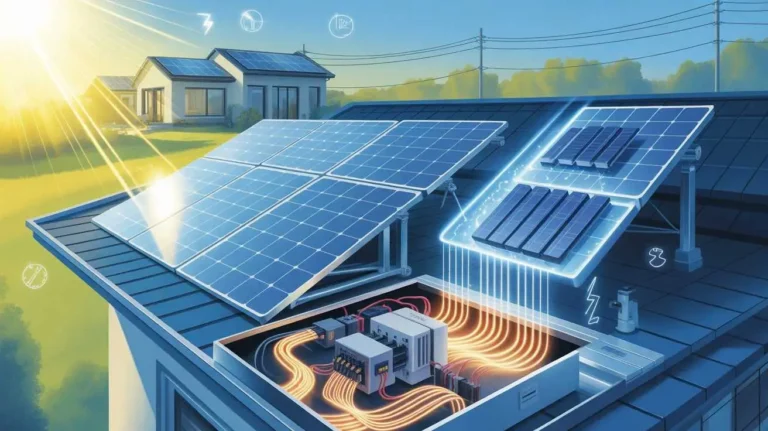
However, solar systems do produce very low levels of electromagnetic fields (EMF) when operating. These come mainly from the inverter, wiring, and electrical flow in the system. But this is important to understand: EMF is not unique to solar panels. It is present in nearly every modern home, including devices like Wi-Fi routers, refrigerators, televisions, and even household wiring.
Multiple international safety guidelines, including standards used in residential electrical systems, consider these EMF levels to be well within safe exposure limits for humans.
This is why millions of installations across the United States continue to operate without any evidence of health harm linked to solar radiation or EMF exposure.
So while the concern is understandable, the real-world data is clear: residential solar systems are considered safe for everyday use.
Key Takeaways
- Solar panels produce a tiny static electric field, not ionizing radiation of any kind
- Solar inverters emit low-level EMF similar to a standard household refrigerator
- The World Health Organization does not link residential solar inverter EMF to health harm
- Standing just 3 feet from a running inverter drops your EMF exposure to near-background levels
Do Solar Panels Emit Radiation: What Type Are We Talking About?
This is the most important question to answer first. The word “radiation” covers many different things. Not all radiation is dangerous.
There are two main types. The first is ionizing radiation. This type carries enough energy to damage cells in your body. X-rays and nuclear energy produce ionizing radiation. The second type is non-ionizing radiation. This type does not carry enough energy to damage cells. Radio waves, microwaves, and household electrical fields are all non-ionizing.
Solar panels produce non-ionizing fields only. They do not produce X-rays. They do not produce gamma rays. They do not produce any form of ionizing radiation. The panels convert sunlight into electricity. That process does not create harmful radiation at any point.
The confusion often comes from the term EMF. EMF stands for electromagnetic field. Every device that uses or moves electricity produces some EMF. Your refrigerator does. Your TV does. Your wall outlets do. The question is not whether EMF exists, it always does around electrical devices. The real question is whether the level is high enough to cause harm. For a well-installed residential solar system, the answer from decades of research is no. You can read more about the broader safety picture in the article on Are Solar Panels Safe for U.S. homes.
Do Solar Panels Give Off Radiation From the Panels Themselves?
Let us look at the panels first. Then we will cover the inverter separately.
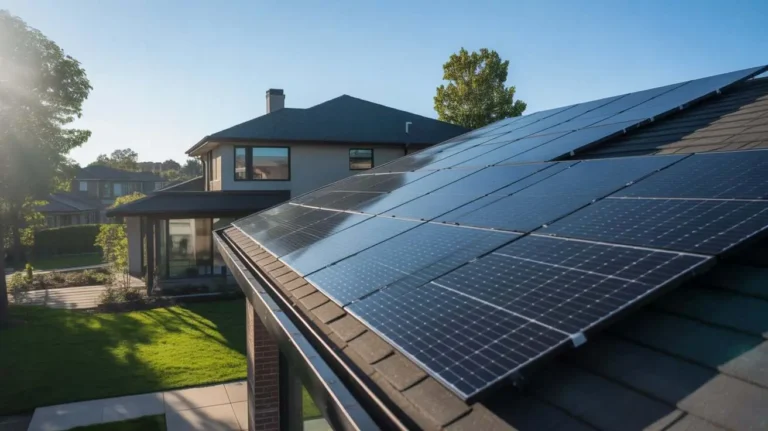
A solar panel sits on your roof. It captures sunlight. It converts that sunlight into direct current electricity. During this process, the panel produces a small static electric field. This field does not pulse. It does not travel through walls. It sits right at the surface of the panel.
The field strength at the panel surface is very low. At 1 foot below the panel, the field is already negligible. By the time you are inside your home, the field from the panels above is effectively zero. Your roof decking, insulation, and ceiling all absorb and reduce it further.
No credible scientific study has linked residential solar panel fields to any health outcome. The U.S. Department of Energy reviewed residential solar safety research. Their findings were consistent. Living under solar panels poses no radiation risk from the panels themselves. That is not a manufacturer’s claim. It is not an installer talking point.
It is what the research shows. One thing people often miss is that solar panels actually block some incoming UV radiation. Your attic space under the panels runs slightly cooler in summer as a result. That is a small but real benefit. It is not a risk. The How Solar Power Works Step by Step article explains exactly how panels work at the physical level without any technical jargon.
Do Solar Panels Emit EMF From the Inverter? Here Is the Real Number
The inverter is a different story. It deserves its own honest explanation.
Your inverter converts DC electricity from your panels into AC electricity for your home. It runs all day while the sun is up. During operation, it produces a low-level alternating magnetic field. This is the main source of EMF in a residential solar system.
How strong is the magnetic field from a residential inverter? At 1 foot away, it reads between 1 and 4 milligauss. The U.S. Environmental Protection Agency puts average home background levels at 0.5 to 4 milligauss from normal wiring and appliances. A running refrigerator at 1 foot produces 4 to 10 milligauss. A hair dryer at 6 inches produces over 100 milligauss. A solar inverter sits at the lower end of what your home already produces every day.
So the inverter EMF sits at or below the level of your refrigerator. It drops off very quickly with distance. At 3 feet from a running inverter, readings fall to near background levels. At 6 feet, the field is essentially undetectable above a normal household background.
Most inverters mount in a garage, utility room, or on an exterior wall. In those locations, your family never spends meaningful time within 1 to 3 feet of the unit. The practical exposure in a normal home is very low. Online discussions often quote the 1-foot reading. But they rarely mention that nobody stands next to their inverter all day. That missing detail changes the picture completely.
The common myths about solar panels article covers several concerns like this one. Some fears sound alarming at first. The actual numbers tell a different story.
How Solar Panels Work With Radiation: The Wiring Question
Some homeowners also ask about the DC wiring that runs from the panels down to the inverter. This is a fair question. DC wiring does produce a small magnetic field while current flows through it.
Solar wiring produces DC magnetic fields. Household wiring produces AC fields. AC fields alternate 60 times per second. DC fields do not alternate. They stay steady. Research shows that steady DC fields interact less biologically than AC fields at the same strength.
The wiring runs are enclosed in conduit. They follow your roof line and exterior walls. They do not run through your living spaces in most standard installations. Even where they do pass through interior spaces, the field at the wall surface is minimal. At 1 foot from the conduit, readings typically fall below 1 milligauss.
For homeowners in Chicago, Denver, or Atlanta, older homes can have complex wiring routes. A certified electrician can measure field levels after installation. This is called a Gauss meter reading. It takes a few minutes. It gives you a real number for your specific home.
What Do U.S. Health Agencies Actually Say About Solar Panel EMF?
This section matters. Real agency positions are different from what you find in online forums.
The World Health Organization looked at all available EMF research carefully. No adverse health effects were found at low-level EMF exposure. Residential electrical systems fall within that range. Solar inverters are included in that category.
The U.S. Environmental Protection Agency does not classify residential solar system EMF as a health hazard. Their published guidance on EMF covers power lines and large industrial equipment. Residential solar inverters do not appear in any EPA hazard category.
The National Cancer Institute reviewed EMF and cancer risk research. Their findings were clear. No consistent link was found between low-level EMF and cancer outcomes. Residential electrical sources were part of that review. Solar inverters fall within that same category.
None of these agencies has issued health warnings about residential solar EMF. That is not because the topic has been ignored. It is because decades of research have not produced evidence of harm at these exposure levels. According to data from the U.S. Energy Information Administration, over 4 million U.S. homes now operate rooftop solar systems. Health agencies monitor residential health trends continuously. No solar-linked radiation health pattern has emerged in that population.
The 30% federal tax credit has specific eligibility rules. The federal solar tax credit explained for U.S. homeowners walks through every detail clearly before you make any decision.
EMF Radiation From Solar Panels: What About Smart Inverters and Monitoring Systems?
Modern solar systems include monitoring devices. These send production data to an app on your phone. Many use WiFi or cellular signals to do this. Some homeowners ask whether these wireless signals add to their EMF exposure.
WiFi signals from a solar monitoring device are non-ionizing radio waves. They operate at the same frequencies as your home router. The signal strength from a solar monitoring device is typically much lower than that of your home router. Your router runs 24 hours a day. Most solar monitoring devices only transmit data at intervals, not continuously.
Most homes already run a WiFi router. A solar monitoring device adds a negligible amount on top of that. The difference is not measurable. Current research does not treat this as a meaningful health consideration.
Some homeowners in California and Texas choose wired monitoring systems over wireless ones. That is a personal choice. It is not a medical need based on current evidence. A wired system tracks production just as well. Ask your installer about wired options before the system goes in.
Solar installation involves many decisions. Equipment choices like monitoring are part of that process. The solar panel installation guide for U.S. homes covers the full picture.
Is There Any Real EMF Risk From Solar Panels for Sensitive Individuals?
This is the honest section. Most articles skip it. I will not.
A small number of people report sensitivity to electromagnetic fields. The condition is sometimes called EHS, electromagnetic hypersensitivity. Symptoms reported include headaches, fatigue, and difficulty concentrating near electrical devices.
The World Health Organization reviewed EHS research carefully. Their findings were clear. People who report EHS cannot reliably detect EMF in controlled studies. The symptoms are real. But current evidence does not link them to EMF. The WHO recommends medical evaluation for reported symptoms. Avoiding EMF sources is not their recommendation.
Does someone in your home feel sensitive to electrical devices? If yes, talk to a doctor first. Do this before installing any new electrical system. Solar included. This is honest advice. It does not ignore the concern. It sends you to the right person.
For anyone using an implanted medical device like a pacemaker, the same applies. Consult your cardiologist. The inverter EMF levels are low. But medical device manufacturers specify their own safety distances. Get that information from your device manufacturer before installation.
You can also read about solar panels’ pros and cons for U.S. homeowners, which covers this and other real limitations without hiding negatives. And if you are still in the research phase on overall system costs, the average solar panel cost in the USA gives you current 2026 pricing to work with.
Final Thoughts
Do solar panels emit radiation that poses a risk to your family? Based on all available U.S. and international research, no. The fields produced by panels, inverters, and wiring fall well within ranges that decades of research have not linked to health harm. They sit at or below the level of common household appliances.
I think the honest position is this: the concern is understandable. When something runs on your roof for 25 years or more, asking questions is smart. But the evidence does not support treating solar EMF as a meaningful health risk for the vast majority of U.S. homeowners. Still researching? SolarInfoPath covers every solar safety question the same way. Real data. Honest limitations. No installer relationships. No sales agenda. Just the information you need to decide for yourself.
FAQs
Do solar panels emit radiation?
Solar panels work by capturing sunlight and converting it into electricity. They do not actively release radiation like broadcasting devices. Any energy involved is part of normal electrical operation.
Do solar panels emit EMF radiation?
Solar panels can be associated with very low electromagnetic fields because electricity flows through wires. This is similar to many household electrical systems. The panels themselves do not create EMF from sunlight.
Are solar panels harmful to humans?
This is a common question for beginners. Solar panels operate passively and do not interact directly with people. Every day exposure to them is similar to that of other electrical equipment used at home.
What are the basic solar panel radiation facts people should know?
Solar panels use visible sunlight, which is a natural form of energy. They do not produce nuclear or ionizing radiation. Most confusion comes from mixing different types of radiation together.
How does solar panel EMF safety compare to other home electronics?
Solar panel EMF levels are generally similar to those from common household wiring. Electrical flow happens within controlled systems. This is part of normal electricity use in daily life.
Why do people worry about radiation from solar panels?
Concerns often come from unfamiliar technical terms or online misinformation. Words like radiation and EMF can sound alarming without context. Learning basic science helps clear up these misunderstandings.

Morgan Lee | Lead Solar Policy & Consumer Research Analyst
Morgan Lee is the founder of SolarInfoPath and an independent solar research analyst with over 10 years of experience studying the U.S. residential and commercial solar market. Morgan’s research focuses on how real homeowner outcomes compare to the savings projections presented during solar sales, a gap that has led to thousands of consumer complaints and active class action lawsuits across New York, California, Texas, and Florida.
All research published on SolarInfoPath is drawn from primary sources, including the National Renewable Energy Laboratory (NREL), the U.S. Department of Energy (DOE), the U.S. Energy Information Administration (EIA), IRS and Treasury guidance under the Inflation Reduction Act, state public utility commission documents, and publicly filed court records related to solar consumer protection cases.
With a background in legal studies, Morgan interprets complex topics, federal tax credits under Section 25D and Section 48, Power Purchase Agreement contract terms, net metering policy changes, and solar litigation, in plain language that homeowners can actually use, without providing legal or financial advice.
SolarInfoPath was built after observing that most homeowners commit $25,000 to $40,000 to a solar system based on incomplete or misleading information, while almost every available source of solar education online has a financial relationship with the industry it covers. SolarInfoPath has no installer affiliations, no lead generation, and no affiliate income. Every article is independent, research-based, and written for informational purposes only.