New Jersey Solar Cost Calculator: 2026 SuSI & Utility Rates
This article is published by SolarInfoPath, an independent research and education platform. SolarInfoPath has no financial relationship with any solar installer, manufacturer, lender, lead generation service, or utility company. We do not sell solar products, earn referral fees, or accept sponsored content. All articles are based on publicly available data from sources including the U.S. Department of Energy, IRS.gov, U.S. Treasury, the National Renewable Energy Laboratory (NREL), the Solar Energy Industries Association (SEIA), and public court and regulatory records.
Information Currency: Solar policy, tax law, utility programs, and financing products change frequently. While SolarInfoPath updates content regularly, some details may not reflect the most recent developments in your state. Always confirm current rules with the appropriate government agency, utility company, or licensed professional before taking any action.
New Jersey homeowners searching for a New Jersey solar cost calculator can use often find generic national tools that miss the specific incentives, utility structures, and electricity rates that make New Jersey one of the most financially compelling solar markets on the East Coast. The state’s average electricity rate runs between 16 and 18 cents per kilowatt hour through utilities like PSE&G, JCP&L, and Atlantic City Electric, and the state averages 4.4 to 4.7 peak sun hours per day, depending on location. Those two numbers, combined with New Jersey’s SREC II program and mandatory full retail net metering, create a financial case that looks meaningfully different from a national average estimate.
This is where things get tricky for New Jersey homeowners: the solar installation cost New Jersey calculator results you see on most websites do not account for the Successor Solar Incentive program, the state’s sales tax exemption, or the property tax protection. Miss any one of those and your cost estimate is off by thousands of dollars before you even talk to an installer.
What Drives Solar Installation Cost in New Jersey
Cost Calculator
Real NJ data — PSE&G, JCP&L, Atlantic City Electric rates, SuSI program income, and full retail net metering built in.
Enter your details on the left and click Calculate to see your personalized New Jersey solar estimate.
A standard residential solar system in New Jersey in 2026 costs between $2,700 and $3,200 per kilowatt before incentives, fully installed. For a typical 7kW system serving a suburban home in Cherry Hill or Princeton, the gross cost runs approximately $18,900 to $22,400, including panels, inverter, mounting hardware, labor, and permitting.
The factors that move your specific system cost within that range are worth understanding before you run any estimate:
- Roof complexity adds labor cost; a multi-plane or tile roof in a suburban Newark neighborhood costs more to install than a simple south-facing single-story roof in Trenton.
- Inverter type affects price; microinverters cost $800 to $2,000 more than a string inverter but perform better on roofs with partial shading from trees or neighboring structures.
- System size should match your annual consumption, not your roof capacity; oversizing creates excess production that earns lower-value credits under some net metering structures.
- Electrical panel upgrades add $1,500 to $3,500 if your existing panel cannot handle the solar connection safely.
What hidden solar costs most New Jersey quotes leave out cover the line items that frequently appear on final invoices but rarely show up in initial estimates.
The Real After-Incentive Cost: A New Jersey Dollar Scenario

Here is a specific calculation for a PSE&G customer in Newark paying $175 per month, which is approximately 1,020 kilowatt hours at 17 cents per kilowatt hour, spending roughly $2,100 per year on electricity.
A 7kW system in Newark with 4.4 average peak sun hours per day produces approximately 9,200 to 9,800 kilowatt hours annually. At full retail net metering through PSE&G, that production offsets most annual consumption and reduces the monthly bill to a basic service charge of $10 to $15.
The cost breakdown looks like this:
- Gross system cost: $21,000
- Federal 30 percent Investment Tax Credit: $6,300
- New Jersey sales tax exemption (no 6.625% tax on equipment): saves approximately $875
- New Jersey property tax exemption: protects $15,000 to $20,000 in added home value from reassessment
- Effective out-of-pocket after federal credit and exemptions: approximately $13,825
- Annual electricity savings: approximately $1,700 to $1,900
- Annual SuSI program income: approximately $500 to $900, depending on current SREC II pricing
- Estimated payback period: 6 to 8 years
That payback timeline reflects real New Jersey numbers, not national averages. The SuSI income stream is the component most homeowners miss when running a solar panel estimate New Jersey tools generate without state-specific programming.
How the solar payback period is calculated for New Jersey homeowners breaks down exactly how each incentive layer affects your break-even timeline in this state.
New Jersey’s SuSI Program: The Incentive Most Calculators Miss
The Successor Solar Incentive program, SuSI, replaced the original SREC program in 2021 and remains the most significant state-level financial incentive available to New Jersey residential solar homeowners. For every 1,000 kilowatt hours your system produces, you earn one Solar Renewable Energy Certificate that utilities are required by New Jersey’s Renewable Portfolio Standard to purchase.
Residential systems under 10kW participate in the Administratively Determined Incentive track, which sets a fixed price per SREC II certificate for a 15 year contract period. The current ADI rate for new residential systems runs approximately $85 to $120 per certificate, depending on when your application is approved and which pricing period applies. A 7kW system producing 9,500 kilowatt hours annually generates approximately 9.5 certificates per year, translating to $807 to $1,140 in annual SuSI income at those rates.
That income runs for 15 years, not 10 like Massachusetts. Over the full contract, a New Jersey homeowner earning $950 per year in SuSI income collects approximately $14,250 in total certificate payments on top of electricity savings. That figure alone nearly covers the entire after-federal-credit out-of-pocket cost on many residential systems.
According to the New Jersey Board of Public Utilities, the current SuSI program rates and ADI track eligibility requirements for New Jersey residential solar are published and updated as program capacity changes.
How New Jersey solar rebates and credits stack together for homeowners covers every state program in detail, including how the SuSI application process works and what documentation your installer needs to submit.
City by City: Solar Panel Cost and Savings Across New Jersey
| City | Avg Sun Hours Per Day | Gross 7kW System Cost | After Federal Credit | Est. Annual Savings | Key Notes |
| Newark | 4.4 hrs | $20,500 to $22,000 | $14,350 to $15,400 | $1,700 to $1,950 | PSE&G territory; urban roof variation; strong net metering |
| Trenton | 4.5 hrs | $19,500 to $21,000 | $13,650 to $14,700 | $1,750 to $2,000 | JCP&L and PSE&G border area; competitive installer market |
| Cherry Hill | 4.6 hrs | $19,000 to $20,500 | $13,300 to $14,350 | $1,800 to $2,050 | Atlantic City Electric territory; southern NJ adds sun hours |
| Atlantic City | 4.7 hrs | $18,500 to $20,000 | $12,950 to $14,000 | $1,850 to $2,100 | Coastal location; highest sun hours in the state; Atlantic City Electric |
| Princeton | 4.5 hrs | $20,000 to $21,500 | $14,000 to $15,050 | $1,750 to $2,000 | JCP&L territory; suburban roofs are generally well-suited |
Atlantic City and the southern New Jersey shore region receive the most annual sun hours in the state, consistently placing coastal homeowners at the top of the production and savings range. Newark and northern New Jersey sit at the lower end of the sun hours spectrum, but still deliver strong annual savings due to PSE&G’s electricity rate and full retail net metering.
Whether solar panels increase your New Jersey home’s resale value covers the property value impact that the state’s tax exemption protects, which adds a financial dimension beyond electricity savings.
How New Jersey Net Metering Works With Your Utility
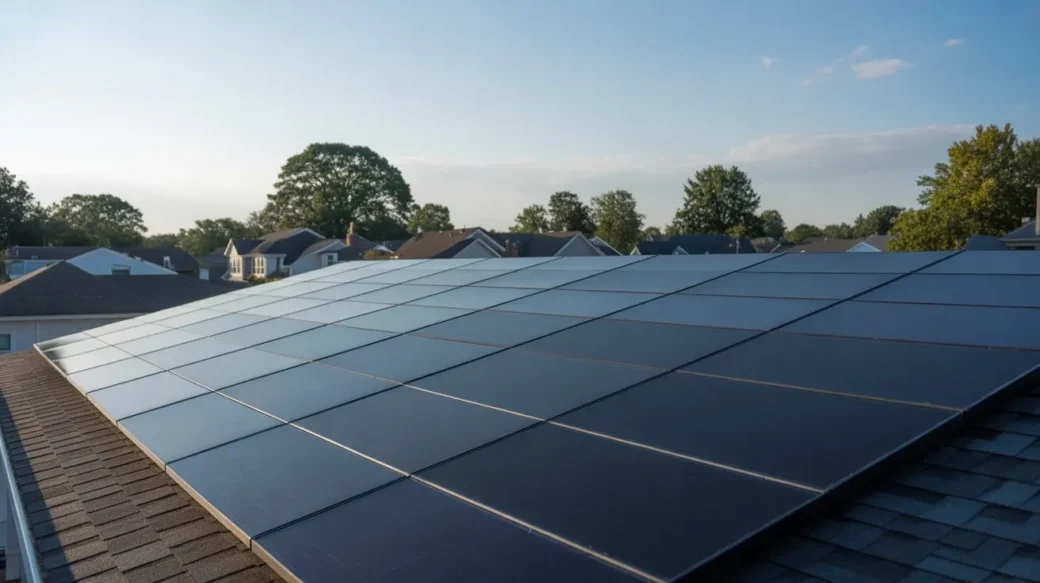
New Jersey maintains mandatory full retail net metering for all investor-owned utilities. PSE&G, JCP&L, Atlantic City Electric, and Rockland Electric are all required by state law to credit surplus solar generation at the full retail electricity rate. When your panels produce more than your home uses during the day, that surplus flows to the grid and your meter runs backward. Your utility credits those kilowatt hours against future consumption at the same rate you would pay to buy electricity.
The practical result is that New Jersey homeowners with properly sized systems typically owe only the monthly basic service charge during high-production summer months. In winter, when production drops 40 to 50 percent due to shorter days and lower sun angles, accumulated summer credits offset the deficit. The annual net effect for most well-sized New Jersey systems is a reduction in annual electricity cost of 80 to 95 percent.
I’ve seen the net metering math work particularly well for New Jersey homeowners who install between March and May, capturing the full summer production cycle in their first year and building a strong credit bank before winter. Systems installed in October or November miss that first summer window and can take an extra billing cycle to demonstrate the full annual benefit.
How net metering works for New Jersey homeowners and what credits are worth explains the credit calculation mechanics and what happens to unused annual credits under New Jersey’s current net metering structure.
Using a Free Solar Cost Calculator for New Jersey: What to Check
A free solar cost calculator New Jersey homeowners use should account for at least five state-specific inputs to produce a reliable estimate. Generic calculators that ask only for your zip code and monthly bill are missing the variables that most affect your actual cost and payback period in this state.
The five inputs a reliable New Jersey solar calculator must include are:
- Your current utility and rate schedule, because PSE&G residential rates differ from JCP&L and Atlantic City Electric rates in ways that affect annual savings by $150 to $300.
- Your roof’s orientation and shading conditions, because a south-facing unshaded roof in Trenton produces measurably more than an east-west split roof with afternoon tree shading in Princeton.
- Your annual kilowatt hour consumption from your utility bill, not just your monthly average, because seasonal peaks in summer air conditioning affect optimal system sizing.
- The current SuSI ADI rate applicable to your application timing, because this figure changes as program capacity fills and directly affects the 15-year income calculation.
- Your expected federal tax liability for the installation year, because the 30 percent credit only reduces what you owe and cannot be received as a cash refund if your liability is lower than the credit amount.
Calculate a localized solar cost estimate using your New Jersey zip code incorporates your local electricity rate and sun hours to produce a more accurate starting estimate than national average tools.
The Honest Limitation: Northern New Jersey Permitting and Timeline
New Jersey’s solar financial case is strong, but the installation timeline in the northern part of the state is a genuine practical limitation worth knowing. Bergen County, Essex County, and Hudson County municipalities have some of the more complex permitting requirements in the state, with multi-department reviews, historic district considerations in some communities, and utility interconnection queues that can extend the full timeline from signed contract to Permission to Operate to 10 to 14 weeks.
That timeline matters for homeowners planning to claim the federal credit in a specific tax year. Starting the process in September or October in northern New Jersey and expecting activation before December 31 carries real risk of a calendar year miss that pushes the credit to the following return.
Southern New Jersey municipalities including Cherry Hill, Vineland, and the Atlantic County area typically move faster, with total timelines running 6 to 9 weeks in most cases. The difference between northern and southern New Jersey permitting is one of the less-discussed regional variations that affects real project outcomes.
How long solar installation takes across New Jersey and American markets covers permitting and interconnection timelines in detail so you can plan your project around the tax year deadline.
What New Jersey homeowners actually save per year after solar activates connects these cost and incentive figures to real annual savings numbers so you can evaluate the full financial picture before making any decisions.
The SolarInfoPath resource library covers New Jersey solar in depth alongside state-specific guides for neighboring markets, and why solar panels make strong financial sense for New Jersey homeowners specifically gives you the complete picture of what makes this state one of the stronger residential solar markets in the country.
Final Thoughts
A New Jersey solar cost calculator homeowners can trust needs to go beyond monthly bill and zip code to account for PSE&G versus JCP&L rates, the SuSI ADI track income, the sales tax exemption, the 15 year certificate contract, and your specific roof and tax situation. The difference between a generic national estimate and a New Jersey-specific calculation is often $3,000 to $6,000 in projected out of pocket cost and 1 to 3 years in projected payback period. Getting that number right from the beginning is the most important step in evaluating whether solar makes sense for your home.
New Jersey’s combination of a 16 to 18 cent electricity rate, mandatory full retail net metering, the SuSI program paying per kilowatt hour for 15 years, a sales tax exemption, and a property tax protection produces a financial case that very few states can match. Atlantic City and Cherry Hill homeowners at the favorable end of the state’s sun range see some of the strongest returns. Even Newark and Princeton homeowners at the lower end of the production range typically reach payback in 7 to 8 years on a system that then runs for another 17 to 18 years at near-zero marginal cost.
Frequently Asked Questions
How much does a solar panel system cost in New Jersey in 2026?
A standard 7kW residential system in New Jersey costs between $18,500 and $22,400 before incentives. After the 30 percent federal tax credit, most New Jersey homeowners pay between $12,950 and $15,700 out of pocket depending on location and system specifications.
What is the SuSI program and how does it affect my solar cost in New Jersey?
The Successor Solar Incentive program pays New Jersey homeowners a fixed rate per Solar Renewable Energy Certificate for 15 years. At current ADI rates, a 7kW system generates approximately $800 to $1,140 in annual SuSI income, significantly reducing the effective net cost of the system over its lifetime.
Does New Jersey have a sales tax exemption for solar panels?
Yes. New Jersey exempts residential solar energy equipment from the 6.625 percent state sales tax. This exemption is applied at the point of purchase and typically saves New Jersey homeowners $800 to $1,200 on equipment costs.
How accurate are free solar cost calculators for New Jersey?
Generic calculators that use only zip code and monthly bill miss New Jersey-specific variables like the SuSI ADI rate, utility-specific net metering structures, and property tax exemption values. A New Jersey-specific estimate should account for all state programs to produce a reliable cost and payback projection.
What is the solar payback period for a New Jersey homeowner?
Most New Jersey homeowners with a properly sized system and full incentive capture reach payback in 6 to 8 years. Southern New Jersey homeowners in Atlantic City Electric territory with higher sun hours and strong SuSI rates can reach payback closer to 5 to 6 years.
Does New Jersey offer net metering for residential solar customers?
Yes. New Jersey requires all investor-owned utilities including PSE&G, JCP&L, Atlantic City Electric, and Rockland Electric to offer full retail net metering to residential solar customers. Surplus generation is credited at the full retail rate rather than a lower wholesale rate.

Morgan Lee | Lead Solar Policy & Consumer Research Analyst
Morgan Lee is the founder of SolarInfoPath and an independent solar research analyst with over 10 years of experience studying the U.S. residential and commercial solar market. Morgan’s research focuses on how real homeowner outcomes compare to the savings projections presented during solar sales, a gap that has led to thousands of consumer complaints and active class action lawsuits across New York, California, Texas, and Florida.
All research published on SolarInfoPath is drawn from primary sources, including the National Renewable Energy Laboratory (NREL), the U.S. Department of Energy (DOE), the U.S. Energy Information Administration (EIA), IRS and Treasury guidance under the Inflation Reduction Act, state public utility commission documents, and publicly filed court records related to solar consumer protection cases.
With a background in legal studies, Morgan interprets complex topics, federal tax credits under Section 25D and Section 48, Power Purchase Agreement contract terms, net metering policy changes, and solar litigation, in plain language that homeowners can actually use, without providing legal or financial advice.
SolarInfoPath was built after observing that most homeowners commit $25,000 to $40,000 to a solar system based on incomplete or misleading information, while almost every available source of solar education online has a financial relationship with the industry it covers. SolarInfoPath has no installer affiliations, no lead generation, and no affiliate income. Every article is independent, research-based, and written for informational purposes only.