
If a solar installation damaged your roof, document everything, stop further damage safely, and notify the installer in writing. Then get an independent roof inspection and review your contract and insurance. A solar panel property damage attorney can help if the installer denies responsibility, but your rights and deadlines depend on state law.
Finding a ceiling stain days after your new solar system went up is stressful. It’s worse when the installer says the roof was already bad. Most disputes follow a predictable path, though, and the records you keep in the first few days often decide how strong your position is later.
This guide covers what to do first, who may be responsible, how insurance works, when small-claims court may apply, what repairs could cost, and when legal help makes sense. It won’t promise compensation, because no honest guide can.
Three steps matter most right now:
- Photograph and date every sign of damage.
- Stop active leaks safely, without climbing onto the roof.
- Notify the installer in writing and keep a copy.
What this guide does not establish: whether your installer is legally liable, whether your insurer will pay, or which deadline applies in your state. Those answers depend on your facts, documents, and state law.
What Do I Do If a Solar Company Damages My Roof During Installation?
Document the damage, prevent further loss safely, notify the installer in writing, and get an independent inspection before agreeing to any repair plan. If you’re asking what do I do if a solar company damages your roof during installation, the order of these steps matters as much as the steps themselves.
The FTC’s home improvement guidance recommends written contracts, checking licensing and insurance, keeping records, and trying to resolve problems with the contractor before escalating. The CFPB gives similar advice: keep signed agreements, warranties, receipts and payment records.
If installation is still underway when you notice damage, ask the crew to pause and photograph the area before work continues. Put that request in writing too.
Document the Damage and Timeline
A clear, dated record is your most valuable asset in any dispute. Save copies before anything is repaired or removed.
Keep these together in one folder:
- Dated photos and videos of interior and exterior damage
- The signed installation contract and any change orders
- Emails, texts, and call notes with the installer
- Invoices, receipts, and payment records
- Permit and building inspection records
- Any pre-installation roof photos or inspection reports
- Roof and equipment warranty documents
Use a simple evidence log to keep it organized:
| Date | Event | Evidence | Who was involved |
| Installation day | System installed | Contract, crew photos | Installer, subcontractor |
| Discovery day | Ceiling stain found | Dated photos, video | Homeowner |
| Report day | Installer notified | Email copy, mail receipt | Homeowner, installer |
| Inspection day | Independent roofer inspects | Written report | Licensed roofer |
These dates are often different, and each one can matter for warranties, insurance notice, and legal deadlines.
Prevent Further Damage Safely
Stop active water entry quickly, but never climb onto a damaged or wet roof yourself. A licensed roofer can install a temporary tarp or seal. Keep the receipt and a description of the work.
Don’t delay urgent mitigation just to preserve evidence. Take photos first, then protect your home. Many contracts and insurance policies expect reasonable steps to limit further loss, which is known as mitigation of damages.
If water reached ceilings or walls, ask about moisture testing. Mold remediation should only be considered after a qualified assessment, not assumed.
Notify the Contractor in Writing
Send a short, factual written notice describing what you saw, when you found it, and what you’re asking for. Email plus a mailed copy creates a strong record.
A useful notice includes:
- Your name, address, and contract number
- The installation date and discovery date
- A description of the observed damage
- Attached photos
- Your requested response, such as an inspection within a set time
Check your contract for a notice-and-cure clause. Some agreements require written notice and give the installer a chance to inspect or repair first. One letter may not satisfy every legal notice rule, so read the contract carefully.
Decision checkpoint: if water is entering your home right now, call a roofer for temporary protection today. Send the written notice to the installer the same day.
Solar Company Damaged My Roof: Who Pays Legally in 2026?
Responsibility depends on what caused the damage, what your contract says, and your state’s law. Many homeowners search “solar company damaged my roof: who pays legally in 2026?” No single national rule changed this year. The answer still depends on evidence and your specific agreement.
Timing alone doesn’t prove cause. A leak after installation is a strong signal, but an installer may argue the roof was already worn, defective, or poorly maintained. That’s why records of the roof’s condition before installation carry so much weight.
| Potentially relevant party | What to examine |
| Solar installer | Scope of work, installation methods, workmanship terms |
| Subcontractor | Who actually did the work and their link to the installer |
| Roofing contractor | Any separate roof work and inspection findings |
| General contractor | Overall project responsibility, if one was used |
| Homeowner | Prior roof condition, maintenance history, contract duties |
| System owner (lease/PPA) | Repair duties under the lease or PPA |
| Insurer | Actual policy terms for this specific loss |
If you lease the system or have a PPA, the system owner may be a separate party from the installer. Your agreement should say who’s responsible for repairs. Reviewing options for exiting a solar agreement can help you understand those obligations.
Contract Terms That Shape Responsibility
Your contract often decides how the dispute must be handled before any court looks at it. Read these clauses closely:
| Clause | What it may do |
| Scope of work | Defines exactly what the installer agreed to do |
| Workmanship warranty | Covers installation defects for a set period |
| Indemnification | Allocates certain losses between parties |
| Limitation of liability | Caps what the installer may owe, subject to state law |
| Notice-and-cure | Requires notice and a chance to fix the problem |
| Dispute resolution | May require mediation or arbitration |
A limitation-of-liability clause isn’t always enforceable. Whether it holds up depends on state law and the facts.
What Evidence Helps Establish the Cause?
Strong evidence connects specific installation work to specific damage. The most useful records include:
- Pre-installation photos or roof inspection reports
- Post-installation photos of penetrations, flashing, and brackets
- An independent roofer’s written inspection report
- Installation drawings and mounting-system specifications
- The roof manufacturer’s installation requirements
- Permit and building inspection records
- Itemized repair estimates linked to observed damage
| What you observed | What may still need proof |
| Leak after installation | That installation work caused it |
| Cracked shingles near brackets | That they cracked during the work |
| Damaged flashing | Who installed or disturbed it |
| Loose mounting hardware | Whether it affected roof integrity |
Roof penetrations and flashing are the most common trouble spots. Tile, shingle, and membrane roofs each fail differently, and flat roofs raise separate mounting questions. For technical background, see whether solar panels can damage your roof.
A structural engineer may be useful if the concern involves roof load rather than leaks. A building inspector can confirm whether the work passed code inspection.
What surprised me when reviewing homeowner disputes for this guide was how often the case hinged on one missing item: a photo of the roof before installation. If you’re planning solar, take those photos now.
Does Homeowners Insurance Cover Solar Panel Installation Damage?
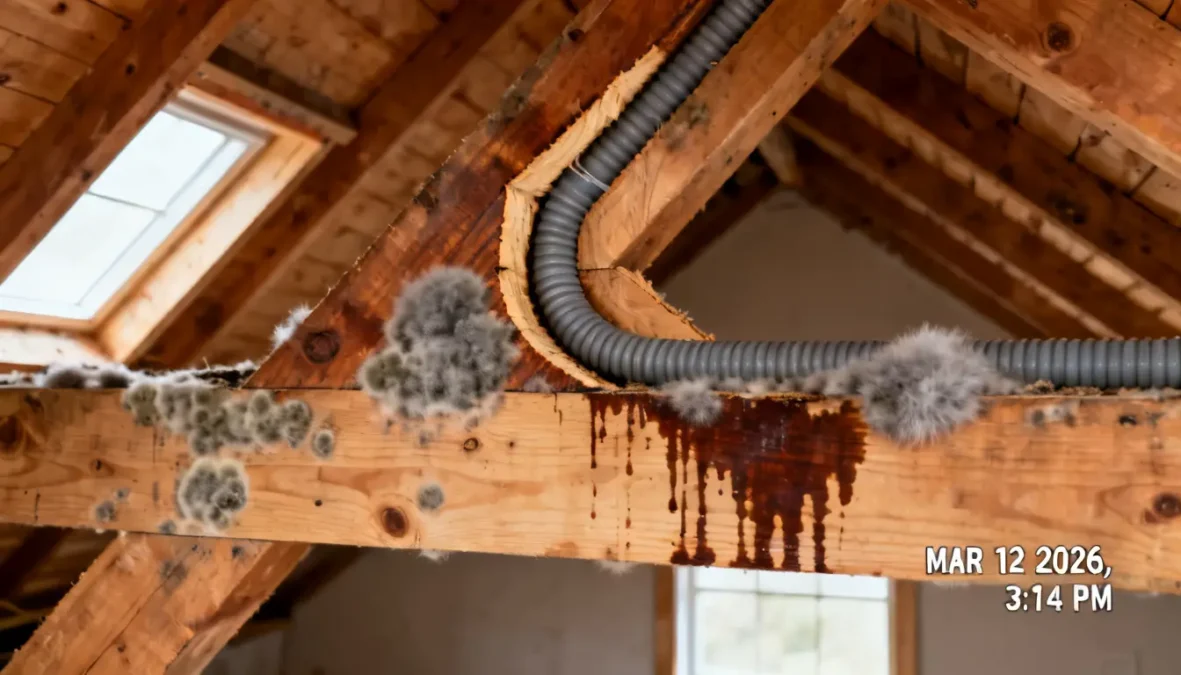
Sometimes, but it depends entirely on your policy wording, exclusions, and the cause of the damage. When homeowners ask “does homeowners insurance cover solar panel installation damage?” the honest answer is that faulty workmanship is often treated differently from the water damage it may cause.
Many policies exclude the cost of fixing poor workmanship itself, yet may cover sudden resulting damage, such as a soaked ceiling. NAIC’s consumer materials explain general policy categories, but only your policy and your insurer’s review settle a specific claim.
Homeowners Insurance vs. Contractor Liability Insurance
These are two different policies serving two different purposes.
| Feature | Homeowners insurance | Contractor liability insurance |
| Who holds it | You | The installer |
| What it may cover | Certain losses to your property | Certain third-party damage the contractor causes |
| Your cost | Deductible, possible premium impact | Usually none if accepted |
| Key limit | Exclusions for workmanship | Policy limits and exclusions |
| Who evaluates | Your insurer’s adjuster | The contractor’s insurer |
A certificate of insurance shows the contractor had a policy at some point. It doesn’t prove that policy will pay your specific claim. Ask the installer, in writing, to report the loss to its liability insurer.
Workers’ compensation insurance is different again. It covers injured workers, not damage to your home.
What to Review Before Filing a Claim
Read your policy before deciding whether to file, because deductibles and notice rules matter.
- Declarations page and deductible amount
- Covered perils and exclusions
- Notice deadlines for reporting a loss
- Documentation and inspection requirements
- Loss-of-use or additional living expense coverage
Hypothetical example: if repairs total $3,300 and your deductible is $2,500, a covered claim would pay at most $800. In that case, pursuing the installer or its insurer directly may make more sense.
If your claim is denied, ask for the reason in writing and review your state insurance department’s complaint options. Never hide facts from an insurer, because that can void coverage.
Can I Sue a Solar Company for Roof Damage in Small Claims Court?
Often yes, if your claim fits your state’s dollar limit and your contract doesn’t require arbitration. Homeowners frequently ask, “Can I sue a solar company for roof damage in small claims court?” Every state sets its own limits, fees, and procedures.
Small-claims court handles lower-value disputes. It’s usually faster and cheaper than a full civil lawsuit, and many people represent themselves.
Verify the Rules in Your State
Check your state judiciary’s official website before filing. Confirm:
- The maximum dollar amount you can claim
- Filing fees for your county
- The correct venue for filing
- Whether businesses can be sued there
- Whether attorneys may appear
- How to serve papers on the company (service of process)
The court clerk can explain procedures but can’t give legal advice. Write down the date you checked each rule, because limits and fees change.
State examples help show how rules differ. For one state’s approach, see how California solar disputes are handled.
Organize the Evidence Before Filing
Judges respond to clear, organized records. Bring:
- Your contract and change orders
- Your evidence log and timeline
- Photos and videos
- The independent inspection report
- Itemized estimates and paid invoices
- Copies of every written request you sent
Emails and texts can be useful evidence. In larger or technical cases, an expert witness such as a roofer may be needed to explain causation.
Check Contractual Dispute Provisions
An arbitration clause may require private arbitration instead of court. Mediation or notice-and-cure terms may also have to come first. Whether these clauses are enforceable depends on your state and contract, so this is where legal advice can help.
Deadlines matter too. Statutes of limitations may differ for property damage and contract claims. Some states have special rules for damage discovered later, but don’t assume yours does. Check your deadline early.
If you win, a court judgment states what’s owed. Collecting it can be a separate step, so ask the court how judgments are enforced.
How Much Could Roof Repairs and Related Work Cost?
Costs vary widely by roof material, damage extent, region, and access, so rely on itemized local estimates rather than national averages. Separate each category so nothing is missed or counted twice.
| Cost category | Evidence to keep |
| Roof repair | Itemized estimate and final invoice |
| Interior water damage | Inspection report, photos, invoices |
| Temporary mitigation | Receipts and description of work |
| Mold remediation (if found) | Qualified assessment and invoice |
| Solar panel removal | Separate written estimate |
| Solar panel reinstallation | Separate written estimate |
| Loss of use or lost production | Receipts, monitoring data, explanation |
Estimate vs. invoice: an estimate is a projected price, while an invoice shows what you actually paid. Courts and insurers usually want both, and an estimate alone doesn’t prove who’s responsible.
Hypothetical calculation:
| Item | Amount |
| Roof repair estimate | $2,400 |
| Interior ceiling repair | $650 |
| Temporary leak mitigation | $250 |
| Illustrative total | $3,300 |
This is a math illustration, not a market average or a legal measure of what you can recover. Whether each item is recoverable depends on evidence, law, and policy terms. Lost solar production and temporary housing costs are harder to recover and need strong documentation.
Panels may need to come off to fix the roof underneath, and the system may sit offline during repairs. Removal and reinstallation should be separate line items to avoid double-counting labor. Permits may be required again, so review what solar permits usually require.
Decision checkpoint: if two roofers give very different estimates, ask each to itemize materials, labor, and scope. The difference usually comes down to scope, not price.
What If the Solar Company Refuses to Resolve the Dispute?
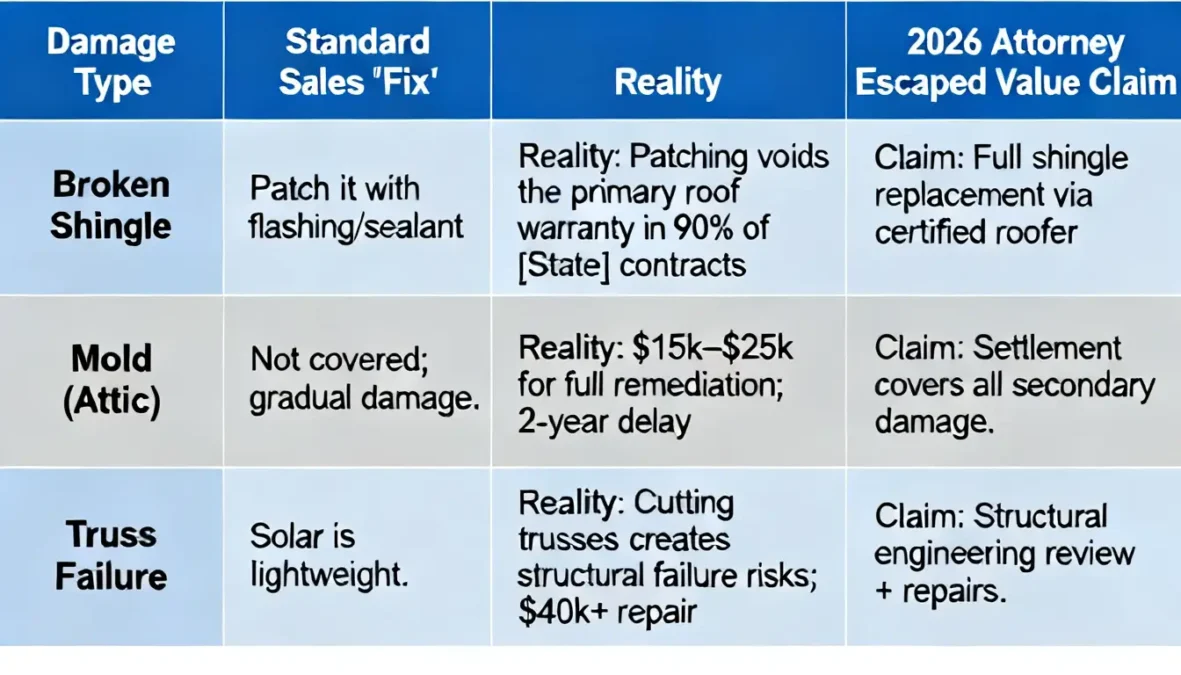
Escalate step by step: written notice, contract and insurance review, a demand letter, a state complaint or mediation, then legal consultation or court. Each step builds the record for the next.
Send a Factual Demand Letter
A demand letter states the problem, your evidence, and the resolution you’re requesting. Keep it calm and factual, with no threats or unsupported accusations.
A clear structure:
- Summary of the project and dates
- Description of the damage
- Evidence attached (photos, report, estimates)
- Amount or action requested
- Reasonable response deadline
Use Complaint and Licensing Routes
A consumer complaint and a claim for money are different things. A licensing board or attorney general may investigate, but that doesn’t guarantee compensation. USAGov keeps a directory of state consumer protection offices to help you find the right agency.
You can also confirm the installer’s license status on your state licensing board’s website. Some states require contractor bonds, which may offer another recovery route.
| Route | What it can do | Main limit |
| Demand letter | States your request formally | Not binding |
| Licensing board complaint | May investigate the contractor | Rarely pays you directly |
| Attorney general complaint | May address patterns of conduct | Not individual compensation |
| Mediation | Helps negotiate a settlement | Voluntary unless required |
| Arbitration | Private binding decision | Limited appeal rights |
| Small claims or civil court | Can issue a judgment | Time, fees, and proof required |
If deception was involved in the sale, see consumer protection options after a solar scam.
When to Consult a Solar Panel Property Damage Attorney
Consider legal help when damages are large, the installer denies responsibility, an arbitration clause applies, or a deadline is close. A property damage or construction defect attorney can review your contract, evidence, and state law in a short consultation.
Legal fees aren’t always recoverable, so ask about costs upfront. Some disputes justify a lawyer, while others are better handled in small-claims court on your own.
Review Any Settlement Carefully
Before signing a settlement, compare it with your itemized repair scope. Check:
- Does it cover roof, interior, and panel work?
- Does the release waive future claims for hidden damage?
- Who performs the repairs, and by when?
- Is payment timing written down?
Decision checkpoint: if a settlement offer doesn’t cover your itemized estimates, don’t sign the release until someone qualified has reviewed it.
Final Steps for Resolving Solar Installation Roof Damage
A documented, step-by-step approach gives you the strongest position, whatever route you take. Before your next move:
- Keep a dated evidence log of damage and communications.
- Get an independent inspection and itemized estimates.
- Review warranty, notice and dispute terms in your contract.
- Check both your homeowners policy and the installer’s insurance.
- Verify your state’s deadlines and small-claims rules.
Most disputes resolve before court when homeowners present clear evidence early. If the installer won’t cooperate, a solar panel property damage attorney can assess your contract, deadlines, and options under your state’s law. Knowing what a solar warranty actually covers can also show whether a warranty claim is the faster path.
Frequently Asked Questions
What should I do first after roof damage?
Photograph the damage, arrange safe temporary protection through a roofer, and notify the installer in writing. Keep copies of everything, including receipts for emergency work.
Who may be responsible for the repair?
Usually the party whose work caused the damage, based on evidence and your contract. That could be the installer, a subcontractor, or another contractor, depending on the facts and state law.
Does homeowners insurance always cover contractor damage?
No. Many policies exclude faulty workmanship but may cover resulting damage such as soaked ceilings. Your specific policy wording and the insurer’s review decide coverage.
What evidence should I collect?
Dated photos, the contract, communications, permit records, an independent inspection report, and itemized estimates. Pre-installation roof photos are especially valuable.
How do I find my state’s small-claims limit?
Check your state judiciary’s official website for current limits, fees, and filing rules. Note the date you checked, since these figures can change.
Does a consumer complaint guarantee compensation?
No. Complaints may lead to investigations or put pressure on the contractor. Recovering money usually requires a settlement, an insurance payment, or a court judgment
Key Terms Explained
| Term | Plain-English meaning |
| Causation | The link between the installer’s work and the damage |
| Negligence | Failing to use reasonable care, as defined by state law |
| Breach of contract | Not doing what the contract required |
| Flashing | Metal or material that directs water away from openings |
| Roof penetration | Where brackets or bolts pass through the roof surface |
| Notice-and-cure | A clause giving the contractor a chance to fix problems |
| Certificate of insurance | A summary of coverage, not proof a claim is covered |
| Statute of limitations | The legal deadline to file a claim |
| Service of process | Formally delivering court papers to the other party |
This article by SolarInfoPath (2026 research framework) is part of a comprehensive solar knowledge architecture covering all major high-value sectors including legal disputes (installation negligence, contracts, liability, fraud, lawsuits, liens, HOA and permitting disputes), financial structures (loans, PPA/lease agreements, DSCR financing, tax equity, investment and project finance), tax law (ITC, Section 48/25D, MACRS depreciation, bonus credits, IRS audits, recapture rules, domestic content and IRA/OBBBA compliance), insurance and risk (property damage, hail/wind/fire claims, bad faith insurance disputes, warranty coverage), policy and regulation (net metering, FERC interconnection, state utility rules, incentive programs and regulatory changes), commercial and utility-scale development (EPC contracts, construction delays, performance bonds, receivership, bankruptcy, asset sale and restructuring), real estate impacts (home value, solar leases, liens, title issues, HOA restrictions, easements), and emerging market structures such as battery storage, community solar, agrivoltaics, SRECs, yieldcos, and institutional investment funds. All content is based on publicly available regulatory, financial, and legal sources and is intended strictly for educational and informational purposes, not legal, tax, or financial advice. Readers should always verify current laws, utility policies, tax regulations, and contract terms with qualified licensed professionals before making decisions, as solar regulations, incentives, and financial structures frequently change across jurisdictions and time.

Solar Legal Analyst· Policy Researcher· Investigative Finance Writer Lead Analyst & Founder of SolarInfoPath
Morgan Lee is a solar legal analyst, policy researcher, and investigative finance writer with 12+ years of experience in U.S. renewable energy law, IRS tax credit compliance, and solar litigation. He is the founder of SolarInfoPath, a research-driven platform focused on primary-source analysis of solar contracts, tax law, regulatory policy, and industry disputes affecting homeowners and commercial developers.
His work is grounded in original legal and regulatory sources, including IRS notices, FERC and CPUC rulings, state court filings, PACER records, and UCC lien databases. He specializes in solar contract disputes, injury and workers’ compensation claims, PACE financing issues, tax equity structures, ITC recapture rules, MACRS depreciation, and federal and state solar policy frameworks.
Morgan’s analysis spans solar litigation, finance structures, and regulatory developments such as the IRA and OBBBA, interconnection reform, domestic content rules, and battery storage incentives. He also covers EPC contracts, PPAs, project financing, and utility-scale solar investment structures.