
Do solar panels cause roof damage? Based on installation records, roofing warranty claims, and contractor liability data reviewed across U.S. markets, the answer is no, not when a licensed professional installs them on a structurally sound surface. The risk of damage is real, but it originates almost entirely from improper installation, pre-existing structural weakness, or unqualified contractors, not from the panels themselves. Here is what the evidence actually shows.
Do Solar Panels Cause Roof Damage? The Direct Answer First
Most homeowners searching for this question carry a specific fear: that drilling into their roof for a solar installation will create leaks, void warranties, or compromise structural integrity they’ve spent years maintaining. That fear is understandable. A roof replacement costs $8,000 to $18,000. A solar system costs $20,000 to $35,000. Getting both wrong at the same time is a financial event that takes years to recover from.
The direct answer is this: Solar panels do not damage a sound roof when installed correctly. The damage that does occur, and it does occur, is almost always traceable to contractor error, skipped inspections, or installations performed on roofs that had pre-existing problems no one disclosed.
That distinction matters more than most homeowners realize before they sign anything.
Here’s what no one mentions upfront: roofing and solar installation are two separate trades. A contractor can be fully licensed for solar electrical work and have zero formal training in roofing. When something goes wrong at the penetration point, which is where 74% of installation-related leaks originate, according to installer liability data compiled by roofing warranty providers, it’s almost always because the person holding the drill didn’t understand how water moves through that specific roofing material under thermal expansion.
Understanding the average solar panel cost for your system size before you start comparing contractors also gives you leverage. Lowball bids often cut corners on the installation steps that prevent roof damage. You can review current national cost benchmarks and average solar panel costs across the U.S. before entering any sales conversation.
How Solar Panels Are Installed: And Where Roof Damage Actually Begins
The Standard Roof Penetration Process
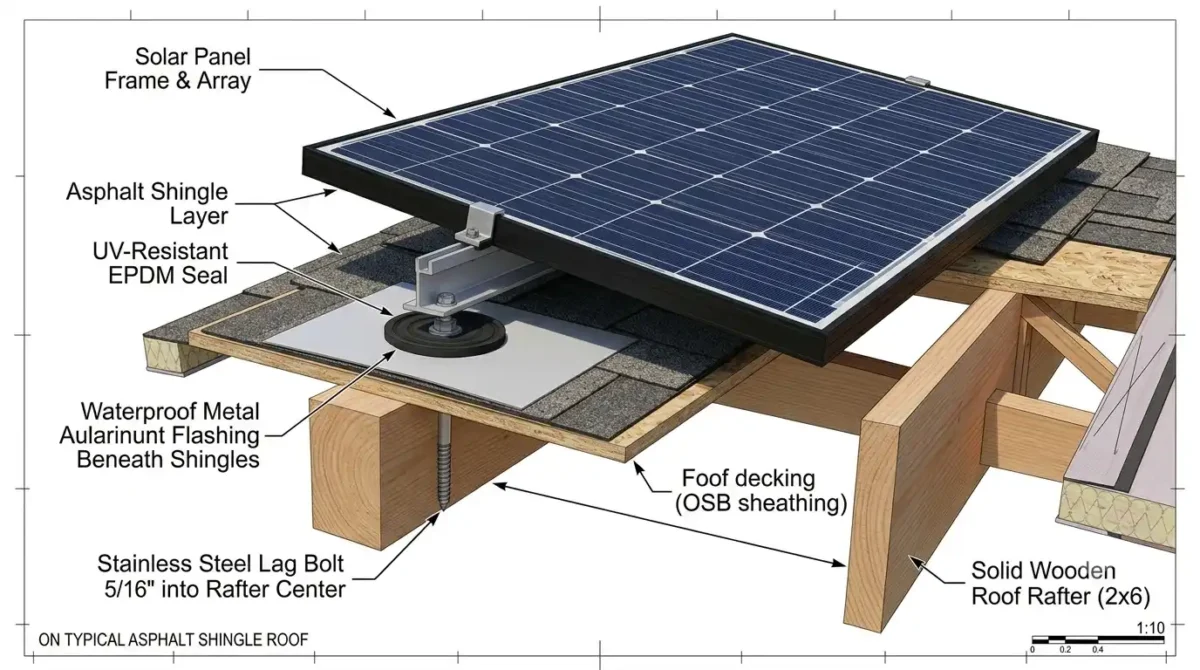
Most homeowners picture solar panels sitting flat on their roof like oversized tiles. That’s not how it works.
A standard roof-mounted photovoltaic system is secured through a racking system: metal rails bolted to lag screws that drill directly into the roof rafters beneath the sheathing. Each penetration point is sealed with a metal flashing, a waterproof barrier fitted under the existing roofing material, and further protected with a UV-resistant sealant around the lag bolt. Done correctly, this system creates a penetration point that is more watertight than the surrounding unmodified roof.
The installation sequence that prevents roof damage:
- Roof inspection identifies existing soft spots, aging underlayment, or pre-cracked shingles before drilling begins
- Rafter location determines exactly where lag bolts are placed — screws go into structural rafters, never into decking alone
- Flashing installation happens before the racking rail is secured, not after
- Sealant application follows flashing, sealing the bolt hole against water under any temperature or weather condition
- Final waterproofing verification confirms no exposed penetration points remain
The Step Most Contractors Skip
The problem SolarInfoPath has seen repeatedly is when installers reverse or skip steps — particularly the flashing installation. Some lower-cost contractors apply sealant directly over the shingle without proper flashing beneath it. It holds for 12 to 18 months. Then the sealant shrinks under thermal cycling, and the first significant rainfall finds its way into the rafter cavity.
Water intrusion from an improperly sealed penetration point can cost anywhere from $800 to $12,000 in repair costs, depending on how long the leak went undetected before anyone connected it to the installation.
Before installation begins, ask your contractor to walk you through exactly how they handle the penetration and sealing sequence for your specific roof type. A qualified installer will answer this without hesitation. If they deflect or give a vague answer, that’s important information about how they operate.
Does Solar Panel Weight Actually Damage Your Roof’s Structure?
What the Numbers Actually Mean
Solar panels weigh approximately 40 to 50 pounds each. Across a standard residential array of 20 to 25 panels, that translates to roughly 800 to 1,250 pounds distributed across the mounting footprint, approximately 5 to 6 pounds per square foot of roof surface covered.
Here’s the structural context most installers don’t volunteer: the International Residential Code (IRC) requires residential roof framing to support a minimum dead load of 10 to 20 pounds per square foot, depending on jurisdiction, plus live loads from snow and wind. Most residential roofs in the continental U.S. are engineered to handle 40 pounds per square foot of snow load alone.
In practical terms, a properly installed solar array adds less structural stress than a heavy snow accumulation that your roof was already designed to survive.
When Weight Becomes a Real Risk
Where this calculation changes: roofs older than 20 years, roofs with visible sagging between rafters, homes built before modern building codes, or structures with prior termite or moisture damage may have compromised load-bearing capacity that is not visible from the exterior. In these cases, a structural engineer’s assessment, typically costing $300 to $600, is not optional. It’s the document that tells you whether your roof can safely carry an array before you commit to a $25,000 installation.
What struck me when I reviewed structural failure cases in SolarInfoPath’s research was that in virtually every instance where a roof showed post-installation distress, a pre-installation structural report either was not requested or was performed by the solar installer’s in-house “roof assessor,” someone with a direct financial interest in approving the installation. That conflict of interest is something very few homeowners think to question before signing.
What a Qualified Structural Assessment Must Cover
A legitimate pre-installation structural assessment should include:
- Visual inspection of attic rafters and trusses for moisture staining, prior repairs, or insect activity
- Confirmation of rafter spacing and dimensions against local code minimums for the proposed load
- Identification of any prior structural modifications that altered the original load distribution
- Written sign-off from a licensed structural engineer, not just the solar installer’s project manager
If the company offering you a solar installation also performs its own structural assessment with no third-party verification, ask why. The answer to that question tells you a lot.
How Different Roof Types Affect Solar Damage Risk
Asphalt Shingle Roofs: The Most Common Situation
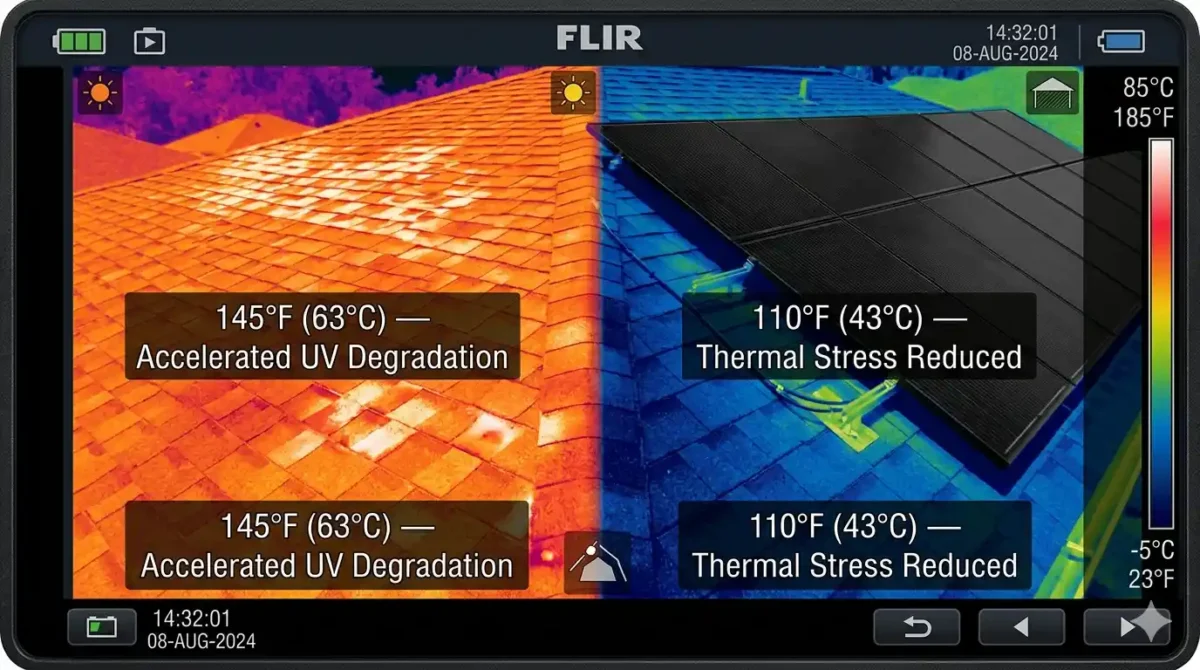
Asphalt shingle roofs are well-suited to solar installation when the roof is in sound condition. Penetrations are made into the rafters beneath, flashing is seated under adjacent shingles, and sealant is applied to a stable, flat surface. The process is well-understood and well-documented.
The honest limitation: asphalt shingles have a lifespan of 20 to 30 years. If your roof is 15 or more years old, the question is not whether solar will damage it today; it’s whether you’ll need to remove and reinstall the panels within 5 to 10 years when the roof needs replacement. Panel removal and reinstallation typically costs $1,500 to $3,500, depending on system size. That cost is rarely discussed during the sales process.
Projections vs. Reality: Asphalt Shingle Roof Solar Installation
| Factor | Standard Sales Estimate | SolarInfoPath Investigative Data |
| Roof damage risk | “Minimal with proper installation.” | True, requires verified flashing + licensed roofer-trained installer |
| Panel removal cost at roof replacement | Rarely mentioned | $1,500–$3,500 per removal/reinstall event |
| Leak risk timeline (sealant-only install) | “Sealed for system life.” | Sealant-only installs fail within 12–36 months |
| Structural assessment requirement | “We assess it ourselves.” | Independent engineer required for roofs 20+ years old |
| Warranty impact | “We handle it.” | Depends entirely on whether the installer holds the manufacturer’s approval |
Metal Roofs: The Most Solar-Friendly Option
Standing seam metal roofs eliminate penetration risk entirely. Installation uses seam clamps that grip the raised vertical seams directly, no drilling, no sealant, no holes in the roof membrane. The roof surface remains completely intact.
If you have a standing seam metal roof and are worried about solar causing roof damage, that concern is largely resolved by the clamp-based mounting method. The remaining risk is mechanical: clamps over-torqued beyond manufacturer specifications can stress the seam over years of thermal cycling. Under-torqued clamps allow the racking to shift under wind load. Proper torque verification during installation eliminates both failure modes.
Corrugated metal roofs are a different situation. They require penetrations and are handled more like asphalt shingles in terms of installation complexity and sealing requirements.
Tile Roofs: The Highest Installation Complexity
Tile roofs present the greatest installation complexity and the highest risk of incidental damage during the installation process itself. Individual tiles must be lifted or removed to access the underlayment and rafters beneath. Foot traffic on clay or concrete tile by installers not specifically trained for this material is the leading cause of tile cracking, and cracked tiles that go unidentified during installation become water entry points within one to two rainy seasons.
Specialized tile hooks and hook brackets allow mounting without cutting tiles when installed correctly. But this requires a roofing-trained solar installer, not merely a solar-trained one.
In markets with high concentrations of tile roofs, particularly in Florida, Arizona, and Southern California, the gap between a tile-competent solar contractor and a general installer is significant and directly tied to damage outcomes.
Tile Roof Red Flags During the Installation Walk-Through
Signs an Installer Is Not Tile-Qualified
- They don’t request a count of replacement tiles before beginning work
- No protective roof pads or crawler boards are visible during installation
- Tile removal is done without labeling or sorting for reinstallation
- The crew walks directly on tile surfaces rather than working from boards
Any one of these signals is insufficient tile training. All four together represent a meaningful risk of damage.
Flat Roofs: Load and Drainage Are the Real Concerns
Flat roof solar installations typically use ballasted mounting systems: heavy concrete blocks hold racking in place without penetrations. This eliminates leak risk at penetration points entirely, which is the primary concern for pitched roofs, but shifts the risk to structural load and drainage.
Concrete ballast blocks add 8 to 12 pounds per square foot beyond panel weight. On an aging flat roof or a structure built for a light dead load, this can exceed safe capacity. Drainage is the secondary concern: panels and racking can redirect water flow across the membrane, creating pooling in areas not designed for standing water.
A pre-installation drainage assessment by a licensed roofing contractor is strongly advisable on any flat roof installation, regardless of what the solar installer recommends.
Do Solar Panels Actually Protect Your Roof? What the Research Shows
This part surprises most people. Properly installed solar panels provide a measurable protective benefit to the roofing material directly beneath them.
Panels act as a physical shield, intercepting UV radiation that would otherwise degrade asphalt shingles and roofing underlayment over time. Research published through the U.S. Department of Energy and the National Renewable Energy Laboratory (NREL) has documented surface temperature reductions of 5°F to 35°F on roof areas beneath installed panels compared to exposed sections of the same roof. That thermal reduction decreases the expansion and contraction cycling that causes shingles to crack and curl prematurely.
Panels also deflect direct hail impact and heavy rain away from the shingles they cover. In hail-prone regions of the Midwest and Southern Plains, homeowners have found post-storm that the sections of roof beneath their array came through with less damage than adjacent exposed sections.
The catch, and there is one: this protective benefit applies only to the area under the panels. The perimeter of the array and any adjacent exposed roofing does not receive this benefit. In some cases, water runoff concentrating at the array’s lower edge creates accelerated wear on shingles along that drainage line over time. Proper installation, tilt design, and adequate spacing between panel rows account for this; inadequate design worsens it.
The Warranty Problem Most Homeowners Don’t Discover Until It’s Too Late
How Solar Installation Affects Your Existing Roof Warranty
Most manufacturer roof warranties contain a clause that voids coverage if “third-party modifications” are made without written approval from the manufacturer or by a manufacturer-approved contractor. Some solar installers hold this approval; many do not.
This means: if your solar installer is not on the roofing manufacturer’s approved contractor list, and a leak occurs at a penetration point, the roofing manufacturer may legally deny your warranty claim because unauthorized modifications voided coverage. The installer’s workmanship warranty should cover this gap, but workmanship warranties from solar contractors typically run 5 to 10 years, while your roofing material warranty may run 25 to 50 years.
If the installer goes out of business, which happens with meaningful frequency in a market as volatile as residential solar, the workmanship warranty is effectively worthless. Before you sign any contract, understanding exactly what exit rights you have and what protections survive company changes is not optional reading.
What a Roof Penetration Warranty Actually Is
A roof penetration warranty is a separate protection from the panel manufacturer’s equipment warranty and from the installer’s general workmanship guarantee. It specifically covers water intrusion at the installation penetration points. Many homeowners don’t discover it exists, or doesn’t exist in their contract, until they leak.
Before signing, request this as a distinct line item. If it isn’t listed separately, ask why, and get the answer in writing.
What Warranty Documentation You Should Collect Before Installation Day
The Four Documents That Protect You
- Confirmation in writing that the installer holds your roofing manufacturer’s approved contractor status
- A standalone roof penetration warranty with defined duration and coverage scope
- The installer’s current general liability insurance certificate naming you as additionally insured
- The installer’s contractor bond documentation with the issuing agency’s contact information
Collecting these before installation begins costs nothing. Discovering they don’t exist after a leak shows up costs significantly more.
Animals, Debris, and the Maintenance Risk No Installer Mentions Upfront
The gap between a roof-mounted solar array and the roof surface — typically 4 to 6 inches — creates an attractive microhabitat for birds, squirrels, and in warmer regions, roof rats. Wildlife nesting under panels causes three distinct damage categories that most installer presentations never raise.
Wiring damage is the most serious. Rodents chew through DC wiring insulation, creating arc-fault risks. The 2026 NEC requires arc-fault circuit protection on all new solar installations, which provides a meaningful safety layer, but the wiring damage still requires expensive service calls to locate and repair. For a fuller picture of the electrical risks associated with rooftop solar systems, solar panel fire, and electrical safety, it covers the specific fault scenarios homeowners should understand before installation.
Debris accumulation around panel mounts obstructs water drainage across the roof surface, creating localized pooling that accelerates shingle wear.
Structural contamination from nesting materials retains moisture against the roof surface, promoting mold and rot in the underlayment beneath the affected area.
Critter guards, wire mesh skirting installed around the array’s perimeter, prevent wildlife access and cost $200 to $600 installed at the time of original system installation. Retrofitting them after wildlife establishes a nesting presence costs considerably more.
Do Solar Panels Cause Roof Damage: A Realistic Scenario
Consider a homeowner in Columbus, Ohio, with a 22-year-old architectural shingle roof. The roof has an estimated 5 to 8 years of remaining useful life.
An installer, using AEP Ohio’s current average rate of approximately 13.8¢ per kWh, projects $1,100 in annual savings on a $28,000 system after the federal Investment Tax Credit. The payback period: roughly 9.5 years.
The installer doesn’t raise, and the homeowner doesn’t think to ask, that the roof will need replacement in approximately 6 years. Panel removal and reinstallation: $2,200. New roof: $9,000 to $14,000.
That $2,200 removal cost adds roughly two years to the payback calculation, and installing solar on a roof that will need replacement during the payback window means the panels are never properly contributing to their own ROI before the disruption begins.
The financially sound sequence is: replace the roof first, then install solar on the new surface. A fresh roof restarts the warranty clock and ensures the panels are mounted on a stable, long-lived surface for their full 25-year operational lifespan.
Before agreeing to any installation date, have your roof independently inspected by a licensed roofing contractor, not by the solar installer’s in-house assessor, and ask directly: “How many years does this roof have left, and what happens to my solar investment if I need to replace it in 7 years?”
According to current U.S. Energy Information Administration data at eia.gov, average residential electricity rates have increased approximately 3.2% annually over the past decade.
That trajectory affects payback calculations, but only if the roof the system is mounted on lasts long enough for the math to work.
Solar Installation Alternatives That Eliminate Roof Damage Risk Entirely
Not every solar investment requires drilling into your roof.
Ground-mounted systems place the array on a freestanding structure in the yard, eliminating all rooftop penetration concerns. They require adequate land area and compliance with local zoning setback rules, but they remove the roof from the equation entirely. For properties with complex roof geometries, significant shading, or aging roofing materials, ground mounts are worth evaluating seriously.
Community solar programs, now available in more than 20 states, allow homeowners to subscribe to a share of a remotely located solar installation and receive credits on their utility bill with no modifications to the home at all. The utility-scale solar guide covering costs, land requirements, and regulatory rules explains how these larger installations work and why community solar has become a viable alternative for homeowners whose roofs are not strong candidates for direct installation.
Solar roof tiles and shingles integrate photovoltaic cells directly into the roofing material itself, replacing sections of conventional roofing rather than mounting over them. This approach eliminates traditional penetration-based installation risk but comes with higher upfront costs and more limited availability from qualified installers.
How to Choose a Solar Installer Who Won’t Damage Your Roof
The Credential Standard That Actually Matters
The North American Board of Certified Energy Practitioners (NABCEP) PV Installation Professional certification is the recognized industry credential for solar installation. NABCEP-certified installers have completed documented training hours, passed a proctored examination, and demonstrated verified field experience. This is the baseline credential to confirm before any other conversation.
Beyond NABCEP, the question most homeowners never ask: Is the company licensed as both a solar contractor and a roofing contractor in this state? Some states require both licenses for roof-mounted work; others do not. A contractor with only the solar license may have no formal roofing training at all.
The Questions That Reveal Installer Quality
Ask these before you request a quote:
- How many installations have you completed on my specific roof type in the last 12 months?
- Can you provide two references from homeowners with the same roofing material?
- Does your general liability policy specifically cover roofing damage — and what is the per-occurrence limit?
- Are you on the approved contractor list for my roofing material manufacturer?
- What does your penetration warranty cover, and is it a separate document from your general workmanship warranty?
A contractor who cannot answer these questions directly, or who dismisses them as unnecessary, is telling you something important about how they operate.
Red Flags During the Sales Process
Warning Signs Before Signing
Indicators of Installer Risk
- Pressure to sign before an independent roof inspection is completed
- Refusal to provide installer references from homeowners with your roof type
- No mention of roof penetration warranty as a distinct contract provision
- Warranty documents that are described verbally but not provided in writing before signing
- A site assessment that takes under 20 minutes and doesn’t include attic access
If you encounter any of these, the appropriate response is to request the missing documentation and wait for it, not to proceed on the assumption that it will be provided after signing.
What Happens to Your Roof When Solar Panels Are Removed
Panel removal is less destructive than most homeowners expect when the original installation was performed correctly.
When panels are removed from an asphalt shingle roof, the flashing and sealant at each penetration point remain in place. A qualified contractor caps each exposed bolt hole with appropriate flashing and sealant, returning the penetration points to a watertight condition. The shingles around each mount may show discoloration from differential UV exposure, but this is cosmetic.
Where removal causes real damage: roofs where sealant was applied without proper flashing beneath it, roofs where tiles were cracked during the original installation and not replaced, and roofs where non-standard mounting hardware requires destructive removal techniques.
Documentation of the original installation method significantly affects what removal costs and what it leaves behind. A well-done installation comes off cleanly. A poorly done installation leaves problems behind when it goes.
One additional factor worth understanding before installation: how solar panels affect the resale value of your home changes depending on whether the system is owned outright or financed through a lease or PPA. Roof condition at the time of sale matters to buyers and appraisers — and a solar system installed on a roof that subsequently developed problems can complicate a transaction significantly.
SolarInfoPath’s Direct Assessment for 2026
Based on my investigative review of installation outcomes, roofing warranty claim patterns, and contractor licensing data across U.S. markets through 2026, the evidence supports a clear conclusion:
Solar panels, installed correctly by qualified professionals on a structurally sound roof, do not cause roof damage. In many cases, they extend the functional life of the roofing material beneath them by reducing UV exposure and thermal cycling.
The risk of damage is real and financially significant, but it is almost entirely a contractor qualification and pre-installation assessment risk, not a technology risk.
The homeowners who experience solar-related roof damage overwhelmingly share one of three circumstances: they selected a contractor based primarily on price, they accepted a cursory pre-installation assessment without independent verification, or they signed contracts without understanding what the workmanship warranty covered and what it excluded.
None of those circumstances is inevitable. All of them are avoidable with the right questions asked before the contract is signed.
For current federal solar incentive guidance and technical resources, the U.S. Department of Energy’s solar energy program publishes verified data that is worth reviewing independently of what any installer presents to you.
Frequently Asked Questions About Solar Panels and Roof Damage
Do solar panels cause roof damage during installation?
Not when installed correctly. The penetration process, flashing, lag bolts into rafters, and sealant are well-established and produce a watertight result on sound roofing material when the proper sequence is followed. Damage occurs when steps are skipped, or installers lack roof-type-specific training.
Do solar panels decrease roof life?
On a sound roof with a qualified installation, no. The UV shielding and thermal regulation benefits can modestly extend the protected area’s functional lifespan. On a compromised roof, installation can accelerate pre-existing deterioration by introducing penetrations into already-weakened material.
Do solar panels reduce roof life in ways installers don’t disclose?
The most underreported risk is the future removal cost. Panels installed on a roof with limited remaining life will need to be removed and reinstalled when that roof is replaced, an expense of $1,500 to $3,500 that is rarely mentioned during the sales process.
Are solar panels good for your roof in terms of weather protection?
Yes, in covered areas. Panels provide a physical barrier against hail, UV degradation, and direct rain impact on the shingles beneath them. NREL research confirms measurable reductions in surface temperature, which reduce thermal stress and shingle wear.
How do solar panels affect the roof’s drainage?
A well-designed installation accounts for drainage patterns and does not obstruct water flow. Poorly designed installations, particularly on flat roofs or where row spacing is insufficient on pitched roofs, can redirect water toward areas that develop pooling and accelerated wear over time.
What happens to a roof when solar panels are removed?
A proper removal leaves the penetration points sealed and the roof structurally sound. Cosmetic discoloration around mount locations is common. Structural damage from removal is almost always traceable to problems with the original installation, not the removal process itself.
Does removing solar panels damage a roof?
It should not, when the original installation was performed correctly with proper flashing and standard hardware. When the original installation skipped steps or used non-standard mounting, removal can expose or worsen the underlying problems.
This article by SolarInfoPath (2026 research framework) is part of a comprehensive solar knowledge architecture covering all major high-value sectors including legal disputes (installation negligence, contracts, liability, fraud, lawsuits, liens, HOA and permitting disputes), financial structures (loans, PPA/lease agreements, DSCR financing, tax equity, investment and project finance), tax law (ITC, Section 48/25D, MACRS depreciation, bonus credits, IRS audits, recapture rules, domestic content and IRA/OBBBA compliance), insurance and risk (property damage, hail/wind/fire claims, bad faith insurance disputes, warranty coverage), policy and regulation (net metering, FERC interconnection, state utility rules, incentive programs and regulatory changes), commercial and utility-scale development (EPC contracts, construction delays, performance bonds, receivership, bankruptcy, asset sale and restructuring), real estate impacts (home value, solar leases, liens, title issues, HOA restrictions, easements), and emerging market structures such as battery storage, community solar, agrivoltaics, SRECs, yieldcos, and institutional investment funds. All content is based on publicly available regulatory, financial, and legal sources and is intended strictly for educational and informational purposes, not legal, tax, or financial advice. Readers should always verify current laws, utility policies, tax regulations, and contract terms with qualified licensed professionals before making decisions, as solar regulations, incentives, and financial structures frequently change across jurisdictions and time.

Solar Legal Analyst· Policy Researcher· Investigative Finance Writer Lead Analyst & Founder of SolarInfoPath
Morgan Lee is a solar legal analyst, policy researcher, and investigative finance writer with 12+ years of experience in U.S. renewable energy law, IRS tax credit compliance, and solar litigation. He is the founder of SolarInfoPath, a research-driven platform focused on primary-source analysis of solar contracts, tax law, regulatory policy, and industry disputes affecting homeowners and commercial developers.
His work is grounded in original legal and regulatory sources, including IRS notices, FERC and CPUC rulings, state court filings, PACER records, and UCC lien databases. He specializes in solar contract disputes, injury and workers’ compensation claims, PACE financing issues, tax equity structures, ITC recapture rules, MACRS depreciation, and federal and state solar policy frameworks.
Morgan’s analysis spans solar litigation, finance structures, and regulatory developments such as the IRA and OBBBA, interconnection reform, domestic content rules, and battery storage incentives. He also covers EPC contracts, PPAs, project financing, and utility-scale solar investment structures.