
What does a solar warranty cover? In 2026, a typical residential system comes with three separate warranties: a 25-year product warranty for equipment defects, a 25-to-30-year performance warranty guaranteeing 84–87% of original output, and a 5-to-10-year workmanship warranty from your installer covering wiring, mounting, and roof penetrations.
If you’re staring at a quote and wondering what you’re actually protected against for the next 25 years, the short answer is this: you’re protected against three very different things, from three different parties, for three different lengths of time. The longer answer, and the one that actually matters when something goes wrong, is figuring out which of those three covers your specific problem, and what happens if one of those parties isn’t around anymore when you need them.
Why solar panel warranty coverage matters for your investment
This coverage matters because a residential system is a 25-to-30-year asset, and the warranties attached to it determine who pays when something fails years after installation: the manufacturer, the installer, or you. A $20,000–$30,000 system with weak warranty terms can turn a single inverter failure in year 12 into a $2,500 out-of-pocket repair. (This guide covers residential rooftop systems; the warranty structures and economics behind larger projects like solar farms and utility-scale installations work very differently.)
Here’s where the numbers shift. Most homeowners assume “25-year warranty” means one thing. In reality, it’s shorthand for a bundle of separate promises with separate expiration dates, separate exclusions, and separate companies standing behind them. The panel manufacturer, the inverter manufacturer, and your installer are three different entities, and only one of those three is likely to still be in business, in its current form, by year 20.
This is the part most people overlook: a strong performance warranty on the panels themselves doesn’t help you if the installer who handled your roof penetrations goes out of business in year 4 and your roof starts leaking in year 6. Understanding what does a solar warranty cover means understanding which warranty applies to which failure, not just trusting the “25-year” number on the brochure.
The three types of solar warranties are explained
A solar panel system carries three distinct warranty types: product, performance, and workmanship, each covering a different failure mode, issued by a different party, and running on a different timeline. Confusing these three is the single most common mistake homeowners make when evaluating a quote.
Product warranty: what it covers and for how long
A product warranty covers manufacturing defects in the physical panel itself, things like cell delamination, cracked glass, junction box failures, frame corrosion, and connector problems, and in 2026, the industry standard for premium residential panels has shifted to 25 years, up from the 10–12 years that was typical through the 2010s.
If a panel fails because the encapsulant layer separates from the glass, or a junction box stops working due to a manufacturing flaw, that’s a product warranty claim. What this coverage typically does not include here is damage from something hitting the panel, a tree branch, hail beyond rated tolerance, or a ladder leaned against it during a roof repair. Those are physical damage events, not manufacturing defects, and they fall under homeowners’ insurance instead.
Budget panels, often from smaller manufacturers without an established US presence, still commonly offer only 10–12 years of product coverage. That gap matters: a panel that fails in year 15 under a 12-year product warranty gets you nothing from the manufacturer, even if the performance warranty (a separate document) is still technically active.
Performance warranty: how your power output is protected
A performance warranty guarantees that your panels will still produce at least a specified percentage of their original rated output by a certain year, typically 84–87% at year 25 for current Tier 1 panels, with premium lines extending that guarantee to year 30 at 87–92%.
This is arguably the warranty that matters most financially, because it directly determines how much electricity your system generates over its lifetime, which is the entire basis of your return on investment calculation. A panel can have a strong performance warranty while carrying a weaker product warranty, or vice versa; the two numbers are independent, and both deserve a look before you sign anything.
Linear vs step performance warranty: which is better?
A linear performance warranty guarantees a steady, predictable decline in output, roughly 0.5% per year for standard panels, or under 0.25% for premium lines, while a step warranty holds output near 98% for the first year, then drops to a lower guaranteed floor that holds through year 25 or 30.
For most homeowners, linear warranties are easier to evaluate because the math is straightforward: multiply the annual degradation rate by the number of years, and you know roughly where your output will land at any point. Step warranties can look more generous on paper in the early years, but what matters for your 25-year ROI calculation is the year-25 floor, not the shape of the curve getting there.
What is a typical degradation rate, and why does it matter?
A typical degradation rate for current-generation panels is about 0.4–0.5% per year, meaning a panel producing 400 watts when new would still produce roughly 360–370 watts in year 20, and premium N-type panels now push that figure under 0.25% annually, preserving more output over the system’s life. Long-term field studies from the National Renewable Energy Laboratory (NREL) place median module degradation in this same range.
This matters because degradation compounds across decades. This is where the numbers shift in a way that’s easy to underestimate: the difference between 0.25% and 0.5% annual degradation sounds tiny, but over 25 years it’s the difference between a panel still producing about 94% of its original output versus about 87%. On a system that was generating $1,800 a year in offset electricity, that gap is roughly $125 a year by year 25, every year, for the remaining life of the system.
Workmanship (installation) warranty: what the installer covers
A workmanship warranty is provided by your installer, not the panel manufacturer, and covers installation-related issues like wiring, mounting hardware, roof penetrations, and overall system integration, typically for 5 to 10 years, with some top-tier installers offering up to 25 years.
This is the warranty most likely to become a problem, because it’s only as good as your installer’s continued existence. If your roof starts leaking around a mounting bracket in year 7, and your installer closed up shop in year 4, the manufacturer’s panel warranties are still valid, but nobody is contractually obligated to fix your roof. One thing most people miss is that this single fact is the entire reason third-party warranty plans exist as a product category.
Solar panel warranty coverage: what’s included and what’s not
When people ask what does a solar warranty cover, the complete answer, taken as a whole, includes manufacturing defects in panels and inverters, guaranteed minimum power output over 25–30 years, and installation-quality issues for the first 5–10 years, but it generally excludes labor costs for non-warranty repairs, shipping fees, weather damage beyond rated tolerances, and any issue traceable to unauthorized modifications.
What is covered under a standard solar warranty
A standard solar warranty bundle covers panel manufacturing defects (25 years), guaranteed power output above a stated floor (25–30 years), inverter defects (10–12 years for string inverters, 25 years for microinverters), and installation workmanship (5–10 years), four overlapping but separate coverage periods running on different clocks from the same installation date.
What solar warranties typically do not cover
Solar warranties typically do not cover labor costs for diagnosing or repairing covered defects, shipping or freight charges for replacement equipment, damage from weather events beyond the panel’s rated tolerance, theft, or any failure connected to DIY repairs or unregistered modifications.
Does the solar warranty cover labor and shipping costs?
Most manufacturer warranties do not cover labor and shipping by default, the manufacturer will replace a defective panel at no cost, but the truck roll to remove the old panel and install the new one, typically $500–$1,500 per visit, generally falls to the homeowner unless a limited labor reimbursement program applies, and those programs usually run only 2–12 years, far shorter than the 25-year product warranty itself.
If your monthly electricity bill is well above $150 and your system is large enough that a single panel failure represents real lost production, that labor-coverage gap is worth asking about directly before you sign, because it’s the most commonly misunderstood exclusion in the entire warranty bundle.
Are inverters, batteries, and racking covered?
Inverters, batteries, and racking each carry their own separate warranties, distinct from the panel warranties: string inverters typically run 10–12 years and usually need replacement once during a 25-year system life at a cost of roughly $2,000–$3,000, microinverters run up to 25 years, and battery storage warranties typically run 10 years, ending at whichever comes first, the year limit, a total energy throughput cap, or a retained-capacity threshold around 60–70%.
Racking and mounting equipment is generally covered under the installer’s workmanship warranty rather than a separate manufacturer’s warranty, which loops back to the same installer-solvency concern discussed earlier.
How long are solar warranties?
Solar warranties run on three separate timelines that all start on your system’s commissioning date but expire independently: the product warranty for 10–25 years, depending on panel tier, the performance warranty for 25–30 years, and the workmanship warranty for 5–10 years, meaning your strongest coverage typically ends well before your weakest coverage does.
Solar panel product warranty length by component
Product warranty length varies significantly by component and tier: premium residential panels (Maxeon, REC, Panasonic, and current N-type lines from LONGi, Jinko, and Trina) now carry 25-to-40-year product warranties, while budget panels, often from smaller manufacturers with limited US service presence, commonly offer only 10–12 years.
How long does a performance warranty last?
A performance warranty lasts 25 years for the industry standard, guaranteeing roughly 84–87% of nameplate output at that point, with premium product lines extending the guarantee to 30 years at output floors around 87–92%.
How long does a workmanship warranty last?
A workmanship warranty lasts 5 to 10 years industry-wide as the baseline, though some top-tier installers extend this to 10 years as standard, and a smaller number offer extended workmanship coverage up to 25 years for an additional cost.
How long do solar panels last after the warranty expires?
Solar panels typically continue generating electricity for 30–40 years total, well beyond the 25-year warranty period, operating at roughly 75–80% of their original output once the warranty has expired, which means the end of your warranty is not the end of your system’s useful life, just the end of the manufacturer’s guarantee on it.
What voids a solar panel warranty?
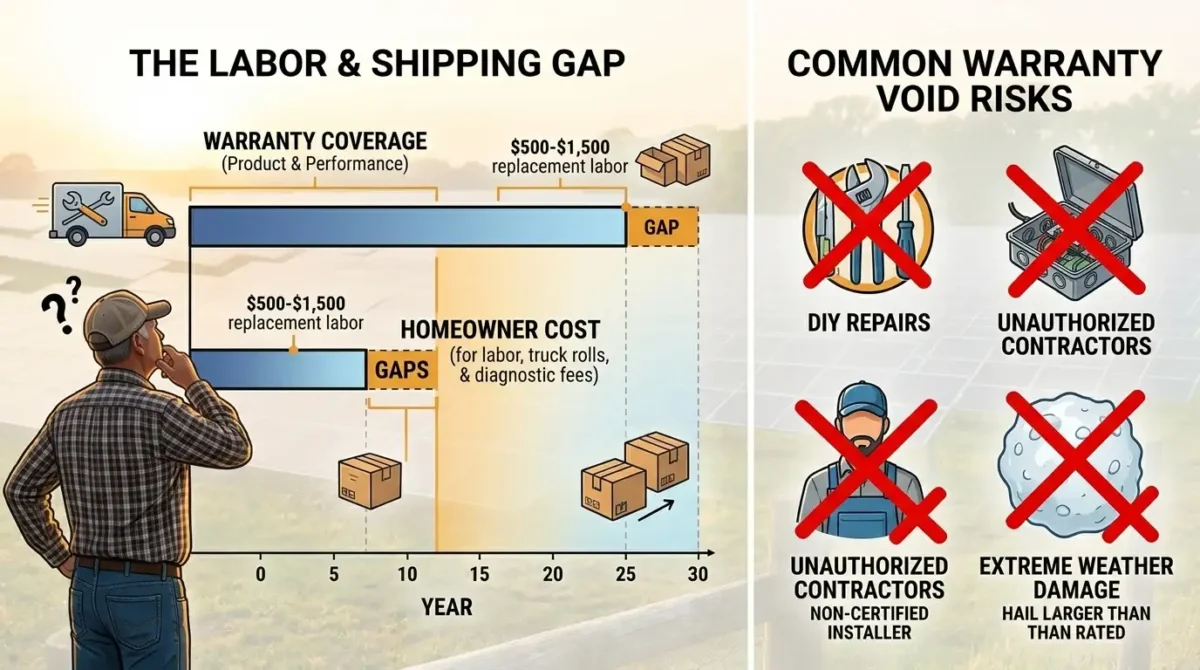
A solar panel warranty can be voided by DIY installation or unauthorized repairs, modifications made by an uncertified or unregistered contractor, failure to perform required maintenance, and damage from excluded weather events or conditions, and most of these void clauses apply permanently, not just for the specific incident.
Installation-related void risks
The most common installation-related void risk is having anyone other than a certified, manufacturer-authorized installer perform the original installation or any subsequent system work; doing so can void both the product and performance warranties immediately, even if the work itself was done competently.
Maintenance and repair void risks
Maintenance and repair void risks center on unauthorized repairs and unregistered contractors: if a system needs service and a homeowner hires a general electrician or handyman instead of a certified solar installer, any warranty claim related to that area of the system can be denied, even for an unrelated future failure, if the manufacturer determines the unauthorized work compromised the system.
Environmental and event-based exclusions
Environmental and event-based exclusions typically remove coverage for damage caused by extreme weather beyond the panel’s rated tolerance, chemical exposure (such as from nearby industrial or agricultural operations), and acts of nature. Generally, these events may be covered separately under homeowners’ insurance, but not under the solar warranty itself.
How to keep your solar warranty valid
Keeping a solar warranty valid mainly comes down to three things: using only certified installers for any work on the system, registering the warranty (and any transfer) within the required window, and keeping documentation, including commissioning records, serial numbers, and any service history, in case a claim is ever needed.
How to check your solar panel warranty status
Checking your solar warranty status means locating two separate documents, the panel manufacturer’s warranty certificate and your installer’s workmanship warranty agreement, and confirming both are registered in your name, since an unregistered warranty can complicate or delay a future claim even if the coverage itself is technically still active.
Finding your warranty documents and registration status
Warranty documents are typically provided at the time of installation, either as physical paperwork or through the manufacturer’s online portal, and registration, when required, usually needs to happen within 30 to 90 days of the system going live (reaching Permission to Operate, or PTO) to ensure full coverage and easy transferability later.
Using your solar monitoring system to track performance
A solar monitoring system tracks your system’s actual output against expected output, and a sustained gap between the two, not a single low-production day, but a consistent pattern over weeks or months, is the primary evidence you’d need to support a performance warranty claim. Here’s a moment worth pausing on: most homeowners check their monitoring app for total savings, but rarely compare it against the degradation curve in their performance warranty. If your system is producing noticeably below where the warranty curve says it should be at year 8 or year 10, that’s worth investigating before the gap becomes the new normal.
How to claim a solar panel warranty
Filing a solar warranty claim starts with documenting the issue, photos, monitoring data showing the performance gap or error codes, and your system’s serial numbers, then routing the claim to the correct party: the installer for workmanship issues, or the manufacturer directly for product and performance issues.
Step-by-step solar warranty claim process
The claim process generally follows four steps: document the failure with photos, error codes, and monitoring data; identify which warranty applies (product, performance, or workmanship) based on the nature of the failure; contact the appropriate party, installer for workmanship, manufacturer for equipment; and retain copies of all correspondence and the original commissioning paperwork throughout.
Documentation you need before filing a claim
Before filing, gather your original purchase invoice, system serial numbers, commissioning and installation records, monitoring data showing the performance discrepancy, and dated photos of any visible damage. Incomplete documentation is one of the most common reasons claims get delayed rather than denied outright.
What to do if your installer has gone out of business
If your installer has gone out of business, your workmanship warranty is generally void, but your manufacturer’s warranties on the panels and inverter remain valid as long as the manufacturer itself still exists. The practical challenge becomes finding another certified installer willing to perform warranty-covered work on a system they didn’t install, which can mean a service call cost even for a “covered” repair. If a faulty installation has already caused real damage to your home and the original company is gone, it can also be worth understanding when a solar panel property damage attorney becomes relevant.
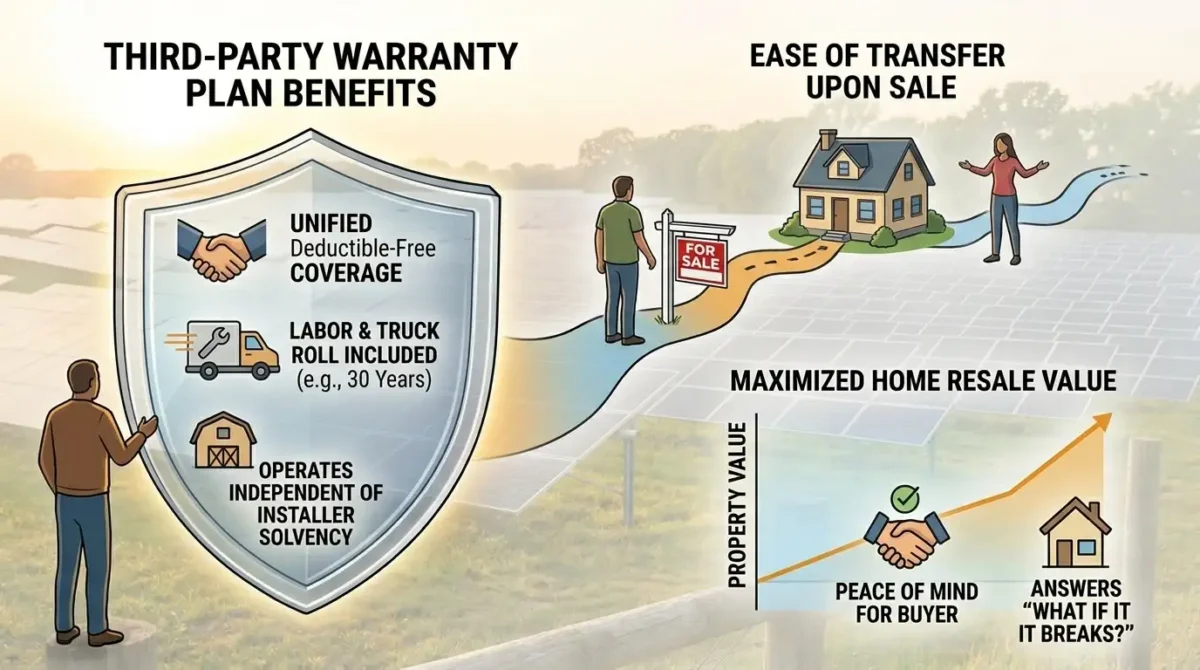
This is exactly the scenario third-party warranty plans are designed to prevent, since they’re administered independently of any single installer’s business status and typically include truck rolls and labor for 30 years with no deductible.
What to do if your warranty claim is denied
If a warranty claim is denied, the most common reasons are insufficient documentation, a determination that unauthorized work was performed on the system, or a finding that the failure falls under an excluded cause (such as weather damage rather than a manufacturing defect), and the appropriate next step is to request the specific reason for denial in writing and, if you believe it’s incorrect, provide additional documentation such as more detailed monitoring data or photos before escalating further.
Is a solar warranty worth it?
For most homeowners, the manufacturer and installer warranties that come standard with a quality installation are sufficient, but a third-party warranty plan becomes worth considering, specifically when the standard workmanship warranty is short (5 years or less) or when the installer is a smaller regional company without a long operating history.
Pros of having comprehensive solar warranty coverage
Comprehensive solar warranty coverage protects what is, for most households, a $20,000–$30,000 investment against the two failure modes most likely to occur over 25 years: equipment defects (covered by product warranties) and gradual output decline beyond expected levels (covered by performance warranties). Without comprehensive coverage, either of these can turn a planned 8-to-10-year payback into a meaningfully longer one.
When a third-party solar warranty plan makes sense
A third-party solar warranty plan makes the most sense when your installer’s workmanship warranty is on the shorter end (5 years), when you’re concerned about installer longevity, or when you want labor and truck-roll coverage that extends across the full 25-to-30-year system life rather than just the first decade, these plans typically transfer fee-free to a new homeowner and operate independently of whether your original installer is still in business.
Solar warranty vs homeowners’ insurance: what’s the difference?
The core difference is that a solar warranty covers manufacturing defects and underperformance, while homeowners insurance covers physical damage from external events like hail, fallen branches, or fire, and the two don’t overlap as much as homeowners often assume, since insurance generally won’t pay for a panel that’s simply degrading faster than promised, and a warranty generally won’t pay for a panel cracked by storm debris.
Does a transferable warranty increase home resale value?
Most solar warranties are transferable to a new homeowner upon sale, often requiring only a registration step and sometimes a $100–$300 fee, and a transferable warranty with 15–20 years of remaining coverage can be a meaningful point in a home sale, since it answers the buyer’s most likely question, what happens if something breaks, before they even ask it.
For homeowners thinking about how solar affects a future sale more broadly, our piece on how solar panels affect how fast homes sell looks at this from the buyer’s perspective in more detail.
Key details to review before signing a solar warranty agreement
Before signing, the details that matter most are the transferability terms, the labor and shipping reimbursement policy, the specific exclusions and void clauses, and, often overlooked, the manufacturer and installer’s track record for actually honoring claims when they’re filed.
Transferability terms
Transferability terms determine whether your warranty’s value survives a home sale: look specifically for whether transfer requires a fee ($100–$300 is typical), whether there’s a deadline for transferring after closing (commonly 30–90 days), and whether the performance warranty transfers on the same terms or resets in any way.
Labor and shipping reimbursement policies
Labor and shipping reimbursement policies are where the gap between “25-year warranty” and “25 years of free repairs” becomes most visible. Confirm whether any labor reimbursement program exists at all, and if it does, exactly how many years it covers, since these programs commonly run only 2–12 years even when the underlying product warranty runs 25.
Exclusions and void clauses to watch for
The exclusions and void clauses worth flagging before signing include any language requiring exclusively manufacturer-certified installers for all future work, any maintenance requirements (such as periodic cleaning) presented as a condition of coverage rather than a recommendation, and any geographic or environmental exclusions relevant to where you live; coastal salt exposure and agricultural chemical exposure are both commonly excluded.
Installer and manufacturer reputation and claims ease
Reputation matters because a warranty is only as useful as the process for using it. A manufacturer with a poor track record for responding to claims or an installer that’s been in business only a year or two both increase the realistic risk that paper coverage won’t translate into an actual repair when you need one. According to information from the U.S. Department of Energy, homeowners evaluating any major home energy investment benefit from researching the long-term track record of both the equipment manufacturer and the company performing the installation, not just the headline warranty terms.
Frequently asked questions about solar warranty coverage
What does a solar warranty cover?
A solar warranty bundle covers three things: manufacturing defects in the panels (product warranty, typically 25 years), guaranteed minimum power output (performance warranty, 25–30 years), and installation quality (workmanship warranty, 5–10 years from the installer).
How long are solar panel warranties?
Product warranties run 10–25 years, depending on panel tier; performance warranties run 25–30 years, and workmanship warranties run 5–10 years, all starting from the same installation date but ending at different points.
What voids a solar panel warranty?
DIY installation, unauthorized repairs by uncertified contractors, and modifications outside the manufacturer’s approved process are the most common ways a solar warranty gets voided, often permanently.
How do I claim my solar panel warranty?
Document the issue with photos, error codes, and monitoring data, then contact your installer for workmanship issues or the panel/inverter manufacturer directly for equipment and performance issues.
How do I check my solar panel warranty?
Locate your manufacturer’s warranty certificate and your installer’s workmanship agreement, confirm that both are registered in your name, and periodically compare your monitoring data against the performance warranty’s degradation curve.
Is a solar warranty worth the cost?
Standard manufacturer and installer warranties included with a quality system are generally sufficient for most homeowners; a paid third-party plan becomes worth considering mainly when the workmanship warranty is short or the installer is a newer, smaller company.
Does a solar warranty cover inverters and batteries?
Yes, but separately, string inverters typically carry 10–12 year warranties, microinverters up to 25 years, and batteries around 10 years, each with its own terms distinct from the panel warranty.
Can I transfer my solar warranty when I sell my home?
Most solar warranties are transferable, typically requiring a registration step and sometimes a $100–$300 fee within 30–90 days of the sale. A transferable warranty with significant remaining coverage can be a meaningful selling point.
This article by SolarInfoPath (2026 research framework) is part of a comprehensive solar knowledge architecture covering all major high-value sectors including legal disputes (installation negligence, contracts, liability, fraud, lawsuits, liens, HOA and permitting disputes), financial structures (loans, PPA/lease agreements, DSCR financing, tax equity, investment and project finance), tax law (ITC, Section 48/25D, MACRS depreciation, bonus credits, IRS audits, recapture rules, domestic content and IRA/OBBBA compliance), insurance and risk (property damage, hail/wind/fire claims, bad faith insurance disputes, warranty coverage), policy and regulation (net metering, FERC interconnection, state utility rules, incentive programs and regulatory changes), commercial and utility-scale development (EPC contracts, construction delays, performance bonds, receivership, bankruptcy, asset sale and restructuring), real estate impacts (home value, solar leases, liens, title issues, HOA restrictions, easements), and emerging market structures such as battery storage, community solar, agrivoltaics, SRECs, yieldcos, and institutional investment funds. All content is based on publicly available regulatory, financial, and legal sources and is intended strictly for educational and informational purposes, not legal, tax, or financial advice. Readers should always verify current laws, utility policies, tax regulations, and contract terms with qualified licensed professionals before making decisions, as solar regulations, incentives, and financial structures frequently change across jurisdictions and time.

Solar Legal Analyst· Policy Researcher· Investigative Finance Writer Lead Analyst & Founder of SolarInfoPath
Morgan Lee is a solar legal analyst, policy researcher, and investigative finance writer with 12+ years of experience in U.S. renewable energy law, IRS tax credit compliance, and solar litigation. He is the founder of SolarInfoPath, a research-driven platform focused on primary-source analysis of solar contracts, tax law, regulatory policy, and industry disputes affecting homeowners and commercial developers.
His work is grounded in original legal and regulatory sources, including IRS notices, FERC and CPUC rulings, state court filings, PACER records, and UCC lien databases. He specializes in solar contract disputes, injury and workers’ compensation claims, PACE financing issues, tax equity structures, ITC recapture rules, MACRS depreciation, and federal and state solar policy frameworks.
Morgan’s analysis spans solar litigation, finance structures, and regulatory developments such as the IRA and OBBBA, interconnection reform, domestic content rules, and battery storage incentives. He also covers EPC contracts, PPAs, project financing, and utility-scale solar investment structures.