The best way to finance solar in 2026 depends on your credit, your equity, and your timeline, not a single “best” product. Cash purchase delivers the highest lifetime savings if you have the capital. A HELOC or credit-union solar loan usually beats installer-partnered loans because it avoids the dealer fee that inflates your loan balance.
Leases and PPAs remove upfront cost but forfeit ownership. One thing has changed for everyone this year: the 30% federal residential tax credit is gone for systems you own outright.
That last point matters more than anything else in this article, so it’s worth saying plainly before anything else: as of January 1, 2026, the Residential Clean Energy Credit (Section 25D) no longer applies to solar systems you purchase or take a loan against.
The IRS confirms that new residential solar expenditures made after December 31, 2025, generally no longer qualify for the former 30% credit. If you’re comparing financing options based on savings estimates that still assume a 30% tax credit, that math is out of date, and it changes which financing option actually makes sense for you.
What Is the Best Way to Finance Solar Panels?
There is no single best solar financing option; the right one depends on three things: how much cash you can put down, your credit profile, and whether you want to own the system outright. Cash purchase wins on total cost. A HELOC or credit union loan wins on cost-per-dollar-borrowed for most homeowners. A lease or PPA wins on simplicity if you can’t or don’t want to take on debt.
Key Factors That Determine the Right Option for You
Four questions narrow this down fast: How much can you put down without draining your emergency fund? What’s your credit score? How long do you plan to stay in the home? And do you want to own the system, or just want a lower electric bill without the responsibility?
- Budget: Cash buyers save the most over 20+ years but tie up capital.
- Credit: Borrowers with FICO scores above 720 get better loan rates meaningfully.
- Timeline: Leases with escalator clauses can complicate a home sale within 5–10 years.
- Ownership goals: Only owned systems build home equity and qualify for state-level incentives.
Solar Financing Options Explained
Every solar financing route falls into one of three buckets: pay outright, borrow to own, or let a third party own it. Each bucket carries a different risk profile and a different relationship with today’s incentive landscape.
Cash Purchase
Paying cash is still the option with the lowest total cost, because you avoid every dollar of interest and every dealer fee baked into financed pricing. A typical residential system runs $29,000–$30,000 before financing markups, according to current lender rate surveys.
Pros and Cons of Paying Cash
The upside is straightforward: no interest, no lender approval process, immediate ownership, and full access to any remaining state or utility incentives. The downside is just as straightforward: most households don’t have $29,000 in liquid savings sitting around, and tying it up in a solar system means it isn’t available for anything else.
Who Cash Purchase Makes Sense For
Cash purchase makes the most sense for homeowners who plan to stay in the home long-term, have the capital without touching emergency savings, and want to avoid debt entirely. If pulling that much cash would leave you without a financial cushion, this isn’t the right starting point; that’s a real limitation, not a sales objection.
Solar Loans
Solar loans let you own the system with $0 down, but the advertised rate rarely tells the full story. Here’s where the numbers shift: many installer-partnered loans carry a dealer fee of roughly 20–30% that gets rolled directly into your loan principal, so a “low rate” loan can cost more overall than a higher-rate loan with no fee.
Secured vs. Unsecured Solar Loans
Secured loans use your home as collateral and generally offer lower rates, but they carry foreclosure risk if you default. Unsecured loans skip the collateral requirement; approval is faster, but the rate is usually higher.
Unsecured solar loans for borrowers with 700+ credit typically run 5–9% APR, while unsecured personal-loan-style solar financing can range as high as 17% for lower credit tiers.
Home Equity Loans and HELOCs for Solar
A HELOC is often the lowest-total-cost financed option, even though its headline rate may appear higher than a promotional solar loan rate. Current HELOC rates for solar run roughly 6.5–8.5% APR, and because there’s no dealer fee, you borrow against the real cash price of the system rather than an inflated one.
On a $26,000 system, a no-fee HELOC can end up costing thousands less over the loan’s life than a “1.99% APR” installer loan that actually financed $32,500 once the dealer fee was added in.
How Solar Loan Interest Rates Affect Total Cost
The rate you’re quoted is only half the equation; the loan principal matters just as much. A lower rate on an inflated balance can cost more than a higher rate on the true cash price. Always ask your installer for the cash price of the system before agreeing to any financed number.
Solar Lease
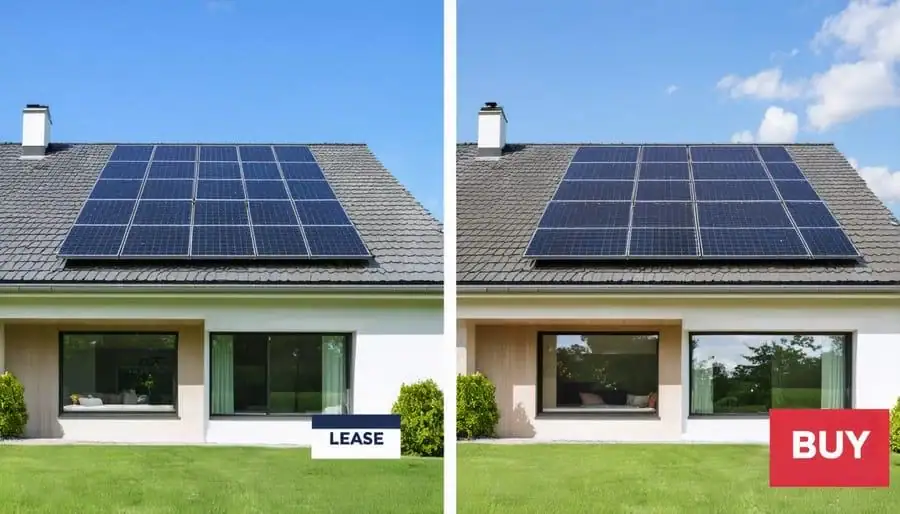
A solar lease means you pay a fixed monthly fee to use a system you never own; the leasing company keeps the incentives, and your bill savings come only from the gap between your lease payment and your old electric bill.
How a Solar Lease Works
You pay a set monthly amount, typically with an annual escalator clause that raises the payment over time. The leasing company retains ownership, handles maintenance, and keeps any tax benefits. This is the part most homeowners don’t find out until after they’ve signed: escalator clauses mean your “fixed” payment isn’t actually fixed for the life of the contract.
Power Purchase Agreements (PPAs)
A PPA charges you per kilowatt-hour produced rather than a flat fee, so your payment tracks your actual usage instead of a set schedule. One detail installers rarely lead with: third-party-owned systems, leases, and PPAs are currently the only residential path still connected to a federal tax credit in 2026.
Because that credit now flows through the commercial 48E structure rather than the expired residential 25D credit, and only for systems under construction before July 2026 or placed in service by 2028.
Solar Lease vs. PPA: What’s the Difference
A lease charges a flat monthly rate regardless of production; a PPA charges by the kWh actually generated. If your production varies seasonally, a PPA payment will vary with it; a lease payment won’t, until the escalator kicks in.
Pre-Paid Lease/PPA (Hybrid Ownership Path)
A pre-paid lease or PPA asks for a discounted lump sum upfront in exchange for a lower or eliminated monthly payment, with ownership sometimes transferring to you after roughly six years. It’s a hybrid: you get some of the cost benefit of ownership without financing the full system yourself on day one.
PACE Financing
PACE financing repays the cost of your solar system through an assessment on your property tax bill rather than a separate loan. It lets homeowners avoid the up-front cost of energy-saving improvements, and because the debt is attached to the property rather than to you personally, it transfers to a new owner if the home is sold rather than following you.
That sounds appealing, but there’s a real catch: federal housing agencies have directed major mortgage buyers not to purchase or refinance mortgages that have a PACE lien attached, which can complicate refinancing or selling the home before the assessment is paid off. PACE is currently available in a limited set of states, so availability is the first thing to confirm, not the rate.
Other Financing Routes
Personal loans, cash-out refinancing, and FHA-backed energy-efficient mortgages round out the list. A cash-out refi can offer a lower rate than a dedicated solar loan if mortgage rates are favorable, but it resets your entire mortgage term, a detail that’s easy to overlook when comparing monthly payments in isolation.
Best Solar Loans: What to Look For
The best solar loans aren’t necessarily the ones with the lowest advertised rate; they’re the ones with the lowest total cost once fees are included. Four factors separate a genuinely good loan from a marketing number.
Interest Rate and APR
Credit union rates for well-qualified borrowers currently run roughly 6–9% APR, consistently below installer-partnered lender averages once fees are factored in.
Dealer Fees and Hidden Costs
This is the single biggest hidden cost in solar financing. Ask your installer directly for the cash price of the system, then compare it to the financed price on any loan offer; the difference is the dealer fee, and it’s often thousands of dollars.
Loan Term Length: Short vs. Long
A longer term lowers your monthly payment but increases total interest paid over the life of the loan. A 25-year term can look attractive on a monthly budget but roughly doubles total interest cost compared to a 10- or 15-year term on the same balance.
Credit Score Requirements
Borrowers above 720 FICO typically qualify for the lowest advertised rates. Below 660, options narrow significantly, and APRs climb into the mid-teens or higher.
Questions to Ask Before Signing
- What is the cash price of this exact system, before any financing markup?
- Is there a dealer fee, and how much does it add to my loan principal?
- Is the rate fixed or variable for the full term?
- Is there a prepayment penalty if I pay the loan off early?
Solar Lease vs. Financing: Which Is Better?
For most homeowners who plan to stay put and want maximum long-term savings, an owned system, cash or loan, outperforms a lease. For homeowners who want zero responsibility and don’t care about ownership, a lease or PPA can still make sense, with the tradeoff being lower total savings.
Ownership and Tax Incentives
Only owned systems can access remaining state-level incentives, and only third-party-owned systems (leases/PPAs) currently connect to any federal credit in 2026. That’s a reversal of how this comparison worked in prior years, and it’s the single most important update homeowners researching solar financing need in 2026.
Monthly Cost Comparison
A financed, owned system often costs more per month early on than a lease, because loan payments are sized to pay off a real asset rather than just cover a service fee. Over time, that gap closes and then reverses once the loan is paid off and the homeowner keeps 100% of the savings.
Impact on Home Value and Resale
Solar panels can affect resale timelines, but the effect depends heavily on whether the system is owned or leased. Leased systems can complicate a sale because the buyer must either qualify to assume the lease or the seller must pay it off, an extra negotiation step that owned systems don’t require.
Maintenance and Long-Term Responsibility
Leases and PPAs typically include maintenance in the payment. Owned systems put that responsibility and cost on the homeowner, though most quality systems require minimal maintenance beyond occasional inspection. It’s worth reviewing what your solar warranty actually covers before assuming any repair is included.
How Solar Incentives Work With Each Financing Option
Incentive access is now the clearest dividing line between financing paths. This is the part that trips up almost everyone comparing quotes right now.
Tax Credits and Rebates
The federal residential credit is off the table for owned systems installed in 2026. Some state-level rebates, property tax exemptions, and sales tax exemptions still apply independently of the federal credit, but they only apply to systems you own, not leased or PPA systems.
Net Metering Benefits by Financing Type
Net metering credits belong to whoever owns the system’s output rights, which, in a lease or PPA, is typically the financing company, not the homeowner. Confirm this specifically in the contract language before signing; it’s rarely stated as plainly as the monthly payment is.
Is It Worth It to Finance Solar Panels?
Yes, for most homeowners with a stable electric bill above roughly $120–$150/month and plans to stay in the home 7+ years, but the math is tighter in 2026 than it was when the federal credit was active. Financing still works because it converts an unpredictable, rising utility bill into a fixed, predictable payment, and ownership still builds equity.
Long-Term Savings Potential
Once a loan is paid off, an owned system delivers the full value of avoided electricity costs with no further payment; that’s the core financial case for financing over leasing, even in a post-credit environment.
Break-Even Timeline
Without the 30% federal credit, payback periods for owned systems are longer than they were in 2025, often extending by several years depending on your utility rate and system cost. This is the honest tradeoff: 2026 financing decisions carry a longer break-even window than the marketing materials still circulating online reflect.
When Financing Solar Makes Financial Sense
Financing makes sense when your current electric bill is high enough that the loan payment is close to or below what you’re already paying, and when you can secure a no-fee or low-fee loan rather than an installer-partnered product with a hidden dealer fee.
When It Might Not Be Worth It
If your monthly electric bill is under roughly $100, if you plan to move within the next few years, or if the only financing available to you carries a heavy dealer fee and a rate above 12%, the payback math may not work in your favor. That’s a real scenario, not a hypothetical, and it’s worth running the numbers before signing anything.
Solar Financing Comparison Table
| Financing Type | Ownership | Typical Rate/Cost | 2026 Federal Credit Access | Best For |
| Cash purchase | Yes | No interest | None (credit expired) | Homeowners with available capital |
| Credit union solar loan | Yes | ~6–9% APR | None | Good credit, no dealer fee wanted |
| Installer-partnered loan | Yes | 1.99–17%+ APR (often + 20–30% dealer fee) | None | Convenience buyers who verify cash price first |
| HELOC | Yes | ~6.5–8.5% APR | None | Homeowners with home equity |
| PACE financing | Yes | ~7–10%, via tax bill | None | States where PACE is available; long-term owners |
| Solar lease | No | Fixed monthly + escalator | No | Zero-responsibility, no-credit-check buyers |
| PPA | No | Per-kWh rate | Possible (via 48E, limited window) | Usage-based payment preference |
How to Choose the Right Solar Financing Option for Your Situation
Start with what you can put down, then check your credit, then decide how much you value ownership. If you can pay cash without financial strain, that route still wins on lifetime cost. If you need to finance, get quotes from a credit union or HELOC lender before comparing anything from an installer’s in-house financing partner; the cash price versus financed price comparison alone will tell you most of what you need to know.
Before signing anything, review local permit requirements, since permitting delays can affect your installation timeline regardless of how you finance the system.
If you’re weighing whether ownership is worth it at all compared to a larger-scale alternative, it’s also worth reading about whether solar farms are worth it as a point of comparison, and confirming whether solar panels cause any roof damage that could affect your homeowner’s insurance or resale conversations later.
Frequently Asked Questions
What is the best way to finance solar?
For most homeowners, a credit union solar loan or HELOC beats an installer-partnered loan because it avoids the dealer fee that inflates the loan principal. Cash purchase remains the lowest-total-cost option for those with available capital.
Is it worth it to finance solar panels?
Usually yes if your monthly electric bill is meaningfully above average and you plan to stay in the home for several years, though 2026 payback timelines are longer without the expired federal residential credit.
What credit score do you need for a solar loan?
Most lenders want 650+ for approval, with the best rates reserved for 720+ FICO scores.
Can you switch from a lease to ownership?
Some lease and PPA contracts include a buyout option, often after several years, but terms vary significantly by provider and must be checked in the original contract.
Is solar loan interest tax-deductible?
Only in specific cases, such as a HELOC where the funds are used to improve the home securing the loan. This is a tax question that depends on your individual filing situation, so confirm details with a tax professional or the IRS residential energy credit guidance rather than relying on a general estimate.
This article by SolarInfoPath (2026 research framework) is part of a comprehensive solar knowledge architecture covering all major high-value sectors including legal disputes (installation negligence, contracts, liability, fraud, lawsuits, liens, HOA and permitting disputes), financial structures (loans, PPA/lease agreements, DSCR financing, tax equity, investment and project finance), tax law (ITC, Section 48/25D, MACRS depreciation, bonus credits, IRS audits, recapture rules, domestic content and IRA/OBBBA compliance), insurance and risk (property damage, hail/wind/fire claims, bad faith insurance disputes, warranty coverage), policy and regulation (net metering, FERC interconnection, state utility rules, incentive programs and regulatory changes), commercial and utility-scale development (EPC contracts, construction delays, performance bonds, receivership, bankruptcy, asset sale and restructuring), real estate impacts (home value, solar leases, liens, title issues, HOA restrictions, easements), and emerging market structures such as battery storage, community solar, agrivoltaics, SRECs, yieldcos, and institutional investment funds. All content is based on publicly available regulatory, financial, and legal sources and is intended strictly for educational and informational purposes, not legal, tax, or financial advice. Readers should always verify current laws, utility policies, tax regulations, and contract terms with qualified licensed professionals before making decisions, as solar regulations, incentives, and financial structures frequently change across jurisdictions and time.

Solar Legal Analyst· Policy Researcher· Investigative Finance Writer Lead Analyst & Founder of SolarInfoPath
Morgan Lee is a solar legal analyst, policy researcher, and investigative finance writer with 12+ years of experience in U.S. renewable energy law, IRS tax credit compliance, and solar litigation. He is the founder of SolarInfoPath, a research-driven platform focused on primary-source analysis of solar contracts, tax law, regulatory policy, and industry disputes affecting homeowners and commercial developers.
His work is grounded in original legal and regulatory sources, including IRS notices, FERC and CPUC rulings, state court filings, PACER records, and UCC lien databases. He specializes in solar contract disputes, injury and workers’ compensation claims, PACE financing issues, tax equity structures, ITC recapture rules, MACRS depreciation, and federal and state solar policy frameworks.
Morgan’s analysis spans solar litigation, finance structures, and regulatory developments such as the IRA and OBBBA, interconnection reform, domestic content rules, and battery storage incentives. He also covers EPC contracts, PPAs, project financing, and utility-scale solar investment structures.