
If you were misled by a solar salesperson, signed a contract you didn’t fully understand, or your system never performed as promised, California law gives you real legal tools to fight back. A solar panel lawsuit lawyer California can review your contract for statutory violations, identify cancellation rights, and pursue breach of contract or consumer fraud claims, often with no upfront attorney cost.
Solar fraud complaints in California have risen sharply since 2022, when aggressive door-to-door sales campaigns swept through communities in Los Angeles, San Diego, Fresno, and Sacramento. Homeowners signed $25,000 to $40,000 agreements based on production estimates that were never met, tax credit promises that didn’t apply to their situation, and financing terms that buried a 20% dealer fee inside the loan principal.
This article covers what qualifies as solar fraud under California law, when you likely need an attorney versus when you can act on your own, and exactly how the legal process works from the first demand letter to a potential class action. Nothing here is legal advice; it’s a map of the legal landscape so you can walk into any consultation already knowing your position.
What Counts as Solar Panel Fraud in California?
California defines solar fraud broadly across several statutes, and many homeowners are surprised to learn that their experience qualifies. Solar fraud isn’t just forged signatures; it includes inflated savings projections, misleading tax credit guarantees, undisclosed financing fees, and high-pressure door-to-door tactics that violate state cooling-off rules.
Deceptive Door-to-Door Sales Tactics
California’s Home Solicitation Sales law gives you a three-day right to cancel certain contracts signed at your home after a door-to-door sales visit, with no reason required. This right must be disclosed in writing at the time of signing. If it wasn’t, your cancellation window may still be open, even months later.
The pattern that shows up repeatedly in California complaints goes like this: a salesperson arrives unannounced, runs through a rushed presentation on a tablet, gets an e-signature on a contract the homeowner didn’t read aloud, and is gone within an hour. The required cancellation notice is either missing or buried in fine print on page 11.
If this matches your experience, a solar panel lawsuit lawyer in California can review your contract, identify potential violations, and explain what legal options may be available.
Forged or Altered Contracts
Forged e-signatures and post-signing contract alterations are more common than most homeowners realize. Some complaints involve contracts where production estimates were changed after signing, or addendums were added without the homeowner’s knowledge.
Under California law, a forged or materially altered contract may be void from the start. That’s a significant legal position, it means you may not owe anything under that agreement, and pursuing remedies through a solar panel lawsuit lawyer in California becomes a much stronger case.
Inflated Savings and Tax Credit Promises
Promising a specific dollar amount in savings or guaranteeing a federal tax credit for every buyer is both financially misleading and legally problematic. The 30% federal Investment Tax Credit requires a tax liability to offset, it’s not a refund. Homeowners with limited tax liability may receive far less than the promised amount, sometimes nothing at all.
Sales presentations that frame the tax credit as “money you’ll get back” without verifying your tax situation create grounds for a misrepresentation claim under the California Consumers Legal Remedies Act (CLRA), which mandates attorney fees for successful plaintiffs.
Hidden Dealer Fees and Predatory Financing
This is the part most California homeowners don’t find out until after they’ve signed their financing documents. Solar loans frequently carry a dealer fee, sometimes called an “origination fee” or “processing markup”, that ranges from 10% to 30% of the loan principal. On a $28,000 system, that’s up to $8,400 added to what you owe, often without a clear line-item disclosure.
California’s Unfair Competition Law, Business and Professions Code Section 17200, prohibits unlawful, unfair, or fraudulent business practices. A dealer fee that was never disclosed, or was misrepresented as standard, can fall squarely within that statute.
Do You Actually Need a Solar Fraud Attorney?
Not every solar dispute requires litigation. The right path depends on the dollar amount involved, what documentation you have, and how far the company is willing to negotiate without legal pressure.
Situations You Can Resolve Without a Lawyer
Some disputes are straightforward enough to handle through regulatory complaints or small claims court:
- Your complaint is under $12,500: California small claims court handles these cases without requiring an attorney, and filing fees are minimal.
- The company is still operating and responsive: a formal written demand, citing specific contract violations, sometimes produces a faster resolution than homeowners expect.
- The issue is a permit problem or interconnection delay: regulatory complaints to the California Public Utilities Commission (CPUC) or the Contractors State License Board (CSLB) are free, require no attorney, and create a formal record.
If your solar system was never connected to the grid due to solar panel permit requirement failures by the installer, a CSLB complaint is often the fastest first step.
Situations That Require Legal Representation
Some scenarios carry enough financial and legal complexity that handling them alone creates real risk:
- The dispute involves PACE financing, which can place a property tax lien on your home
- Your contract contains an arbitration clause that limits your options
- The company has filed for bankruptcy
- The dollar amount exceeds $50,000
- You’re a senior homeowner, which triggers California’s Elder Abuse Act protections
- Your contract was signed under clear misrepresentation of the federal tax credit
In these situations, a consumer protection attorney with solar experience typically reviews the case at no charge before taking it on.
Legal Grounds to Sue a Solar Company in California
California offers more legal pathways for solar disputes than most states. Understanding which statute applies to your situation determines the remedies available, including whether you can recover attorney fees on top of damages.
Breach of Contract and Buyout Clause Disputes
Every solar purchase agreement, lease, or PPA is a contract. If the company didn’t deliver what the contract promised, whether that’s a specific production level, an installation timeline, or a warranty response, you have a breach of contract claim.
Lease and PPA agreements deserve special attention here. If you signed a lease, the solar company still owns the system. The buyout clause in most California solar leases sets a purchase price that can exceed $20,000 after 10 years. That clause is a financial obligation that affects your ability to sell the home, review how solar affects your home’s resale value before assuming it’s a neutral factor.
FTC/California Cooling-Off Rule Violations
The Federal Trade Commission’s Cooling-Off Rule and California’s parallel Home Solicitation Sales law both require that door-to-door contracts include a written notice of your three-day cancellation right. The notice must be in the same language as the contract.
If that notice was missing, incomplete, or not provided at the time of signing, your right to cancel may extend well beyond the standard three days. Courts in California have applied this broadly in consumer protection cases.
TILA Rescission for Undisclosed Lender Fees
The Truth in Lending Act (TILA) gives borrowers a rescission right when required disclosures are missing or inaccurate. A TILA rescission can, in some circumstances, cancel the entire loan, not just allow you to renegotiate terms.
This remedy is precise and technically demanding. TILA rescission notices must be sent correctly to the right parties within the applicable window. This is one area where attempting it without an attorney significantly increases the risk of losing the right entirely.
California Elder Abuse Act Claims
California’s Elder Abuse Act applies to consumers aged 65 and older and provides significantly stronger remedies than standard consumer protection statutes, including treble damages (up to three times actual losses) and mandatory attorney fee awards.
Seniors have been a documented target of aggressive solar sales tactics in Los Angeles County, the Inland Empire, and the Central Valley. If you or a family member signed a solar agreement under high-pressure conditions and are 65 or older, a solar panel lawsuit lawyer in California can help review the circumstances, assess potential claims, and explain the legal options available under California law.
UCC-1 Lien and Title Disputes
Here’s something that catches homeowners completely off guard: solar loan lenders frequently file a UCC-1 financing statement against the solar equipment, and sometimes against the home itself, as security interest. This filing can appear on title reports and delay or block a home sale.
What struck me when I reviewed California title complaint patterns is that many homeowners discover a UCC-1 lien only when they’re in escrow, not before. Clearing it requires a formal lien release from the lender, which can take weeks and sometimes requires legal pressure.
If your installer went out of business, tracking down the lien holder to obtain a release becomes a more complex process, one where legal representation often accelerates the outcome.
Consumer Protection Statute Violations (UCL, CLRA)
Two California statutes cover the broadest range of solar fraud scenarios:
- California Unfair Competition Law (Bus. & Prof. Code §17200): Prohibits any unlawful, unfair, or fraudulent business practice. This statute is intentionally broad, which makes it powerful for cases where the conduct was clearly wrong but doesn’t fit neatly into a single category.
- California Consumers Legal Remedies Act (CLRA): Specifically prohibits misrepresentation in consumer transactions. A successful CLRA claim requires the company to pay your attorney fees, which is why consumer protection attorneys often take these cases on contingency.
Both statutes allow class actions, meaning your case may connect to a broader group of similarly harmed California homeowners.
California Solar Fraud Class Action Lawsuits
A California solar fraud class action lawsuit is a legal proceeding where one or more plaintiffs represent a larger group of homeowners who suffered the same harm from the same company. Class actions have been filed against several solar companies in California in recent years, often targeting systemic deceptive sales practices rather than individual contract disputes.
Individual Claim vs. Class Action: Which Applies?
| Factor | Individual Claim | Class Action |
| Dollar amount | Any | Higher individual losses strengthen it |
| Harm type | Unique to your situation | Same practice affected many others |
| Timeline | 6–18 months typical | 2–5 years typical |
| Your role | Active participant | Often passive after joining |
| Attorney cost | Contingency or flat fee | Plaintiff attorney carries all cost |
| Recovery | Full damages potential | Shared settlement, often lower per person |
The right choice depends on your specific losses. If your damages are $30,000 or higher and the harm was specific to your contract, an individual claim often recovers more. If the company used the same deceptive script on thousands of California homeowners, a class action may be built already, and you may be eligible to join without filing anything separately.
When a Class Action Makes Sense
A California solar fraud class action lawsuit makes the most sense when the conduct was systematic rather than situational. Examples include a company that trained all its salespeople to make the same tax credit misrepresentation, or a lender that added the same undisclosed dealer fee to every California loan it originated.
Your attorney can check whether an existing class action covers your situation before recommending an individual filing.
Legal Help for Defective Solar Panel Installation
Defective installation is a separate legal category from fraud, it involves physical failures, code violations, and warranty breaches rather than misrepresentation. A lawyer for defective solar panel installation in California evaluates these cases differently, focusing on CSLB licensing requirements, installer warranty language, and manufacturer warranty terms.
Roof Damage and Leaks
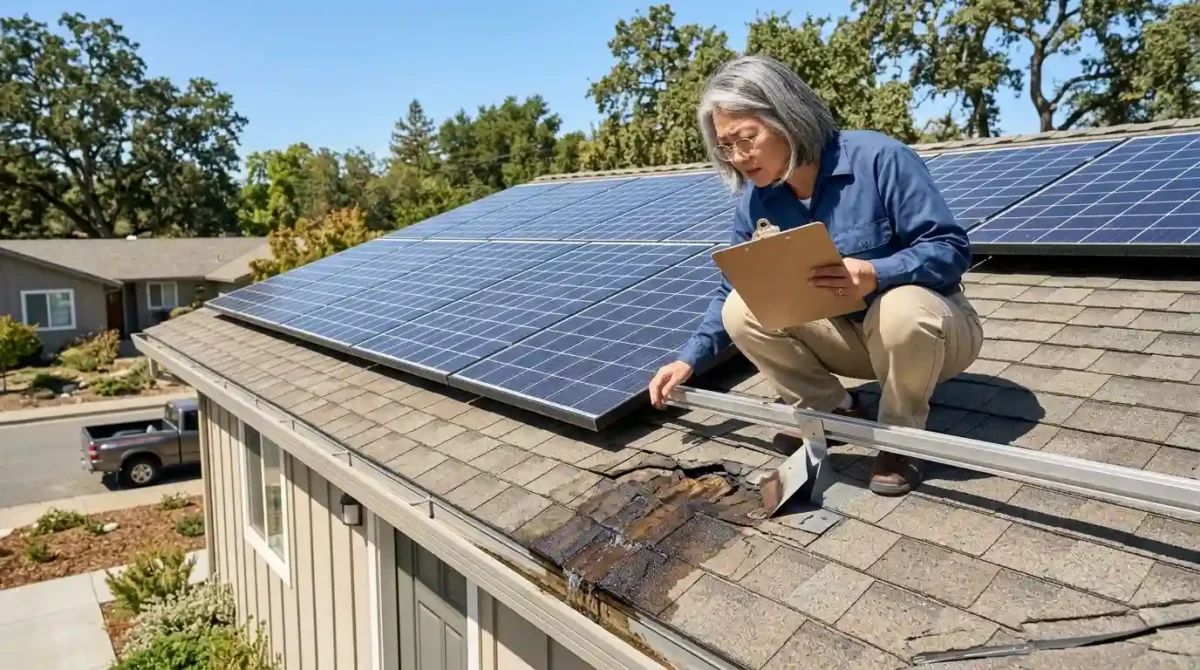
Improper roof penetrations are one of the most common installation complaints in California. Leaks caused by improperly flashed roof mounts can cause significant structural damage that extends well beyond the solar system itself.
If your installer is still operating, a formal demand letter citing the CSLB’s installation standards and the contract’s warranty clause is typically the first step. If the damage is significant, read about how solar panels can affect roof integrity to understand what a damage assessment should cover before you engage anyone.
System Underproduction and Non-Activation
A system that produces 30% less than projected in the first year represents a measurable, documentable breach of the performance warranty in many California solar contracts. Utility production data, available through PG&E, SCE, or SDG&E, provides the objective baseline an attorney needs to quantify the claim.
If your system was never activated or is still waiting for interconnection approval long after installation, that’s a separate and often faster claim. California’s Solar Billing Plan (formerly NEM) requires interconnection, and delays caused by installer errors rather than utility backlogs can shift liability back to the contractor. A solar lawsuit lawyer in California can review your production records, contract terms, and interconnection history to determine what legal options may be available.
Interconnection Delays
Interconnection delays are genuinely complicated in California right now. PG&E’s interconnection queue in northern California has been backlogged, causing delays that are not the installer’s fault. But delays caused by incomplete permit applications, wrong equipment specifications, or failure to respond to utility correction requests are installer failures and may constitute breach of contract.
Understanding how solar panel permit requirements work in California helps you distinguish between a utility delay and an installer error, which directly affects who’s legally responsible.
Enforcing Installer and Manufacturer Warranties
Most California solar installations carry two separate warranties: one from the installer covering workmanship, and one from the panel manufacturer covering production degradation. These are legally distinct obligations.
If your installer went out of business, the workmanship warranty may be effectively unenforceable, but the manufacturer warranty often remains. Read what a solar warranty actually covers before assuming either warranty protects you in the way the salesperson described.
What Happens When You Sue a Solar Company: The Process
Most homeowners picture a courtroom when they think about suing a solar company. The reality is that the majority of California solar disputes resolve before any lawsuit is filed, through demand letters, regulatory pressure, or negotiated settlement. Here’s how the process actually moves.
Case Review and Evidence Gathering
Every attorney consultation starts with documents. The stronger your paper trail, the faster an attorney can identify your legal position.
Gather these before any consultation:
- Signed contract, all pages and addendums
- Original sales presentation materials or email quotes
- Financing agreement and all loan disclosures
- 12 months of utility bills before and after installation
- System monitoring data (from the app or portal)
- All written communications with the company
- Permit and inspection records
- Any warranty documents provided at signing
A realistic scenario: a homeowner in Fresno signed a 25-year PPA with SDG&E-adjacent utility coverage, paying $0.22/kWh under the agreement while SCE’s 2026 residential rate runs close to $0.27/kWh. The sales pitch projected $4,200 in annual savings. Actual monitoring data after 18 months showed production at 61% of the contracted estimate, translating to roughly $1,100 in real savings, less than a third of what was promised. That gap, documented in utility bills and system monitoring logs, forms the core of a breach of warranty claim.
The Demand Letter Stage
A demand letter from an attorney carries measurably more weight than a homeowner’s own complaint. It cites specific statutes, identifies the remedy being sought, and establishes a formal response deadline, typically 30 days.
Many California solar companies resolve disputes at this stage to avoid litigation costs and CPUC regulatory attention. An attorney-drafted demand letter costs less than people assume, and in CLRA cases, the company may owe your attorney fees anyway if the claim succeeds.
Negotiation, Mediation, and Arbitration
If the demand letter produces a response, negotiation typically follows. Most California solar contracts include a mandatory arbitration clause, which means disputes go to a private arbitrator rather than a court. Arbitration is faster than litigation (typically 3 to 9 months), but outcomes are final and appeals are extremely limited.
Check your contract for this clause before assuming you can take the company to court. If arbitration is required, an attorney experienced in solar cases can still represent you through that process.
Filing a Lawsuit
If negotiation fails and arbitration isn’t required (or isn’t enforceable in your contract), filing a lawsuit becomes the next step. California superior court handles civil claims above the small claims threshold. Litigation timelines run 12 to 24 months on average, though cases with strong documentation often settle before trial.
What If the Solar Company Went Bankrupt?
Solar company bankruptcy is more common in California than most homeowners realize. Several installers that were active in the Los Angeles basin between 2020 and 2023 have since ceased operations or filed for Chapter 7 or Chapter 11 protection.
Pursuing the Loan Servicer or Lien Holder
When the installer goes bankrupt, your loan doesn’t disappear. The lender or loan servicer still holds your debt. If that lender was complicit in the deceptive sales process, for example, by funding a loan the same day as signing, before required rescission periods expired, they may carry separate liability under TILA or state consumer protection statutes.
The U.S. Department of Energy’s solar energy research resources document the scale of consumer protection concerns in residential solar financing, providing useful context if you’re building a regulatory complaint.
Filing a Creditor Claim
If the solar company is in active bankruptcy proceedings, you can file a creditor claim in the bankruptcy case. This doesn’t guarantee recovery, but it preserves your position if assets are distributed. An attorney can file this for you, often at a flat fee since the process is procedurally defined.
Attorney Fees: What Suing a Solar Company Actually Costs
Cost is the first concern most homeowners have, and it’s usually the last reason a good case should go unpursued. Understanding fee structures removes that barrier.
| Fee Type | How It Works | Best For |
| Contingency | No upfront cost; attorney takes 33–40% of recovery | Strong fraud, Elder Abuse, and CLRA cases |
| Flat fee | Fixed amount for defined work (demand letter, contract review) | Smaller disputes, document review, complaint filing |
| Hourly | Billed per hour, typically $250–$500 for consumer attorneys in CA | Complex litigation with uncertain scope |
Contingency Fee Cases
Contingency arrangements are common in California solar fraud cases because statutes like the CLRA and the Elder Abuse Act include mandatory attorney fee provisions. When a statute requires the company to pay your attorney fees upon success, the attorney’s financial risk drops, which makes contingency more accessible.
Flat Fee Arrangements
A flat fee contract review, typically $300 to $700 in California, identifies whether your agreement contains statutory violations before you commit to any further action. That’s often the most useful first step, knowing your legal position before deciding how aggressively to pursue it.
Hourly Billing
Hourly billing suits complex cases where scope is genuinely uncertain, such as multi-party PACE financing disputes or cases where interconnection failures and fraud claims overlap. Understand total estimated hours before agreeing to hourly representation.
How to Choose a Solar Fraud Attorney in Los Angeles or Statewide in California
A solar fraud attorney in Los Angeles or anywhere in California should have verifiable experience in consumer protection law, ideally with prior solar cases. General practice attorneys unfamiliar with TILA, the CLRA, or CPUC regulations may miss statutory arguments that significantly affect your outcome.
Questions to Ask Before Hiring
Ask these questions before signing any representation agreement:
- Have you handled solar-specific consumer protection cases in California?
- Which statutes are most relevant to my situation, based on what I’ve described?
- Do you work on contingency for cases like mine, and what percentage?
- What’s the realistic timeline from demand letter to resolution?
- Are there any weaknesses in my documentation that I should address before we proceed?
- Is there an existing class action I should know about that might cover my situation?
An attorney who gives direct, specific answers to these questions, including honest assessments of case weaknesses, is a better indicator of competence than one who makes broad promises about outcomes.
Small Claims Court vs. Hiring a Solar Panel Lawsuit Lawyer
A small claims court in California handles disputes up to $12,500 for individuals. The process is designed for self-representation, filing fees are low, and hearings are typically scheduled within 30 to 70 days.
| Factor | Small Claims | Hiring an Attorney |
| Cost cap | $12,500 maximum recovery | No statutory cap |
| Representation | Self-represented | Attorney handles the case |
| Timeline | 30–70 days to hearing | 3–24 months depending on path |
| Complexity | Low; judge decides quickly | High; full legal argument |
| Best for | Clear disputes under the cap | Fraud, TILA, CLRA, Elder Abuse claims |
| Attorney fees | Not recoverable | Recoverable under CLRA and Elder Abuse Act |
Small claims is genuinely useful for a bounded dispute, say, an installer who charged for a permit that was never pulled and won’t refund the $800 fee. For anything involving misrepresentation, a UCC lien, PACE financing, or losses above the cap, small claims leave significant recovery on the table.
Making Sense of Your Options as a California Solar Homeowner
If you’ve had a frustrating experience with a solar company in California, you don’t have to figure everything out on your own. Issues such as misleading sales claims, unexpected costs, poor installation, or a system that isn’t performing as promised can leave homeowners unsure about what to do next.
Start by keeping your contract, invoices, financing documents, emails, text messages, and records of any problems with your solar system. A Solar Panel Lawsuit Lawyer California can review these details, explain your legal options, and help you understand whether you may have a valid claim against the company.
Most importantly, don’t ignore the problem if you believe you were misled or received poor-quality work. Every situation is different, so take time to review your documents and seek qualified legal advice before deciding whether to pursue a complaint, settlement, or lawsuit.
Frequently Asked Questions
How much does it cost to sue a solar company in California?
It depends on the fee arrangement. Contingency cases cost nothing upfront, the attorney is paid from the recovery. A flat-fee contract review typically runs $300 to $700. Hourly billing for full litigation averages $250 to $500 per hour for consumer protection attorneys in California. CLRA and Elder Abuse Act cases may require the company to pay your attorney fees if you win.
Can I join a class action against my solar company in California?
Possibly. A California solar fraud class action lawsuit may already be active against your company. An attorney can check whether your situation qualifies you as a class member, which would require no separate filing on your part. If no class action exists and many others were harmed the same way, one may be initiated with your participation.
What if my solar company already declared bankruptcy?
Your loan obligation to the lender continues regardless of installer bankruptcy. However, if the lender participated in the deceptive sale or funded the loan before required rescission periods expired, they may carry separate liability. You can also file a creditor claim in the bankruptcy case to preserve your right to any asset distribution.
Does suing my solar company hurt my credit?
Filing a lawsuit does not affect your credit score. However, stopping loan payments while a dispute is pending can. Before suspending any payment, consult an attorney about whether doing so is protected under your state rescission or dispute rights; stopping payments without that legal basis creates a separate credit and collection problem.
How long does a solar lawsuit take in California?
A demand letter and negotiated settlement: 1 to 4 months. Mediation or arbitration: 3 to 9 months. Litigation through a California superior court: 12 to 24 months, though many cases settle before trial. Cases with documented violations and clear damages typically move faster than cases requiring extensive discovery.
This article by SolarInfoPath (2026 research framework) is part of a comprehensive solar knowledge architecture covering all major high-value sectors including legal disputes (installation negligence, contracts, liability, fraud, lawsuits, liens, HOA and permitting disputes), financial structures (loans, PPA/lease agreements, DSCR financing, tax equity, investment and project finance), tax law (ITC, Section 48/25D, MACRS depreciation, bonus credits, IRS audits, recapture rules, domestic content and IRA/OBBBA compliance), insurance and risk (property damage, hail/wind/fire claims, bad faith insurance disputes, warranty coverage), policy and regulation (net metering, FERC interconnection, state utility rules, incentive programs and regulatory changes), commercial and utility-scale development (EPC contracts, construction delays, performance bonds, receivership, bankruptcy, asset sale and restructuring), real estate impacts (home value, solar leases, liens, title issues, HOA restrictions, easements), and emerging market structures such as battery storage, community solar, agrivoltaics, SRECs, yieldcos, and institutional investment funds. All content is based on publicly available regulatory, financial, and legal sources and is intended strictly for educational and informational purposes, not legal, tax, or financial advice. Readers should always verify current laws, utility policies, tax regulations, and contract terms with qualified licensed professionals before making decisions, as solar regulations, incentives, and financial structures frequently change across jurisdictions and time.

Solar Legal Analyst· Policy Researcher· Investigative Finance Writer Lead Analyst & Founder of SolarInfoPath
Morgan Lee is a solar legal analyst, policy researcher, and investigative finance writer with 12+ years of experience in U.S. renewable energy law, IRS tax credit compliance, and solar litigation. He is the founder of SolarInfoPath, a research-driven platform focused on primary-source analysis of solar contracts, tax law, regulatory policy, and industry disputes affecting homeowners and commercial developers.
His work is grounded in original legal and regulatory sources, including IRS notices, FERC and CPUC rulings, state court filings, PACER records, and UCC lien databases. He specializes in solar contract disputes, injury and workers’ compensation claims, PACE financing issues, tax equity structures, ITC recapture rules, MACRS depreciation, and federal and state solar policy frameworks.
Morgan’s analysis spans solar litigation, finance structures, and regulatory developments such as the IRA and OBBBA, interconnection reform, domestic content rules, and battery storage incentives. He also covers EPC contracts, PPAs, project financing, and utility-scale solar investment structures.