
The best solar battery storage systems for most homeowners are lithium iron phosphate (LFP) units with 10–20 kWh usable capacity, a minimum 80% depth of discharge, and a 10-year warranty guaranteeing at least 70% end-of-warranty capacity. Whether battery storage adds real financial value depends on your state’s net metering policy, your utility’s time-of-use rate structure, and whether your primary goal is backup power or bill reduction.
Most homeowners ask about solar batteries because they’ve had a power outage, or because an installer told them they “need” one. Both are valid starting points. But the problem is that the $12,000 to $20,000 battery decision usually gets made during a sales conversation, not after a real analysis of local utility rates, charge cycle math, or what the warranty actually guarantees.
This guide is the analysis that the sales process doesn’t provide. Every number below is specific, every scenario is grounded in real utility data, and where the math doesn’t favor a battery, that’s stated clearly.
What Is Solar Battery Storage and How Does It Actually Work?
A home battery storage system captures excess electricity your solar panels generate during the day and stores it for use at night, during peak-rate hours, or when the grid goes down. The battery connects to your solar array through either a hybrid inverter (for new installations) or an AC-coupled inverter (for retrofitting onto an existing system).
The core unit of measurement is kilowatt-hours (kWh), the amount of energy the battery can store and deliver. A 10 kWh battery can theoretically power 10 kilowatts of appliances for one hour, or 1 kilowatt of appliances for ten hours. But here’s what the spec sheet rarely explains clearly: usable capacity is not the same as nameplate capacity.
Most LFP batteries advertise usable capacity at or near 100% depth of discharge. Lead-acid and older lithium-ion NMC units, by contrast, commonly limit usable capacity to 80–90% of the nameplate figure to protect the cells.
A battery rated at 13.5 kWh nameplate with 90% DoD gives you 12.15 kWh of real storage, a difference that changes your outage runtime calculation by nearly 90 minutes for a typical essential load panel.
A DC-coupled battery connects directly to your solar panels before the inverter, requiring only one energy conversion. An AC-coupled system pulls already-converted power from your home’s electrical panel.
DC coupling is more efficient, typically 96–98% round-trip efficiency versus 89–94% for AC coupling, and works best in new solar installations. AC coupling is the practical choice when you already have solar and want to add storage without replacing your existing inverter.
LFP vs. NMC: Why Battery Chemistry Changes Your Long-Term Math
LFP (lithium iron phosphate) batteries now dominate the residential market in 2026 for three financially relevant reasons: they last longer, they run hotter without safety risk, and they can be discharged more deeply without accelerating degradation.
The chemistry comparison isn’t just a technical footnote; it directly affects the total lifetime value of your investment.
| Feature | LFP (LiFePO4) | NMC (Nickel Manganese Cobalt) |
| Cycle life (typical) | 3,000–6,000 full cycles | 1,500–3,000 full cycles |
| Thermal runaway risk | Very low | Moderate to elevated |
| Depth of discharge | Up to 100% | Typically 80–90% |
| Energy density | smaller (larger physical size) | Higher (more compact) |
| Cobalt content | None | Yes |
| Degradation at high DoD | Minimal | Accelerated |
| Typical end-of-warranty capacity | 70–80% | 60–70% |
What this table means for a real homeowner: if you cycle your battery once daily for bill savings (charging cheaply at night or from solar, discharging at peak), an LFP unit at 3,500 cycles covers roughly 9.5 years of daily use. An NMC unit at 2,000 cycles covers about 5.5 years before reaching its warranty floor. Over a 10-year ownership period, that difference is significant.
Lead-acid batteries, still used in some off-grid systems, carry a 300–500 cycle life, require maintenance, and cannot be discharged below 50% without serious degradation. They are not a practical choice for grid-tied residential storage in 2026.
The insight most comparison articles skip: LFP’s lower energy density means the physical battery is larger and heavier. In homes with limited garage or utility room space, this becomes a real installation constraint.
Some 20 kWh LFP cabinet systems weigh over 350 pounds and require wall reinforcement or floor-mounting. Ask for the physical dimensions and weight spec before signing a contract.
Solar Battery Capacity: How Much Storage Do You Actually Need?
The right battery size depends entirely on what you’re trying to accomplish, and most homeowners are trying to accomplish two different things at once, which is where oversizing mistakes happen.
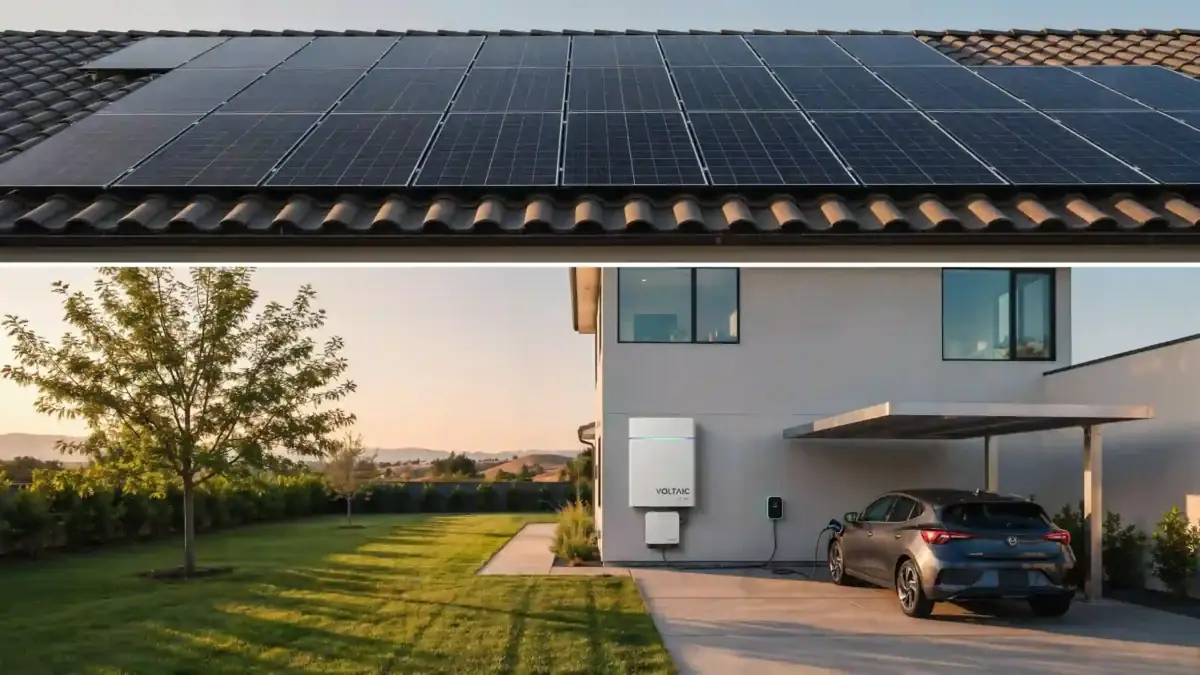
There are three distinct use cases, and each has a different capacity requirement:
Use Case 1: Essential Load Backup Only
Essential loads typically include your refrigerator, lights, phone charging, a few outlets, and a ceiling fan, but not central air, electric dryers, or EV chargers. A standard essential load panel draws roughly 1–2 kW continuously.
A 10 kWh usable LFP battery at 1.5 kW average draw gives you approximately 6–7 hours of essential backup without any solar recharge. If your solar panels recharge the battery during daylight hours, you can extend that indefinitely during a multi-day outage, as long as the sun cooperates.
Use Case 2: Whole-Home Backup
Running central AC, a refrigerator, and standard lighting simultaneously can draw 5–8 kW or more. A whole-home backup setup typically requires 20–30 kWh of capacity and a battery system rated at 7.6 kW or higher continuous output. This means multiple battery units, which pushes total installed cost past $25,000 before the federal tax credit.
Use Case 3: Time-of-Use Bill Shifting
If your utility charges peak rates of $0.35–0.45/kWh from 4–9 PM and off-peak rates of $0.10–0.15/kWh overnight, you can charge your battery during off-peak hours and discharge it during peak hours. For this use case, 10–13.5 kWh is usually sufficient, sized to cover your evening load, not your overnight load.
If your primary goal is outage protection, size your essential loads and add solar recharge capability. If your goal is bill savings through TOU shifting, size your peak evening consumption. Trying to do both with one battery often leads to oversizing that extends the payback period by 3–5 years.
Power Output Ratings: Continuous vs. Peak: Why This Number Gets Ignored
Most homeowners focus entirely on battery capacity (kWh) and forget about power output (kW). This is one of the most common misunderstandings I’ve seen when reviewing battery specs, and it directly determines whether your battery can actually run your appliances.
Continuous power output is what the battery can sustain indefinitely. Peak power output (sometimes called surge capacity) is what it can deliver for a few seconds, critical for starting motors in refrigerators, well pumps, and air conditioners.
Here’s where the numbers shift: a refrigerator compressor starting up can draw 3–4x its running wattage for 1–2 seconds. A 5 kW continuous / 10 kW peak battery handles this easily. A 3.8 kW continuous / 5 kW peak battery may trip its internal protection system when your refrigerator, sump pump, and HVAC kick on simultaneously.
| Common Appliance | Running Watts | Startup Surge |
| Refrigerator | 150–400W | 800–1,200W |
| Central AC (3-ton) | 3,500W | 8,000–9,000W |
| Well pump (1 HP) | 750W | 2,000–3,000W |
| Sump pump | 400–800W | 1,200–2,400W |
| Window AC (10,000 BTU) | 900W | 2,200W |
The practical rule: your battery’s peak power rating should exceed the combined startup surge of the two largest motor-driven appliances you plan to back up. If you’re backing up a central AC system, you likely need a battery rated at 7.6 kW continuous or higher, which eliminates several popular entry-level options.
Before purchasing, ask your installer for a load calculation that lists both the running watts and startup surge for every appliance you want to back up. This is standard practice for any qualified installer; if they can’t provide it, that’s a meaningful warning sign.
Round-Trip Efficiency: The Hidden Loss That Affects Your Return
Round-trip efficiency measures how much of the energy you put into a battery actually comes back out. A battery with 90% round-trip efficiency loses 10% of every kWh stored, a loss that compounds daily across the life of the system.
For a homeowner cycling 10 kWh daily over 10 years:
- At 96% round-trip efficiency: 10 kWh stored → 9.6 kWh retrieved per cycle × 3,650 cycles = 35,040 kWh delivered
- At 89% round-trip efficiency: 10 kWh stored → 8.9 kWh retrieved per cycle × 3,650 cycles = 32,485 kWh delivered
That 7% efficiency gap represents 2,555 kWh of lost electricity over a decade, worth roughly $300–$900 depending on your local rate. Not catastrophic on its own, but it’s a real cost that the sales pitch typically skips.
DC-coupled systems achieve higher round-trip efficiency (96–98%) because energy flows from panels to battery without an AC conversion step. AC-coupled systems run through two conversions, DC to AC through the solar inverter, then AC to DC into the battery, and typically land at 89–94%.
If you’re installing solar and storage together from scratch, DC coupling is the more financially efficient choice. If you’re adding a battery to existing solar, AC coupling is usually the only practical option.
What I noticed when reviewing 2026 battery spec sheets from major manufacturers: several companies advertise round-trip efficiency under “ideal conditions”, 77°F, partial state of charge, low discharge rate.
Real-world efficiency in a hot garage or during a high-power draw can be 3–5 percentage points lower. Ask for the efficiency figure at your expected ambient temperature, not just the peak spec.
Cycle Life and Battery Degradation: What the Warranty Actually Guarantees
Solar battery warranties in 2026 are structured around three limits: years of coverage, total charge cycles, and total energy throughput (MWh). Your battery’s warranty expires when it hits whichever limit comes first.
A typical residential LFP warranty might read: “10 years, 4,000 cycles, or 37 MWh throughput, whichever comes first, with a minimum 70% capacity retention at the end of the warranty.”
Here’s why the throughput limit matters more than most buyers realize: if you cycle your 13.5 kWh battery once daily, your annual throughput is roughly 13.5 kWh × 365 = 4,927 kWh (4.9 MWh) per year. A 37 MWh throughput warranty covers approximately 7.5 years of daily cycling, not 10, despite what the years-based warranty suggests.
If your primary use case is TOU bill shifting (cycling daily), check the MWh throughput limit first. It may be the binding constraint, not the calendar-year warranty.
End-of-warranty capacity is equally important. A battery guaranteed to retain 70% capacity after 10 years of a 13.5 kWh system will deliver at least 9.45 kWh at the end of the warranty period. That’s still meaningful storage. A battery that retains only 60% delivers 8.1 kWh, a 14% reduction in your backup runtime compared to the 70% retention unit.
| Warranty Parameter | What It Means Financially |
| 10-year / 4,000 cycles | First limit hit = warranty ends |
| 37 MWh throughput | Daily cycling may expire in 7–8 years |
| 70% end-of-warranty capacity | Minimum real storage you’re guaranteed |
| 60% end-of-warranty capacity | 14% less backup runtime at year 10 |
Read the warranty document, not just the headline spec. The binding document is always the warranty agreement, not the marketing material.
Battery Management Systems: The Safety Layer Most Buyers Don’t Think About
Every residential solar battery includes a Battery Management System (BMS), the embedded electronics that monitor and protect individual cells. A well-designed BMS prevents overcharging, overheating, and deep over-discharge, all of which permanently damage cells and create safety risks.
What a quality BMS monitors in 2026:
- Cell-level voltage: ensures no single cell charges or discharges outside its safe operating range
- Temperature: shuts down charging or discharging if the internal temperature exceeds safe limits
- State of charge (SOC): tracks remaining capacity and communicates with your inverter and monitoring app
- Current limits: prevent surge draws that could damage cells or wiring
- Cell balancing: redistributes charge across cells to prevent premature degradation
The BMS is also why LFP chemistry is particularly well-suited to residential storage. LFP cells have a flatter voltage curve during discharge, which makes SOC estimation more accurate and makes the BMS’s job simpler.
NMC cells have a steeper voltage curve that makes precise SOC calculation harder and can result in unexpected shutdowns during high-draw events.
The practical implication for buyers: ask your installer which communication protocol the battery BMS uses, typically CAN bus or RS485. Your hybrid inverter must be certified as compatible with the specific BMS protocol of the battery brand you’re installing.
Mismatches between inverter and BMS communication protocols are a real cause of installation failures and warranty complications that rarely get discussed up front.
Solar Battery Storage Cost: What You Should Actually Expect to Pay in 2026
Residential solar battery storage installed cost in 2026 ranges from $900 to $2,000 per kWh of usable capacity, depending on battery brand, system size, coupling type, and local labor rates. A single 10 kWh LFP battery system runs $10,000–$15,000 installed before the federal tax credit.
The federal Investment Tax Credit (ITC) applies to standalone battery storage systems installed in 2026 at 30% of the total installed cost, provided the battery meets the IRS’s energy storage requirements. For a $13,000 installed battery system, that’s a $3,900 direct tax credit, reducing net cost to roughly $9,100.
To claim the full 30% ITC on a standalone battery, the system must be charged at least 70% from solar energy in the first year. Batteries paired with a new solar installation automatically qualify. Standalone retrofits require documentation showing the solar-to-battery charge ratio, an often-overlooked detail that affects your tax filing.
A real cost scenario for a Midwest homeowner:
A homeowner in Columbus, Ohio, served by AEP Ohio, paying an average rate of $0.14/kWh (Ohio’s 2026 residential average per EIA data), with a south-facing roof and an existing 8 kW solar system, decides to add a single 13.5 kWh LFP battery for TOU shifting and backup power.
- Installed cost: $14,200
- Federal ITC (30%): −$4,260
- Net cost: $9,940
- Annual TOU savings estimate (AEP Ohio’s peak vs. off-peak differential of roughly $0.08/kWh, cycling 10 kWh daily): $290/year
- Payback period from bill savings alone: approximately 34 years
This is where the honest limitation must be stated: in states with lower electricity rates and limited TOU rate differentials, battery storage does not pay back from bill savings within a reasonable timeframe. The financial case in Ohio is largely based on backup power value and grid resilience, not monthly bill reduction.
The math is different in California, where peak rates on SCE’s TOU-D-PRIME plan can reach $0.55/kWh versus $0.17/kWh off-peak. There, the same daily cycling strategy could save $690/year, a payback period under 15 years, net of the ITC. Know your utility’s rate structure before making the investment decision.
For additional context on how solar permitting and installation costs interact, see our guide on solar panel permit requirements before finalizing your system design.
Modular and Stackable Battery Design: The Flexible Investment Path
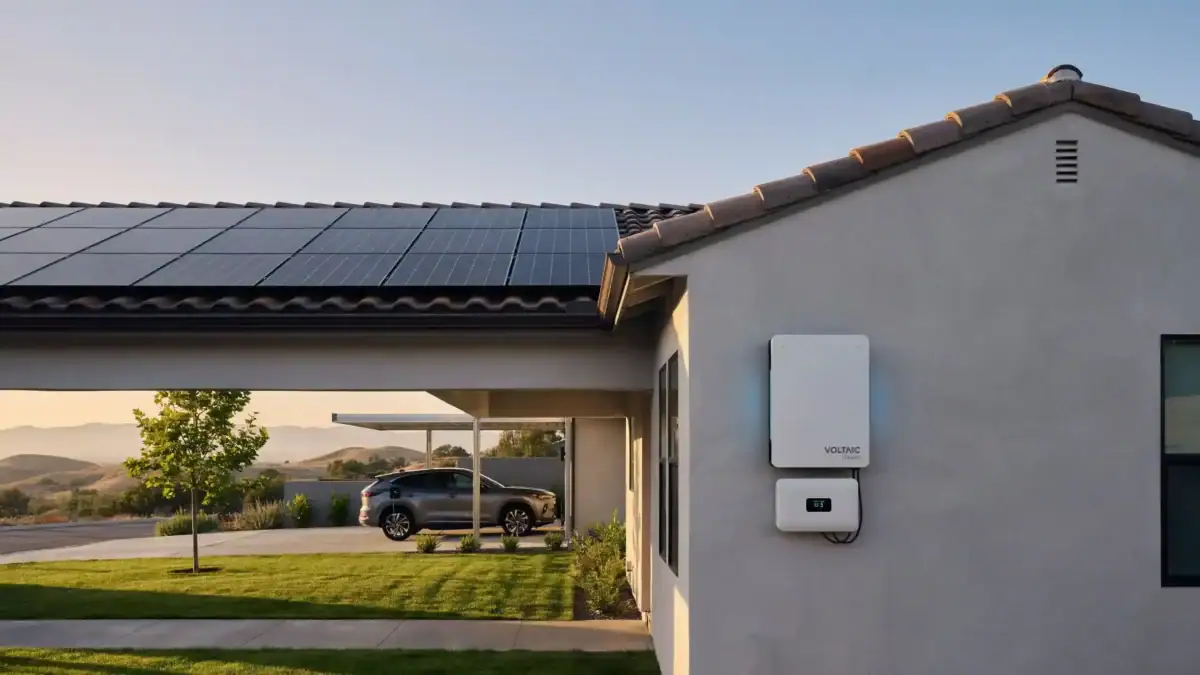
Modular battery systems, where capacity can be added in increments without replacing the entire system, have become the dominant residential format in 2026, and for good reason.
Rather than committing to a 20 kWh system upfront, a modular LFP battery allows you to start with a single 5 kWh or 10 kWh module and add capacity later as your needs or budget change. The key requirements:
- The battery cabinet and hybrid inverter must be rated to support expanded capacity
- Additional modules must be compatible with the existing BMS
- Your interconnection agreement with the utility must reflect the larger storage capacity
The phased investment benefit in practice: a homeowner who installs 10 kWh now and adds 10 kWh in three years spreads $20,000 of system cost over time while still qualifying for the 30% ITC on each installation, provided each expansion meets the IRS charging requirements.
The hidden constraint: not all “expandable” batteries are equally flexible. Some manufacturers require that expansion modules be installed within a specific window after the original installation (often 24 months) to maintain warranty coverage on the full system.
Others allow indefinite expansion as long as the modules are from the same product generation. Read the expansion terms in the warranty document, not just the product page.
Rack-mounted battery systems, common in commercial installations and some high-capacity residential setups, offer greater scalability than wall-mounted units, but require dedicated floor space and professional installation. Wall-mounted units are more practical for most homes but cap out at 2–4 modules in most product lines.
Net Metering, TOU Rates, and When Battery Storage Adds Financial Value
Whether battery storage makes financial sense in your state depends primarily on how your utility compensates solar excess generation, and whether it charges significantly more during peak hours than off-peak hours.
The relationship between net metering policy and battery ROI is direct: in states with full retail net metering, your solar panels already earn bill credits at the full retail rate for every kWh sent to the grid. Adding a battery to store that power, and then consuming it later, doesn’t add financial value over simply exporting it and taking the credit.
In states where net metering has been reduced or eliminated, including Nevada, California (with NEM 3.0’s dramatically lower export rates), and several others moving in that direction, battery storage becomes financially compelling. Under California’s NEM 3.0 structure, export rates dropped by roughly 75% compared to NEM 2.0.
Homeowners on NEM 3.0 who export solar without storage may earn as little as $0.04–0.08/kWh for their excess power, versus consuming it directly (or from a battery) at a value of $0.35–0.55/kWh during peak hours.
Before purchasing a battery, request your utility’s current net metering tariff in writing, not a verbal summary from an installer. The tariff document will specify the exact per-kWh compensation rate, any capacity limits, and the billing structure. In some states, this rate is set to decline further in 2026–2027 as utility commissions finalize new tariff filings.
For homeowners considering solar primarily as a home value investment, our analysis of how much faster homes sell with solar covers how battery storage affects property value perceptions in buyer markets.
Virtual Power Plants and Grid Services: The Emerging Value Stream
Virtual Power Plants (VPPs), programs where utilities or aggregators pay homeowners to dispatch their battery storage during grid stress events, are now available in select markets and represent a genuinely new financial opportunity that most solar articles haven’t caught up with.
Under a VPP agreement, a homeowner enrolls their battery in a program managed by their utility or a third-party aggregator. During peak demand events, typically summer afternoons when the grid is stressed, the program remotely discharges enrolled batteries to the grid, reducing strain and delaying infrastructure upgrades. In return, homeowners receive financial compensation per kWh dispatched.
Active VPP programs as of 2026 include:
- Green Mountain Power (Vermont): Pays enrolled Tesla Powerwall owners a monthly participation fee plus per-event compensation
- Pacific Gas & Electric (California): ELRP and DRAM programs compensate aggregated battery dispatch
- Xcel Energy (Colorado): Time-of-Use Battery Storage program offers bill credits for event participation
- OhmConnect / Swell Energy: Third-party aggregators operating in multiple U.S. markets
The realistic earning expectation: VPP programs in 2026 typically generate $100–$300 per year per enrolled battery for most homeowners, depending on the number of dispatch events and the program’s compensation structure. This is supplemental income; it doesn’t fundamentally change the battery payback math, but it meaningfully reduces net cost over a 10-year ownership period.
One nuance that aggregator marketing rarely explains: participating in a VPP program means your battery may be partially or fully discharged during an event that coincides with a real grid outage in your area. Some programs include provisions to reserve a minimum state of charge (typically 20%) for homeowner use, but the terms vary. Review the enrollment agreement for this detail before signing.
Off-Grid Solar and Battery Storage: A Different Calculation Entirely
Off-grid solar systems require substantially more battery capacity than grid-tied backup systems, and the economics, permitting, and design requirements are fundamentally different.
An off-grid home must store enough energy to survive multiple consecutive low-sun days, which means accounting for worst-case solar production, not average production. In most U.S. climates, you should design for 3–5 days of autonomy without meaningful solar input during winter months.
For a home consuming 30 kWh per day:
- 3 days of autonomy: 90 kWh of usable storage
- At $1,200/kWh installed, $108,000 in battery storage alone
- This does not include solar panels, inverters, or installation
This math is why off-grid solar is typically only financially rational for rural properties where grid connection costs exceed $15,000–$50,000 or more. If you’re weighing off-grid against grid connection, get an actual utility grid extension cost estimate in writing before making any solar investment decisions.
Off-grid systems also require more complex permitting in most jurisdictions. The solar panel permit requirements for off-grid installations differ from grid-tied systems and typically involve additional electrical inspections and local fire department review of the battery installation location.
How to Evaluate a Solar Battery Warranty Before You Sign
A solar battery warranty is only as valuable as what it actually guarantees, and the gap between the headline promise and the binding document is where most homeowners get surprised.
Before signing any battery installation contract, review these five warranty elements:
What triggers warranty coverage?
Most warranties cover manufacturing defects and premature capacity loss. They typically exclude damage from improper installation, grid events outside specified voltage ranges, and installation in environments that exceed the battery’s rated operating temperature range (commonly 32°F–113°F).
What does “70% capacity retention” mean in practice?
If your 13.5 kWh battery degrades to 9.4 kWh (69.6% of nameplate) before year 10, does the warranty require a full replacement or a partial credit? Most manufacturers offer module replacement, not full system replacement- and the replacement lead time can be 8–16 weeks.
Is labor covered?
Some battery warranties cover the replacement module but not the labor to remove and install it. Labor for a battery swap can run $500–$1,500. Verify explicitly.
Is the warranty transferable?
If you sell your home, a transferable battery warranty increases resale value. Our research on how much faster homes sell with solar indicates that buyers increasingly ask about remaining warranty coverage as part of the solar system valuation.
Who handles the warranty claim: the manufacturer or the installer?
If your installer goes out of business (a real risk in a consolidating market), a direct manufacturer warranty is more durable than an installer-backed warranty. Confirm the warranty is registered directly with the manufacturer in your name.
UL Certification and Permitting: What’s Required in 2026
In 2026, residential solar battery storage systems must carry UL 9540 certification to receive permits in virtually every U.S. jurisdiction. Without it, no licensed installer can legally pull a permit, and no insurance company should cover the installation.
UL 9540 is the Standard for Energy Storage Systems and Equipment. It covers the full battery system, cells, BMS, enclosure, and interconnection equipment. UL 9540A is a separate test standard that evaluates fire propagation risk in battery arrays; many jurisdictions now require both certifications for residential permits.
The installation clearance requirements that create real-world problems:
Most AHJs (Authorities Having Jurisdiction) follow NFPA 855, the National Fire Protection Association’s Standard for the Installation of Stationary Energy Storage Systems. In 2026, NFPA 855 requires:
- Minimum 3-foot clearance from HVAC equipment
- Maximum indoor installation temperature of 77°F ambient (most manufacturers)
- Specific setback distances from sleeping areas in some jurisdictions
- Automatic disconnects accessible from outside the structure in some fire districts
Garage installations, the most common residential location, often require additional fire separation documentation. In California (which leads in adoption and therefore in regulatory precedent), local fire departments have increasingly required sprinkler or fire suppression proximity for battery installations above 20 kWh.
The permitting reality check: battery storage permits in busy markets (California, Texas, Arizona, Florida) are currently running 4–12 weeks from submission to Permission to Operate. Factor this into your installation timeline.
An installer who promises a 2-week total timeline is either working in a very permissive jurisdiction or isn’t accounting for the battery permit separately from the solar panel permit.
The impact of installation location on your roof and home structure is a real consideration. Our guide on whether solar panels cause roof damage is relevant reading before your installation team finalizes equipment placement.
Best Solar Battery Brands in 2026: What Separates the Field
The best solar battery brands in 2026 are distinguished not by marketing claims but by four measurable factors: independently verified cycle life data, real-world installer feedback on BMS reliability, accessible warranty claim processes, and UL certification status.
Rather than ranking specific models, which change as manufacturers update product lines, here are the characteristics that separate tier-one products from the rest of the field:
Tier-One Indicators:
- Published cycle life data from third-party testing, not internal testing
- BMS firmware updates are provided over the air (OTA), not requiring a service call
- Dedicated U.S.-based warranty support with documented average claim resolution times
- Modular design that allows single-module replacement under warranty
- Active VPP program compatibility with major utility programs
Red Flags in Battery Marketing (Based on SolarInfoPath’s review of 2026 residential solar contracts):
- Cycle life claimed without specifying the discharge depth at which it was tested
- “Up to” efficiency figures without specifying test conditions
- Warranty documents that reference “reasonable degradation” without defining the percentage floor
- No U.S. entity listed as the warranty obligor (reliance solely on the overseas manufacturer)
- Installation manuals that don’t specify minimum clearance requirements
The Department of Energy’s Battery Storage Program at NREL provides independent performance data on residential battery technologies — one of the few truly unbiased sources for comparing real-world performance versus manufacturer claims.
Tesla Powerwall Cost and Comparison Context
The Tesla Powerwall has served as the residential battery market reference point since 2016, and in 2026, its pricing and performance specs remain a useful baseline for evaluating competing options.
As of 2026, the Powerwall 3 (the current generation) integrates a solar inverter, eliminating the need for a separate inverter in new solar-plus-storage installations. This integration changes the cost comparison structure: you’re evaluating an all-in-one system against a battery-plus-inverter combination from other manufacturers.
Tesla Powerwall installed cost in 2026 ranges from $11,500 to $15,500 for a single unit, depending on region and installer pricing. The battery capacity is 13.5 kWh usable. After the 30% federal ITC, the net cost ranges from approximately $8,050 to $10,850.
What the Powerwall does well: seamless app integration, strong autonomous backup performance, and broad installer familiarity mean fewer compatibility issues.
What it doesn’t offer: the expandability of some competing modular systems (Powerwall 3 supports up to 4 units stacked, but each requires separate electrical work), and Tesla’s direct customer service for non-Tesla-installer customers has historically been a friction point in warranty claim situations.
For homeowners evaluating solar battery backup for home use against the market, the Powerwall is a reasonable reference point, but it isn’t automatically the best financial choice for every situation.
Competing LFP systems from established manufacturers may offer better per-kWh cost, longer cycle life warranties, or more flexible modular expansion, depending on your specific use case.
Projections vs. Reality: What Installers Say vs. What SolarInfoPath Found
| Claim | Standard Sales Estimate | SolarInfoPath 2026 Data |
| Battery payback period | 7–10 years | 12–25 years in most non-CA states |
| Annual TOU savings (10 kWh daily) | $800–$1,200/year | $200–$700/year (rate-dependent) |
| Outage protection runtime (13.5 kWh) | “3 days” | 6–14 hours (essential loads only, no solar) |
| Battery degradation at year 10 | “Minimal” | 20–30% capacity loss (cycle-dependent) |
| VPP program earnings | “$500+/year” | $100–$300/year (event-dependent) |
| ITC applies automatically | Always | Requires 70% solar charge documentation |
| Installation timeline | “2–4 weeks” | 4–12 weeks including permit (busy markets) |
| Round-trip efficiency | “97%” | 89–96% (coupling and temperature dependent) |
These are industry-wide patterns, not indictments of any specific company. The gap between projected and real-world performance is common across the residential battery market, and it’s the gap this guide is designed to close.
What to Do Before Contacting a Battery Installer
The best solar battery storage decision starts with your own numbers, not a sales presentation. Before requesting any quotes:
- Pull your last 12 months of utility bills and calculate your average daily kWh consumption
- Identify your utility’s current TOU rate structure (available on the utility’s website under “Rate Schedules”)
- Confirm your state’s current net metering compensation rate
- Decide whether your primary goal is backup power, bill reduction, or both — the answer changes the system design
- Check the DSIRE database (dsireusa.org) for current state-level battery storage incentives in your state
Going into an installer conversation with this information protects you from oversized system recommendations and allows you to evaluate competing quotes on an apples-to-apples basis.
A battery installation that’s right for a California homeowner on NEM 3.0 paying $0.45/kWh peak may be completely wrong for a Texas homeowner on a flat rate at $0.12/kWh. The honest version of this decision is always specific to your situation.
Frequently Asked Questions About Solar Battery Storage
How long do solar batteries last?
LFP residential batteries in 2026 carry 10-year warranties and are rated for 3,000–6,000 full charge cycles. Cycled once daily, a 3,500-cycle battery lasts approximately 9.5 years before reaching the warranty’s minimum capacity floor. Real-world service life often extends to 12–15 years at reduced capacity, though this isn’t warranted.
What is the solar battery backup for the home?
A single 10–13.5 kWh residential battery system costs $10,000–$15,000 installed before incentives. After the 30% federal ITC, the net cost typically falls in the $7,000–$10,500 range. Whole-home backup systems requiring 20–30 kWh and high-power output inverters can reach $25,000–$40,000 installed.
Is solar battery storage worth it financially?
In California and other states with high peak electricity rates, reduced net metering compensation, or frequent grid outages, the financial case is strong. In states with low electricity rates, full retail net metering, and stable grids, the payback from bill savings alone often exceeds 20 years. The honest answer depends on your specific utility tariff, electricity rate, and use case.
What happens to a solar battery during a grid outage?
A properly installed battery with automatic transfer switching disconnects from the grid and powers your backed-up loads within milliseconds. During the outage, your solar panels can recharge the battery in real time (weather permitting), extending your protection indefinitely for essential loads in sunny conditions.
Does the federal tax credit apply to battery-only additions?
Yes, the 30% ITC applies to standalone battery storage installations as of 2026, provided the battery is charged primarily from solar energy (at least 70% solar-sourced in the first year). Batteries charged primarily from the grid do not qualify for the full ITC. Verify your specific situation with a qualified tax professional using current IRS guidance at energy.gov.
What is the difference between essential load backup and whole-home backup?
<section class="faq-section">
    <h2>Frequently Asked Questions About Solar Battery Storage</h2>

    <div class="faq-item">
        <h3>How long do solar batteries last?</h3>
        <p>
            LFP residential batteries in 2026 carry 10-year warranties and are rated for 3,000–6,000 full charge cycles. Cycled once daily, a 3,500-cycle battery lasts approximately 9.5 years before reaching the warranty's minimum capacity floor. Real-world service life often extends to 12–15 years at reduced capacity, though this isn't warranted.
        </p>
    </div>

    <div class="faq-item">
        <h3>What is the solar battery backup for the home?</h3>
        <p>
            A single 10–13.5 kWh residential battery system costs $10,000–$15,000 installed before incentives. After the 30% federal ITC, the net cost typically falls in the $7,000–$10,500 range. Whole-home backup systems requiring 20–30 kWh and high-power output inverters can reach $25,000–$40,000 installed.
        </p>
    </div>

    <div class="faq-item">
        <h3>Is solar battery storage worth it financially?</h3>
        <p>
            In California and other states with high peak electricity rates, reduced net metering compensation, or frequent grid outages, the financial case is strong. In states with low electricity rates, full retail net metering, and stable grids, the payback from bill savings alone often exceeds 20 years. The answer depends on your specific utility tariff, electricity rate, and use case.
        </p>
    </div>

    <div class="faq-item">
        <h3>What happens to a solar battery during a grid outage?</h3>
        <p>
            A properly installed battery with automatic transfer switching disconnects from the grid and powers your backed-up loads within milliseconds. During the outage, your solar panels can recharge the battery in real time (weather permitting), extending protection indefinitely for essential loads in sunny conditions.
        </p>
    </div>

    <div class="faq-item">
        <h3>Does the federal tax credit apply to battery-only additions?</h3>
        <p>
            Yes, the 30% ITC applies to standalone battery storage installations as of 2026, provided the battery is charged primarily from solar energy (at least 70% solar-sourced in the first year). Batteries charged primarily from the grid do not qualify for the full ITC. Verify your situation with a qualified tax professional using current IRS guidance.
        </p>
    </div>

    <div class="faq-item">
        <h3>What is the difference between essential load backup and whole-home backup?</h3>
        <p>
            Essential load backup powers a sub-panel containing only critical circuits, refrigerator, lights, select outlets, and medical equipment. Whole-home backup powers your entire electrical panel, including HVAC, water heater, and large appliances. Essential load backup generally requires 10–15 kWh of storage, while whole-home backup typically requires 20–30+ kWh and higher power output ratings. The cost difference is substantial.
        </p>
    </div>
</section>
Essential load backup powers a sub-panel containing only critical circuits, refrigerator, lights, select outlets, and medical equipment. Whole-home backup powers your entire electrical panel, including HVAC, water heater, and large appliances. Essential load backup requires 10–15 kWh of storage. Whole-home backup typically requires 20–30+ kWh and higher power output ratings. The cost difference is substantial.
This article by SolarInfoPath (2026 research framework) is part of a comprehensive solar knowledge architecture covering all major high-value sectors including legal disputes (installation negligence, contracts, liability, fraud, lawsuits, liens, HOA and permitting disputes), financial structures (loans, PPA/lease agreements, DSCR financing, tax equity, investment and project finance), tax law (ITC, Section 48/25D, MACRS depreciation, bonus credits, IRS audits, recapture rules, domestic content and IRA/OBBBA compliance), insurance and risk (property damage, hail/wind/fire claims, bad faith insurance disputes, warranty coverage), policy and regulation (net metering, FERC interconnection, state utility rules, incentive programs and regulatory changes), commercial and utility-scale development (EPC contracts, construction delays, performance bonds, receivership, bankruptcy, asset sale and restructuring), real estate impacts (home value, solar leases, liens, title issues, HOA restrictions, easements), and emerging market structures such as battery storage, community solar, agrivoltaics, SRECs, yieldcos, and institutional investment funds. All content is based on publicly available regulatory, financial, and legal sources and is intended strictly for educational and informational purposes, not legal, tax, or financial advice. Readers should always verify current laws, utility policies, tax regulations, and contract terms with qualified licensed professionals before making decisions, as solar regulations, incentives, and financial structures frequently change across jurisdictions and time.

Solar Legal Analyst· Policy Researcher· Investigative Finance Writer Lead Analyst & Founder of SolarInfoPath
Morgan Lee is a solar legal analyst, policy researcher, and investigative finance writer with 12+ years of experience in U.S. renewable energy law, IRS tax credit compliance, and solar litigation. He is the founder of SolarInfoPath, a research-driven platform focused on primary-source analysis of solar contracts, tax law, regulatory policy, and industry disputes affecting homeowners and commercial developers.
His work is grounded in original legal and regulatory sources, including IRS notices, FERC and CPUC rulings, state court filings, PACER records, and UCC lien databases. He specializes in solar contract disputes, injury and workers’ compensation claims, PACE financing issues, tax equity structures, ITC recapture rules, MACRS depreciation, and federal and state solar policy frameworks.
Morgan’s analysis spans solar litigation, finance structures, and regulatory developments such as the IRA and OBBBA, interconnection reform, domestic content rules, and battery storage incentives. He also covers EPC contracts, PPAs, project financing, and utility-scale solar investment structures.