
RBI Solar was a Cincinnati, Ohio maker of solar racking for commercial and utility-scale projects. It never sold rooftop systems to homeowners. In November 2021, its parent, Gibraltar Industries, folded it into the Terrasmart brand. In July 2026, Gibraltar sold that racking business to Unirac. If you searched the name for a home solar quote, you need a residential installer.
That is the short answer. The longer one matters if you own land, run a business, or signed a contract that names this company. Old directory pages still list it as a stand-alone firm. They are years out of date.
So what happened to RBI Solar, and what does it mean for you? Let’s walk through it, one piece at a time.
What Is RBI, and Does It Still Exist in 2026?
The brand no longer operates on its own. Since late 2021, its products and crews have run under the Terrasmart name. Its old web address now sends visitors straight to Terrasmart’s site.
Here is the timeline in brief:
| Year | What Happened |
| 1932 | Rough Brothers, its sister company, is founded |
| 2015 | Gibraltar Industries buys the business |
| 2018 | Gibraltar adds SolarBOS (wiring parts) |
| 2021 | Four solar brands merge as Terrasmart |
| Feb 2026 | Gibraltar sells the wiring unit for $70 million |
| Jul 2026 | Gibraltar sells racking to Unirac for $5 million |
The hidden layer: That last sale closed on July 15, 2026, per Gibraltar’s SEC filing. Most review sites have not caught up. If a page shows “0 reviews” or a CEO name with no date, treat it as stale.
Why should you care? Because warranties, service calls, and contract claims follow the company that owns the business today. Not the logo on an old spec sheet.
Who Was Inc., and What Did the Company Make?
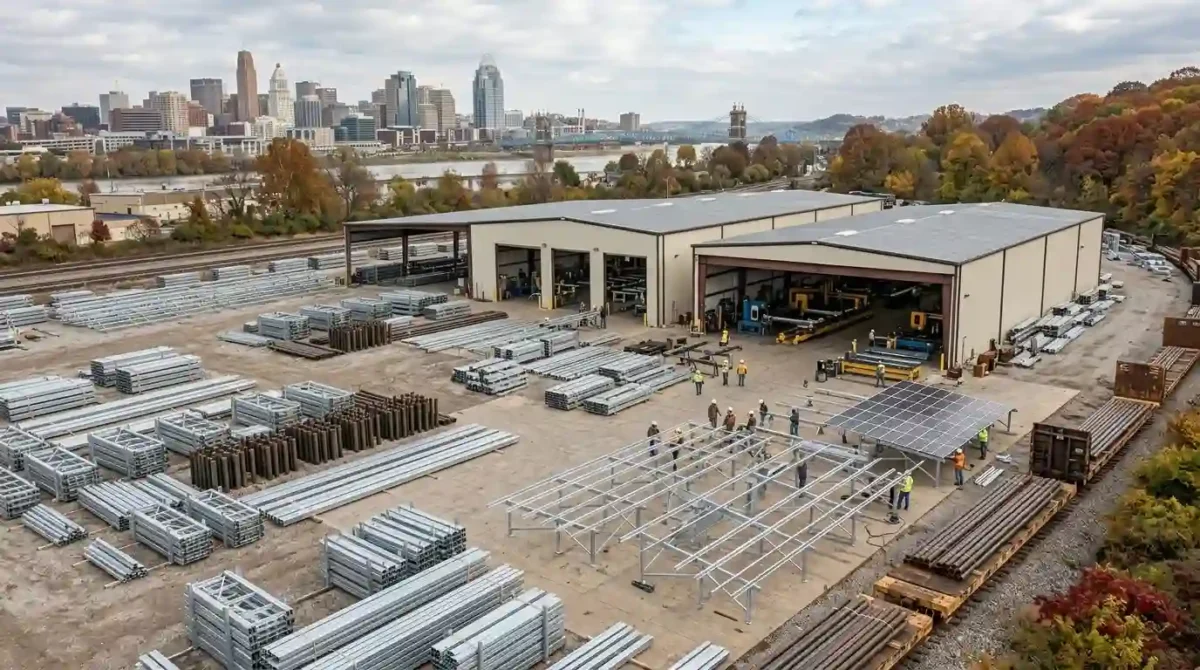
RBI Inc designed and built steel racking that holds solar panels in place. Its focus was custom pile-foundation ground mounts, plus roof and canopy structures. Buyers were developers, contractors, and project owners, not households.
Think of racking as the skeleton of a solar array. Panels make the power. Racking keeps them aimed, anchored, and safe in wind and snow.
The company’s main lines included:
- Fixed-tilt ground mounts on driven steel piles
- Roof mounts for flat commercial roofs
- Carports and parking canopies
- Mounts for landfills and brownfields
Was RBI Inc an Installer, a Maker, or Both?
It was both a maker and an installer, at commercial scale. It made the racking, then often sent its own crews to drive piles and build the frame. That mix is less common than most people think.
| Role | What They Do | Who Hires Them |
| Racking maker | Designs and builds frames | Contractors, developers |
| Installer | Puts the system on site | Owners, contractors |
| EPC firm | Runs the whole build | Project owners |
EPC stands for engineering, procurement, and construction.
From a contract standpoint, this is where buyers get confused. If one firm both makes and installs the racking, a defect claim can point at the product or the labor. Your contract should say which warranty covers which.
How Is It Linked to Rough Brothers and Gibraltar?
Rough Brothers is a Cincinnati greenhouse builder founded in 1932. The solar arm grew up beside it as a sister company. Gibraltar Industries bought Rough Brothers in June 2015, and the solar business came with it.
Why Do Founding Dates Differ Online?
Some sites show 1932. Others show 2009. The first is the greenhouse parent. The second is likely the solar arm’s start. Neither is wrong, but mixing them up is a common error on directory sites.
Where Did RBI Solar Cincinnati Operate?
It ran its offices and pre-assembly work in the Cincinnati area of southwest Ohio. After the 2021 merger, Cincinnati stayed one of four division sites. The others were Buffalo, New York; Fort Myers, Florida; and Grand Rapids, Michigan.
We do not publish phone numbers or street addresses here. For current contact details, check the owner’s official site.
Did RBI Cincinnati Only Build Ohio Projects?
No. It served projects in many states, not just Ohio. When the four brands merged in 2021, the combined group reported about 19 GW across roughly 4,600 projects nationwide.
Here’s where it gets interesting for Ohio, though. Being based in Cincinnati did not make Ohio an easy market.
Why Do Ohio’s Siting Rules Matter for Racking Demand?
Ohio Senate Bill 52, passed in 2021, lets counties ban large solar farms in their unincorporated townships. By September 2025, 37 Ohio counties had created solar exclusion zones in at least one township.
The effect shows up in the numbers, per the Ohio Environmental Council:
- About 3,965 MW of utility-scale solar now runs in Ohio.
- About 440 MW won approval in 2025.
- About 1,200 MW was withdrawn or canceled in 2025.
What I found striking: In 2025, Ohio lost almost three times more planned solar than it approved. That trend shrinks demand for exactly the kind of racking this Cincinnati firm built.
Larger projects also need approval from the Ohio Power Siting Board. Local pushback often centers on farmland loss and stormwater runoff from graded sites. Both can delay a build by a year or more.
Decision checkpoint: If you own farmland in an Ohio county with an exclusion zone, a utility-scale lease offer may never reach construction. Check your county’s SB 52 resolutions before you sign any option.
What Mounting Systems Came Out of the Cincinnati Line?
The core products were fixed-tilt ground mounts, single-axis trackers, roof mounts, canopies, and landfill mounts. Each fits a different site. The choice can swing a project’s cost and output by double digits.
| System | Best Site | Main Trade-Off |
| Fixed-tilt | Rocky, sloped, or snowy land | Lower output, low upkeep |
| Single-axis tracker | Flat, open land | More output, moving parts |
| Ballasted roof | Flat roofs | Weight limits |
| Carport | Parking lots | Higher steel cost |
| Landfill mount | Capped landfills | No digging allowed |
How Do Fixed-Tilt Ground Mounts Work?
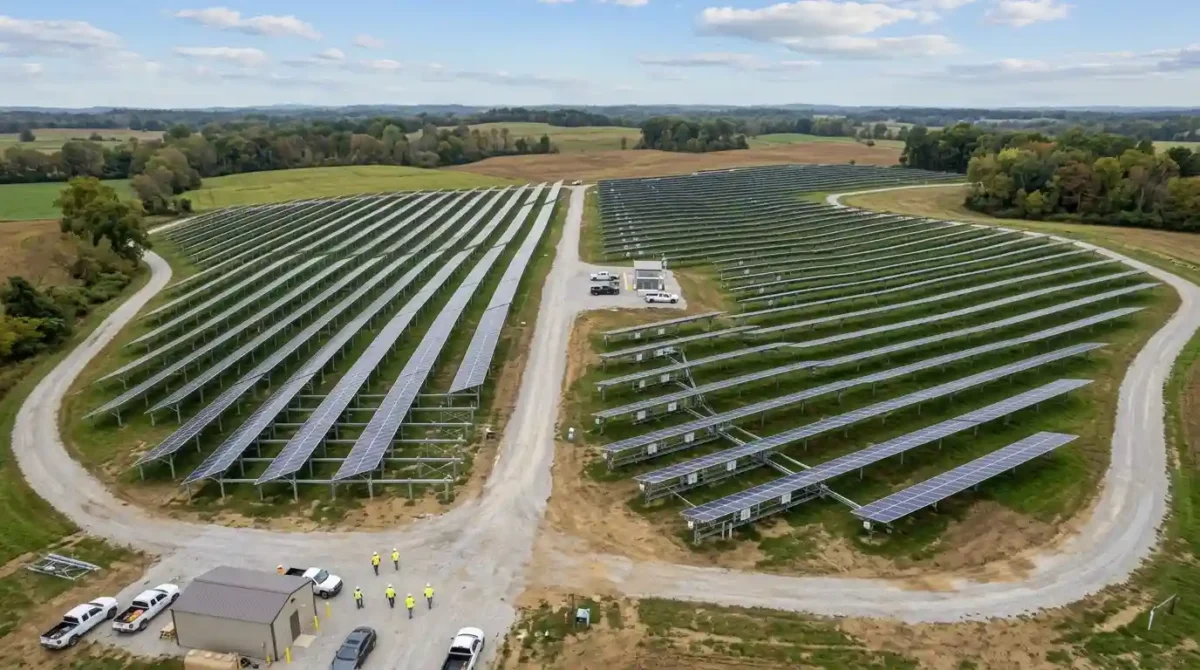
A fixed-tilt mount holds panels at one angle all year. Steel piles are driven into the ground. Rails and clamps then hold the panels in rows.
Few moving parts mean little to break. That is why fixed-tilt still makes sense on hilly or snowy sites.
When Does a Single-Axis Tracker Make Sense in Ohio?
A single-axis tracker turns panels east to west to follow the sun. Industry estimates put the gain at 12% to 25% more energy than fixed-tilt. The extra cost often runs $0.15 to $0.35 per watt.
Here’s the part most sales decks skip. Ohio’s cloudy winters can push the real gain toward the low end of that range. Let’s run the math on a sample site.
Sample tracker math (assumptions, not a quote):
| Item | Fixed-Tilt | Tracker |
| Site size | 5 MW | 5 MW |
| Yearly output (est.) | 6,250 MWh | 7,190 MWh |
| Extra output | — | 940 MWh |
| Extra yearly value at $50/MWh | — | $47,000 |
| Extra build cost at $0.20/W | — | $1,000,000 |
Assumes 1,250 kWh per kW for fixed-tilt, a 15% tracker gain, and a $50/MWh power price.
At those numbers, the tracker’s extra cost takes about 21 years to pay back. That is a contrarian result. Trackers tend to pay off faster in sunnier states like Texas or Arizona than in Ohio.
Decision checkpoint: On an Ohio site, ask for a tracker-vs-fixed comparison using local weather data. A national yield figure can overstate the gain by thousands of dollars a year.
When Are Roof, Carport, and Landfill Mounts Used?
These fit sites where ground-mount rows will not work. Roofs suit warehouses. Carports suit parking lots. Landfill mounts suit capped dumps that cannot be dug into.
What Is a Ballasted Mount?
A ballasted mount uses concrete blocks instead of bolts. That avoids drilling holes in a roof or a landfill cap. The catch is weight. A structural engineer must confirm the roof can carry the load.
What Is Agrivoltaics?
Agrivoltaics means farming under or between solar rows. Sheep grazing is a common form on Ohio solar sites. Raised racking and wider rows make it work, at a higher steel cost.
How Does a Racking Choice Change Project Costs in Ohio?
Racking is one of the bigger hardware costs after panels. Its price depends on steel, soil, wind and snow loads, and how many piles the site needs. A bad soil report alone can add six figures to a mid-size build.
What Drives Solar Racking Cost?
The biggest cost factors are:
- Soil type. Rocky or wet ground needs deeper or screw piles.
- Snow and wind loads. Northern Ohio needs stronger frames.
- Steel prices. Tariffs push steel costs up.
- Slope. Steep land needs custom pile heights.
- Labor. Pile crews are in high demand.
A geotechnical survey tests the soil before design. Skipping it is a classic way to blow a budget.
How Do Northern and Southern Ohio Sites Differ?
Northern Ohio sites face more snow and lake-effect wind. Southern Ohio sites face hillier ground and clay soils. Both change how racking is designed and what it costs.
| Region | Main Challenge | Racking Response |
| Lake Erie shore (Toledo, Cleveland) | Heavy snow, strong wind | Steeper tilt, stronger frames |
| Central Ohio (Columbus) | Flat farmland, wet soils | Trackers possible, drainage plans |
| Southwest Ohio (Cincinnati, Dayton) | Rolling hills, clay soils | Custom pile depths, grading |
| Southeast Ohio (Appalachian foothills) | Steep slopes, old mine land | Fixed-tilt, careful erosion control |
Snow is the quiet cost driver up north. Panels need enough tilt and ground clearance for snow to slide off. Otherwise winter output drops close to zero for days at a time.
Down south, runoff is the bigger worry. Grading a hillside for rows can send silt into creeks. Ohio EPA stormwater permits apply to most sites that disturb an acre or more.
This regional split is one reason the RBI line leaned on custom pile foundations. A one-size frame rarely fits both a Lake Erie farm field and a Brown County hillside.
Does Domestic Manufacturing Still Matter?
Yes, and more in 2026 than before. Federal rules now limit credits for projects tied to “prohibited foreign entities.” U.S.-made steel racking helps projects meet domestic content goals.
Ask any supplier:
- Where is the steel made?
- Where are the frames fabricated?
- Can you document it for tax purposes?
What Federal and Ohio Incentives Affect Commercial Solar Today?
The commercial federal credit (Section 48E) still exists, but the clock is short. Projects that began construction after July 4, 2026 must be placed in service by December 31, 2027 to qualify.
The insight few articles mention: Treasury Notice 2025-42 ended the 5% cost safe harbor for most projects above 1.5 MW. Builders must now show real physical work on site. Driving steel piles counts. That puts racking crews at the center of the mid-2026 rush.
Ohio adds its own incentive for big projects. Under Ohio Revised Code 5727.75, solar farms can pay a fixed fee instead of property tax:
| Item | Amount |
| Base payment | $7,000 per MW per year |
| Extra county fee | Up to $2,000 per MW |
| Ohio worker rule | At least 70% of staff (newer applications) |
For homeowners, the 30% federal credit ended for systems placed in service after December 31, 2025. You can confirm the rules through the U.S. Department of Energy and IRS guidance.
Is RBI Solar Relevant to Ohio Homeowners?
Not directly. It never sold home rooftop systems. If you want panels on your house in Ohio, you need a licensed residential installer. Still, the Ohio rules below shape your savings just as much.
How Does Ohio Net Metering Actually Pay You?
Ohio pays you only the generation rate for extra power you send back, not the full retail rate. That one detail changes the math more than any panel choice.
Here’s how it works, step by step:
- Your panels make power during the day.
- Your home uses what it needs first. That power saves you the full retail rate.
- Extra power flows to the grid through your meter.
- Your utility credits that extra power at the generation (supply) rate only.
- Delivery charges are not credited back.
There is also a size cap. Your system can’t exceed 120% of your past yearly use. And co-ops and city-owned utilities don’t have to offer net metering at all.
Decision checkpoint: The more of your solar power you use at home, the better your payback in Ohio. Homes that sit empty all day lose value on every exported kilowatt-hour.
What Would Solar Look Like for a Cincinnati Home?
Money scenario: A family in Cincinnati’s Westwood area pays Duke Energy Ohio about $160 a month. At Ohio’s June 2026 average of 19.19 cents per kWh, that is roughly 10,000 kWh a year. Their south-facing roof fits an 8 kW system.
| Item | Estimate |
| Yearly solar output | About 9,600 kWh |
| Used at home (60%) | 5,760 kWh × $0.19 = $1,094 |
| Sent to grid (40%) | 3,840 kWh × $0.09 = $346 |
| Estimated yearly savings | About $1,440 |
Assumes about 1,200 kWh per kW per year and a supply rate near 9 cents. Your real rates will differ.
Both parents work from home, so daytime use is high. That helps.
Problem scenario: A retired couple in Shaker Heights, near Cleveland, pays CEI about $110 a month. Their roof faces east, under mature oaks, and they are away most winters. Shade and export-heavy use could stretch payback past 15 years. For them, solar may not pay off.
What Should Homeowners Look For in an Installer?
Look for license proof, a written output estimate, and clear warranty terms. Reading real buyer reports helps too. Our breakdown of what real 8M Solar reviews reveal shows how to read installer feedback with a critical eye.
You can test any output estimate with free tools from the National Renewable Energy Laboratory.
How Can You Vet Any Racking Supplier or Installer?
Check credentials, engineering stamps, warranties, and who owns the company today. That last item matters more in 2026 than ever, given the ownership shifts covered above.
Use this checklist before you sign:
- Confirm the current legal owner of the brand.
- Ask for NABCEP-certified staff on site.
- Get drawings stamped by a licensed engineer.
- Get the racking warranty in writing.
- Ask who honors warranties after a sale.
- Request a soil report for ground mounts.
- Check insurance and bonding.
- Ask for three recent project references.
What Happens to a Racking Warranty After a Sale?
A racking warranty often runs 10 to 25 years, but it is only as good as the company that honors it. When a business is sold, the buyer may take on all old warranties, some of them, or none. The purchase deal decides it, not your contract.
Ask three questions in writing:
- Did the new owner assume warranty obligations for past projects?
- Who do you call for a claim, and what proof do they need?
- Are installation (labor) warranties covered, or only the steel?
Here’s a detail that surprises many owners. A product warranty and a workmanship warranty can split apart in a sale. The steel maker’s promise may carry over, while the crew’s labor promise does not. If a frame fails because piles were driven too shallow, that is usually a workmanship issue.
Keep a simple folder for every project. Include the signed contract, stamped drawings, the warranty letter, and photos from install day. Those four items settle most claims faster than any phone call.
What Does “Signed and Sealed Drawings” Mean?
It means a licensed professional engineer has checked and stamped the design. Most building departments require it for commercial racking. The stamp confirms the frame can handle local wind and snow loads.
Why Are Directory Reviews and Salary Data Unreliable?
Many directory pages run on old or estimated data. One shows zero reviews. Others show revenue of “$0” or salary guesses made by software. In my view, a brand page with no data is worse than no page at all.
What Legal Friction Points Should Ohio Buyers Watch?
Ownership changes, stalled projects, and damage claims cause the most disputes. None of this is legal advice. It is a map of where problems tend to start.
Common friction points include:
- A stalled build. Learn how solar project debt workouts are handled when a project runs out of money.
- A contract you want to exit. See how homeowners get out of a solar contract and what it can cost.
- Misleading sales claims. A solar fraud attorney can review false promises made during a sale.
- Lease buyout terms. Our guide on how solar lease buyouts work in California explains the clauses that often trap owners.
- Roof or property damage. Learn about solar panel property damage claims.
- Injuries on a job site. Pile driving is heavy work. See how solar installation injury lawsuits work.
- Group disputes. Track solar panel class action lawsuits in 2026.
A real-world pattern: When a racking business changes hands, warranty claims often stall while the buyer sorts out which contracts it took on. Keep your original warranty, invoices, and serial numbers. Ask the current owner, in writing, whether it honors the old terms.
The Ohio Takeaway: What the RBI Story Teaches Buyers
RBI Solar is now part of solar history, not a company you can hire under that name. Its racking line, sold under the Terrasmart name since 2021, now belongs to Unirac. For Ohio buyers, three lessons stand out.
First, always check who owns a brand today. Second, in Ohio’s climate, simpler racking often beats fancy trackers on payback. Third, if you are a homeowner, focus on net metering and self-use, not on utility-scale gear.
Looking ahead, expect fewer large Ohio solar farms while SB 52 bans spread and the federal credit winds down in 2027. Smaller rooftop and carport projects may hold up better.
Your next step: if a contract names this company, email the current owner and ask in writing who honors its warranty.
Frequently Asked Questions
What does the company make today?
Its products are sold under the Terrasmart name after 2021. They include ground mounts, trackers, canopies, and pile foundations.
Is it a residential solar installer?
No. It has always served commercial and utility projects in Ohio and across the U.S.
Where is the company based?
Its roots are in Cincinnati, Ohio. Cincinnati stayed a division site after the 2021 merger.
Who owns the business now?
Gibraltar sold the racking arm of RBI Inc. to Unirac in July 2026. The brand itself was retired into Terrasmart in 2021.
Is it related to Rough Brothers?
Yes. Rough Brothers is a Cincinnati greenhouse maker founded in 1932 and was its sister company under Gibraltar.
Do Ohio homeowners still get a federal solar tax credit?
No. The 30% home credit ended for systems placed in service after December 31, 2025.
How does net metering work in Ohio?
Ohio credits extra solar power at the generation rate only. Co-ops and city utilities are not required to offer it.
Can Ohio counties block solar farms?
Yes. Under Senate Bill 52, counties can ban large wind and solar projects in unincorporated townships.
This article by SolarInfoPath (2026 research framework) is part of a comprehensive solar knowledge architecture covering all major high-value sectors including legal disputes (installation negligence, contracts, liability, fraud, lawsuits, liens, HOA and permitting disputes), financial structures (loans, PPA/lease agreements, DSCR financing, tax equity, investment and project finance), tax law (ITC, Section 48/25D, MACRS depreciation, bonus credits, IRS audits, recapture rules, domestic content and IRA/OBBBA compliance), insurance and risk (property damage, hail/wind/fire claims, bad faith insurance disputes, warranty coverage), policy and regulation (net metering, FERC interconnection, state utility rules, incentive programs and regulatory changes), commercial and utility-scale development (EPC contracts, construction delays, performance bonds, receivership, bankruptcy, asset sale and restructuring), real estate impacts (home value, solar leases, liens, title issues, HOA restrictions, easements), and emerging market structures such as battery storage, community solar, agrivoltaics, SRECs, yieldcos, and institutional investment funds. All content is based on publicly available regulatory, financial, and legal sources and is intended strictly for educational and informational purposes, not legal, tax, or financial advice. Readers should always verify current laws, utility policies, tax regulations, and contract terms with qualified licensed professionals before making decisions, as solar regulations, incentives, and financial structures frequently change across jurisdictions and time.

Solar Legal Analyst· Policy Researcher· Investigative Finance Writer Lead Analyst & Founder of SolarInfoPath
Morgan Lee is a solar legal analyst, policy researcher, and investigative finance writer with 12+ years of experience in U.S. renewable energy law, IRS tax credit compliance, and solar litigation. He is the founder of SolarInfoPath, a research-driven platform focused on primary-source analysis of solar contracts, tax law, regulatory policy, and industry disputes affecting homeowners and commercial developers.
His work is grounded in original legal and regulatory sources, including IRS notices, FERC and CPUC rulings, state court filings, PACER records, and UCC lien databases. He specializes in solar contract disputes, injury and workers’ compensation claims, PACE financing issues, tax equity structures, ITC recapture rules, MACRS depreciation, and federal and state solar policy frameworks.
Morgan’s analysis spans solar litigation, finance structures, and regulatory developments such as the IRA and OBBBA, interconnection reform, domestic content rules, and battery storage incentives. He also covers EPC contracts, PPAs, project financing, and utility-scale solar investment structures.