
Solar energy quotes are written price proposals from installers that show what a system would cost, what equipment it includes, and how much power it should produce. Getting at least three detailed quotes is the simplest way to avoid overpaying and to spot weak offers. This guide explains how to request them, what each quote should include, and how to compare them line by line before you sign anything.
What Is Included in Solar Energy Quotes?
A complete quote lists the system size, exact equipment, total price, expected production, warranties, financing terms, and cancellation rules. If any of these are missing, ask the installer to add them in writing.
| Item | What to check |
| System capacity | Total kW and number of panels |
| Equipment | Exact panel, inverter, and battery models |
| Price | Total project price and any itemized extras |
| Production | Estimated annual kWh and the assumptions behind it |
| Installation | Scope of work, timeline, and exclusions |
| Permits | Who handles approvals and inspections |
| Utility | Interconnection steps and permission to operate (PTO) |
| Warranty | Coverage, exclusions, and claim process |
| Financing | Cash price, amount financed, APR, fees, and payment schedule |
| Cancellation | Conditions, fees, and refund terms |
A quote that shows only a monthly payment or a “savings” figure isn’t enough to make a decision. You need the full price and the details behind it to compare offers fairly.
How to Get Quotes for Solar Energy
Start with your utility bills, then request written quotes from at least three licensed installers for a similar system. Comparing quotes for solar energy only works when every installer is pricing the same kind of project.
Gather Your Utility Bills First
Collect your last 12 months of electricity bills. Installers use your yearly kWh usage to size the system, and your rate per kWh to estimate savings. You can find your real rate by dividing your total bill amount by the kWh you used.
Request at Least Three Written Quotes
Ask each installer for a written, itemized quote, not just a phone estimate. If you’d like a rough price range before you start, our solar panel cost calculator by ZIP code gives you a local starting point.
Online Estimates vs. In-Home Site Visits
Online estimates are fast and useful for a first look, but they rely on satellite images and assumptions. A site visit lets the installer check your roof, shading, and electrical panel, which leads to a more accurate final quote.
Ask whether the price might change after the site visit. Some homes need a main electrical panel upgrade or roof repairs, and those costs should be listed before you commit.
How to Compare Solar Power Quotes
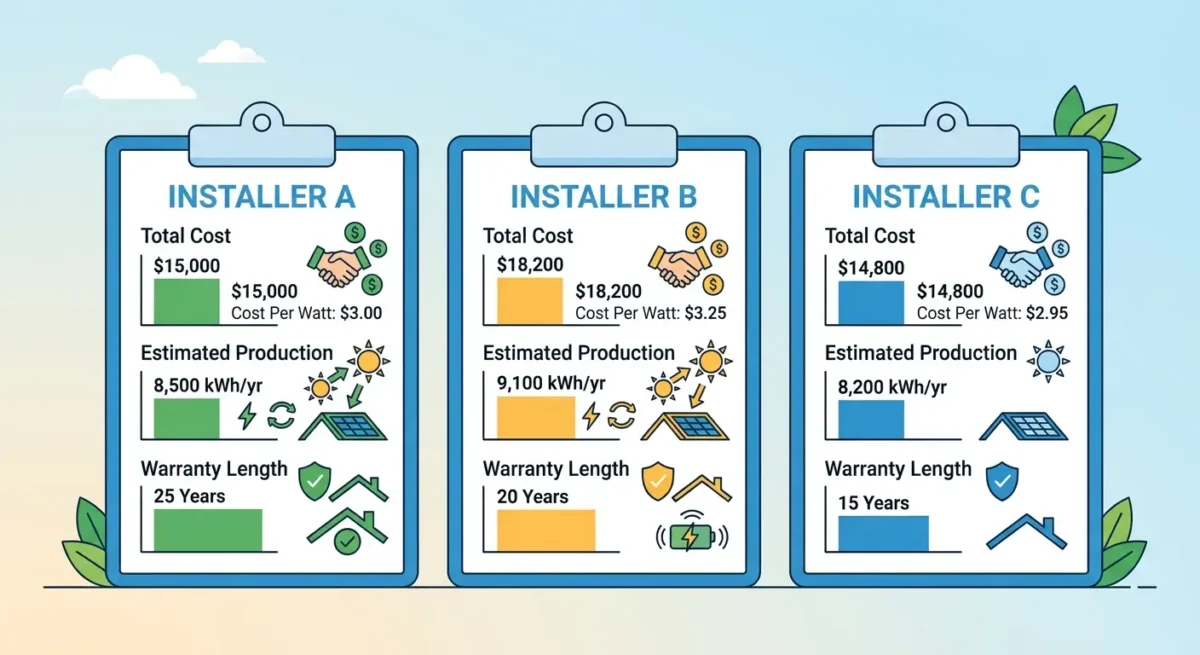
Compare price per watt, equipment, expected production, and warranties side by side. Solar power quotes can look very different at first glance, so put the key numbers into one simple table.
Compare Cost per Watt
Divide each quote’s total price by the system size in watts. A $21,000 quote for a 7 kW (7,000-watt) system works out to $3.00 per watt. This makes quotes for different system sizes easier to compare, and our guide to average solar panel costs in the USA helps you judge whether a price looks reasonable.
Compare Equipment Models
Check the exact panel, inverter, and battery models in each quote. Two systems with the same size can use very different equipment, so a slightly higher price may reflect better components or longer warranties.
Compare Production Estimates
Each quote should state expected annual production in kWh. If one installer predicts much higher output than another for a similar system, ask how they calculated it, including shading, roof direction, and system losses.
Compare Warranties
Look for two separate types of coverage: equipment warranties from the manufacturer and a workmanship warranty from the installer. Our guide to what a solar warranty covers explains the common exclusions to watch for.
| Factor | Installer A | Installer B | Installer C |
| Total cash price | From quote | From quote | From quote |
| System size (kW) | From quote | From quote | From quote |
| Cost per watt | Calculate | Calculate | Calculate |
| Estimated annual kWh | From quote | From quote | From quote |
| Panel and inverter models | From quote | From quote | From quote |
| Workmanship warranty | Check terms | Check terms | Check terms |
| Timeline and PTO responsibility | From quote | From quote | From quote |
Quotes on Solar Energy: Cash Price vs. Financed Price
Always ask for the cash price and the financed price for the same system. Many quotes on solar energy lead with a low monthly payment, which can hide the total cost.
The Consumer Financial Protection Bureau found that some solar loans include dealer or program fees that can raise the amount financed by 30% or more above the cash price. A financed quote should list the APR, all fees, the loan term, and the total of all payments.
Compare loans by APR and total repayment, not by the advertised interest rate alone. Our guide to solar financing explains how fees and loan terms change what you really pay.
Leases and power purchase agreements (PPAs) work differently. You usually don’t own the system, and payments may rise each year through an escalator, so compare those offers by total contract cost.

Quotes About Solar Energy Savings and Tax Credits
Treat savings estimates as projections, and check every incentive the quote includes. Quotes about solar energy savings depend on assumptions about your usage, your utility rate, and future rate increases.
Ask which electricity rate the installer used. EIA reports the 2025 U.S. average residential price at 17.30 cents per kWh, but your own rate may be higher or lower. Also ask how exported power is credited, since many utilities pay less for exports than for the power you buy.
Be careful with tax credits. The IRS says the Residential Clean Energy Credit isn’t available for expenditures made after December 31, 2025. A 2026 quote that subtracts a 30% federal credit from a homeowner-owned system needs a clear explanation, and our guide on the solar tax credit ending covers the details.
Renewable Energy Quotes for Batteries and Add-Ons
Ask for battery storage and other add-ons as separate line items, so you can see what each one adds to the price. Renewable energy quotes that bundle everything into one number are harder to compare.
A battery can store solar power for evening use or backup during outages, but it adds high cost. Ask for the battery model, its usable capacity, which circuits it will back up, and its warranty. Our home battery storage guide explains what to look for.
Other common add-ons include main electrical panel upgrades, roof work, and monitoring equipment. Each should appear as its own line, with a clear reason why it’s needed.
Checking the Installer Behind the Quote
A good price only matters if the company is licensed, reputable, and clear about its obligations. Spend a few minutes checking each installer before you choose.
Confirm the company’s license with your state’s licensing board, and ask for proof of insurance. Read reviews on more than one platform, check the dates, and look at how the company responds to complaints.
Read the cancellation clause before paying any deposit. Ask what’s refundable and when, and make sure the installation timeline, permit responsibilities, and payment milestones are written into the contract.
Watch for pressure tactics, such as “today only” pricing or a reluctance to give you a written quote. The Federal Trade Commission’s guide to solar power for your home explains what to check, and our guide on solar scams and consumer protection covers warning signs in more depth.
Making Your Final Decision
The best of your solar energy quotes isn’t always the cheapest one. Choose the offer with a fair price per watt, quality equipment, realistic production estimates, clear warranties, and transparent financing from a licensed installer you trust. Take your time, compare every quote in writing, and don’t sign until every question has a clear answer.
Frequently Asked Questions
How many solar quotes should I get?
Get at least three written quotes for a similar system. That gives you enough comparison to spot overpriced offers and unusual production estimates.
Are online solar quotes accurate?
Online quotes are a helpful starting point, but they rely on satellite images and assumptions. A site visit usually leads to a more accurate final price.
What is a good price per watt in a solar quote?
It depends on your state, system size, and equipment. Divide the total price by the system’s watts, then compare that figure across your quotes and with current local averages.
Should a solar quote include the federal tax credit?
Not for a homeowner-owned system bought in 2026. The IRS says the residential credit doesn’t apply to expenditures made after December 31, 2025.
Can I negotiate a solar quote?
Yes. Sharing a lower written quote for a similar system can lead an installer to adjust the price, equipment, or warranty terms.
Is it free to get solar quotes?
Most installers provide quotes and site visits at no cost. Be cautious if a company asks for a deposit before giving you a full written proposal.
This article by SolarInfoPath (2026 research framework) is part of a comprehensive solar knowledge architecture covering all major high-value sectors including legal disputes (installation negligence, contracts, liability, fraud, lawsuits, liens, HOA and permitting disputes), financial structures (loans, PPA/lease agreements, DSCR financing, tax equity, investment and project finance), tax law (ITC, Section 48/25D, MACRS depreciation, bonus credits, IRS audits, recapture rules, domestic content and IRA/OBBBA compliance), insurance and risk (property damage, hail/wind/fire claims, bad faith insurance disputes, warranty coverage), policy and regulation (net metering, FERC interconnection, state utility rules, incentive programs and regulatory changes), commercial and utility-scale development (EPC contracts, construction delays, performance bonds, receivership, bankruptcy, asset sale and restructuring), real estate impacts (home value, solar leases, liens, title issues, HOA restrictions, easements), and emerging market structures such as battery storage, community solar, agrivoltaics, SRECs, yieldcos, and institutional investment funds. All content is based on publicly available regulatory, financial, and legal sources and is intended strictly for educational and informational purposes, not legal, tax, or financial advice. Readers should always verify current laws, utility policies, tax regulations, and contract terms with qualified licensed professionals before making decisions, as solar regulations, incentives, and financial structures frequently change across jurisdictions and time.

Solar Legal Analyst· Policy Researcher· Investigative Finance Writer Lead Analyst & Founder of SolarInfoPath
Morgan Lee is a solar legal analyst, policy researcher, and investigative finance writer with 12+ years of experience in U.S. renewable energy law, IRS tax credit compliance, and solar litigation. He is the founder of SolarInfoPath, a research-driven platform focused on primary-source analysis of solar contracts, tax law, regulatory policy, and industry disputes affecting homeowners and commercial developers.
His work is grounded in original legal and regulatory sources, including IRS notices, FERC and CPUC rulings, state court filings, PACER records, and UCC lien databases. He specializes in solar contract disputes, injury and workers’ compensation claims, PACE financing issues, tax equity structures, ITC recapture rules, MACRS depreciation, and federal and state solar policy frameworks.
Morgan’s analysis spans solar litigation, finance structures, and regulatory developments such as the IRA and OBBBA, interconnection reform, domestic content rules, and battery storage incentives. He also covers EPC contracts, PPAs, project financing, and utility-scale solar investment structures.