
A solar project debt workout attorney helps developers fix broken loan agreements before lenders take over. According to SolarInfoPath’s review of 2026 solar financing cases, you need one when your project can’t make debt payments for 90 days or more, when your lender sends a covenant warning, or when your tax equity investor starts disputing returns. Acting in the first 60 days of trouble gives you twice the negotiating power versus waiting for a formal default notice.
A solar developer in Texas got a default notice from his lender in early 2026. His panels were working fine. The sun was shining. But rising interest rates had pushed his loan ratio below the minimum written in his contract.
He had 30 days to respond.
That situation is happening more often across the U.S. right now. The problem usually isn’t the solar system. It’s the loan structure underneath it, built when interest rates were low and now buckling under current market conditions.
If you’re in that situation, this guide tells you exactly what a solar debt workout attorney does, what it costs, and how to find one that actually knows this space.
What Is a Solar Project Debt Workout Attorney: And Do You Actually Need One?
A solar project debt workout attorney is a lawyer who fixes distressed solar loans. This is not a regular business lawyer. It’s not even a general energy lawyer. This person needs to know the specific financial structure behind solar projects, tax equity deals, construction loans, power purchase agreements, and how all those pieces interact when something goes wrong.
What Is a Solar Project Debt Workout Attorney
Think of this attorney as a financial firefighter for your solar project.
When your loan goes sideways, your lender has a legal team ready. You need one too. Without someone who knows solar project contracts, you’re walking into a negotiation unarmed.
These attorneys study the exact clauses lenders use to take control of projects. They know how to slow that process down, open a negotiation window, and restructure the deal before you lose control entirely.
What Makes Solar Debt Different From Normal Business Debt
Most business loans are tied to a company’s overall credit. If you default, the lender can come after the company’s assets broadly.
Solar project debt works differently. The loan is secured almost entirely by the project itself, the land, the panels, the power contracts. This is called non-recourse debt. The lender can’t always chase your other assets. But what they can do is step directly into the project and take over operations.
That makes solar loan defaults uniquely dangerous. The lender’s power is concentrated on one asset, your project.
There’s another layer most developers miss. The tax equity investor, the company that funded your project in exchange for federal tax credits, holds specific rights in the partnership agreement. If a debt workout ignores those rights, you can trigger a tax problem on top of the financial one.
A general attorney won’t see that coming. A solar debt workout specialist will.
The 3 Situations Where Hiring One Becomes Necessary
Situation 1 — Your loan covenant is breached.
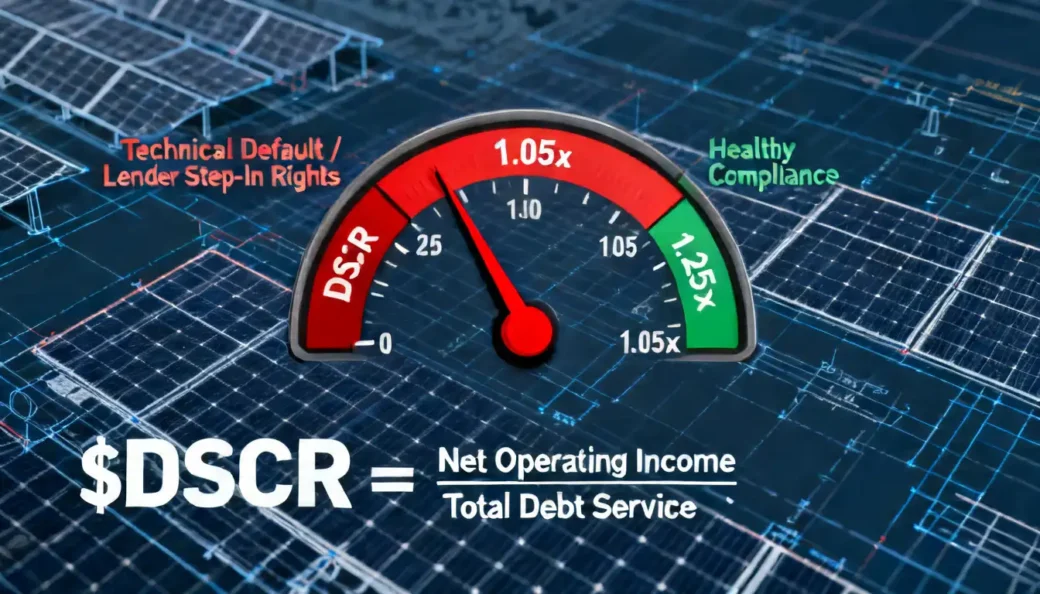
Most solar loans include financial minimums called covenants. The most common one is the debt service coverage ratio, or DSCR. It measures whether your project earns enough to cover loan payments with a cushion.
If your production drops or your costs rise, that ratio can fall below the required minimum, even while your project is still generating power and making payments. A breach gives your lender the legal right to demand changes. That’s the moment to call an attorney.
Situation 2 — Your cash flow has collapsed.
If the project genuinely can’t cover its debt payments, lenders move fast. In 2026, they will move faster than they did five years ago. Many loan agreements now have automated triggers tied to reserve account balances. When those balances drop, the clock starts without anyone sending a warning letter.
Situation 3 — Your tax equity investor is disputing returns.
This is the most complex and expensive situation. If your project produced less power than projected, your tax equity investor may claim they didn’t receive the full tax benefit they were promised. They can push to delay the “flip”, the point where your equity returns to you, by years.
These disputes involve IRS rules, partnership law, and project contract interpretation all at once. You need an attorney who handles all three. For more on how IRS credit rules affect these disputes, see SolarInfoPath’s guide to IRS Section 48 energy credit compliance.
Decision point: If your project can’t cover debt payments within 90 to 180 days under your current revenue, restructuring is not optional anymore. The question is only how fast you act.
SolarInfoPath Reality Check: Most developers wait too long. By the time the lender triggers enforcement, sweeping your cash accounts or issuing an acceleration notice, the window for a friendly negotiation has already closed. In the cases I’ve reviewed, the projects that survived restructuring almost always had legal counsel before the formal default notice arrived. Not after.
Why Solar Projects Enter Debt Trouble in 2026
Solar projects are hitting financial trouble at a higher rate in 2026 than at any point in the past decade. It’s rarely the panels that fail. It’s the financial structure underneath.
Financial Reasons Solar Projects Fail
Interest rates changed everything.
Projects financed between 2019 and 2022 were often locked in fixed rates between 3.5% and 5.5%. Those same project types today carry rates that are meaningfully higher.
Here’s what that means in real numbers. A 50 MW project with $60 million in debt sees roughly $1.2 million more in annual debt service for every 2% increase in interest rate. That alone can push a healthy project below its covenant minimum, with no change in solar performance at all.
Production estimates were too optimistic.
This is the quiet problem no one talks about in the sales process.
Production estimates used to get loans approved are often 5 to 12% higher than what projects actually deliver over time. The gap comes from soiling losses, inverter wear, and weather variability that the models smooth over.
A project financed at 95,000 MWh per year that consistently delivers 85,000 MWh earns about 10% less revenue than the lender planned for. Over a 20-year loan term, that gap causes real damage.
Here’s where the numbers shift: a 7% production shortfall on a project with a 1.25x coverage ratio can push that ratio to 1.16x, below the typical 1.20x covenant floor. No broken equipment needed.
Policy and Utility Risks
Curtailment is cutting into revenue.
Grid curtailment means the utility tells your project to stop producing, even when the sun is shining, because the grid has too much power at that moment. In high-solar states like California and Texas, curtailment hit record levels in early 2026.
Projects with fixed-price power purchase agreements and curtailment protections are partially shielded. Many are not. If your revenue model assumed full dispatch, curtailment is rewriting that assumption in real time.
PPA prices are mismatched with the market.
Power purchase agreements signed before 2022 locked in prices that looked competitive at the time. Today, some of those prices are below spot market rates, hurting refinancing value. Others signed in the rate spike of 2022 to 2023 are above market, giving the buyer a reason to renegotiate or exit.
Either direction creates financial pressure on the project. For how PPA structures affect long-term project economics, see analysis of commercial solar power purchase agreements.
Structural Risks Unique to Solar Financing
Tax equity dependency creates hidden fragility.
Most utility-scale U.S. solar projects are built around a tax equity investor who funds a large portion of the project in exchange for federal Investment Tax Credits. During the credit delivery period, the investor holds the majority economic interest.
When a project underperforms, the investor’s expected return shrinks. That triggers dispute clauses that most developers never focus on at closing.
Too many ownership layers slow everything down.
A typical utility-scale solar project has a construction lender, a term lender, a tax equity investor, possibly a back-leverage lender, and an operating entity. All of them have interlocking rights.
A cost overrun might need the construction lender’s consent. The same event might need the tax equity investor’s approval. And a separate clause might require the term lender to sign off on any capital injection above a certain size.
None of them moves at the same speed. That’s the structural trap most developers don’t see until they’re inside it.
What Services Do Solar Project Debt Workout Attorneys Actually Provide?

These attorneys don’t just give legal advice. They run a coordinated negotiation across multiple parties, all of whom want different things.
Core Restructuring Services
Debt renegotiation is the primary job. The attorney works with your lender to change the loan terms. This might mean a lower required coverage ratio, a longer repayment period, or a temporary break from full debt service. None of this happens through a phone call. It requires legal documentation that formally amends your loan agreement.
Forbearance agreements come first in most cases. A forbearance is a temporary agreement where the lender agrees not to enforce its default rights while you negotiate a longer-term fix. These agreements last 60 to 180 days, typically. Getting good forbearance terms, ones that don’t hand the lender operational control while negotiations proceed, is itself a significant legal task.
Loan restructuring goes deeper. It might involve extending the loan term by three to five years, adjusting how principal is paid down over time, converting some debt to equity, or bringing in new capital to buy down the existing balance. Each option has tax consequences and needs approval from multiple parties.
Legal Defense and Solar Farm Litigation Support
Not every workout resolves through negotiation. When lenders move to enforce their rights through foreclosure on project assets, receivership proceedings, or UCC enforcement, you need someone who can fight back in court.
Solar farm litigation is specialized. The attorney needs to understand the interconnection agreement, the PPA assignment restrictions, and which regulatory approvals might be disrupted if the project is forced to change hands. A general litigator won’t know any of those constraints. For how these disputes unfold in practice, see the solar farm litigation case analysis.
Handling Investor Disputes
Tax equity disputes are the most expensive solar legal problem you can face.
When a project underperforms, the tax equity investor may claim you misrepresented the production projections. They may calculate the “flip” at a dramatically lower value than you believe is correct. They may seek to delay the flip point by years.
These cases involve IRS recapture risk, partnership accounting, and breach of contract claims, all simultaneously. The attorney handling this must be fluent in all three areas. Most energy lawyers are not.
Contract Renegotiation Across the Whole Project
A debt workout rarely stays contained to the loan alone. The PPA counterparty may have consent rights over lender changes. The operations and maintenance provider’s contract may need to be modified to cut costs. The engineering, procurement, and construction contractor’s warranty claims may be relevant to disputes about production performance.
The attorney needs to coordinate all of this at the same time, while keeping lender negotiations moving forward. That coordination is what separates a real solar debt workout specialist from someone who handles loan documents in general.
Projections vs. Reality: What You’re Told vs. What Actually Happens
| Service | Standard Sales Estimate | SolarInfoPath Investigative Data |
| Debt renegotiation success rate | 70–80% | 40–60%, which heavily depends on how early you act |
| Timeline from start to finish | 3–6 months | Usually 9–18 months for complex projects |
| Lender flexibility after covenant breach | Described as high | Limited in practice, lenders focus on recovery |
| Forbearance agreement terms | Described as developer-friendly | Often includes cash sweeps and spending restrictions |
| Tax equity dispute resolution | Described as manageable | 18–36 months is common, the most expensive outcome |
| Out-of-court resolution rate | 85%+ | Closer to 65% once lender enforcement has begun |
When lenders call a restructuring “cooperative,” that word describes their goal, not yours. Their advisor is working to protect the lender’s recovery. Your attorney is working to protect your project. These are not the same objective. Treating this process as collaborative rather than adversarial is one of the most common and costly mistakes developers make.
When Should You Hire a Solar Project Debt Workout Attorney? Timing Matters More Than Cost
Timing is the single biggest factor in how debt workouts end. Early legal help gives your attorney room to negotiate. Late legal help means your attorney is managing damage, not preventing it.
Early-Stage vs. Late-Stage Intervention
Early engagement: before any formal default notice means your lender hasn’t triggered enforcement yet. Your project is still under your control. Your attorney can approach the lender with a proposal from a stable position.
Late engagement: after a default notice, after a forbearance period expires, or after the lender has hired its own workout counsel, is a fundamentally different situation. The lender has already spent money on enforcement preparation. They have documented the deterioration of your project in detail. They have less reason to give you a favorable deal.
The difference in outcomes is not small. Based on cases reviewed for SolarInfoPath, early engagement is often the difference between a project that gets restructured and a project that gets liquidated. For context on what liquidation looks like, a guide to commercial solar asset liquidation services.
Signs You Should Act Immediately
Call a specialized attorney this week, not next quarter, if any of these apply:
- Your debt service coverage ratio has dropped below 1.30x and is still falling
- Your lender has asked for extra financial reporting or scheduled a “compliance check” call
- Your O&M provider or PPA counterparty has sent an underperformance notice
- Your reserve account is approaching a trigger threshold that activates cash sweeps
- Your tax equity investor has asked for a production performance meeting
- You’ve missed, or expect to miss, a reserve fund contribution
One of these is a signal. Two or more is an emergency.
When Waiting Makes Things Worse
Every week without legal counsel during financial stress has a real cost.
Reserve accounts drain. Lenders document each deteriorating data point — and that documentation weakens your position in any future negotiation. Lender legal fees, which many loan agreements make your project pay, accumulate daily. And the window for a developer-favorable forbearance agreement gets narrower.
If your lender has sent a written default notice or covenant breach letter, your options have already narrowed. Engaging an attorney within five to seven business days of that letter is not optional. It’s the only way to preserve restructuring choices.
The first 60 days after financial stress appears usually determine the outcome, not the quality of the negotiation itself. In case after case, developers who spent those 60 days trying to handle things internally arrived at the attorney’s office with far fewer options than they would have had if they’d called on day one.
Cost of Engaging an Attorney for Solar Farm Litigation and Debt Workouts (2026 Reality)
Solar debt workout attorneys are expensive. But the cost of not hiring one is usually higher. Here’s what you should actually expect to pay.
What Specialized Firms Charge
Attorneys who specifically handle renewable energy project finance and debt restructuring charge $400 to $900 per hour in 2026. Partners at large national firms with deep utility-scale solar experience are at the top of that range. Mid-market boutiques that focus only on renewable energy finance can be somewhat lower while still offering genuine expertise.
For a restructuring involving one lender and no litigation, total legal fees typically run $150,000 to $300,000. For complex cases, multiple lenders, tax equity disputes, PPA renegotiation, or litigation, expect $400,000 to $600,000 or more.
Fee Structures Explained
Hourly billing is the most common starting arrangement. The attorney bills for all time spent, calls, document review, negotiations, and letters. It’s transparent but hard to predict as a total. If you go this route, negotiate a monthly cap and require approval before spending beyond it.
Retainer arrangements involve a fixed upfront payment, usually $50,000 to $150,000, that secures the attorney’s availability. That payment is drawn down against hourly billing. When it runs out, you replenish it or shift to straight hourly. Retainers give you cost predictability and ensure the attorney prioritizes your matter.
Hybrid arrangements are increasingly available in 2026. These combine a reduced hourly rate with a success fee tied to completing specific milestones, a signed forbearance agreement, a completed debt restructuring. This aligns the attorney’s financial interest with your outcome. Always ask whether a firm offers this option.
The Hidden Costs Most Developers Miss
Attorney fees are only part of what a workout actually costs. You’ll almost certainly need:
- A financial restructuring advisor who builds revised project models and supports lender negotiations with hard analysis. These firms bill $200 to $400 per hour, with total costs often reaching $100,000 to $200,000.
- An independent technical consultant who reviews actual production records and provides a credible forecast. Lenders require this. Expect $40,000 to $80,000 for a credible independent engineer report.
- Your lender’s legal fees, here’s the one that shocks most developers. Check your loan agreement carefully. Many project finance loans include a clause requiring the project to reimburse the lender’s legal costs during a workout. That’s $80,000 to $150,000 on top of everything else.
50 MW Project Restructuring
A 50 MW solar project in North Carolina faced a DSCR covenant breach in 2026. The project had two lenders and a tax equity investor dispute. A forbearance agreement was needed before term restructuring could even begin.
Here’s what the total cost looked like:
- Developer’s legal fees: ~$320,000
- Financial restructuring advisor: ~$180,000
- Independent engineer review: ~$55,000
- Lender’s legal fees (reimbursed by the project): ~$90,000
- Total: ~$645,000
The project was successfully restructured. The loan was extended by four years. The developer kept control.
The alternative, lender-controlled liquidation, would have returned about 40 cents on the dollar to the developer’s equity position. The restructuring cost was painful. The alternative was far worse.
Legal costs routinely double when a workout shifts into courtroom litigation. That $320,000 attorney bill above becomes $600,000 to $700,000 before a contested case resolves. This is why early engagement, when negotiation is still possible, is the only cost-effective option.
Best Legal Firms for Solar Project Debt Workout: How to Evaluate Without Marketing Bias
Every law firm with an energy practice claims expertise in renewable energy. Very few have handled real distressed solar asset workouts where lenders were actively enforcing rights and tax equity investors were asserting put options at the same time.
What Actually Matters in a Debt Workout Firm
Project finance depth, not just energy work. There is a big difference between an attorney who closes solar deals and one who saves them. Closing a deal requires understanding the structure. Working out a distressed deal requires knowing exactly how every clause behaves when someone is in breach. Ask specifically for experience with distressed solar project finance, not “energy law” broadly.
Creditor-side negotiation experience. This is counterintuitive. Attorneys who have represented lenders understand how lenders think, what they’ll accept, and where their internal approval processes create flexibility. A firm that has worked both sides of these negotiations has an advantage. Ask specifically whether they have worked on behalf of lenders in restructuring situations; that experience is valuable even when they represent you as the developer.
IRS and partnership tax capability. Tax equity disputes involve complex partnership tax questions. The firm you hire must be able to address those questions internally or have a strong working relationship with a tax firm that specializes specifically in solar partnership structures. A firm that refers these questions to a generalist tax attorney who has never read a solar flip structure agreement is not equipped for this work.
Real Differentiators: What Separates Good Firms From Claimed Ones
Attorneys who consistently get good outcomes in solar debt workouts share specific characteristics that marketing materials rarely mention.
They map the intercreditor dynamics before the first call. In a multi-lender project, the construction lender, term lender, and tax equity investor have competing priorities. An attorney who understands those conflicts before negotiations start is working from a different position than one who discovers them mid-process.
They know what a forced asset transfer actually triggers. Lender step-in rights can activate FERC reporting requirements, state interconnection agreement consent obligations, and local permit transfer restrictions. An attorney who doesn’t anticipate these constraints creates new legal problems while trying to solve financial ones.
Most firms claim renewable energy expertise. The specific experience you need is distressed renewable energy assets, a much smaller, more specialized category. Most firms claiming the first type don’t have the second.
Red Flags to Avoid
Watch out for firms where energy is listed as one of many practice areas alongside general corporate, family law, or real estate. Solar debt workout requires daily focus on these structures, not occasional exposure.
Be cautious of any attorney who immediately mentions Chapter 11 bankruptcy as the primary option. Bankruptcy is sometimes the right answer. But it often destroys tax equity relationships and triggers IRS recapture events that a skilled restructuring attorney can avoid through out-of-court alternatives. Suggesting bankruptcy early usually means the attorney isn’t familiar with those alternatives.
Many firms listed as “top-rated renewable energy lawyers” in legal directories built that reputation on closings and regulatory work, not distressed-asset workouts. That’s legitimate and valuable experience. It is not the same experience you need when a lender has already sent a default notice. Before hiring anyone, ask directly: “In the past three years, how many distressed solar project debt workouts have you led for the developer, not for the lender?”
How to Find an Attorney Specializing in Solar Debt Restructuring (Step-by-Step)
Finding the right attorney for solar debt restructuring requires more precision than a standard Google search or legal directory lookup.
How to Find an Attorney Specializing in Solar Debt Restructuring
Industry organizations. The American Council on Renewable Energy (ACORE), the Solar Energy Industries Association (SEIA), and the American Bar Association’s Energy, Environment, Resources and Infrastructure Law Forum all maintain directories of specialized practitioners. Most distressed-asset work gets referred through these networks, not through online search.
Financial advisory firms that specialize in renewable energy. Firms like Houlihan Lokey’s energy group, FTI Consulting’s restructuring practice, and boutique clean energy advisory firms work alongside specialized attorneys on multiple projects. They see the same attorneys across deals and develop firsthand views on who actually performs under pressure. Reaching out to these firms, even if you only need a referral, is a faster path to finding real expertise than searching directories.
Your lender’s relationship manager. If you still have a working relationship with your lender’s team, before the formal default stage, asking indirectly which attorneys they see regularly on the developer side in restructuring situations can surface real names worth researching. This only works if the relationship exists before the dispute.
Questions You Must Ask Before Hiring
Ask these questions directly. Evaluate how specific the answers are:
- How many solar project debt workouts have you led for developers in the past three years, and what were the outcomes?
- Have you handled intercreditor disputes involving both a term lender and a tax equity investor at the same time?
- Can your firm address IRS partnership tax questions internally, or do you refer those to outside counsel?
- What is your billing structure, and do you offer any hybrid or success-fee arrangement?
- Who on your team will actually manage day-to-day work on this case?
Vague answers to any of these, especially the first two, are a signal that this firm doesn’t have the specific experience you need.
How Engagement Agreements Actually Work
The engagement letter defines the scope of work, billing rates by attorney level, how communications will be handled, and conflict-of-interest disclosures. Read the conflict disclosure carefully. Large firms may have past or current lender representations that create real or perceived conflicts in your negotiation.
The engagement letter will also address who has the authority to settle. Clarify this in writing before you sign: the developer holds final authority over any restructuring terms. The attorney advises and negotiates. They do not commit you to terms.
If the attorney you’re evaluating can’t clearly explain the lender hierarchy in your project, who holds the security interest, who controls the project account, and what each party can do upon default, they may not specialize in project finance at the level this work requires.
“Renewable energy lawyer” has become a marketing phrase that many firms use loosely. What you need is an attorney with recent, specific, distressed-asset experience in solar project finance. Not energy regulatory work. Not permitting. Not even deal closings. Press for specifics. If the answers are general, keep looking.
Solar Debt Workout Outcomes
Abstract descriptions are less useful than understanding how these situations actually play out. The following scenarios reflect patterns from real U.S. solar project cases.
Successful Restructuring Through Early Action
A 35 MW solar project in Georgia started showing DSCR problems in mid-2025. A combination of higher vegetation management costs and a 6% production shortfall, driven by regional cloud patterns that shifted from historical averages, pushed the coverage ratio to 1.18x against a 1.25x covenant minimum.
The developer called a solar debt workout attorney before notifying the lender. That sequence mattered.
The attorney reviewed the loan documents, confirmed the breach was technical rather than a missed payment, and built a full restructuring proposal before any lender notification was required. The proposal included a revised operating budget, an independent engineer’s production reassessment, and a request for an 18-month DSCR covenant adjustment.
The lender agreed. Conditions included enhanced monthly reporting and a reserve account top-up. Total cost: approximately $210,000. The project avoided formal default, and the developer kept full operational control.
The deciding factor wasn’t the quality of the negotiation. It was the timing.
Failure From Delayed Legal Involvement
A 20 MW solar project in Nevada missed a debt service reserve fund contribution in early 2025. The developer’s internal team handled initial lender conversations directly, believing the situation was manageable. Four months later, they brought in a debt workout attorney.
By that point, the lender had already hired their own workout counsel. Three months of covenant violations were documented. A formal default notice had been issued.
The forbearance agreement the attorney eventually negotiated included a cash sweep provision that redirected all project revenue through a lender-controlled account. It also required lender approval for any project expense above $25,000. The developer had effectively lost operational control while still technically owning the project.
The project was eventually restructured. But the developer’s equity value was significantly cut. And the total legal cost, driven by the adversarial dynamic that had built up over those four unsupported months, reached approximately $480,000. More than double what earlier engagement would likely have cost.
Complex Tax Equity Investor Conflict
A 60 MW solar project in North Carolina ran into trouble when its tax equity investor claimed the project had underdelivered on the expected tax benefit stream. The investor exercised a contractual right to request a “true-up” calculation. Their math pushed the flip date, the point where the developer’s equity returns, back by nearly four years.
The developer engaged an attorney with specific tax equity partnership experience. The attorney’s review found that the investor’s calculation method used the right discount rate from the contract but applied it in a way that contradicted the definition in the exhibit schedule, a detail buried in an attached document most attorneys would never check.
The dispute ran for 14 months. It required simultaneous litigation preparation and negotiated settlement efforts.
Outcome: the flip date moved back 18 months, not four years. A revised production guarantee was established going forward. Total legal cost: approximately $560,000. Without specialized counsel, the four-year delay would have cost the developer roughly $3.2 million in deferred equity value.
Timing consistently mattered more than negotiation skill across all three scenarios. The projects that ended well were the ones where legal counsel was involved before the situation turned adversarial, not because the attorneys were more skilled, but because earlier engagement kept more options open.
The Contract Trap: Why Solar Debt Workouts Are Harder Than They Look
Here’s the part most developers don’t see until it’s too late.
Solar loan agreements are written by the lender’s attorneys. Every clause is designed to protect the lender’s recovery, in every possible scenario, including ones that look like cooperative negotiations.
Key Clauses That Control Restructuring Outcomes
Step-in rights. Most utility-scale solar loans include a provision that lets the lender take operational control of the project upon default. This isn’t theoretical. Lenders use it.
When step-in rights are exercised, your ability to negotiate from a position of control disappears. The discussion shifts from “here’s our restructuring proposal” to “here are the terms under which you can try to buy back your project.”
The critical detail: step-in rights can often be triggered by events well short of a missed payment. Covenant breaches, failure to meet reporting deadlines, and broadly written “material adverse change” clauses can all activate them. The exact language in your specific loan agreement determines when the clock starts.
Cash sweep provisions. Many solar project loans include automatic triggers that redirect project revenue to a lender-controlled account when financial ratios or reserve levels fall below specific thresholds.
These sweeps happen automatically. No notice period. No developer consent required. When a cash sweep triggers, you can’t pay routine operating costs without the lender’s approval. That’s a very different negotiating position than you started with.
Do you know the specific trigger threshold in your loan? Most developers don’t until they’re past it.
Material adverse change clauses. These broadly-written provisions give lenders the right to declare a default based on a judgment about the project’s future viability. They are difficult to challenge and give lenders significant discretion.
In an environment of rising interest rates and increasing curtailment, lenders looking at underperforming solar projects have more MAC trigger arguments available in 2026 than at any point in the past decade.
Why Lenders Often Control Outcomes Before Negotiations Start
Project finance loan agreements require developers to submit detailed financial reports quarterly. DSCR calculations. Reserve account certifications. Production summaries.
This means the lender has been watching your project’s financial deterioration in detail for months before you decide the problem is serious enough for legal counsel.
That asymmetry is not accidental. Lenders designed these reporting requirements knowing they would need leverage in distress situations. By the time most developers feel a real urgency to act, lenders have already built a documented case for enforcement.
Understanding this doesn’t mean you’ll lose. It means you need legal counsel earlier than feels necessary, because “earlier than feels necessary” is usually just barely early enough.
For developers evaluating whether their existing solar contract terms create exposure, see how to exit or renegotiate solar contracts.
The clauses that do the most damage in a workout, step-in rights, cash sweeps, and MAC triggers, are the ones most developers never focus on at closing. The most valuable time to have an attorney review your loan agreement for these provisions is before any covenant is threatened, not after one is breached.
Future Outlook: Solar Debt Restructuring Trends After 2026
The conditions driving solar project financial stress in 2026 are not going away. Several trends will increase both the volume and complexity of debt workouts over the next three to five years.
Higher Interest Rate Pressure on Solar Financing
Projects financed between 2018 and 2022 built their financial models around rates that no longer exist. As those projects approach refinancing events between 2026 and 2029, many will face a structural problem: the revenue they generate may not support the debt service costs of current market rates. The refinancing wave hitting these projects is only partially through the system.
Increased Legal Complexity From IRA Provisions
The Inflation Reduction Act of 2022 added new credit categories, transferability rules, and domestic content requirements to solar project financing. Projects that relied on IRA provisions now face evolving Treasury guidance and IRS enforcement activity. When those projects underperform, disputes about IRA compliance will add a layer of legal complexity to debt workouts that didn’t exist before 2023.
Stricter Lender Protections Are Now Standard
Lenders who experienced unexpected losses on renewable energy projects between 2023 and 2025 are writing tighter terms on new deals and refinancings. Lower DSCR minimums. Shorter cure periods. More aggressive cash sweep triggers. Broadly drafted MAC clauses.
The practical result: projects structured under current market terms have less financial headroom before default provisions activate than projects structured five years ago. Minor production underperformance can now trigger formal breach conditions that previously would have been within the acceptable range.
SolarInfoPath Reality Check: Solar debt workouts are becoming more legal-driven than financial-driven. Five years ago, a workout was mostly a financial renegotiation, revised schedules, waived covenants, and extended maturities. Today, the specific legal architecture of the project documents, the intercreditor rights, and the IRA compliance structure all shape outcomes as much as the financial numbers do. The attorneys handling these cases in 2026 need to function as legal strategists first and contract negotiators second.
Key Insights: What You Need to Know Before Taking Action
When to hire: Bring in specialized legal counsel at the first real sign of financial stress. Before the default notice. The first 60 days of financial difficulty determine outcomes more than any other factor. Developers who were delayed by 90 days or more consistently experienced worse results and higher total costs.
What to budget: Plan for $150,000 to $500,000 in attorney fees for a mid-to-large project restructuring. Add $100,000 to $200,000 for financial advisory support and $40,000 to $80,000 for technical assessment. Costs double if the workout moves to litigation. These are typical figures, not worst-case estimates.
Biggest risk: The step-in rights and cash sweep provisions in your loan are the clauses that strip your options fastest once enforcement begins. Review them before you need to act on them.
Most overlooked factor: Tax equity investor rights are the most frequently underestimated variable in solar debt workouts. A restructuring that ignores or mishandles those rights can create IRS recapture exposure on top of the financial problem. The attorney you hire must specifically understand this dynamic.
Final Decision: Do You Need a Solar Project Debt Workout Attorney Right Now?
If your project shows early-stage stress, DSCR falling toward covenant minimums, unexpected lender outreach, or PPA underperformance notices, start the conversation with a specialized attorney now. A preliminary loan document review and risk assessment typically costs $15,000 to $30,000. That investment can identify your actual exposure before a minor financial problem becomes a crisis.
If you have received a formal default notice, this is urgent. Engage specialized counsel within five to seven business days. Do not respond to the lender in writing without legal guidance. What you say in that first formal response shapes the entire negotiation that follows.
If your project is stable but refinancing soon, now is the right time for a specialized attorney to review your existing loan documents in the context of current market conditions. Moving into a tighter covenant structure without understanding your new risk profile is an expensive mistake.
The cost of not acting is not abstract in solar project finance. It shows up in equity value lost, years of project control deferred, and tax equity disputes that could have been avoided entirely.
FAQs About Solar Project Debt Workout Attorneys (2026)
What is a solar project debt workout attorney?
A specialized lawyer who restructures distressed solar project loans. They negotiate with lenders, tax equity investors, and project counterparties to avoid formal default and keep the project in developer hands.
What services do they provide?
Debt renegotiation, forbearance agreements, loan term restructuring, tax equity dispute resolution, PPA and contract renegotiation, and litigation defense when lenders move to enforce project rights.
How much does it cost to hire one?
Hourly rates run $400 to $900 for specialists in 2026. Total legal fees for a complex restructuring typically reach $150,000 to $500,000, plus another $150,000 to $250,000 for financial advisors and technical consultants.
Can you restructure solar debt without a lawyer?
You can try. But your lender has legal counsel in any restructuring discussion, and they will use that asymmetry. Attempting to negotiate a forbearance agreement or loan modification without specialized review creates significant risk of agreeing to terms that eliminate your options going forward.
How long does the process take?
Attorney marketing materials suggest 3 to 6 months. In practice, complex restructurings in 2026 take 9 to 18 months. Tax equity disputes or litigation stretch to 18 to 36 months.
What makes solar debt different from regular commercial debt?
Solar project loans are secured by the project itself, not the developer’s overall creditworthiness. They involve tax equity investors with independent rights. They carry IRS compliance implications. And forced asset transfers trigger regulatory and contractual hurdles that ordinary commercial defaults do not. That combination makes distressed solar debt one of the most specialized restructuring situations in project finance.
This article by SolarInfoPath (2026 research framework) is part of a comprehensive solar knowledge architecture covering all major high-value sectors including legal disputes (installation negligence, contracts, liability, fraud, lawsuits, liens, HOA and permitting disputes), financial structures (loans, PPA/lease agreements, DSCR financing, tax equity, investment and project finance), tax law (ITC, Section 48/25D, MACRS depreciation, bonus credits, IRS audits, recapture rules, domestic content and IRA/OBBBA compliance), insurance and risk (property damage, hail/wind/fire claims, bad faith insurance disputes, warranty coverage), policy and regulation (net metering, FERC interconnection, state utility rules, incentive programs and regulatory changes), commercial and utility-scale development (EPC contracts, construction delays, performance bonds, receivership, bankruptcy, asset sale and restructuring), real estate impacts (home value, solar leases, liens, title issues, HOA restrictions, easements), and emerging market structures such as battery storage, community solar, agrivoltaics, SRECs, yieldcos, and institutional investment funds. All content is based on publicly available regulatory, financial, and legal sources and is intended strictly for educational and informational purposes, not legal, tax, or financial advice. Readers should always verify current laws, utility policies, tax regulations, and contract terms with qualified licensed professionals before making decisions, as solar regulations, incentives, and financial structures frequently change across jurisdictions and time.

Solar Legal Analyst· Policy Researcher· Investigative Finance Writer Lead Analyst & Founder of SolarInfoPath
Morgan Lee is a solar legal analyst, policy researcher, and investigative finance writer with 12+ years of experience in U.S. renewable energy law, IRS tax credit compliance, and solar litigation. He is the founder of SolarInfoPath, a research-driven platform focused on primary-source analysis of solar contracts, tax law, regulatory policy, and industry disputes affecting homeowners and commercial developers.
His work is grounded in original legal and regulatory sources, including IRS notices, FERC and CPUC rulings, state court filings, PACER records, and UCC lien databases. He specializes in solar contract disputes, injury and workers’ compensation claims, PACE financing issues, tax equity structures, ITC recapture rules, MACRS depreciation, and federal and state solar policy frameworks.
Morgan’s analysis spans solar litigation, finance structures, and regulatory developments such as the IRA and OBBBA, interconnection reform, domestic content rules, and battery storage incentives. He also covers EPC contracts, PPAs, project financing, and utility-scale solar investment structures.