
The best solar battery backup system for home is the one that matches your essential loads, how long outages last, the power your appliances draw, your existing solar equipment, its warranty, and its installed cost. No single model wins for every household. Start with what must stay on, then compare usable capacity, continuous power, and compatibility.
A home battery is one of the larger purchases a homeowner can make, and most “top battery” lists skip the question that matters most: best for what? A battery that easily runs a refrigerator, router, and lights may not start a well pump or central air conditioner.
This guide is built around your home’s needs, not a manufacturer ranking. You’ll learn how to size a system from your appliances, how backup actually works, which specifications matter, what installation can involve, and how 2026 incentives have changed.
Who this guide is for: homeowners adding a battery to new or existing solar, people in outage-prone areas, and anyone comparing quotes who wants to understand the numbers.
What this guide does not establish: that any specific battery is right for your home, how long your backup will last, or what you’ll save. Those depend on your loads, configuration, utility tariff, and the exact product you choose.
Start With Your Home’s Backup Needs
Before comparing batteries, decide which appliances must run and for how long. That single step shapes capacity, power output, cost, and installation scope.
Why Needs Define the Best Solar Battery Backup System for Home
A battery that’s “best” for keeping lights and a fridge running isn’t automatically best for whole-home backup. Battery choice follows your needs, not the other way around.
Two questions drive almost everything:
- Energy: how many kWh do your chosen loads use over the outage?
- Power: how many kW do they draw at once, including startup surges?
NREL’s residential storage analysis considers both power capacity (kW) and energy capacity (kWh), which is why capacity alone is never enough to choose a battery.
Essential Loads or Whole-Home Backup?
Essential-load backup powers a few priority circuits, while whole-home backup tries to run most of the house. The difference affects battery size, inverter output, and electrical work.
| Feature | Essential-load backup | Whole-home backup |
| What stays on | Selected circuits (fridge, lights, router, pumps) | Most household circuits |
| Panel setup | Often a critical-loads subpanel | Whole-home transfer or backup gateway |
| Power needed | Lower continuous kW | Higher continuous and peak kW |
| Capacity needed | Smaller kWh | Larger kWh, often expandable |
| Installed cost | Lower | Higher |
| Runtime | Longer per kWh | Shorter unless loads are managed |
List the Appliances You Need During an Outage
Write down each appliance, its running watts and its startup surge, using the nameplate or manual. Motor-driven loads such as pumps and compressors can draw several times their running power for a few seconds when they start.
Illustrative load list (check your own appliance labels):
| Appliance | Illustrative running load | Surge concern? | Notes |
| Refrigerator | 100–200 W average | Yes, compressor start | Cycles on and off |
| LED lighting circuits | 50–150 W | No | Easy to back up |
| Internet router and modem | 15–30 W | No | Keeps communication working |
| Sump pump | Several hundred W running | Yes, high start | Critical during storms |
| Well pump | Often 1,000 W or more | Yes, high start | Check 240 V requirements |
| Medical equipment | Varies by device | Varies | Confirm with the device maker |
| Gas furnace blower | Several hundred W | Yes | Needed for heat in winter |
| Central air conditioner | Several kW | Yes, very high start | Often requires whole-home power capacity |
| Electric water heater | Several kW | No | Heavy energy draw |
| EV charger | Several kW | No | Usually excluded from backup |
These ranges are illustrative only. Real values vary widely by model, so read your nameplates or ask an electrician to measure them.
Estimate How Long You Need Backup Power
Runtime = usable energy ÷ average load. This is the most useful formula in the whole buying process.
Example 1 (blueprint): a 10 kWh battery serving a 2 kW average load has an idealized runtime of 5 hours.
Example 2 (blueprint): 10 kWh ÷ 1.5 kW ≈ 6.67 hours.
Real runtime is usually shorter. Conversion losses, reserve settings, temperature, changing loads, and equipment limits all reduce it.
| Scenario (10 kWh usable, 20% reserve kept) | Average load | Approximate runtime |
| Essentials only | 0.5 kW | About 16 hours |
| Moderate loads | 1.5 kW | About 5.3 hours |
| Heavy loads | 3 kW | About 2.7 hours |
Your average load must also stay within the battery’s continuous output rating. Otherwise, the system may shut down even when energy remains.
Decision checkpoint: if your list includes central air, an electric water heater, or a well pump, plan for whole-home power capacity, or decide which loads you’ll switch off during outages.
Solar Battery Storage: How the System Works
A solar battery stores electricity, and an inverter converts it to household AC power during outages, but only if the system is designed for backup. Understanding solar battery storage starts with one fact many homeowners miss: ordinary grid-tied solar panels usually shut off when the grid fails.
The Department of Energy explains that standard grid-connected solar generally stops during an outage unless it’s specifically configured for backup. This anti-islanding protection keeps line workers safe.
The main parts of a backup system:
- Solar panels produce DC electricity.
- An inverter converts DC to AC, either a solar, battery, or hybrid inverter.
- The battery stores energy, managed by its battery management system (BMS).
- A backup gateway or transfer switch separates your home from the grid during outages.
- A critical-loads panel or main panel decides which circuits receive backup power.
- Monitoring software shows state of charge, production, and usage.
What Happens When the Grid Goes Down?
The transfer equipment disconnects your home from the grid, and the battery inverter forms a local “island” to power selected circuits. A grid-forming inverter lets solar keep working inside that island.
The sequence looks like this:
| Step | What happens |
| 1. Grid fails | Utility power drops |
| 2. Isolation | Gateway or transfer switch disconnects from the grid |
| 3. Transition | Battery begins supplying backed-up circuits |
| 4. Island operation | Inverter runs the home’s backup circuits |
| 5. Solar recharge | Panels charge the battery, if configured and sunny |
| 6. Grid returns | System reconnects and resumes normal operation |
Transition times vary by product. Some systems switch fast enough that many devices keep running, while others cause a short interruption. Check the specification sheet.
Can Solar Panels Recharge the Battery During an Outage?
Yes, when the system is configured for backup and the sun is out, but recharge depends on weather, season, system size, and how much power you’re using. Several cloudy days can stop the battery from refilling fully.
This is the part most people overlook. During a winter storm, your panels might produce little for days. A battery sized only for a sunny-day cycle may run short.
What Are AC-Coupled and DC-Coupled Batteries?
AC-coupled batteries connect on the AC side and often suit existing solar systems, while DC-coupled batteries share a hybrid inverter with the panels and often suit new installations.
| Feature | AC-coupled | DC-coupled |
| Connection point | After the solar inverter (AC side) | Before conversion (DC side) |
| Typical use | Adding storage to existing solar | New solar-plus-storage systems |
| Inverter | Separate battery inverter | Shared hybrid inverter |
| Conversion steps | More, slightly more loss | Fewer for solar charging |
| Retrofit ease | Often simpler | May require inverter change |
Your existing inverter determines what’s possible. To understand how the parts fit together, see how residential solar systems work.
Best Solar Battery: How to Compare the Important Specifications
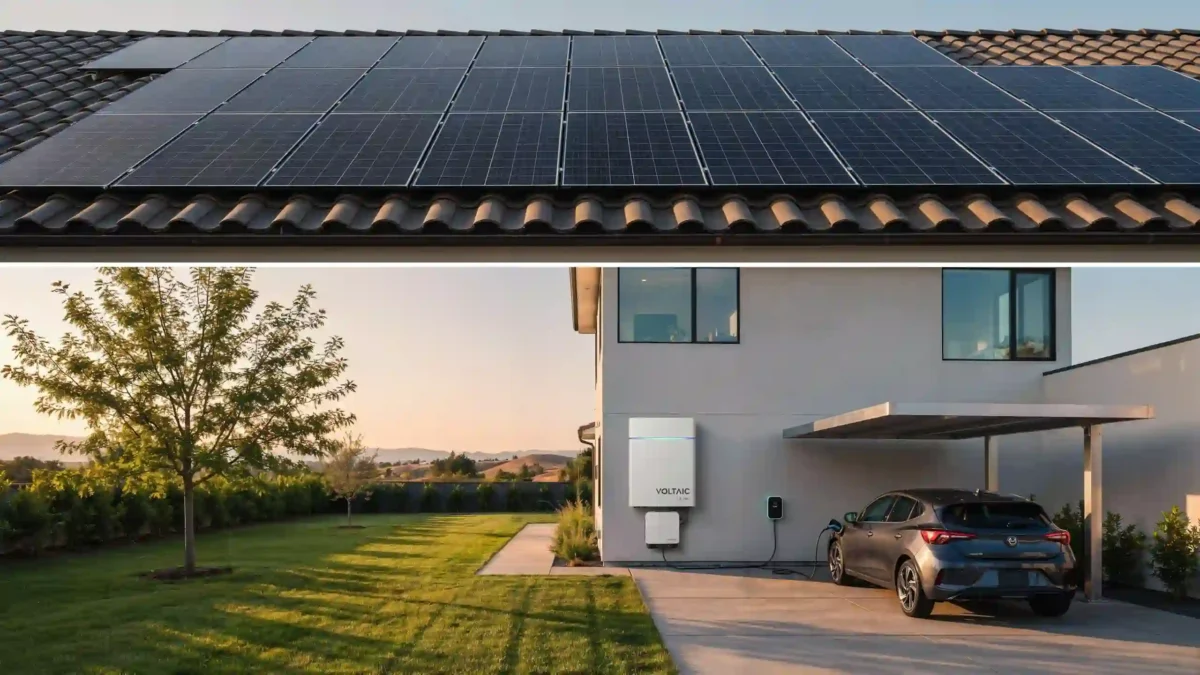
The right comparison uses the same specifications for every option: usable capacity, continuous and peak power, efficiency, chemistry, expandability, compatibility, and warranty. A fair way to find the best solar battery for your needs is to judge every model by the same criteria, not by marketing headlines.
Usable Capacity, Continuous Power, and Peak Power
These three numbers answer different questions.
| Specification | Unit | Question it answers |
| Nominal capacity | kWh | How much the battery holds in total |
| Usable capacity | kWh | How much energy you can actually use |
| Continuous power | kW | How much load it can run at once, sustained |
| Peak power | kW | How much it can deliver briefly for surges |
| Peak duration | Seconds | How long peak power lasts |
Nominal capacity can mislead you, because some energy is reserved to protect the battery. Always compare usable kWh. A battery can store plenty of energy yet still be unable to start a large motor if its peak power is too low.
Efficiency, Chemistry, and Expandability
Round-trip efficiency measures how much energy comes back out compared with what went in. NREL uses 85% as a representative assumption in its 2024 utility-scale battery analysis, but that’s a model assumption, not a rating for any home product. Check each data sheet and its test conditions.
Chemistry matters, but it doesn’t decide the winner alone:
| Chemistry | General characteristics | Things to check |
| Lithium iron phosphate (LFP) | Common in home storage, long cycle life, good thermal stability | Usable capacity, weight, temperature limits |
| Nickel manganese cobalt (NMC) | Higher energy density, more compact | Thermal management, warranty terms |
| Lead-acid | Older technology, heavier, more maintenance | Lower usable depth, shorter life |
Expandability matters if your needs grow. Some systems let you add capacity (kWh) or power (kW) modules later, but only within manufacturer limits.
Warranty and Long-Term Capacity
Warranty length alone doesn’t show total value. Compare these terms side by side:
- Warranty term in years
- Energy throughput or cycle limit
- Guaranteed end-of-warranty capacity
- Exclusions (temperature, installation, misuse)
- Labor coverage for replacements
Batteries degrade with time and cycling, so a warranty that guarantees retained capacity tells you more than the term alone. Learn what a solar warranty actually covers before comparing documents.
A Transparent Scoring Worksheet
Weight each criterion by what matters to you, then score every quote the same way.
| Criterion | Your weight (1–5) | Option A score | Option B score |
| Usable capacity vs. your needs | |||
| Continuous power vs. your loads | |||
| Peak power for motor starts | |||
| Compatibility with your solar | |||
| Warranty and retained capacity | |||
| Installed cost per usable kWh | |||
| Safety certification and location fit |
A worksheet you control beats a hidden, affiliate-style ranking. Publisher rankings, including EnergySage’s 2026 comparison, reflect that publisher’s own method and date, not a universal standard.
Best Solar Battery for Home: Compare Systems by Use Case
The right battery depends on whether you need essentials, whole-home backup, a retrofit, or long outages. Thinking in use cases is the most practical way to find the best solar battery for home use, because the specification that matters most changes with the scenario.
| Use case | Most important specs | Watch out for |
| Essential loads | Usable kWh, efficiency | Paying for power you won’t use |
| Whole-home | Continuous and peak kW | Electrical upgrade costs |
| Existing solar | Compatibility, coupling | Inverter limits |
| Long outages | Capacity, solar recharge | Cloudy-day shortfalls |
Best Fit for Essential-Load Backup
Focus on usable capacity and efficiency, since the loads are modest. A smaller system with a critical-loads panel can stretch energy further.
- Pros: lower cost, longer runtime per kWh, simpler installation
- Cons: the rest of the house goes dark
Best Fit for Whole-Home Backup
Prioritize continuous power, peak power, and expandable capacity. Large loads like air conditioning need high power output, and they drain stored energy quickly.
- Pros: the household runs close to normal
- Cons: higher cost, possible panel upgrades, shorter runtime without load management
Best Fit for an Existing Solar System
Start with your inverter model and system architecture. AC-coupled batteries often retrofit more easily. A DC-coupled system may require replacing your inverter. Check the manufacturer’s approved configurations, especially for microinverter systems.
Best Fit for Longer Outages
Combine enough capacity, solid solar recharge, and active load management. Shed heavy loads during multi-day outages, and size for cloudy weather rather than sunny averages.
Best Battery Storage for Solar: Compatibility and Installation
The best battery storage for solar must work with your inverter, electrical panel, roof or wall space, and local rules. A high-rated battery that doesn’t fit your system is the wrong choice.
Can You Add a Battery to Existing Solar Panels?
Usually yes, but the inverter, system architecture, and manufacturer-approved configurations decide how.
Compatibility checklist:
- Inverter make, model, and age
- String inverter, microinverters, or optimizers
- AC-coupled or DC-coupled options available
- Whether solar can recharge the battery during outages
- Remaining warranty on existing equipment
- Utility interconnection rules for adding storage
Electrical Panel, Backup Circuits, and Permits
Your main panel’s capacity and circuit layout may require upgrades or a separate backup subpanel. Local permits, inspections, and utility approvals are often required.
DOE notes that local utility, building code, and fire code rules can affect storage installations. Review what solar permits usually require before scheduling work.
Indoor and Outdoor Installation Considerations
Location must follow the product’s instructions and local code.
| Factor | What to check |
| Enclosure rating | Whether it’s rated for outdoor use |
| Operating temperature | Hot and cold limits from the data sheet |
| Clearances | Required spacing from doors, windows, vents |
| Ventilation | Any model-specific requirements |
| Weight and dimensions | Wall strength or floor space |
| Noise | Fans or inverter hum near living areas |
Never attempt battery wiring yourself. Use a licensed electrician or qualified installer.
Home Solar Battery Costs and the Factors That Change the Price
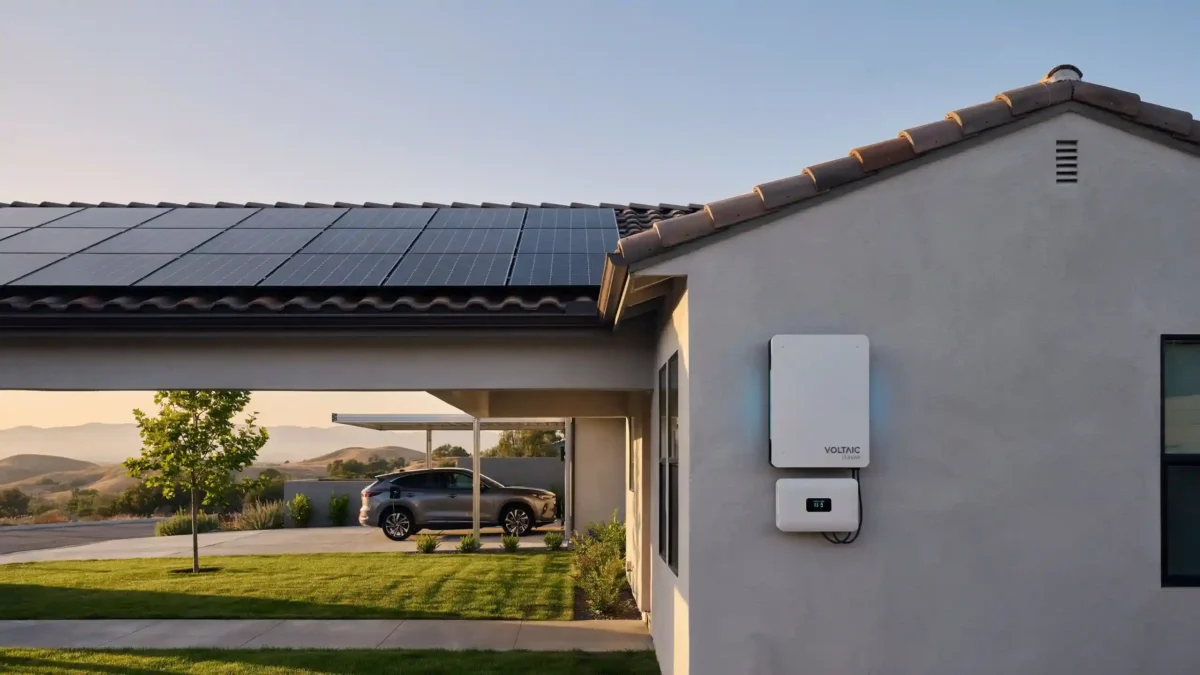
Installed cost includes much more than the battery: inverter, labor, wiring, possible panel upgrades, permits, and commissioning. Compare quotes on the same basis.
Battery Hardware Versus Installed System Cost
| Cost component | Included in battery price? | Often in installed quote? |
| Battery modules | Yes | Yes |
| Battery or hybrid inverter | Sometimes | Yes |
| Backup gateway or transfer switch | Rarely | Usually |
| Installation labor | No | Yes |
| Wiring and conduit | No | Yes |
| Electrical panel upgrade | No | Only if needed |
| Permits and inspection | No | Often |
| Commissioning | No | Usually |
NREL’s 2024 residential model describes a representative 5 kW / 12.5 kWh system and includes permitting, inspection, and interconnection in its cost structure. It’s a modeled system, not a recommended size for every home.
Compare Cost per Usable kWh
Cost per usable kWh = total installed cost ÷ usable kWh. It helps compare different sizes fairly.
Hypothetical example:
| Option | Installed cost | Usable capacity | Cost per usable kWh |
| A | $12,000 | 10 kWh | $1,200 |
| B | $15,000 | 13.5 kWh | About $1,111 |
The figures are illustrative, not market prices. Option B costs more overall but less per usable kWh. Cost per kWh doesn’t capture power output or warranty, though, so use it alongside your scoring worksheet.
Estimate the Cost of Your Intended Backup Setup
Get at least two itemized quotes for the same configuration. Note the date of each quote and what’s excluded. For broader context on residential pricing, see average U.S. residential solar prices, and compare payment options in how solar loans, leases, and PPAs differ.
Can a Home Battery Save Money on Electricity Bills?
Sometimes, depending on your utility tariff, but backup resilience and bill savings are different goals. Use your actual tariff for any savings estimate.
How Time-of-Use Rates Affect Battery Value
Under time-of-use rates, a battery can store cheaper or solar energy and use it when grid prices peak. The savings depend on the gap between peak and off-peak prices and on your usage pattern.
Hypothetical example: shifting 8 kWh a day from a 40¢ peak rate to stored solar avoids $3.20 a day, or about $1,170 a year, before efficiency losses. A smaller price gap shrinks that figure quickly.
How Net Metering and Net Billing Change the Calculation
If your utility credits exports at full retail value, a battery adds less financial value. If exports earn less, storing solar for later use becomes more valuable.
| Policy | Export credit | Battery financial value |
| Full net metering | Near retail rate | Lower |
| Net billing | Below retail rate | Higher |
| Time-of-use with low export credit | Varies by hour | Often highest |
Learn how net metering affects your savings before trusting a payback figure. Some utilities also run demand response or virtual power plant programs that pay batteries to support the grid.
When Backup Resilience Matters More Than Payback
If outages threaten medical needs, pipes, sump pumps or work, resilience may justify the cost even without fast payback. In my view, homeowners should decide this first. A battery bought for peace of mind shouldn’t be judged by the same spreadsheet as one bought to cut bills.
A battery may not be worth it if outages are rare, your utility offers full retail net metering, your rates have little time-of-use difference, or your system isn’t compatible without costly upgrades.
Battery Versus Generator Versus Portable Power Station
| Feature | Home battery | Standby generator | Portable power station |
| Fuel | Solar and grid | Natural gas or propane | Recharged from outlet or solar |
| Noise | Quiet | Loud | Quiet |
| Runtime | Limited by capacity and recharge | Long while fuel lasts | Short |
| Maintenance | Low | Regular servicing | Low |
| Whole-home possible | With enough power | Often | No |
| Bill savings | Possible | No | No |
Battery Safety, Warranties, and Long-Term Ownership
Safe, long-lasting performance depends on certified equipment, qualified installation, and following the manufacturer’s limits.
Safety Certifications and Installation Requirements
Check the product’s safety certifications and installation manual, and follow local building and fire codes. Certification shows testing against specified standards. It doesn’t guarantee zero risk.
For broader electrical safety context, see solar fire risks and prevention.
Battery Degradation and Warranty Limitations
Capacity declines gradually with cycles and time, and heat speeds it up. Plan for eventual replacement, and keep warranty documents and installation records together.
Maintenance, Monitoring, and Recycling
Most lithium-ion home batteries need little hands-on maintenance, but monitoring matters. Watch the app for alerts, firmware updates, and capacity changes. At end of life, ask the installer or manufacturer about recycling options. Lithium-ion batteries shouldn’t go in household trash.
Home Battery Incentives and Current Tax Rules
Federal residential battery credits changed for 2026, so check current rules before counting any incentive.
Federal Tax Guidance for 2026
The IRS states that the Residential Clean Energy Credit applied to qualifying property installed from 2022 through December 31, 2025, and isn’t available for property placed in service after that date. The IRS guidance referenced a 3 kWh minimum battery capacity, but meeting that threshold doesn’t make a 2026 installation eligible.
Background on why the residential solar credit ended. Date checked: October 23, 2026.
State and Utility Incentives
Some states and utilities still offer battery rebates or performance payments, each with its own eligibility, budget, and deadlines. California’s Self-Generation Incentive Program (SGIP), for example, has specific eligibility and funding conditions, and its rules don’t apply in other states.
Start with DSIRE’s database of state incentives, then confirm directly with the program:
- Is the program currently funded?
- Who’s eligible (income, location, utility)?
- Does it require a specific installer or equipment list?
- Must you enroll before installation?
Final Steps for Choosing a Home Battery Backup System
A clear, needs-first process leads to a better choice than any ranking. Before you request quotes:
- List the appliances that must stay powered.
- Estimate energy use and the runtime you need.
- Check continuous and peak power for motor loads.
- Confirm compatibility with your existing solar.
- Compare usable capacity, efficiency, and warranty terms.
- Include installation and electrical-upgrade costs.
- Verify current incentives and local requirements.
- Compare dated, source-backed specifications and prices.
The best solar battery backup system for home is the one that keeps your essential loads running for the outages you actually face, at an installed cost that makes sense for your goals. Use the runtime formula, the scoring worksheet, and itemized quotes, and you’ll be comparing real numbers instead of marketing claims.
Frequently Asked Questions
How much battery capacity does a home need?
It depends on which loads you back up and for how long. Add up the daily kWh of your essential appliances, then size for your expected outage length plus a reserve.
Can solar panels work during a power outage?
Only if the system is designed for backup with a compatible inverter and transfer equipment. Standard grid-tied systems shut off for line-worker safety.
How long can a home battery run a refrigerator?
Often a day or more on its own, because refrigerators cycle on and off. Actual runtime depends on the fridge’s real usage and the battery’s usable capacity.
Can a battery run central air conditioning?
Sometimes, but it needs high continuous and surge power. Air conditioning also drains stored energy quickly, so runtime may be short.
Can I add a battery to existing solar panels?
Usually yes, often through an AC-coupled battery. Your inverter type and the manufacturer’s approved configurations decide what’s possible.
How much does an installed home battery cost?
It varies by size, power output, electrical work, and location. Compare itemized quotes and calculate cost per usable kWh for a fair comparison.
What does a home battery warranty cover?
Typically defects plus a guaranteed retained capacity for a set term or throughput limit. Check exclusions and whether labor is covered.
Is a home battery worth it without frequent outages?
It can be under time-of-use rates or low export credits. Otherwise, the financial case is weaker, and resilience becomes the main reason to buy.
This article by SolarInfoPath (2026 research framework) is part of a comprehensive solar knowledge architecture covering all major high-value sectors including legal disputes (installation negligence, contracts, liability, fraud, lawsuits, liens, HOA and permitting disputes), financial structures (loans, PPA/lease agreements, DSCR financing, tax equity, investment and project finance), tax law (ITC, Section 48/25D, MACRS depreciation, bonus credits, IRS audits, recapture rules, domestic content and IRA/OBBBA compliance), insurance and risk (property damage, hail/wind/fire claims, bad faith insurance disputes, warranty coverage), policy and regulation (net metering, FERC interconnection, state utility rules, incentive programs and regulatory changes), commercial and utility-scale development (EPC contracts, construction delays, performance bonds, receivership, bankruptcy, asset sale and restructuring), real estate impacts (home value, solar leases, liens, title issues, HOA restrictions, easements), and emerging market structures such as battery storage, community solar, agrivoltaics, SRECs, yieldcos, and institutional investment funds. All content is based on publicly available regulatory, financial, and legal sources and is intended strictly for educational and informational purposes, not legal, tax, or financial advice. Readers should always verify current laws, utility policies, tax regulations, and contract terms with qualified licensed professionals before making decisions, as solar regulations, incentives, and financial structures frequently change across jurisdictions and time.

Solar Legal Analyst· Policy Researcher· Investigative Finance Writer Lead Analyst & Founder of SolarInfoPath
Morgan Lee is a solar legal analyst, policy researcher, and investigative finance writer with 12+ years of experience in U.S. renewable energy law, IRS tax credit compliance, and solar litigation. He is the founder of SolarInfoPath, a research-driven platform focused on primary-source analysis of solar contracts, tax law, regulatory policy, and industry disputes affecting homeowners and commercial developers.
His work is grounded in original legal and regulatory sources, including IRS notices, FERC and CPUC rulings, state court filings, PACER records, and UCC lien databases. He specializes in solar contract disputes, injury and workers’ compensation claims, PACE financing issues, tax equity structures, ITC recapture rules, MACRS depreciation, and federal and state solar policy frameworks.
Morgan’s analysis spans solar litigation, finance structures, and regulatory developments such as the IRA and OBBBA, interconnection reform, domestic content rules, and battery storage incentives. He also covers EPC contracts, PPAs, project financing, and utility-scale solar investment structures.