
Commercial solar panel installation averaged about $1.77 per watt nationally in mid-2026, per SEIA and Wood Mackenzie. Smaller business systems often cost more. The 30% federal credit still applies, but only if construction began by July 4, 2026, or the system runs by December 31, 2027.
That deadline is the single biggest factor in your 2026 math. Miss it, and payback can stretch by several years.
This guide covers what it costs, which incentives remain, how the process works, and how to judge a proposal. It’s written for U.S. business owners, facility managers, farms, and nonprofits. It’s educational, not tax or legal advice.
What Is Commercial Solar Installation, and Who Qualifies?
Commercial solar installation means putting solar on a business, farm, or public building to cut its power bills. Systems often range from about 25 kW to several megawatts. Owners include businesses, farms, schools, churches, and local governments.
You’re a good candidate if you have:
- A roof or open land with good sun
- Steady daytime electricity use
- A building you own or a long lease
- Tax liability, or eligibility for elective pay
What Does Commercial Solar Cover Beyond Businesses?
Commercial solar also covers nonprofits, schools, farms, and public buildings. The tax rules differ for each. A nonprofit can’t use a tax credit directly, but it may qualify for elective pay, covered below.
Tenants can go solar too. They’ll need the landlord’s written approval and a lease long enough to recover the cost.
What Types of Commercial Solar Panels Fit Rooftops, Carports, and Ground Mounts?
Most commercial solar panels are the same kind used on homes, just in larger numbers. The big difference is how they’re mounted.
| Mount Type | Best For | Main Trade-Off |
| Rooftop (ballasted) | Flat warehouse roofs | Roof weight limits |
| Rooftop (attached) | Pitched or metal roofs | Roof penetrations |
| Ground mount | Open land | Uses land, needs grading |
| Carport | Parking lots | Higher steel cost |
Is Rooftop or Ground-Mount Better for Your Site?
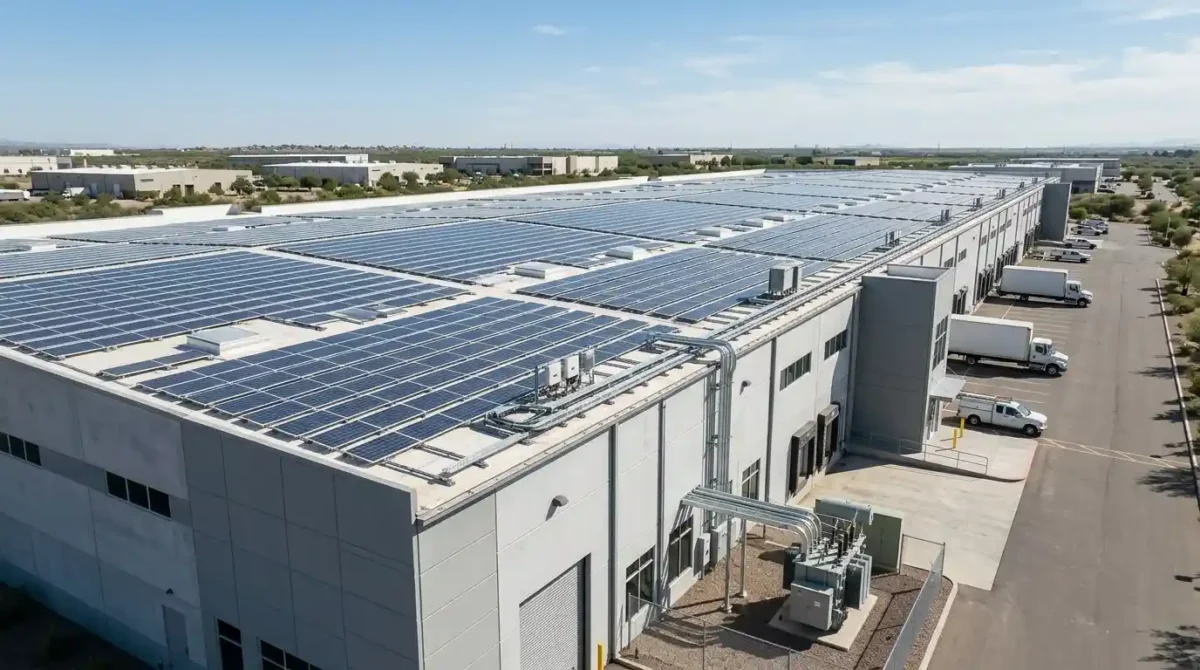
Rooftop systems use space you already have. Ground mounts are easier to service and can face the sun at the best angle. If your roof needs replacing within 10 years, a ground mount or carport may be smarter.
Racking suppliers change over time, which can affect long-term warranty support. Our report on what happened to RBI Solar shows why. Always ask who will honor a racking warranty years from now.
Do Solar Carports Make Sense?
Carports turn parking lots into power plants and shade cars. They cost more per watt because of the extra steel. They often make sense where roof space is limited, or where EV charging is planned.
How Does a Business Solar System Work From Sunlight to Your Meter?
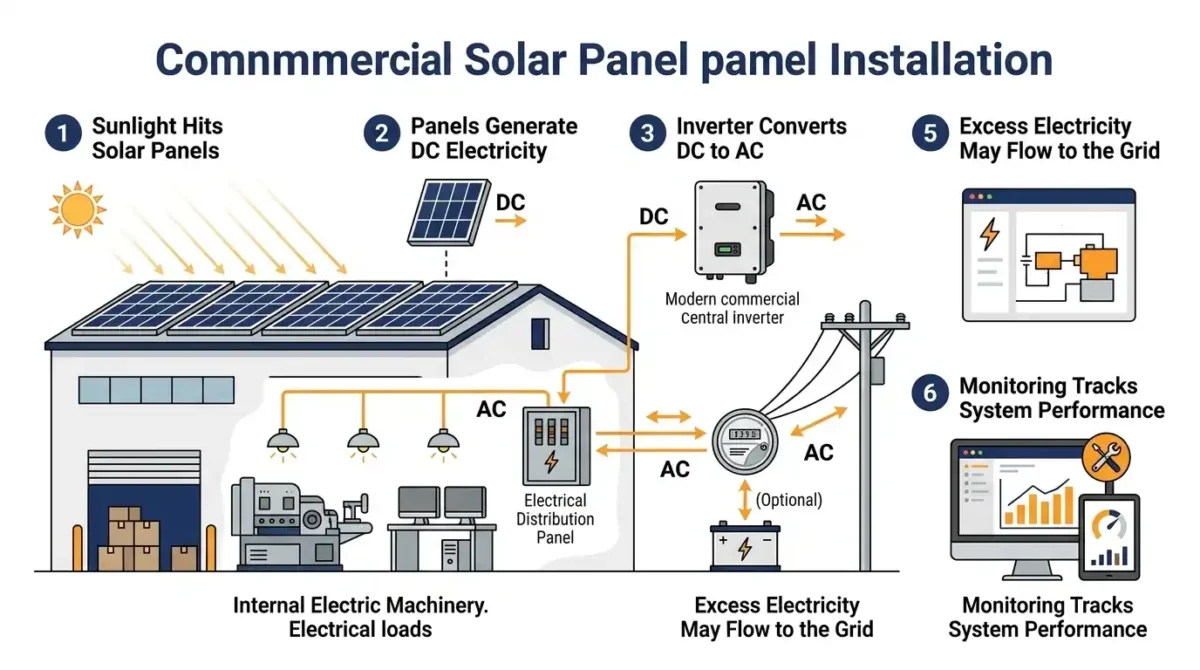
A commercial solar installation turns sunlight into DC power. Then it converts it to AC and feeds your building first. Any extra may flow to the grid, based on your utility’s rules.
The main parts:
- Panels make DC electricity
- Inverters convert it to AC for your building
- Racking holds panels in place
- Switchgear and meters connect to your service
- Monitoring tracks output daily
How you’re paid for exports depends on your state and utility. Some offer net metering. Others pay a lower export rate, which makes on-site use more valuable.
How Much Does Commercial Solar Panel Installation Cost in 2026?
Business system prices averaged $1.77 per watt in Q2 2026, up 5.6% from a year earlier. Panel prices fell 16%. But higher costs for wiring, steel, and shipping more than made up for it, per SEIA and Wood Mackenzie.
That national number leans toward larger projects. Small systems usually cost more per watt.
What Is the Average Cost Per Watt for Commercial Solar Panels?
Expect commercial solar panels and labor to cost about $1.50 to $3.00 per watt, mostly based on size. Here’s a sample range by system size:
| System Size | Assumed $/W Range | Estimated Cost Range |
| 50 kW | 2.25–3.00 | 112,500–150,000 |
| 100 kW | 2.00–2.75 | 200,000–275,000 |
| 250 kW | 1.80–2.40 | 450,000–600,000 |
| 500 kW | 1.65–2.20 | 825,000–1.1 million |
| 1 MW | 1.50–2.00 | 1.5–2.0 million |
Illustrative ranges only, before incentives. Get site-specific quotes.
Why Is the Cost Per Watt Lower Than for Homes?
Fixed costs like design, permits, and crew setup are spread across far more panels. SEIA’s Q2 2026 data put home systems at $3.36 per watt, almost double the business average.
What Factors Change Commercial Solar Installation Cost the Most?
Site conditions and utility upgrades drive the biggest swings in commercial solar installation cost. Two projects of the same size can differ widely in price.
Key cost drivers:
- Roof condition: An old roof may need replacing first.
- Structure: Weak roofs may need reinforcement.
- Grid hookup: Utility upgrades can add tens of thousands of dollars.
- Mounting type: Carports and ground mounts cost more than flat-roof ballast.
- Tariffs: Duties on steel, copper, and aluminum are pushing up wiring and frame costs in 2026.
- Labor rules: Prevailing wage requirements can raise labor costs on larger projects.
Damage during installation is another hidden cost. If a crew harms your roof, our guide to solar panel property damage claims explains how these cases are handled.
What Ongoing Costs Should You Budget For?
Plan for about $19 per kW each year for upkeep. That’s the figure in NREL‘s 2024 benchmark for a rooftop business system. It works out to about $1,900 a year for 100 kW.
Also budget for:
- Inverter replacement, often once over the system’s life
- Monitoring software fees
- Insurance for the solar asset
- Occasional panel cleaning in dusty areas
What Tax Credits and Incentives Can Commercial Solar Still Claim?
Commercial solar can still claim a 30% federal credit in 2026, but the deadlines are tight. Under the 2025 tax law, solar projects must have begun construction by July 4, 2026. If not, they must be running by December 31, 2027.
The July 4 date has passed. So for most new projects, the real goal is to be running by the end of 2027.
Is the 30% Federal Tax Credit Still Available in 2026?
Yes, for qualifying projects, under Section 48E. The credit has a base rate and several adders:
| Credit Part | Rate | Condition |
| Base credit | 6% | All qualifying projects |
| Full credit | 30% | Meets wage rules, or under 1 MW AC |
| Energy community adder | +10% | Site in a qualifying area |
| Domestic content adder | +10% | Enough U.S.-made parts |
| Low-income adder | +10% or +20% | Allocated through a federal program |
Do Prevailing Wage and Apprenticeship Rules Apply to You?
Only if your system is 1 MW AC or larger. Smaller projects get the full 30% without meeting these rules. Larger ones must pay local prevailing wages and use registered apprentices, or the credit drops to 6%.
This is the detail most guides skip. A 1.2 MW AC project that ignores wage rules can lose 24 points of credit. On a $2 million system, that’s $480,000.
How Do Equipment Sourcing Rules Affect Eligibility?
Projects that started after 2025 must meet “foreign entity” sourcing limits. For 2026, at least 40% of the key parts must come from allowed sources. SEIA says the rules aren’t final yet. Ask your installer how they track this.
How Does Depreciation Work for Solar in 2026?
100% bonus depreciation is back for property bought after January 19, 2025. You can claim it with the credit. But you must reduce your tax basis by half the credit.
Here’s a point of real confusion. SEIA still describes solar as five-year MACRS property. Other industry analyses say the 2025 law removed that five-year class for solar that began construction after 2024. Ask your CPA which applies before you build your model.
What Grants, PACE Financing, and State Programs Exist?
USDA’s REAP program, PACE financing, and state incentives can reduce costs further. Each has strict rules.
Who Can Use the USDA REAP Program?
REAP serves farms and rural small businesses. Under a final rule taking effect October 16, 2026:
- Grants cover up to 25% of eligible costs (down from 50%)
- The cap is $500,000 for renewable systems (down from $1 million)
- Ground-mount solar on certified cropland is no longer eligible
- Rooftop systems on farm buildings remain eligible
How Does PACE Financing Work?
PACE lets you repay solar costs through a property tax assessment over many years. It’s available only in states and counties that have adopted it. The debt stays with the property if you sell.
Where Do SRECs and State Incentives Apply?
Some states pay for solar renewable energy certificates (SRECs). Others offer rebates or tax breaks. State rules vary a lot. Our guide to how Connecticut solar companies are vetted shows how much one state’s rules can differ.
Can Nonprofits, Schools, and Governments Benefit?
Yes, through elective pay. It turns the credit into a cash payment. Tax-exempt groups, governments, tribes, and rural power co-ops can use it. For systems of 1 MW or more, domestic content rules may reduce the payment unless an exception applies.
For official guidance on clean energy programs, see the U.S. Department of Energy.
Should You Buy, Finance, Lease, or Use a PPA?
Owning usually pays best over time, if you can use the tax benefits. A PPA or lease suits firms that want low upfront cost or owe little tax.
| Option | Upfront Cost | Who Gets Tax Benefits | Best For |
| Cash | Full | You | Strong cash and tax appetite |
| Loan | Low | You | Good credit, tax appetite |
| PACE | None | You | Where PACE is offered |
| Lease | Low or none | Lessor | Limited tax appetite |
| PPA | None | Developer | Pay only for power produced |
When Does Owning the System Win?
Owning wins when you can use the tax breaks in the first few years. If you owe little tax, those breaks sit unused. You can also sell credits to another taxpayer, often at 88 to 95 cents per dollar.
If a loan-backed project runs into trouble, our guide to solar project debt workout options explains how owners and lenders work it out.
When Does a PPA or Lease Make More Sense?
A PPA makes sense for nonprofits without elective pay access, or businesses that won’t own the building long. You pay a set rate per kWh, often with a yearly escalator.
What Contract Terms Should You Check?
Read the escalator, buyout, and building-sale clauses closely. These often cause disputes later.
- Escalator: How much does the rate rise each year?
- Buyout: When can you buy the system, and at what price?
- Sale of building: Can the buyer take over the contract?
- Removal: Who pays to remove the system at the end?
Many of these clauses match home solar leases. Our guide on how solar lease buyouts work in California explains buyout math that applies in many states.
If you’re already locked into terms you regret, see how to get out of a solar contract.
Step-by-Step Installation Process?
A typical commercial installation takes about 3 to 12 months from first visit to final approval. The utility hookup is usually the slowest step.
| Phase | Typical Duration |
| Site assessment and energy audit | 1–4 weeks |
| Design and feasibility | 2–6 weeks |
| Permits and interconnection | 1–9 months or more |
| Construction | 2–12 weeks |
| Inspection and approval to operate | 2–8 weeks |
Ranges vary widely by utility, state, and project size.
Step 1: Site Assessment and Energy Audit
The installer reviews 12 months of utility bills, your load profile, roof condition, and shading. A structural engineer may check roof capacity.
Step 2: Feasibility and System Design
The design sets system size, layout, and inverter type. You should get a yearly output estimate in kWh, plus the math behind it.
Step 3: Permits and Utility Interconnection
The utility hookup is where most delays happen. Your utility checks whether its local lines can take your system. If they can’t, you may pay for upgrades.
How Do You Check Hosting Capacity?
Many utilities post hosting maps. These show how much new solar a local line can take. Check before you sign. A full line can sink a project.
What Do the Building Department and Fire Marshal Review?
They check roof loads, wiring, fire paths on the roof, and the emergency shutoff. Plans usually need an engineer’s stamp.
Step 4: Construction
Most rooftop jobs cause little fuss. Expect a short, planned power cut when the system ties into your service. Book it after hours if you can.
Job sites carry real safety risks. Confirm your installer has workers’ comp and liability coverage. Then read about how solar installation injury lawsuits work if an accident occurs on your property.
Step 5: Inspection and Permission to Operate
Local inspectors approve the work. Then the utility grants permission to operate. Don’t turn the system on before that approval.
Step 6: Monitoring and Maintenance
Software flags drops in output. Most systems need a yearly check, plus inverter tests and some cleaning.
How Do You Estimate Payback and ROI Before You Commit?
Divide your net cost by your yearly savings. Here’s an illustrative example for a 100 kW rooftop system.
Assumptions: $2.25/W, 1,300 kWh per kW per year, 14.5¢/kWh (near the July 2026 U.S. business average from EIA), 21% tax rate, $19/kW upkeep, and full bonus depreciation.
| Item | With 30% Credit | Without Credit |
| System cost | $225,000 | $225,000 |
| Federal credit | −$67,500 | $0 |
| Bonus depreciation tax value | −$40,163 | −$47,250 |
| Net cost | $117,337 | $177,750 |
| Yearly energy value (130,000 kWh) | $18,850 | $18,850 |
| Yearly upkeep | −$1,900 | −$1,900 |
| Net yearly savings | $16,950 | $16,950 |
| Simple payback | About 7 years | About 10.5 years |
Illustrative only. Depreciation treatment, rates, and output vary. Confirm with a tax advisor.
The gap is the key point. Meeting the federal deadline can cut payback by more than three years in this example.
How Do Demand Charges Change the Math?
Solar alone often does little to cut demand charges. These charges are based on your highest short burst of use. That peak may come on a cloudy day or after sunset. If demand charges are a big share of your bill, the savings above may be overstated.
When Does Battery Storage Improve Returns?
A battery helps most when demand charges are high, or export rates are low. It can shave peaks and store midday solar for later use. Storage also has its own credit timeline. It isn’t bound by the 2027 solar cutoff.
What Risks Can Shift Your Payback?
- Missing the 2027 placed-in-service deadline
- Interconnection upgrade costs
- Export rate cuts by your utility
- Panel degradation and inverter failures
- Selling or leaving the building early
Check every production estimate with free tools from the National Renewable Energy Laboratory.
How Do You Choose a Commercial Solar Company You Can Trust?
A reliable commercial solar company shows its licenses, insurance, and finished projects of similar size. Check them before you compare prices.
What Licenses, Certifications, and Insurance Should You Verify?
- State electrical or solar contractor license
- General contractor license, if required in your state
- NABCEP-certified staff (helpful, not required)
- Liability, workers’ comp, and builder’s risk insurance
- Bonding for larger projects
Reviews help too. Our breakdown of what real 8M Solar reviews reveal shows how to read installer feedback for patterns.
What Should You Ask a Commercial Solar Company Before Signing?
Ask any commercial solar company these questions, and get the answers in writing:
- How will you prove the project meets the 2027 deadline?
- Who pays if utility upgrade costs come in high?
- Who handles wage rules, if the system is 1 MW AC or more?
- How do you document sourcing rules for the credit?
- What’s your workmanship warranty, and who backs it?
- Is the price fixed, and what triggers change orders?
How Do You Compare Proposals Side by Side?
Put each proposal into the same format:
| Item | Proposal A | Proposal B | Proposal C |
| Price per watt | |||
| Year-1 production (kWh) | |||
| Degradation rate | |||
| Inverter replacement plan | |||
| Workmanship warranty | |||
| O&M included? |
Marketing claims and real terms often differ. Our guide to how solar Google Ads work explains why ad promises and actual proposals don’t always match.
What Red Flags Signal an Unreliable Proposal?
- A promise of the 30% credit with no deadline plan
- Payback estimates with no stated assumptions
- No interconnection study or hosting check
- Pressure to sign quickly
- Claims of “free solar” for your business
If a seller misled you, a solar fraud attorney can review false promises.
When many buyers share the same problem, track solar panel class action lawsuits in 2026.
Real Business Scenarios: Who Wins and Who Doesn’t?
Money scenario (Ohio warehouse): A distributor owns a flat-roofed warehouse with heavy daytime use. A 250 kW rooftop system goes in by mid-2027. With the full credit and bonus depreciation, payback lands near 6 to 8 years.
Nonprofit scenario (Arizona school): A charter school can’t use a tax credit. It uses elective pay for a 400 kW carport system under 1 MW AC, so wage rules don’t apply. If it’s running by the end of 2027, the cash payment cuts its net cost sharply.
Problem scenario (Iowa farm): A grain farm planned a ground mount on cropland, expecting a REAP grant. Under the October 2026 rule, that site is ineligible. A barn rooftop system may be the better fit, or the project may not pencil out at all.
What Are the Pros and Cons of Going Solar for a Business?
| Pros | Cons |
| Lower, more predictable power costs | High upfront cost if owned |
| Tax credit and depreciation value | Tight 2027 federal deadline |
| Hedge against rising utility rates | Interconnection delays and fees |
| Sustainability goals and reporting | Demand charges may stay high |
| Backup power with storage | Roof and lease complications |
Is Your Building a Good Fit? A Site-Readiness Checklist
- Roof has 10+ years of life left, or land is available
- Little shading from trees or nearby buildings
- 12 months of utility bills on hand
- You own the building or have a long lease
- You have tax liability, or qualify for elective pay
- Your utility’s hosting map shows capacity
- You can meet a late-2027 in-service date
The Bottom Line for 2026
Commercial solar panel installation can still pay off in 2026, but timing is key to the numbers. Projects running by the end of 2027 keep the 30% credit. Projects that slip past it lose a large share of their value.
Start with your bills, your roof, and your utility’s hosting map. Those three things decide whether a solar panel installation makes sense for you. Then get three proposals in the same format and have your CPA review the tax model.
Frequently Asked Questions
1. How much does a 100 kW business solar system cost?
A 100 kW commercial solar system typically costs around $200,000 to $275,000 before incentives. The final price depends on equipment, labor, roof conditions, and utility interconnection fees. Federal incentives may reduce the eligible project’s net cost, depending on current requirements and deadlines.
2. How long does commercial solar panels installation take?
It takes usually 3 to 12 months, depending on system size, permitting, and utility approval. Construction itself may take a few weeks to several months. Interconnection delays and required electrical upgrades can extend the overall timeline.
3. Is the 30% federal solar tax credit ending?
The federal solar tax credit has strict deadlines under the 2025 tax law. Qualifying solar projects generally must have begun construction by July 4, 2026, or be placed in service by December 31, 2027, subject to applicable rules. Businesses should confirm eligibility and timing with a qualified tax professional before investing.
4. Does commercial solar reduce demand charges?
Yes, It can lower electricity costs, but it may not significantly reduce demand charges. These charges depend on your building’s peak electricity use, which can occur when solar production is low. Battery storage may help businesses reduce peak demand when properly sized.
5. Can nonprofits get federal solar incentives?
Yes, eligible nonprofits, schools, and government entities may qualify for elective pay under applicable federal clean energy tax credit rules. This mechanism can allow qualifying organizations to receive a payment instead of claiming a traditional tax credit. Eligibility, credit amounts, and project deadlines should be verified using current IRS guidance.
6. How long do commercial solar panels and inverters last?
Commercial solar panels commonly have performance warranties of around 25 years or longer, although actual service life varies. Inverters generally have shorter lifespans and may require replacement during the system’s operating life.
7. Should I replace my roof before installing commercial solar panels?
If your roof has fewer than 10 years of useful life remaining, replacing it before installation may prevent expensive removal and reinstallation later. A structural assessment can also identify load limitations or necessary repairs. Compare roof replacement costs with the project’s expected savings before deciding.
This article by SolarInfoPath (2026 research framework) is part of a comprehensive solar knowledge architecture covering all major high-value sectors including legal disputes (installation negligence, contracts, liability, fraud, lawsuits, liens, HOA and permitting disputes), financial structures (loans, PPA/lease agreements, DSCR financing, tax equity, investment and project finance), tax law (ITC, Section 48/25D, MACRS depreciation, bonus credits, IRS audits, recapture rules, domestic content and IRA/OBBBA compliance), insurance and risk (property damage, hail/wind/fire claims, bad faith insurance disputes, warranty coverage), policy and regulation (net metering, FERC interconnection, state utility rules, incentive programs and regulatory changes), commercial and utility-scale development (EPC contracts, construction delays, performance bonds, receivership, bankruptcy, asset sale and restructuring), real estate impacts (home value, solar leases, liens, title issues, HOA restrictions, easements), and emerging market structures such as battery storage, community solar, agrivoltaics, SRECs, yieldcos, and institutional investment funds. All content is based on publicly available regulatory, financial, and legal sources and is intended strictly for educational and informational purposes, not legal, tax, or financial advice. Readers should always verify current laws, utility policies, tax regulations, and contract terms with qualified licensed professionals before making decisions, as solar regulations, incentives, and financial structures frequently change across jurisdictions and time.

Solar Legal Analyst· Policy Researcher· Investigative Finance Writer Lead Analyst & Founder of SolarInfoPath
Morgan Lee is a solar legal analyst, policy researcher, and investigative finance writer with 12+ years of experience in U.S. renewable energy law, IRS tax credit compliance, and solar litigation. He is the founder of SolarInfoPath, a research-driven platform focused on primary-source analysis of solar contracts, tax law, regulatory policy, and industry disputes affecting homeowners and commercial developers.
His work is grounded in original legal and regulatory sources, including IRS notices, FERC and CPUC rulings, state court filings, PACER records, and UCC lien databases. He specializes in solar contract disputes, injury and workers’ compensation claims, PACE financing issues, tax equity structures, ITC recapture rules, MACRS depreciation, and federal and state solar policy frameworks.
Morgan’s analysis spans solar litigation, finance structures, and regulatory developments such as the IRA and OBBBA, interconnection reform, domestic content rules, and battery storage incentives. He also covers EPC contracts, PPAs, project financing, and utility-scale solar investment structures.