
Commercial solar panel installation means putting a photovoltaic system on a business’s roof or land to produce electricity on site. Whether it makes sense depends on your electricity use, roof or land suitability, utility tariff, financing, incentives, and interconnection requirements. No single price or payback period applies to every business.
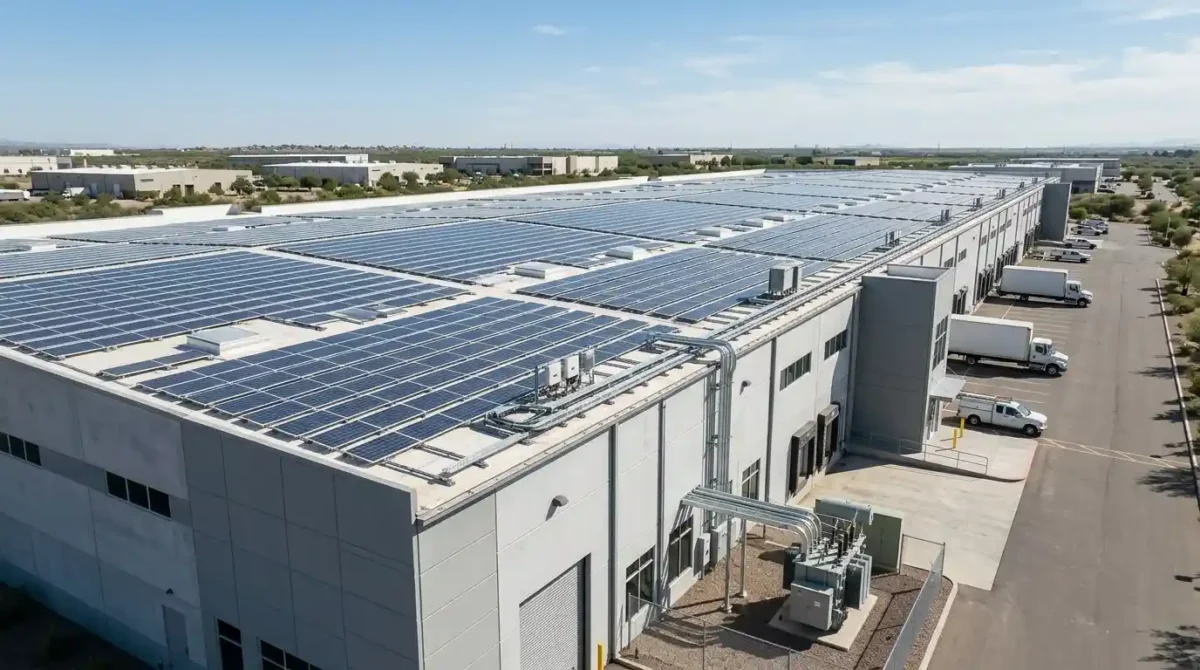
Commercial systems can sit on a warehouse roof, cover a parking lot, or be mounted on open land beside a factory or farm. They range from small systems for a single retail store to multi-megawatt projects serving manufacturing plants.
This guide is for business owners, property and facility managers, finance teams and anyone weighing a solar project for a commercial property. It explains how systems work, what drives cost, how installation unfolds, how savings are estimated, which financing and incentive questions to ask, and how to compare installers fairly.
It’s written as an independent guide, not a sales page, so you’ll find assumptions spelled out rather than promised savings.
How a Business Solar System Works
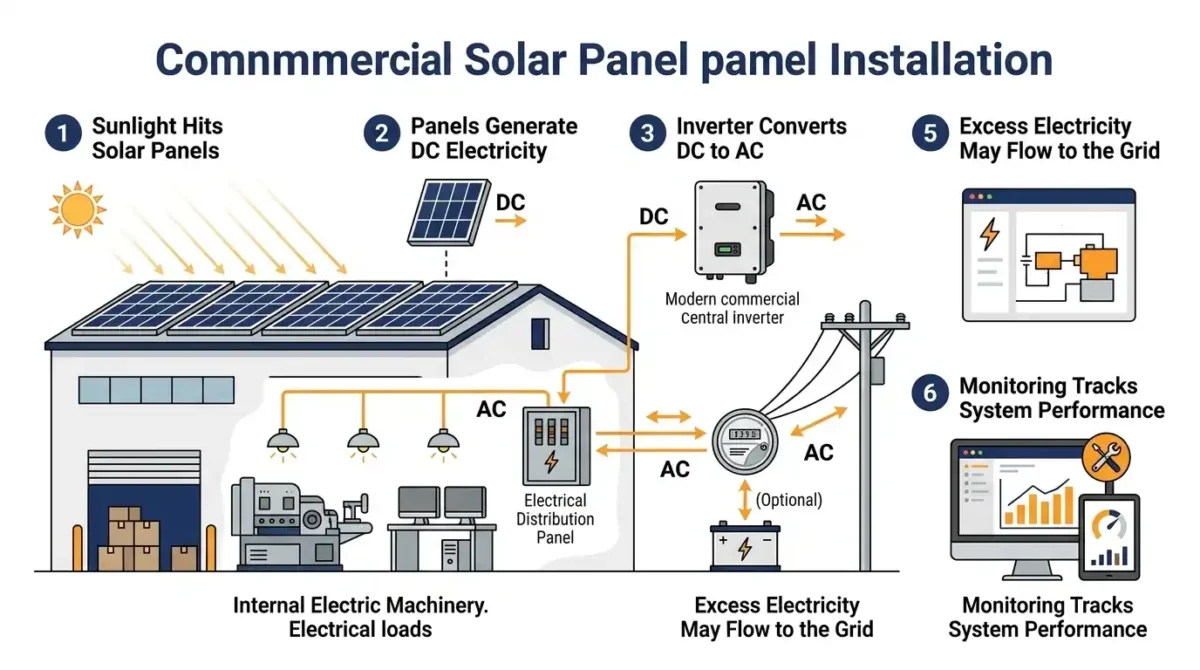
Solar modules turn sunlight into direct current (DC) electricity, inverters convert it to alternating current (AC) for your building, and any surplus may flow to the grid. The system works alongside your utility connection, so your building draws from both.
Rooftop and Ground-Mounted Systems
Rooftop systems use space you already have. Flat commercial roofs often use ballasted racking that sits on the roof under weight, or penetrating mounts fastened to the structure. Sloped roofs typically use rails attached to the framing.
Ground-mounted arrays need suitable land, grading, and site planning, but they offer more flexibility in orientation and tilt. Carport structures are a third option, generating power while shading parked cars.
How the System Connects to Your Building
A commercial system has several main parts working together:
- PV modules produce DC electricity.
- Inverters (string, central, or microinverters, sometimes with power optimizers) convert DC to AC.
- Mounting systems hold the modules securely.
- Switchgear and transformers connect the system to your electrical service.
- Utility meters track power flowing in and out.
- Monitoring software reports output and alerts you to problems.
Capacity is described in two ways. DC capacity reflects module nameplate ratings, while AC capacity reflects inverter output. They’re different measures, so any cost or size comparison must use the same units. The ratio between them, called the DC-to-AC ratio, is a normal design choice.
What Determines the Right System Size?
The right size balances how much power you use with what your site can support. Designers look at annual consumption, hourly or interval data showing when you use power, your daytime load, available roof or land area, shading, and how your utility credits exported electricity.
A system sized to match daytime use often delivers better value than one producing large surpluses. Exported power is frequently credited at less than the retail rate.
Commercial Solar Panel Installation Costs: What Businesses Need to Budget
Total project cost includes equipment, labor, engineering, permits and often roof or grid work, and the final figure depends heavily on scope. Understanding each component helps you read proposals more critically.
Equipment, Labor, Engineering and Soft Costs
Hardware is only part of the bill. A typical project budget includes:
| Cost Component | What It Covers |
| Modules | Solar panels themselves |
| Inverters | String, central or microinverters |
| Mounting and racking | Rails, ballast, attachments, carports |
| Electrical equipment | Wiring, switchgear, transformers, meters |
| Installation labor | Crews, equipment rental, site work |
| Engineering and design | Electrical and structural engineering |
| Permitting and inspection | Local approvals and fees |
| Project management | Scheduling, procurement, oversight |
| Soft costs | Sales, overhead, financing, contingency |
Soft costs, the non-hardware expenses, can be a meaningful share of commercial projects. They’re often where proposals differ most.
Roof and Interconnection Costs
Two cost categories often surprise businesses. The first is the roof. An older membrane may need replacement before panels go on, and some structures need reinforcement to carry the added load. Replacing a roof after installation usually means paying to remove and reinstall the array.
The second is the grid connection. Utilities may require studies, and those studies can identify upgrades to transformers, switchgear or local lines. Depending on your utility’s rules, part of that cost may fall on your project.
Cost Per Watt and Project-Size Examples
Installed cost per watt is calculated as total installed cost ÷ system capacity in watts. For example, a hypothetical $400,000 project with 200,000 watts of capacity works out to $2.00 per watt.
That’s simple arithmetic for illustration, not an estimate for any building. Larger systems usually cost less per watt because fixed costs like design and permitting spread across more capacity.
How to Interpret Industry Benchmarks
The U.S. Department of Energy’s 2025 Q1 solar cost benchmarks model a representative 250 kW DC commercial rooftop system based on a school building. Its PV-only benchmark is $1.95 per watt DC under a minimum sustainable price case and $1.98 per watt DC under a modeled market price case.
These figures are useful context, but they describe a modeled system, not a quote. Your price will reflect your region, roof type, equipment, labor market, interconnection needs, and whether batteries or roof work are included.
For a deeper look at business solar pricing, see what drives commercial project costs.
Commercial Solar Installation: The Step-by-Step Project Process
A commercial solar installation typically moves through five stages, from bill analysis to final utility approval. Each stage can affect timing and cost, so knowing the sequence helps you plan.
Step 1: Review Electricity Use and Utility Bills
Everything starts with your energy data. Gather at least 12 months of utility bills and, where available, interval data showing usage every 15 minutes or hour. You’ll also need your tariff details, including energy charges, demand charges, fixed fees and export compensation rules.
This data shows how much power you use and when you use it, which shapes system size and savings estimates.
Step 2: Conduct a Site and Roof Assessment
An installer or engineer then evaluates the site. They check shading from nearby buildings or trees, roof age and condition, structural capacity, the existing electrical service, and construction access.
A structural engineer may need to confirm the roof can carry the added weight and wind loads. If the roof is near the end of its life, this is the moment to plan replacement.
Step 3: Design and Proposal Review
With data and site information, the installer designs the system and prepares a proposal. A good proposal states system size, expected annual generation, equipment brands and models, total cost, what’s excluded, warranties and financing assumptions. Review it carefully before moving forward.
Step 4: Permits and Utility Interconnection
Next come approvals. Your local building department reviews structural and electrical plans, and fire officials may check access pathways and rapid shutdown requirements. In parallel, the installer submits an interconnection application to your utility, which may require studies and upgrades.
Permitting rules vary by location, so see what solar permits usually require. Interconnection is often the longest step, and utility interconnection delays can stretch timelines significantly.
Step 5: Construction, Inspection and Operation
Once approved, crews install racking, modules, inverters, and electrical equipment. Construction length depends on system size and site complexity. Plan for safety zones, possible brief electrical shutdowns and coordination with daily operations.
After construction, local inspectors verify code compliance and the utility grants permission to operate. Monitoring then begins, giving you ongoing performance data.
Commercial Solar Panels: System Design, Performance and Maintenance
Equipment choices, site conditions, and maintenance together determine how much electricity a system produces over its life. Commercial solar panels are generally similar in technology to residential ones, but commercial projects often use larger modules and different inverter configurations suited to bigger arrays.
Equipment and Performance Considerations
Several factors shape real-world output. Module wattage and efficiency set the baseline, while inverter capacity determines how much power reaches the building. Shading, orientation and tilt all affect generation, and output varies by season and weather.
Panels also degrade slowly over time, producing a little less each year. Production estimates should state the degradation rate they assume, along with the solar resource data and modeling method used. A performance ratio compares actual output with theoretical output and helps flag underperformance.
Remember that a production estimate is a forecast, not a guarantee. Actual generation can fall above or below projections.
Maintenance and Warranties
Commercial systems need modest but regular care. Typical maintenance includes:
- Continuous monitoring to catch faults quickly
- Periodic inspections of modules, wiring, and racking
- Cleaning where dust, pollen, or debris reduce output
- Inverter servicing and eventual replacement during the system’s life
- Vegetation management for ground-mounted arrays
Warranties come in several forms. Module manufacturers typically offer product and performance warranties, inverter manufacturers offer their own, and installers provide workmanship coverage. Read exclusions carefully, and learn what solar warranties actually cover.
When Batteries May Be Relevant
Battery storage adds cost and complexity, so it isn’t right for every project. It can make sense when a business faces high demand charges, time-of-use rates with large price gaps, low export compensation, or a need for backup power.
The value of a battery depends on how it’s dispatched and what your tariff rewards. DOE also publishes separate PV-plus-storage benchmarks, so treat battery costs as a distinct line item with their own assumptions.
Commercial Solar Savings, Utility Bills and Payback
Solar saves money by reducing the electricity you buy, but the size of those savings depends on your tariff structure, not just the average price per kWh.
How Solar Affects the Electricity Bill
Commercial bills usually have three parts. Energy charges are based on kilowatt-hours used. Demand charges are based on your highest power draw during a billing period. Fixed charges stay the same regardless of usage.
Solar reduces energy charges most directly. It may not reduce demand charges much if your peak occurs on a cloudy afternoon or after sunset. Fixed charges remain no matter how much solar you install, so solar rarely eliminates the whole bill.
Electricity you use on site is worth roughly your energy rate. Exported electricity is credited according to your utility’s net metering or net billing rules, often at a lower value. The EIA reported a 2025 U.S. average commercial retail price of about 13.37 cents per kWh. That’s national context only, since your actual tariff may differ significantly. Check current rates through EIA’s Electric Power Monthly.
How to Estimate Potential Annual Savings
A simple method is: net annual benefit = avoided electricity costs + export compensation − incremental operating costs.
Here’s a hypothetical example. A 250 kW system produces about 325,000 kWh a year, a figure that varies widely by location. The business uses 85% of that on site and avoids an energy rate of $0.10 per kWh. It exports the rest at $0.04 per kWh and spends $4,000 a year on maintenance.
| Item | Calculation | Amount |
| Self-consumed solar | 276,250 kWh × $0.10 | $27,625 |
| Exported solar | 48,750 kWh × $0.04 | $1,950 |
| Operating costs | Assumed | −$4,000 |
| Net annual benefit | $25,575 |
This example assumes no demand-charge savings and doesn’t double-count generation or value exports at the full retail rate. Real results depend on your tariff, consumption pattern, and system performance.
Simple Payback vs. Investment Return
Simple payback divides upfront cost by annual net benefit. Using the hypothetical system above at $1.98 per watt, the gross cost is about $495,000, giving a simple payback of roughly 19 years before incentives. If the project qualified for a 30% federal credit, net cost would fall to about $346,500, and payback would shorten to around 13.5 years. Depreciation could shorten it further.
Simple payback ignores financing costs, tax effects, changing utility rates and the timing of cash flows. Internal rate of return (IRR) and net present value (NPV) capture those factors, which is why finance teams usually prefer them for capital decisions. Ask installers for both metrics with every assumption disclosed.
Financing and Incentives for Commercial Solar Projects
How you pay for solar changes your cash flow, your obligations, and who receives the tax benefits.
Cash Purchase, Loan, Lease or PPA
| Option | Who Owns the System | Payment Structure | Who Gets Tax Benefits |
| Cash purchase | Business | Upfront payment | Business, if eligible |
| Solar loan | Business | Loan repayments | Business, if eligible |
| Solar lease | Third party | Fixed lease payments | Lessor |
| Power purchase agreement | Third party | Per-kWh electricity rate | Provider |
Buying with cash or a loan gives you ownership, potential tax benefits, and the full long-term value, but you’re responsible for maintenance. Leases and power purchase agreements reduce upfront cost and often shift maintenance to the provider. However, you don’t own the equipment, and PPA rates may escalate each year.
Contract length, escalation clauses, and end-of-term options vary widely. For a side-by-side look, see how solar loans, leases and PPAs compare, and for third-party contracts, review commercial solar PPA laws.
Federal and State Incentives
Federal tax treatment depends on current law, your project’s dates, and your business’s circumstances. Commercial solar projects placed in service after 2024 generally fall under the Section 48E clean electricity investment credit.
Under the One Big Beautiful Bill Act, signed July 4, 2025, solar projects generally needed to begin construction before July 5, 2026, or be placed in service by December 31, 2027, to qualify. The base credit is 6%. It rises to 30% for projects meeting prevailing wage and apprenticeship requirements, or for qualifying smaller projects. Bonus adders may apply for domestic content or energy community locations.
Businesses that own systems may also benefit from accelerated depreciation under MACRS, which can improve after-tax returns. For details on federal credit rules, see IRS Section 48 energy credit compliance.
States and utilities may offer separate rebates, performance payments, or tax incentives, each with its own eligibility rules and funding limits. DSIRE and your state energy office are good starting points, but confirm details directly with the program.
What to Verify Before Using an Incentive in a Financial Model
Before counting any incentive, confirm your eligibility and the project’s timing. Gather the required documentation, such as wage and apprenticeship records. Check whether the proposal shows gross cost or cost after incentives, and when the benefit actually arrives, since tax credits reduce liability when you file rather than at installation.
Have a qualified tax professional review your situation. No incentive is automatic, and tax treatment depends on individual circumstances.
How to Evaluate a Commercial Solar Company and Its Proposal
A strong proposal clearly explains scope, assumptions, exclusions, and responsibilities. Before you choose a commercial solar company, make sure you understand exactly what you’re buying and what you’re not.
Compare Equivalent Project Scopes
Proposals often differ in ways that make prices hard to compare. Line them up on the same basis: system capacity in the same units (DC or AC), equipment brands and models, and estimated annual generation. Then check which work is included, whether roof work and interconnection upgrades are covered, warranty terms, and financing assumptions.
A lower price that excludes interconnection upgrades or roof preparation may end up costing more.
Check Qualifications and Contract Terms
Verify that the installer holds required state and local licenses for commercial electrical and construction work, and confirm it carries adequate general liability and workers’ compensation insurance. Ask about experience with projects of your size and type, whether work is subcontracted, and who handles monitoring and service after installation.
Also review contract terms on change orders, equipment substitutions, schedule commitments, and what happens if production falls short of projections.
Review Financial Assumptions Independently
Look closely at the tariff the model uses, the production assumptions, and the degradation rate. Check any assumed utility rate escalation, maintenance costs, and financing charges. If assumptions aren’t disclosed, ask for them in writing. An independent engineer or energy consultant can review larger projects.
Comparing Commercial Solar Companies: Due Diligence Before You Sign
Getting multiple proposals helps, but only if you compare them fairly. When evaluating commercial solar companies, use the same assumptions across every bid.
Build a Fair Comparison
A simple comparison worksheet keeps bids honest:
| Factor | What to Check |
| System size | Same units (DC or AC) across bids |
| Annual production | Same modeling assumptions |
| Equipment | Brand, model, warranty |
| Total cost | Inclusions and exclusions listed |
| Interconnection | Who pays for upgrades |
| Roof work | Included or separate |
| Warranties | Workmanship, equipment, production |
| Financing | Rate, term, escalation, fees |
Questions to Ask Before Signing
Ask each bidder these questions in writing:
- What’s the realistic schedule, including utility approval?
- Who handles and pays for interconnection upgrades?
- How are change orders priced?
- Can equipment be substituted, and with what approval?
- Who monitors and maintains the system?
- What happens if production falls below estimates?
Red Flags to Investigate
Be cautious with proposals that promise specific savings without showing assumptions, or that leave exclusions unclear. Pressure to sign immediately is a warning sign. So are guarantees that aren’t defined in the contract, and incentive claims that assume eligibility without verification.
Risks, Limitations and Common Mistakes
Most commercial solar problems trace back to unchecked assumptions or unclear contracts.
On the financial side, costs can overrun, and systems can produce less than expected. Utility tariffs and export rules may change, and maintenance, inverter replacement, and roof work add costs over time. Interconnection delays can postpone savings, and financing obligations continue whether or not the system performs as projected.
Property issues matter too. If you lease your building, you’ll need landlord approval and clear terms on who owns and maintains the system. If you sell the property, contracts may need to be assigned to the buyer, and termination provisions can be costly.
A common mistake is comparing proposals with different scopes or assumptions. Another is sizing a system for maximum output when exports earn little credit, or ignoring the roof’s remaining life.
You can reduce uncertainty by getting written assumptions, comparing several equivalent proposals, and verifying interconnection requirements with your utility. Use engineering review where warranted, and have contracts reviewed before signing.
Final Checklist for Evaluating a Commercial Solar Project
A well-planned project starts with good data and clear contracts. Before committing, confirm these essentials:
- Review your electricity bills and current utility tariff
- Confirm roof or land suitability, including roof life
- Compare proposals using equivalent system scopes
- Check all cost assumptions and exclusions
- Verify interconnection requirements and possible upgrade costs
- Review financing obligations and incentive assumptions with a tax professional
- Check warranties, maintenance responsibilities and contract terms
- Test conservative financial assumptions before relying on projected savings
A successful commercial solar panel installation depends on the specific building, the utility tariff, the project scope, and the written contract. Businesses that gather solid data, compare proposals fairly, and verify incentives early are in the best position to make a confident decision.
Frequently Asked Questions
How long does a business solar project take?
Timelines vary with system size, permitting, and utility approval. Interconnection is often the longest step, so start the utility application early.
Does solar eliminate a business’s electricity bill?
Rarely. Solar reduces energy charges, but fixed charges and some demand charges usually remain.
Should the roof be replaced before installing solar?
If the roof is near the end of its life, replacing it first often avoids paying to remove and reinstall panels later.
Can a business install solar on a leased building?
Yes, with landlord approval. The lease should clarify system ownership, maintenance, and what happens if either party leaves.
Can a battery reduce demand charges?
It can if your tariff has meaningful demand charges and the battery is dispatched to cut peak usage. Results depend on your load profile.
Are commercial solar savings guaranteed?
No. Savings depend on production, utility rates, and contract terms, so any estimate is a forecast rather than a promise.
How many proposals should a business get?
Getting three or more comparable bids helps you spot outliers. Make sure each uses the same scope and assumptions.
What information should I gather before requesting proposals?
Collect 12 months of utility bills, interval data if available, your tariff schedule, roof age and condition details, and property ownership documents.
Where can I find official cost benchmarks?
The U.S. Department of Energy publishes solar cost benchmarks, and the EIA publishes electricity price data. Both are useful context, not quotes.
What happens if production falls short of estimates?
That depends on your contract. Some agreements include production guarantees with defined remedies, while many simply rely on estimates.
This article by SolarInfoPath (2026 research framework) is part of a comprehensive solar knowledge architecture covering all major high-value sectors including legal disputes (installation negligence, contracts, liability, fraud, lawsuits, liens, HOA and permitting disputes), financial structures (loans, PPA/lease agreements, DSCR financing, tax equity, investment and project finance), tax law (ITC, Section 48/25D, MACRS depreciation, bonus credits, IRS audits, recapture rules, domestic content and IRA/OBBBA compliance), insurance and risk (property damage, hail/wind/fire claims, bad faith insurance disputes, warranty coverage), policy and regulation (net metering, FERC interconnection, state utility rules, incentive programs and regulatory changes), commercial and utility-scale development (EPC contracts, construction delays, performance bonds, receivership, bankruptcy, asset sale and restructuring), real estate impacts (home value, solar leases, liens, title issues, HOA restrictions, easements), and emerging market structures such as battery storage, community solar, agrivoltaics, SRECs, yieldcos, and institutional investment funds. All content is based on publicly available regulatory, financial, and legal sources and is intended strictly for educational and informational purposes, not legal, tax, or financial advice. Readers should always verify current laws, utility policies, tax regulations, and contract terms with qualified licensed professionals before making decisions, as solar regulations, incentives, and financial structures frequently change across jurisdictions and time.

Solar Legal Analyst· Policy Researcher· Investigative Finance Writer Lead Analyst & Founder of SolarInfoPath
Morgan Lee is a solar legal analyst, policy researcher, and investigative finance writer with 12+ years of experience in U.S. renewable energy law, IRS tax credit compliance, and solar litigation. He is the founder of SolarInfoPath, a research-driven platform focused on primary-source analysis of solar contracts, tax law, regulatory policy, and industry disputes affecting homeowners and commercial developers.
His work is grounded in original legal and regulatory sources, including IRS notices, FERC and CPUC rulings, state court filings, PACER records, and UCC lien databases. He specializes in solar contract disputes, injury and workers’ compensation claims, PACE financing issues, tax equity structures, ITC recapture rules, MACRS depreciation, and federal and state solar policy frameworks.
Morgan’s analysis spans solar litigation, finance structures, and regulatory developments such as the IRA and OBBBA, interconnection reform, domestic content rules, and battery storage incentives. He also covers EPC contracts, PPAs, project financing, and utility-scale solar investment structures.