Solar Panels North Carolina 2026: Guide to Duke’s New Rates
Solar Panels North Carolina 2026 starts with three real numbers that shape almost every homeowner’s decision: Duke Energy rates around 13¢ per kWh, state solar production of roughly 4.7 to 5.1 peak sun hours per day, and annual household electricity use that often sits near 12,000 kWh per year for an average home.
But what do these numbers actually mean in real money?
Let’s break it into a simple scenario.
If a home uses 1,000 kWh per month, the average electricity bill comes to about $130 per month, or roughly $1,560 per year at current rates. That is your baseline before solar.
Now assume a typical 7 kW solar system in North Carolina. In many parts of the state, that system can generate around 9,000 to 10,500 kWh per year, depending on roof direction and location. At 13¢ per kWh, that equals roughly $1,170 to $1,365 in annual savings.
So here is the key question: if your system is saving nearly the same amount as your yearly bill, how long does it actually take to recover the installation cost?
That answer depends on your final system price, incentives, and local utility rules—but the production difference across regions is just as important.
For example, a system in Raleigh or Charlotte may perform close to the higher end of that range, while homes in shaded or mountainous areas may see lower output and slower savings growth over time.
North Carolina is also the second-largest solar-producing state in the U.S. (EIA data), which shows strong statewide adoption. But the real financial outcome still depends on your exact location, roof conditions, and utility structure.
That is why two homes in the same state can see very different solar savings—even with the same system size.
How Solar Panels Work for a North Carolina Home: Solar Easy Explanation
Solar panels are made from photovoltaic cells, which are silicon layers that release electrons when sunlight hits them. That movement of electrons creates direct current electricity, and your inverter converts that to alternating current, the same type every appliance and fixture in your home runs on. That is the solar easy explanation North Carolina homeowners need before anything else: your roof generates power, your home uses it first, and the Duke Energy grid fills in only when your panels cannot meet demand on their own.
When your panels produce more than your household needs, common on clear spring and fall afternoons across the Piedmont, the surplus flows back to the grid. North Carolina’s net metering policy requires Duke Energy Progress and Duke Energy Carolinas to credit that surplus at the retail rate, currently around 13 cents per kilowatt hour. How net metering works and whether it is worth it covers how North Carolina’s retail rate credit compares to other states and what changes to watch in future regulatory proceedings.
What Solar Actually Costs and Saves a North Carolina Homeowner: Real Numbers
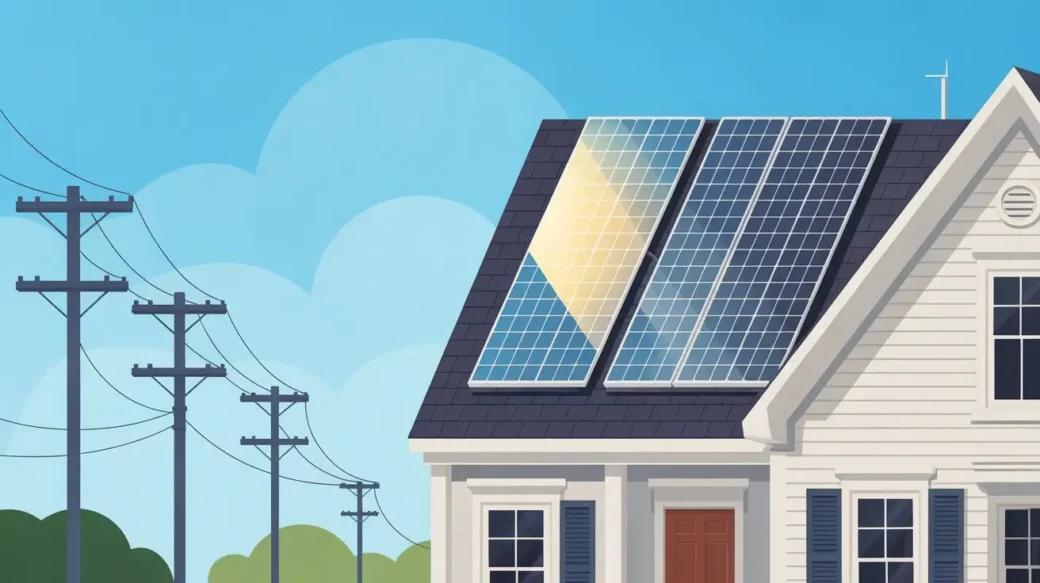
A homeowner in Raleigh paying $130 per month to Duke Energy Progress, roughly 1,000 kWh at 13.0 cents per kWh, spends about $1,560 per year on electricity. A 7-kilowatt solar system in Raleigh receiving approximately 5.0 peak sun hours per day generates around 10,200 to 11,200 kWh per year, covering most or all of that household’s annual consumption, depending on roof angle and shading.
Before incentives, a 7-kilowatt system in North Carolina typically costs $17,500 to $21,000 installed. After applying the federal solar tax credit that reduces your system cost by 30%, the net cost drops to $12,250 to $14,700. North Carolina also fully exempts solar energy equipment from the state’s 4.75% combined sales tax rate, saving approximately $831 to $998 on a typical system at purchase. The state’s 80% property tax exclusion for solar installations means your home’s increased assessed value from panels is 80% exempt from local property taxes, so your annual tax bill rises only slightly, even as your home becomes more valuable.
Energy. gov’s Residential Clean Energy Credit guidance confirms the federal 30% credit applies through at least 2032. Current IRS guidance on the federal solar tax credit explains exactly how to claim it. With estimated annual electricity savings of $1,300 to $1,560 for a well-suited Raleigh area home, payback periods typically land in the 9 to 12 year range after the federal credit. What the solar payback period means and how to calculate yours shows how North Carolina’s numbers compare to national averages.
How Solar Production Varies Across North Carolina, City by City
North Carolina is not one uniform solar environment, and understanding that in solar energy simple terms North Carolina homeowners can actually use starts with geography. The coastal plain around Wilmington and the Outer Banks receives more consistent sun than the western mountains near Asheville. The Piedmont region covering Charlotte, Raleigh, Durham, and Greensboro represents the state’s sweet spot — strong sun hours, dense suburban rooftop access, and two Duke Energy utilities with established net metering programs. Here is how five real North Carolina cities compare:
| City | Avg Sun Hours/Day | Est. Annual Savings (7kW) | Key Solar Notes |
| Raleigh | 5.0 hrs | $1,300 to $1,560 | Duke Energy Progress territory, strong suburban roof access, and active net metering |
| Charlotte | 4.9 hrs | $1,270 to $1,520 | Duke Energy Carolinas; large suburban market; HOA restrictions vary by community |
| Wilmington | 5.1 hrs | $1,330 to $1,580 | Duke Energy Progress: best sun hours in the state; coastal humidity is manageable |
| Asheville | 4.7 hrs | $1,220 to $1,460 | Duke Energy Progress; mountain terrain can create shading on north-facing slopes |
| Greensboro | 4.9 hrs | $1,270 to $1,500 | Duke Energy Carolinas; consistent Piedmont production; fewer shading issues than Charlotte |
Rural Eastern North Carolina counties served by electric cooperatives have excellent unobstructed solar potential with fewer HOA complications than suburban Charlotte or Raleigh neighbourhoods. Cooperative customers should verify their specific net metering terms before estimating savings, as cooperative policies can differ from Duke Energy’s structure. How solar energy benefits and costs differ by state provides context on where North Carolina ranks in the national solar landscape.
North Carolina Solar Incentives in Plain Language: Solar for Dummies North Carolina
North Carolina does not currently have a state income tax credit for residential solar. The state’s 35% solar energy tax credit expired in 2015 and has not been renewed for residential installations. Knowing this upfront prevents the most common planning mistake North Carolina homeowners make when they see national estimates that assume a state credit exists. To put it in solar for dummies North Carolina terms, the state gives you three real financial benefits worth knowing — and none of them is a state income tax credit:
Federal Investment Tax Credit (30%): Cuts your federal tax bill dollar for dollar in the year your system goes live. On a $19,000 system, that is $5,700 back directly.
Sales Tax Exemption: North Carolina exempts solar equipment from the state’s 4.75% sales and use tax under G.S. 105-164.13, saving approximately $902 on a $19,000 system at purchase.
Property Tax Exclusion (80%): 80% of the home value your panels add is excluded from local property tax assessment. On $15,000 in added value, only $3,000 is taxed.
How all solar incentives and costs layer together for U.S. homeowners explains how to sequence these programs correctly so no savings are missed. Whether solar panels increase your home value in the USA covers what North Carolina homeowners specifically can expect on resale, particularly relevant given the partial property tax exclusion structure.
The Honest Limitation: North Carolina’s Net Metering Policy Is Under Pressure
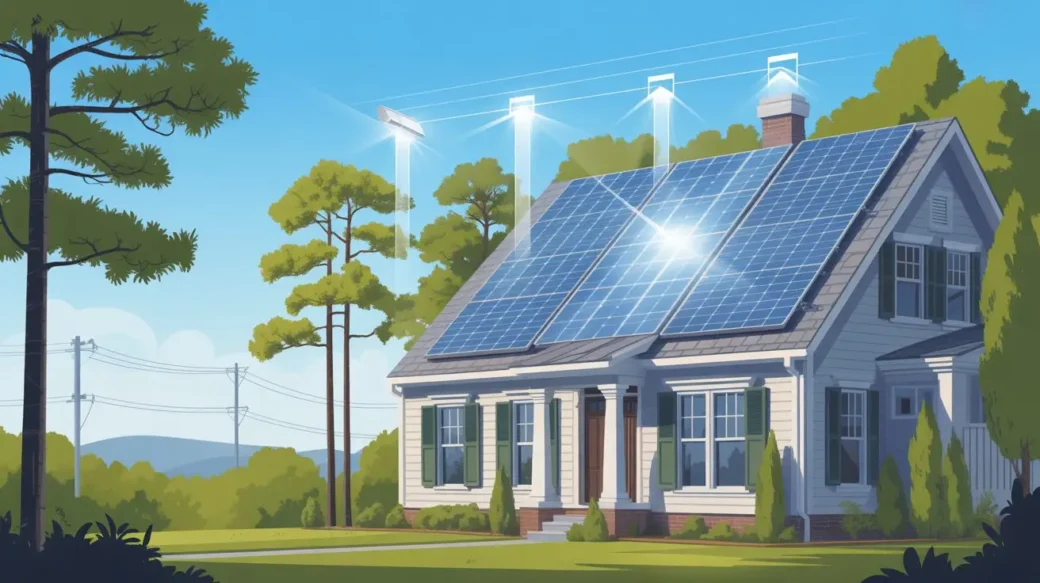
North Carolina’s net metering situation is positive right now, but it carries a real uncertainty that any honest assessment of solar panels explained simply for North Carolina, has to address. Duke Energy has been actively pursuing regulatory changes to reduce net metering compensation before the North Carolina Utilities Commission. If the avoided cost model replaces the current retail rate credit, the financial return for surplus production would drop significantly, extending payback periods for systems sized to overproduce.
This does not mean solar is a poor decision in North Carolina today. It means system sizing matters more here than in states with locked retail rate net metering. A system matched closely to your annual consumption is more resilient to policy changes because your primary savings come from direct self-consumption at the full retail rate rather than from grid credits that could change.
HOA restrictions across suburban Charlotte and the Research Triangle around Raleigh and Durham are also a practical consideration many homeowners discover late in the planning process. North Carolina law limits outright HOA bans on solar, but HOAs can impose aesthetic conditions that push installations toward less productive roof orientations. Common solar panel myths that American homeowners believe address several misconceptions specific to south eastern states. Why solar panels are worth it in North Carolina covers the full long term financial case with current Duke Energy rate projections built in.
Final Thoughts
For North Carolina homeowners in Raleigh, Charlotte, Wilmington, and across the Piedmont with south or southwest facing rooftops and minimal shading, solar panels North Carolina 2026 comes down to this: strong sun hours, the 30% federal tax credit, a sales tax exemption, and an 80% property tax exclusion create a meaningful financial return even without a state income tax credit. The net metering policy currently adds retail rate value to every surplus kilowatt hour your system generates, and that makes the math work clearly for well-sized systems across most of the state.
The most important planning decision for North Carolina homeowners is system sizing relative to actual annual consumption. Sizing to match your usage rather than overproduce protects your return regardless of how net metering regulatory proceedings resolve. For homeowners who want to research the full picture of North Carolina solar costs, incentives, and city-level production data, the solar education resources at this state-specific overview page cover all of it in one place, built around real state figures.
Frequently Asked Questions
Solar panels explained simply for North Carolina: where does a homeowner start?
Start with your Duke Energy bill. Your monthly kilowatt-hour usage and your current rate determine how large a system you need and how much you can realistically save before any incentive is factored in.
What solar incentives are currently available for North Carolina homeowners?
North Carolina homeowners can access the federal 30% Investment Tax Credit, a sales tax exemption on solar equipment under G.S. 105-164.13, and an 80% property tax exclusion on the added home value from their installation. There is no current state income tax credit.
What is the solar easy explanation for how net metering works in North Carolina?
Duke Energy Progress and Duke Energy Carolinas are required to credit your account at the retail electricity rate for surplus solar power sent to the grid, currently around 13 cents per kilowatt hour. Those credits offset your bill during lower production periods.
What is the solar energy simple terms explanation for North Carolina’s 80% property tax exclusion?
When solar adds value to your home, 80% of that added value is excluded from local property tax assessment. Only 20% of the solar-related home value increase is taxed, which keeps your annual property tax bill close to what it was before installation.
Does North Carolina have a state income tax credit for residential solar?
No. The North Carolina 35% residential solar tax credit expired in 2015 and has not been renewed. The federal 30% Investment Tax Credit is the primary tax-based incentive available to North Carolina homeowners today.
Is Solar for dummies North Carolina a reasonable investment for homes near Asheville?
Yes, but with realistic expectations. Asheville averages 4.7 peak sun hours per day, slightly below the state average, and mountain terrain can create shading on certain roof orientations. Well-sited homes in the Asheville area typically see payback periods in the 10 to 13-year range after the federal credit.

Morgan Lee is a homeowner and solar energy researcher based in the United States. After installing a rooftop solar system in 2022 and spending months comparing quotes, incentives, and installer reviews, Morgan realized how confusing and overwhelming the process felt for most American families. That experience led to the creation of SolarInfoPath, a no-pressure, educational platform designed to help U.S. homeowners understand solar energy clearly and confidently. Morgan focuses on practical, research-backed information covering solar costs, installation timelines, federal tax credits, and long-term savings. All content on this site is written from a homeowner’s perspective with the goal of making solar energy simple and accessible for everyday Americans.