
A solar panel warranty can protect you against several different problems: equipment defects, faster-than-promised power loss, installation mistakes, and failures in other system components. The written document decides what’s covered, for how long, which remedy you receive, and which exclusions apply. A long term on paper doesn’t guarantee an easy or free repair.
You’ve probably heard a salesperson mention a “25-year warranty.” But that number rarely tells the whole story. It may cover panel output only, not the inverter on your wall or the labor needed to climb onto your roof.
Warranties are also easy to confuse with homeowners insurance and home warranty plans. Those are separate documents with separate purposes. A homeowner who assumes one replaces another can end up paying for a repair out of pocket.
This guide explains the main types of coverage, what’s usually included and excluded, how long protections last, how home warranties and insurance fit in, how to file a claim, and what happens when a home is sold. It ends with a checklist you can use before installation or after a fault.
Solar Panel Warranty: The Main Types of Coverage
Most residential systems come with at least three separate protections: a product warranty, a performance warranty, and a workmanship warranty. Each one answers a different question, and each comes from a different company or document.
If you’re new to how the parts of a system fit together, start with how residential solar systems work. Knowing the components makes warranty documents much easier to read.
Product Warranty
A product warranty covers specified defects in the materials or manufacturing of the panel itself. Examples a manufacturer might review include a faulty junction box, a failed connector, delamination (layers of the module separating), or moisture getting inside the module.
The remedy is usually repair or replacement, and sometimes a refund or credit, depending on the terms. The coverage period, exclusions, and remedy differ from one model to the next, so the product’s own warranty PDF is the only reliable source.
Parts coverage doesn’t automatically include labor, removal, reinstallation, or shipping. A replacement panel may be free, while the work to swap it isn’t.
Performance Warranty
A performance warranty, sometimes called a power-output warranty, promises that the panel will keep producing at least a stated percentage of its original rated power over a set period. Panels lose a little output every year through normal degradation. This warranty sets the limit on how much loss is acceptable.
Here’s a hypothetical example. A 400-watt panel carries a warranty guaranteeing 80% of its rated power at year 25. Under that schedule, it should still produce at least 320 watts when measured the way the warranty specifies. Real thresholds and schedules vary, so check the exact percentages in your document.
Measurement method matters. Many warranties measure output under Standard Test Conditions (STC), the lab conditions used to set a panel’s nameplate rating. That’s very different from what you see on a cloudy afternoon.
A performance warranty also isn’t a promise about your electricity bill. Your savings depend on your usage, rates, shading, weather, and utility export rules, none of which the warranty covers.
Workmanship and Installation Warranty
A workmanship warranty comes from your installer, not the panel manufacturer. It covers specified problems caused by the installation itself, such as poorly sealed roof penetrations, loose mounting, faulty wiring, or incorrect connections.
The term and scope come from your signed installation agreement. There’s no national standard length, so don’t assume a number you heard during the sales visit.
| Warranty Type | Purpose | Possible Coverage | Common Limitations |
| Product | Equipment defects | Repair or replacement of a defective panel | May exclude labor, shipping, and physical damage |
| Performance | Output over time | Remedy if output drops below the threshold | Strict measurement rules; not a savings promise |
| Workmanship | Installation quality | Specified installation defects, sometimes roof leaks | Depends on the installer’s terms and continued business |
Solar Panel Warranties: What Is Covered and What Is Excluded?
Coverage depends on two things: whether the problem is a covered defect, and whether any exclusion applies. Solar panel warranties are written to cover specific failures under specific conditions, so it pays to read the exclusions before you need them.
The Federal Trade Commission’s guidance on warranties advises reading the terms before you buy. It also suggests checking which remedies and exclusions apply, and keeping copies of the warranty and your receipts.
Covered Defects Versus Excluded Damage
A defect claim usually requires evidence that the product failed because of how it was made, not because of something that happened to it. A cracked cell from a manufacturing flaw may qualify for review. A panel cracked by a falling branch generally won’t fall under the product warranty, although homeowners insurance may apply.
Common exclusion categories to look for include:
- Physical damage from impacts, falling objects, or hail
- Weather events such as hurricanes, floods, or lightning
- Fire, pest, and rodent damage
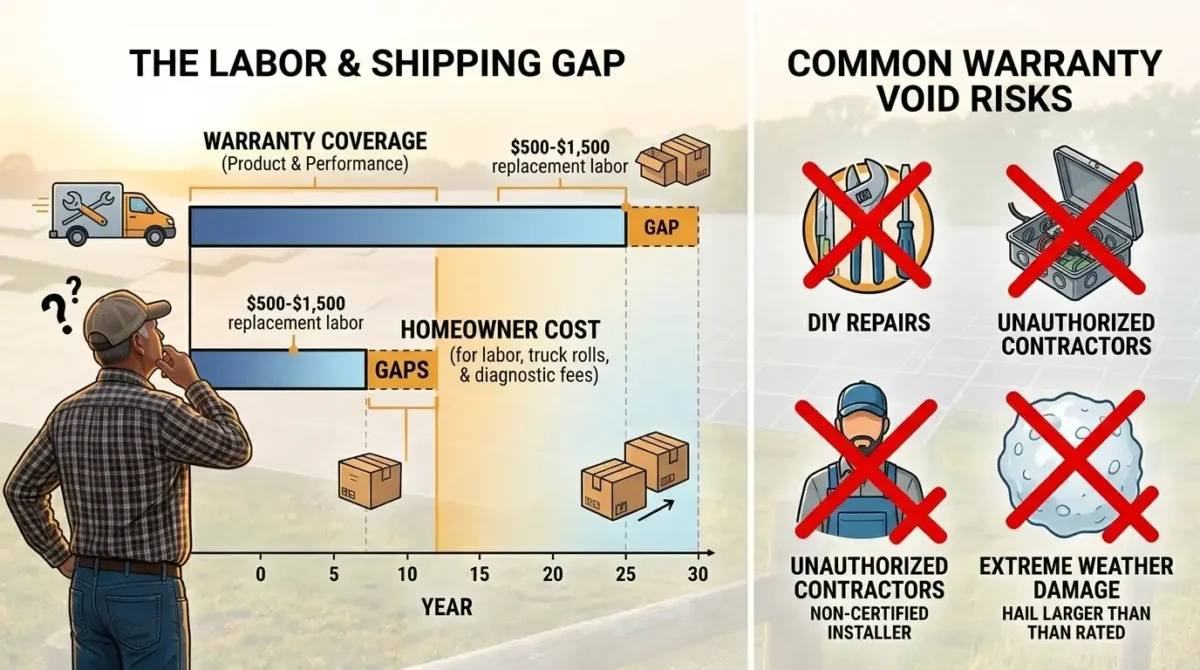
- Improper installation by an unauthorized party
- Unauthorized repairs or modifications
- Corrosion or salt exposure outside the stated environmental limits
- Operating outside temperature or other specified conditions
Not every warranty uses these exclusions, and some use others. A single incident, like a storm, may require checking both your warranty and your insurance policy, since each covers different parts of the loss.
Labor, Shipping and Replacement Limits
This is the part most people overlook. A warranty can approve a replacement panel and still leave you with a meaningful bill. Removing panels, getting a crew on the roof, testing the fault, shipping the old module, and installing the new one all cost money.
| Expense | Status |
| Replacement part for a confirmed defect | Often covered, subject to the terms |
| Labor to remove and reinstall | Check the contract; may be limited or excluded |
| Shipping and transportation | Check the contract; may be capped |
| Diagnostic or inspection fees | Check the contract; often a separate issue |
| Roof access equipment | Often a separate issue |
| Damage from storms or impacts | Often a separate issue for insurance |
Some warranties reimburse labor up to a set amount. Others cover parts only. Some also allow the manufacturer to supply a different model if the original is no longer made, which can matter if the new panel looks or performs differently.
For a sense of what out-of-pocket repairs can cost, compare with average U.S. residential solar prices.
How Long Do Solar Warranties Last?
There’s no single standard length, because terms vary by product, model, manufacturer, and installation agreement. The honest answer to how long solar warranties last is that each document sets its own clock.
Product and Performance Periods
Many current panels carry performance warranties of around 25 years. That’s a common market pattern, not a universal rule. Product warranty periods vary more widely between manufacturers and models, so check the current datasheet and warranty PDF for your exact panel.
Term length alone doesn’t measure coverage quality. A shorter warranty with labor and shipping included may protect you better than a longer one that covers only parts. Proration also matters: some warranties reduce the benefit as years pass, while non-prorated coverage doesn’t shrink over time.
The start date matters too. Coverage may begin on the purchase date, the installation date, the shipment date, or the date the system began operating. Find the warranty commencement date in your document.
Inverter, Battery and Mounting Coverage
Your panels aren’t the only equipment on your property, and the other parts usually have their own terms. The U.S. Department of Energy notes that string inverters often last around 10 to 15 years, so they may need replacing during the panels’ life.
| Component | Where Coverage Comes From | What to Check |
| Panels | Panel manufacturer | Product and performance terms |
| Inverter | Inverter manufacturer | Term, labor, any paid extensions |
| Microinverters or optimizers | Their manufacturer | Per-unit replacement terms |
| Battery | Battery manufacturer | Years, cycles, throughput and capacity limits |
| Mounting and racking | Racking manufacturer | Structural and corrosion terms |
| Monitoring equipment | Equipment or service provider | Hardware and subscription terms |
| Installation work | Installer | Workmanship term and roof coverage |
Battery warranties are especially complex. They often end at whichever comes first: a number of years, a number of charge cycles, or a total amount of energy throughput. They also usually promise a minimum remaining capacity. See how home batteries are compared before relying on a battery’s headline term.
Keep separate documents for each component. When something fails, you’ll need to know whose warranty applies.
Does Home Warranty Cover Solar Panels?
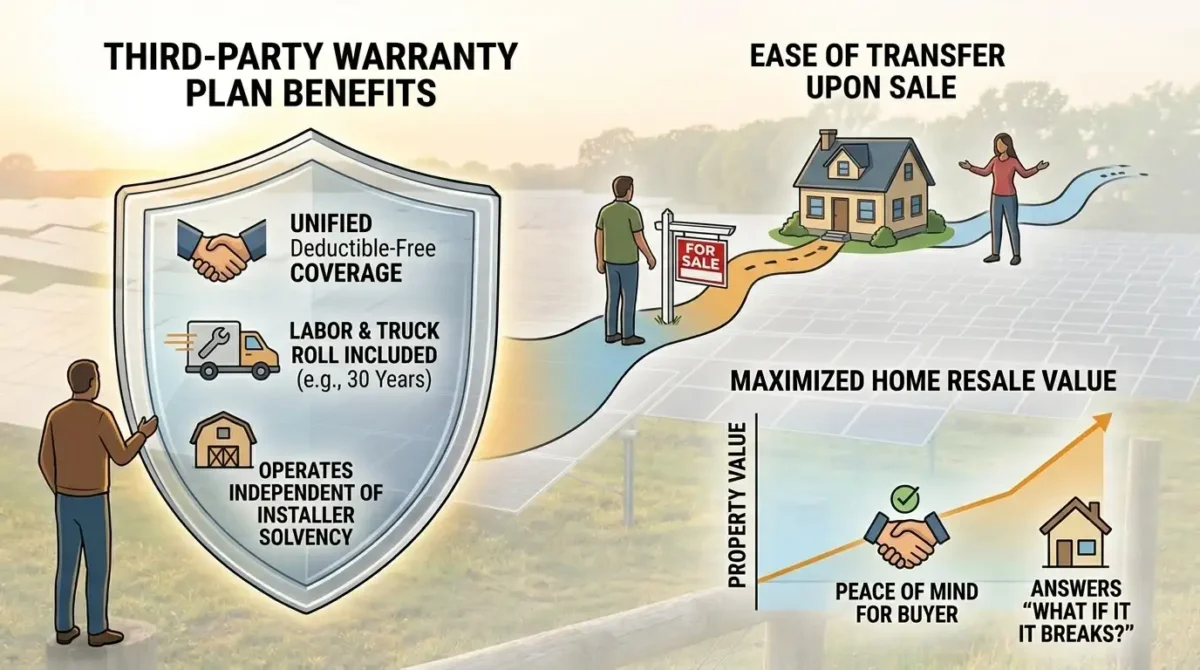
Usually not, unless the contract specifically includes them or you’ve bought a solar add-on. If you’re asking “does home warranty cover solar panels,” the answer lives in the written home warranty contract, not in general assumptions.
Standard Plans Versus a Solar-Specific Add-On
A home warranty is a service contract that covers repairs to listed home systems and appliances, such as HVAC, plumbing, or a water heater. Standard plans commonly exclude rooftop solar equipment. Some providers sell an optional solar add-on, but it only helps if the contract actually names the equipment and the type of failure you have.
Before relying on an add-on, check:
- Which components are listed: panels, inverter, battery, mounting
- Whether it covers failures from wear, defects, or both
- Service fees charged per visit
- Annual or per-claim coverage limits
- Whether you must use the provider’s contractors
- Exclusions for roof work, pre-existing conditions, or equipment still under a manufacturer warranty
An add-on can overlap with coverage you already have from the manufacturer. Compare it carefully before paying for it.
Home Warranty Versus Homeowners Insurance
These two are easy to mix up, but they protect against different things. A home warranty is a service contract for breakdowns. Homeowners insurance covers specified losses, such as damage from certain storms, fire, or theft.
| Feature | Home Warranty | Homeowners Insurance | Manufacturer Warranty |
| Main purpose | Repairs for listed breakdowns | Specified property losses | Product defects and output |
| Solar coverage | Only if the contract includes it | Depends on policy wording | Covers its own product |
| Typical cost | Annual fee plus service fees | Premium plus deductible | Included with the product |
| Who decides | Home warranty company | Insurer | Manufacturer |
Two hypothetical scenarios show why different documents apply. In the first, an inverter stops working after five years with no outside cause. You’d start with the inverter manufacturer’s warranty, then check any home warranty add-on.
In the second, a hailstorm cracks several panels. The product warranty likely won’t apply, since it’s external damage. Your homeowners insurance policy is where you’d look first, subject to its terms and deductible.
The National Association of Insurance Commissioners (NAIC) encourages homeowners to confirm with their insurer whether home upgrades are covered. Ask whether your policy includes the panels, whether coverage limits need raising, and whether you should report the installation. If storm damage also affects your roof, see who pays when solar work damages a roof.
How to File a Warranty Claim for Solar Equipment
A strong claim starts with identifying the equipment, documenting the problem, and contacting the right party.
Identify the Equipment and the Problem
Record the panel or inverter model number, serial number, installation date, and the fault you’ve observed. The serial number is usually on a label on the back of the panel or the side of the inverter. If it’s on the roof, ask your installer or check your installation records rather than climbing up yourself.
Gather supporting evidence:
- Screenshots from your monitoring app showing the change in output
- Inverter error messages or fault codes
- Photos taken safely from the ground
- Maintenance records and cleaning dates
- Your purchase receipt and installation contract
Never open electrical equipment or walk on your roof to investigate. Panels can carry voltage whenever light hits them. If something looks burned or smells hot, see solar fire risks and warning signs.
Lower output doesn’t automatically mean a defect. Seasonal changes, new shading, dirt, or a tripped breaker can all reduce production. Don’t draw conclusions from a single day’s reading.
Review the Terms and Contact the Correct Party
Decide whether the problem concerns the product, its performance, the installation, or another component. Equipment defects usually go to the manufacturer, while installation problems usually go to the installer. Many installers also handle manufacturer claims for their customers, so contacting them first often makes sense.
Follow the written claim procedure exactly. Some warranties require registration, specific forms, or testing by an authorized service provider. If a claim is denied, ask for a written explanation that names the specific contract clause and evidence relied on.
Keep a Claim Record
Track every step: dates, contact names, case numbers, documents submitted and responses received. Here’s a hypothetical timeline:
- March 2, 2026: monitoring app shows one inverter offline
- March 3, 2026: installer contacted; case number assigned
- March 10, 2026: technician confirms a fault code
- March 24, 2026: manufacturer approves a replacement unit
- April 8, 2026: replacement installed; labor invoice reviewed against the warranty
If a dispute stays unresolved, the FTC’s guidance explains your options, and USA.gov lists state consumer protection offices. For persistent disputes, see consumer protection options for solar disputes.
Warranty Transfers When Buying or Selling a Home
Coverage doesn’t always transfer automatically, so check the documents before closing.
Check the Documents Before Closing
The DOE’s homeowner’s guide to going solar recommends checking who installed an existing system, which warranties remain, and who owns the equipment. Start by confirming whether the system is owned outright, financed, leased, or covered by a power purchase agreement.
| Ownership Type | Who Typically Handles Repairs | What the Buyer Should Request |
| Owned (paid off) | Homeowner, under warranties | All warranty documents and transfer instructions |
| Financed with a loan | Homeowner, under warranties | Loan payoff or assumption terms, plus warranties |
| Lease or PPA | Usually the system owner | The agreement and its transfer requirements |
Collect product warranties, installation records, and any transfer instructions. Some manufacturers require you to register the new owner within a set time, and some charge a fee. To understand lease and loan structures, see how solar loans, leases, and PPAs differ.
What If the Installer No Longer Exists?
Installer closures are a real concern. A manufacturer’s warranty and an installer’s workmanship warranty are separate obligations, so losing the installer doesn’t necessarily end the equipment coverage.
Identify the equipment manufacturer and model, then ask the manufacturer about current claim channels. They may list authorized service providers who can perform warranty work. Workmanship coverage, however, may be difficult to enforce once the installer is gone.
Solar Warranty: How to Compare Coverage Before Installation
The best time to evaluate coverage is before you sign, while you can still choose equipment and installers. A solar warranty comparison should look at what’s actually promised, not just the number of years printed in a brochure.
Compare More Than the Number of Years
Use the same questions for every quote:
- Which components and defect types are covered?
- What output threshold applies, and how is it measured?
- Are labor, shipping, diagnostics, and reinstallation included?
- What exclusions apply, especially for weather and installation?
- Is registration required, and by when?
- Does coverage transfer to a new owner?
- How is a claim filed, and who handles it?
Also ask about the warranty provider’s continuity. A long promise depends on the company still being around to honor it. That’s one reason some buyers value manufacturers with established U.S. service networks.
Get any verbal promise in writing. If the salesperson says the installer covers roof leaks for 10 years, that should appear in the signed agreement.
Evaluate Extended Coverage Carefully
Some installers and third parties sell extended warranties or service contracts. These can fill real gaps, such as inverter labor after the original term. They can also duplicate protection you already have.
Possible benefits:
- Coverage beyond the original inverter or workmanship term
- Labor and diagnostics that the manufacturer excludes
- Defined response times, if stated in writing
Possible drawbacks:
- Overlap with existing manufacturer coverage
- Deductibles or per-visit service fees
- Exclusions that limit useful protection
Distinguish an extended warranty from a maintenance or monitoring plan. Maintenance plans cover routine service like inspections, while warranties cover failures. A longer term isn’t automatically better if the exclusions are broad.
Weigh any extra cost against your system’s economics. See how solar payback periods work to understand how repair costs and service fees change the math.
Final Checklist for Your Solar Equipment Coverage
Use this checklist before installation, after a fault, or before buying a home with existing panels:
- ☐ Product, performance, workmanship, inverter and battery documents collected
- ☐ Coverage start and end dates recorded for each component
- ☐ Covered defects, remedies and exclusions reviewed
- ☐ Labor, shipping, diagnostics and removal terms confirmed
- ☐ Registration, maintenance and transfer requirements noted
- ☐ Home warranty and insurance terms checked where relevant
- ☐ Claim contact details and model and serial numbers saved
A solar panel warranty is only as useful as your understanding of its written terms and the records you keep. Read each document before you need it, store everything in one place, and contact the manufacturer, installer or insurer that actually covers the problem.
Frequently Asked Questions
Does a performance guarantee promise lower electricity bills?
No. It promises a minimum panel output under stated test conditions. Your bill depends on usage, rates, weather, and utility rules.
Does a product warranty cover labor and shipping?
Not always. Some include labor up to a limit, while others cover only parts. Check the labor and shipping clauses before filing.
Can a solar add-on make a home warranty cover my inverter?
Possibly, if the add-on contract names the inverter and the type of failure. Check service fees, limits, and contractor rules first.
Are inverters and batteries covered separately?
Usually, yes. Each has its own manufacturer and terms, which are often shorter than the panel performance term.
Does homeowners insurance cover storm-damaged panels?
It may, depending on your policy wording, limits, and deductible. Contact your insurer to confirm coverage for your system.
What happens if my installer goes out of business?
The manufacturer’s equipment coverage may continue, but workmanship coverage can be harder to enforce. Contact the manufacturer for current claim channels.
Can coverage transfer to a new owner?
Often, but not always automatically. Some warranties require registration or a fee within a set period after the sale.
What should I do if a claim is denied?
Ask for the written reason, including the specific clause relied on. Then review your options through official consumer resources.
How do I find my original warranty document?
Check your installation contract package, the manufacturer’s website, or your installer. You’ll need the exact model number to find the right version.
What records should I keep for the life of the system?
Keep warranties, receipts, the installation contract, permits, serial numbers, monitoring records, and all claim correspondence.
This article by SolarInfoPath (2026 research framework) is part of a comprehensive solar knowledge architecture covering all major high-value sectors including legal disputes (installation negligence, contracts, liability, fraud, lawsuits, liens, HOA and permitting disputes), financial structures (loans, PPA/lease agreements, DSCR financing, tax equity, investment and project finance), tax law (ITC, Section 48/25D, MACRS depreciation, bonus credits, IRS audits, recapture rules, domestic content and IRA/OBBBA compliance), insurance and risk (property damage, hail/wind/fire claims, bad faith insurance disputes, warranty coverage), policy and regulation (net metering, FERC interconnection, state utility rules, incentive programs and regulatory changes), commercial and utility-scale development (EPC contracts, construction delays, performance bonds, receivership, bankruptcy, asset sale and restructuring), real estate impacts (home value, solar leases, liens, title issues, HOA restrictions, easements), and emerging market structures such as battery storage, community solar, agrivoltaics, SRECs, yieldcos, and institutional investment funds. All content is based on publicly available regulatory, financial, and legal sources and is intended strictly for educational and informational purposes, not legal, tax, or financial advice. Readers should always verify current laws, utility policies, tax regulations, and contract terms with qualified licensed professionals before making decisions, as solar regulations, incentives, and financial structures frequently change across jurisdictions and time.

Solar Legal Analyst· Policy Researcher· Investigative Finance Writer Lead Analyst & Founder of SolarInfoPath
Morgan Lee is a solar legal analyst, policy researcher, and investigative finance writer with 12+ years of experience in U.S. renewable energy law, IRS tax credit compliance, and solar litigation. He is the founder of SolarInfoPath, a research-driven platform focused on primary-source analysis of solar contracts, tax law, regulatory policy, and industry disputes affecting homeowners and commercial developers.
His work is grounded in original legal and regulatory sources, including IRS notices, FERC and CPUC rulings, state court filings, PACER records, and UCC lien databases. He specializes in solar contract disputes, injury and workers’ compensation claims, PACE financing issues, tax equity structures, ITC recapture rules, MACRS depreciation, and federal and state solar policy frameworks.
Morgan’s analysis spans solar litigation, finance structures, and regulatory developments such as the IRA and OBBBA, interconnection reform, domestic content rules, and battery storage incentives. He also covers EPC contracts, PPAs, project financing, and utility-scale solar investment structures.