
Solar panel costs typically range between $2.50–$3.50 per watt installed, putting a full home system at roughly $ 15,000- $ 28,000 before incentives, most commonly $20,000–$26,000 for a 7–8 kW system.
Individual panels alone run $200–$400 each, but panel price is only a fraction of total project cost, which also includes the inverter, mounting hardware, wiring, labor, and permitting. As of 2026, the 30% federal residential tax credit that used to lower this number has expired, so state and utility programs now carry more weight in the final price a homeowner actually pays.
How Much Do Solar Panels Cost?
There’s no single “solar panel cost”; it depends on whether you’re asking about one panel, a full system, or the installed price per watt, and each answers a different question. Understanding which one you’re actually asking about is the first step to comparing quotes accurately.
What Is the Average Cost of a Solar Panel?
The average U.S. residential solar system costs $2.50 to $3.50 per watt before incentives, or roughly $20,000–$26,000 for a typical 7.2 kW system. This figure comes from aggregated 2025–2026 installer pricing data (EnergySage, NREL benchmarking reports) and moves with local labor rates, permitting fees, and panel efficiency.
That per-watt figure is an installed cost; it bundles equipment and labor together, which is why it’s the number worth comparing across quotes rather than the sticker price of a single panel.
How Much Does One Panel Cost?
A single residential solar panel (roughly 400–440 watts) typically costs $200–$400 on its own, or about $0.40–$0.60 per watt at the component level. Premium monocrystalline panels sit at the higher end; budget polycrystalline panels sit lower, though they’re less common in new residential installs today.
Here’s where the numbers shift: multiply that per-panel price by the 18–24 panels a typical home needs, and you get a materials cost that’s still only about a third of the full installed project, which is exactly why “how much does a panel cost” and “how much does a solar system cost” produce very different-looking numbers for the same house.
Solar Panel Price vs. Total Solar System Cost
Panel price is not the same as system price. A full installed system includes:
- Panels, roughly 30–40% of total cost
- Inverter(s), converts DC to usable AC power
- Racking and mounting hardware
- Wiring and electrical balance-of-system components
- Labor, typically 10–20% of the total
- Permitting and inspection fees
- Optional battery storage, a separate, often five-figure line item
A homeowner comparing “panel cost” quotes without accounting for these categories will consistently underestimate their real budget.
How Much Does a Home Solar System Cost?
Average Cost of a Home Solar System
Most U.S. homes install a system between 5 kW and 10 kW, with an installed cost of $15,000 to $35,000 before incentives, depending on system size, roof complexity, and local labor costs. Cash buyers and financed buyers see different total costs once interest is factored in — a financed system can cost several thousand dollars more over the loan term than the sticker price suggests.
Solar System Cost by System Size
| System Size | Approx. Capacity | What It Represents | Typical Installed Cost Range* |
| Small | 3 kW | Lower electricity use, small footprint homes | $9,000–$12,000 |
| Medium | 5–6 kW | Moderate household electricity use | $15,000–$21,000 |
| Large | 8–10 kW | Higher electricity use, larger homes | $24,000–$32,000 |
| Very Large | 10+ kW | High consumption, EVs, pools, or all-electric homes | $32,000+ |
*Estimates only, actual pricing varies by state, installer, roof condition, and equipment tier. These are not quotes.
These aren’t universal recommendations; the right size for a specific home depends on actual annual kWh usage from utility bills, not home square footage or a rule of thumb.
Cost of Solar Panel Per Watt
What Does Cost Per Watt Mean?
Cost per watt is the total installed system price divided by the system’s rated capacity in watts; it’s the standard metric for comparing solar quotes on an apples-to-apples basis, since it normalizes for system size. A $24,000 quote for an 8 kW (8,000-watt) system works out to $3.00 per watt.
How to Calculate Solar Cost Per Watt
The formula is simple:
Total installed cost ÷ system size in watts = cost per watt
Example: A hypothetical 7,000-watt system quoted at $19,600 works out to $19,600 ÷ 7,000 = $2.80 per watt. Running this calculation on every quote you receive, not just comparing the bottom-line total, is the single easiest way to spot an inflated bid.
Cost Per Watt vs. Cost Per Panel
Comparing only individual panel prices can be misleading because two installers can use identically priced panels while charging very different amounts for labor, permitting, or markup. This is the part most people overlook when shopping quotes: a “cheaper panel” doesn’t guarantee a cheaper system.
Cost Per Watt vs. Cost Per kWh
These measure two different things entirely. Cost per watt is a one-time installation metric: what you pay to build the system. Cost per kWh is an ongoing metric: what your utility charges for grid electricity, or what your solar-generated electricity effectively costs once the system is paid off. Confusing the two leads to inaccurate payback estimates.
Solar Panel Installation Cost
What Is Included in Solar Installation Cost?
A complete solar installation includes panels, inverter, mounting system, electrical equipment, labor, permitting, inspection, utility interconnection, and monitoring hardware, with battery storage as a common but separate add-on. Installation labor and soft costs (permitting, design, sales, overhead) can account for a substantial share of total project price, which is part of why identical equipment can be quoted very differently by two installers in the same market.
Solar Panels Cost vs. Solar Installation Cost
“Solar panels cost” often gets used loosely to mean the whole project, but technically it refers only to the panels themselves. “Installation cost” is the full turnkey price, the number that actually matters for budgeting.
Cost for Different Home Sizes
Square footage alone is a weak predictor of solar cost. What actually drives system size is annual electricity consumption in kWh, which is influenced by square footage but also by insulation, climate, household size, and appliances like EVs, pools, or electric heating.
Cost for a 1,200-Square-Foot Home
A smaller home like this often uses less electricity and may need only a 3–5 kW system, but a household running window AC units, an EV, or an inefficient older HVAC system could still need a larger array despite the smaller footprint.
Cost for a 1,500-Square-Foot Home
This size home commonly lands in the 4–6 kW range, though the right number should come from 12 months of actual utility bills, not a square-footage formula.
Cost for a 2,000-Square-Foot Home
Homes around this size often fall in the 6–8 kW range, but a two-story home with high ceilings and heavy AC use can require more capacity than a single-story home of the same footprint.
Cost for a 3-Bedroom House
Bedroom count is an even weaker sizing signal than square footage; a 3-bedroom home occupied by two people uses far less electricity than one occupied by a family of six, regardless of floor plan.
Decision checkpoint: If your installer is sizing your system off square footage or bedroom count alone, rather than your last 12 months of utility bills, ask them to re-run the numbers. Consumption-based sizing is more accurate and prevents both over- and under-sizing.
Solar Panel Price Per Square Foot
Is Solar Priced Per Square Foot?
Not meaningfully. Solar systems are priced by capacity (watts) and installed cost, not roof area, because two roofs of identical size can support very different system sizes depending on orientation, shading, and usable space. A “cost per square foot of roof” figure is more of a rough industry shorthand than a pricing method installers actually use.
How Much Roof Space Do Solar Panels Need?
A standard 400-watt panel is roughly 18 square feet, so an 8 kW system (about 20 panels) needs approximately 350–400 square feet of usable, unshaded roof space. Usable area is reduced by roof orientation, chimneys, vents, shading from trees or neighboring structures, and setback requirements from fire codes.
What Determines Solar Panel Price?
Several factors combine to set the final price of any system:
- System size: larger systems cost more in total but often less per watt
- Panel wattage and efficiency: higher-efficiency panels cost more per unit but need fewer panels
- Roof condition: an aging roof may need replacement first, adding cost
- Roof orientation and shading: affect both system design and price
- Inverter type: string inverters, microinverters, and hybrid inverters carry different price points
- Installation labor: varies significantly by region and installer
- Permits and inspection: fees vary by city and county
- Electrical upgrades: an older panel box may need updating before solar can be added
- Battery storage: a major, optional cost addition
- Geographic location: labor costs and permitting complexity vary by state and even by city
- Utility requirements: interconnection rules and equipment standards differ by utility
Solar Panels Price in the USA
Why Solar Prices Differ Across the United States
Solar pricing is not national; it’s shaped by local labor markets, electricity rates, permitting requirements, and installer competition. A system that costs $2.60/watt in one metro area might cost $3.40/watt in another, even with identical equipment, because of differences in labor costs, permitting complexity, and how competitive the local installer market is.
Solar Panel Cost by State
State-level solar economics differ for reasons that go well beyond sunlight. What actually changes the math from state to state:
- Electricity rates: states with high utility rates (much of the Northeast and California) see faster payback even with higher upfront costs
- Net metering and export compensation rules: how much a utility credits you for excess solar sent to the grid varies enormously by state and even by utility within a state
- State-level incentives: some states still offer rebates, performance payments, or property/sales tax exemptions even though the federal 30% credit is gone
- Permitting and interconnection speed: some states and cities move quickly; others have long queues that add real time (and sometimes cost) to a project
- Climate and roof exposure norms: affects system sizing, not just production
Rather than publishing a generic 50-state price table, which tends to go stale within months as rates and programs change, the most reliable approach is checking your state’s current status directly through the DSIRE database, the U.S. government’s official clearinghouse for state and utility solar incentives, before assuming any number applies to your specific location.
Solar Energy Cost vs. Electricity Cost
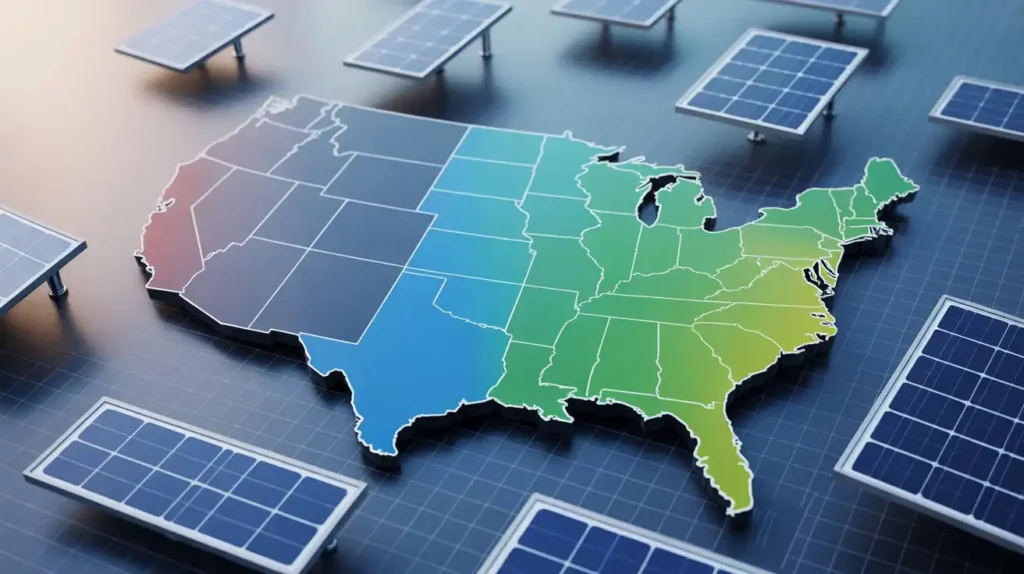
What Does Solar Electricity Cost?
Once a system is paid off, the electricity it generates is effectively free aside from minor maintenance, but during the payback period, the “cost” of solar electricity is best understood as the installed system price divided by its expected lifetime kWh output. This levelized figure is usually well below the price of grid electricity over the long run, though the upfront cost is real and immediate.
How Electricity Rates Affect Solar Economics
The higher your utility’s rate per kWh, the more each unit of solar-generated electricity is worth to you, which is why homeowners in high-rate states tend to see faster payback than homeowners with the same system in a low-rate state, even with identical sun exposure.
Solar Cost Per kWh
A rough levelized cost can be estimated as: total system cost ÷ estimated lifetime kWh production. This is a planning estimate, not a guaranteed outcome, since production depends on weather, panel degradation, and maintenance.
Solar Energy Cost Over Time
The upfront system cost is fixed at installation, but the electricity-generation economics compound over the 25+ year life of the system, meaning the real financial picture only becomes clear when you look years, not months, past install day.
Solar Prices and Electricity Savings
How Solar Can Reduce Grid Electricity Purchases
A correctly sized system offsets some or all of a home’s grid electricity purchases by generating power on-site during daylight hours, reducing the kWh a household buys from its utility.
What Determines Potential Solar Savings?
- Household electricity usage
- The utility’s electricity rate
- System production (sun exposure, orientation, shading)
- How much power is self-consumed vs. exported
- The utility’s compensation rate for exported electricity
Example of a Solar Savings Calculation
This is a hypothetical illustration only, not a promised outcome: A home using 1,000 kWh/month at a rate of $0.16/kWh spends roughly $160/month on electricity. An 8 kW system producing enough to offset 80% of that usage could reduce the grid bill to roughly $32–$40/month, before accounting for any fixed utility connection fees that typically remain regardless of solar production. Actual results depend entirely on local rates, production, and utility billing structure.
Solar Panel Payback Period
What Is the Solar Payback Period?
The payback period is the time it takes for electricity bill savings to equal the net cost of the system, commonly 6 to 12 years for U.S. homeowners, though this window has lengthened somewhat for many households now that the federal tax credit has ended.
Basic Payback Formula
Net solar cost ÷ estimated annual savings = simple payback period
Factors That Change Payback
- Local electricity rates
- Total system cost
- Actual solar production
- Financing terms (cash vs. loan)
- Remaining state/utility incentives
- Net metering export compensation
- Whether a battery was added
Solar Panels Prices With and Without Financing
Paying Cash for Solar
Paying cash avoids interest entirely, so the total amount paid equals the system price; this typically produces the shortest payback period, but requires the full amount upfront.
Financing a Solar System
Solar loans let homeowners spread the cost over 10–25 years, but interest changes the total amount paid over the life of the loan, sometimes substantially.
Why Financing Changes Total Solar Cost
Monthly payment is not the same as total project cost. A financing agreement can raise the ultimate amount paid well above the cash price because of:
- Interest rate
- Loan term length
- Origination or dealer fees
- Other financing-specific terms
This is where the numbers shift the most on paper; a system with a low monthly payment can still cost significantly more over 20 years than the same system paid in cash.
Solar Battery Cost
How Batteries Affect Total Solar System Cost
Home battery storage typically adds $10,000–$20,000 to a project, depending on battery capacity and brand, a substantial increase over a solar-only system.
Solar-Plus-Storage vs. Solar-Only
Batteries provide backup power and can increase self-consumption of solar electricity, but they add high upfront cost and, depending on local net metering rules, may or may not meaningfully shorten payback.
Battery Cost and Payback
A battery does not automatically save money; its financial value depends heavily on local electricity rates, outage frequency in your area, and how favorable (or unfavorable) your utility’s export compensation is. In states with strong net metering, a battery is often more of a resilience purchase than a financial one.
Solar Incentives and Rebates (2026 Update)
This section needs a direct, current correction that most competing content still gets wrong: the 30% federal residential solar tax credit (Section 25D) expired on December 31, 2025, under the One Big Beautiful Bill Act. Homeowners installing systems in 2026 can no longer claim it. This is one of the most significant recent changes in U.S. solar economics, and it materially shifts the payback math discussed earlier in this guide.
What’s Still Available in 2026
- State-level incentives: some states maintain rebates, performance-based incentives, or tax exemptions independent of the federal credit; verify current status through DSIRE
- Property tax exemptions: many states still exempt the added home value from solar from property tax reassessment
- Sales tax exemptions: offered in some states on solar equipment purchases
- Utility rebates: some utilities offer their own incentive programs, separate from state or federal policy
- Third-party ownership (leases/PPAs): the commercial 48E credit can still apply when a third party owns the system, which is why leases and power purchase agreements remain a federal-incentive pathway even though direct homeowner ownership no longer qualifies
Why Incentive Rules Can Change
State and utility programs are set by legislation and utility commission rulings that can change with budget cycles or policy shifts; a program that exists today isn’t guaranteed to exist next year, which is exactly why checking current status before committing to a system matters more now than it did when the federal credit provided a stable baseline.
Decision checkpoint: If your solar quote still assumes a 30% federal tax credit reducing your net price, that quote is using outdated math for a 2026 installation. Ask your installer to show the price with and without a federal credit so you can see the real number.
Net Metering and Panels Cost
What Is Net Metering?
Net metering is a billing arrangement where a utility credits a solar homeowner for excess electricity sent back to the grid, typically applied against electricity drawn from the grid at other times (like at night).
How Net Metering Can Affect Solar Economics
The compensation rate for exported electricity directly affects payback; full retail-rate net metering makes solar math significantly more favorable than programs that pay a reduced wholesale-like rate for exports.
Why Utility Policies Matter
Two homes with identical systems in different utility territories can see meaningfully different savings purely because of how each utility structures its net metering or export compensation program.
Net Metering Is Different Across States
Some states mandate favorable net metering statewide; others leave it up to individual utility commissions or have moved to reduced-rate export programs. This is a detail worth confirming directly with your utility before finalizing a quote, since it changes the payback estimate more than almost any other single variable.
Are Solar Panels Worth the Cost?
There’s no universal yes or no answer; it depends on a specific combination of factors for your home and utility.
Situations That Can Improve Solar Economics
- High local electricity rates
- Good roof exposure with minimal shading
- Long expected ownership period in the home
- Favorable utility export compensation
- A reasonably priced installation quote (verified against the per-watt benchmarks above)
Situations That Can Change the Calculation
- An expensive or complex installation (old roof, panel upgrade needed)
- A significantly shaded roof
- Plans to move within a few years
- Low household electricity consumption
- Unfavorable or reduced net metering compensation
- Major roof work required before installation
Decision checkpoint: If your average monthly electricity bill is under roughly $80–$100, the math for a full system often doesn’t pencil out within a reasonable timeframe; a smaller system or waiting may be the more financially sound choice.
Solar Panel Lifespan and Long-Term Cost
How Long Do Solar Panels Last?
Most manufacturers warranty panels for 25 years, and many continue producing meaningful power well beyond that, though output gradually declines over time.
Solar Panel Degradation
Panels typically lose about 0.3–0.5% of output per year, meaning a panel producing 100% of rated output in year one might produce roughly 85–90% after 25 years, a gradual, predictable decline rather than a sudden drop.
Long-Term Maintenance
Routine maintenance is minimal: periodic cleaning and occasional inspection, but inverters typically need replacement once during a system’s lifetime, which is a cost worth budgeting for separately from the initial install.
How Lifespan Affects Overall Solar Cost
A 25+ year usable life means the true cost-per-kWh of solar electricity keeps dropping the longer a system operates past its payback point, which is the core of the long-term financial case for solar, separate from any short-term incentive.
Solar Panel Maintenance and Repair Cost
Routine Solar Maintenance
Occasional panel cleaning and visual inspection are typically sufficient; most systems need little active maintenance in a normal year.
Common Solar System Problems
Inverter failure, wiring issues, and physical damage from storms or debris are the most common sources of repair costs over a system’s lifetime.
Potential Repair Expenses
Inverter replacement is generally the largest single maintenance cost a homeowner is likely to face, typically arriving somewhere in the middle of the system’s lifespan rather than early on.
How to Compare Solar Quotes
Comparing quotes accurately means checking the same line items across every bid:
| Item | What to Check |
| System capacity | kW |
| Total price | Full installed price |
| Cost per watt | Comparable metric across quotes |
| Panel wattage | Watts per panel |
| Inverter | Type and capacity |
| Battery | Included or separate |
| Installation | Included? |
| Electrical work | Included? |
| Permits | Included? |
| Financing | APR/term/fees |
| Warranty | Equipment and workmanship |
| Estimated production | Annual kWh |
A quote that looks cheaper on total price alone can be more expensive per watt, use a lower-tier inverter, or exclude permitting — details that only show up when you compare line by line.
Solar Cost Calculator (Manual Method)
You don’t need special software to run a rough estimate; the underlying math is simple:
Inputs needed:
- Annual electricity usage (kWh, from your utility bill)
- Electricity price per kWh
- Desired solar offset (%)
- Estimated cost per watt in your area
- Battery cost, if applicable
- Applicable state/utility incentives
Basic calculations:
- System cost = system watts × cost per watt
- Annual electricity cost = annual kWh × electricity rate
- Simple payback = net system cost ÷ estimated annual savings
These are planning estimates, not guaranteed financial outcomes; actual production, rates, and costs will vary from any calculator’s assumptions.
Examples
The following are clearly hypothetical illustrations to show how the math scales, not real project data or promised results.
Example 1: Small Home: Lower electricity consumption, a 3–4 kW system, lowest upfront cost of the group, fastest to install.
Example 2: Average Home: Moderate electricity consumption, a 6–7 kW system, the most common configuration installed nationally.
Example 3: Large Home: Higher electricity consumption (often due to AC load, pool equipment, or an EV), an 8–10 kW system, and a proportionally higher upfront cost.
Example 4: Solar + Battery: Same system size as Example 2, with a battery added; total project cost increases substantially, and the payback period typically lengthens unless local net metering compensation is weak enough that self-consumption via battery becomes the more economical path.
Where This Leaves You
Solar panel cost isn’t a single number. A panel price, a system price, a cost-per-watt figure, and a cost-per-kWh figure all answer different questions, and mixing them up is where most homeowners misjudge their budget before they ever get a quote.
The bigger shift for 2026 is the end of the federal 30% tax credit. It used to smooth over a lot of state-by-state variation in solar economics.
Now that it’s gone, the details that actually determine your outcome are more local than ever: your utility’s rate, its net metering terms, your roof’s exposure, and the real installed cost per watt you’re quoted.
None of that makes solar automatically a good or bad decision. It just means the decision rests more heavily on your specific numbers than it did a year ago.
If your electricity bill runs high, your roof gets good sun, and you plan to stay long enough to reach payback, the math still works for a lot of households.
If your usage is low, your roof is shaded, or your state’s export compensation is weak, a smaller system, or waiting, may be the more honest next step.
Either way, the protection is the same: get the per-watt cost, check current state and utility incentives directly rather than assuming last year’s numbers still apply, and run the payback math on your own bills before signing anything.
Frequently Asked Questions
How much do solar panels cost?
Most U.S. homeowners pay $15,000–$28,000 for a full system before incentives, or $2.50–$3.50 per watt installed.
How much are solar panels for a house?
A typical home system costs $20,000–$26,000 before incentives, varying by system size and location.
What is the average cost of solar panels?
The national average is roughly $2.50–$3.50 per watt installed.
How much does a solar system cost?
Most residential systems fall between $15,000 and $35,000 depending on size and equipment.
How much does solar cost per watt?
Typically $2.50–$3.50 per watt installed, before incentives.
How much does solar cost per kWh?
Levelized cost over a system’s life is usually well below grid electricity rates, though this depends on upfront cost and actual production.
How much do solar panels cost for a 1,500-square-foot house?
Often in the $15,000–$20,000 range for a 4–6 kW system, though actual sizing should be based on electricity usage, not square footage.
How much do solar panels cost for a 2,000-square-foot house?
Commonly $18,000–$24,000 for a 6–8 kW system, again dependent on actual consumption.
How much does it cost to install solar panels?
Installation (labor, permitting, equipment) is bundled into the total per-watt price of $2.50–$3.50/watt.
Is solar cheaper than electricity from the grid?
Over the system’s full lifespan, yes for most households, but the upfront cost means the near-term picture depends on financing and payback timeline.
Are solar panels worth the cost?
It depends on your electricity rate, roof exposure, ownership timeline, and local net metering rules; see the decision framework above.
Does solar cost the same in every state?
No, labor costs, permitting, and incentive programs all vary meaningfully by state and even by utility.
Does a battery increase solar system cost?
Yes, typically by $10,000–$20,000, and its financial payback depends heavily on local rates and net metering rules.
This article by SolarInfoPath (2026 research framework) is part of a comprehensive solar knowledge architecture covering all major high-value sectors including legal disputes (installation negligence, contracts, liability, fraud, lawsuits, liens, HOA and permitting disputes), financial structures (loans, PPA/lease agreements, DSCR financing, tax equity, investment and project finance), tax law (ITC, Section 48/25D, MACRS depreciation, bonus credits, IRS audits, recapture rules, domestic content and IRA/OBBBA compliance), insurance and risk (property damage, hail/wind/fire claims, bad faith insurance disputes, warranty coverage), policy and regulation (net metering, FERC interconnection, state utility rules, incentive programs and regulatory changes), commercial and utility-scale development (EPC contracts, construction delays, performance bonds, receivership, bankruptcy, asset sale and restructuring), real estate impacts (home value, solar leases, liens, title issues, HOA restrictions, easements), and emerging market structures such as battery storage, community solar, agrivoltaics, SRECs, yieldcos, and institutional investment funds. All content is based on publicly available regulatory, financial, and legal sources and is intended strictly for educational and informational purposes, not legal, tax, or financial advice. Readers should always verify current laws, utility policies, tax regulations, and contract terms with qualified licensed professionals before making decisions, as solar regulations, incentives, and financial structures frequently change across jurisdictions and time.

Solar Legal Analyst· Policy Researcher· Investigative Finance Writer Lead Analyst & Founder of SolarInfoPath
Morgan Lee is a solar legal analyst, policy researcher, and investigative finance writer with 12+ years of experience in U.S. renewable energy law, IRS tax credit compliance, and solar litigation. He is the founder of SolarInfoPath, a research-driven platform focused on primary-source analysis of solar contracts, tax law, regulatory policy, and industry disputes affecting homeowners and commercial developers.
His work is grounded in original legal and regulatory sources, including IRS notices, FERC and CPUC rulings, state court filings, PACER records, and UCC lien databases. He specializes in solar contract disputes, injury and workers’ compensation claims, PACE financing issues, tax equity structures, ITC recapture rules, MACRS depreciation, and federal and state solar policy frameworks.
Morgan’s analysis spans solar litigation, finance structures, and regulatory developments such as the IRA and OBBBA, interconnection reform, domestic content rules, and battery storage incentives. He also covers EPC contracts, PPAs, project financing, and utility-scale solar investment structures.