
According to an investigative review of 2026 residential solar contracts and AHJ records, solar panel permit requirements are legally mandatory in virtually every U.S. jurisdiction before installation begins. A standard residential project requires, at a minimum, a building permit, an electrical permit, and a utility interconnection agreement. The full process typically takes 2 to 8 weeks, depending on your local Authority Having Jurisdiction (AHJ). Skipping any step risks forced removal, fines, and loss of net metering eligibility.
Most homeowners discover this only after a sales rep has already walked through their attic and quoted a $28,000 system. The permit process is treated as a background detail, something the installer “handles.”
But what installers don’t always tell you is that permit delays, rejected applications, and interconnection backlogs are among the top reasons solar projects run 6 to 12 weeks beyond their promised completion dates.
Understanding solar panel permit requirements before you sign anything gives you real leverage. You’ll know what to ask, what to verify, and when a project is falling behind for reasons that have nothing to do with your roof.
What Is a Solar Panel Permit?
A solar panel permit is a legally required authorization issued by your local Authority Having Jurisdiction (AHJ), typically a city building department or county planning office, confirming that your photovoltaic (PV) system meets all applicable building, electrical, fire, and zoning codes before installation begins.
Why Solar Permits Are Legally Required
Solar permits exist because a rooftop PV system is a permanent structural and electrical modification to your home. Your local building authority is not being bureaucratic for its own sake, the codes they enforce protect you, your neighbors, emergency responders, and the electrical grid itself.
Under the National Electrical Code (NEC) Article 690, all grid-tied solar installations must meet strict wiring, inverter, and rapid shutdown standards. Your building permit simultaneously triggers a structural review ensuring your roof framing can support the additional load of a typical residential solar array, which runs between 800 and 1,200 pounds for a 7–10 kW system.
Here’s what most homeowners don’t realize: your homeowner’s insurance policy may not cover a solar system installed without a permit. If a fire starts at an unpermitted inverter, your carrier has grounds to deny the claim entirely.
Who Issues Solar Permits?
The AHJ, your local city or county building department, is the primary permit authority for both the building permit and the electrical permit. The utility company independently issues the interconnection agreement and, after final inspection, the Permission to Operate (PTO). These are two separate approval tracks running in parallel, and a delay in either one stalls your activation.
In some municipalities, a single combined PV permit covers both structural and electrical review. In others, you need two separate applications submitted to two separate offices. That distinction alone can change your timeline by two to three weeks.
Types of Solar Permits You’ll Need
Building Permit for Solar Panels
A building permit is required whenever a solar installation makes structural changes to your property, which a rooftop mount always does. The permit verifies that your roof can support the racking system and panel weight without compromising structural integrity.
Your installer must submit a site plan showing panel placement, roof framing details, and a structural load calculation, typically stamped by a licensed professional engineer (PE) for systems above a certain size threshold, which varies by jurisdiction.
Electrical Permit for Solar Installations
The electrical permit covers all wiring, conduit runs, inverter placement, disconnect switches, and grid-tied connection points. Inspectors verify compliance with NEC Article 690, which governs photovoltaic systems specifically.
This is the permit that catches the most problems. Undersized conduit, improper rapid shutdown device placement, or a missing AC disconnect will fail inspection, and every failed inspection adds one to three weeks to your timeline.
Interconnection Agreement with Your Utility
The interconnection agreement is separate from local permits and is issued directly by your utility company. It authorizes your system to connect to the grid, establishes your net metering billing profile, and specifies the maximum system size your service panel can accommodate.
Processing times vary considerably by utility. Some investor-owned utilities complete the interconnection review in 10 business days.
Others, particularly in states with high solar adoption and aging grid infrastructure, are running 60 to 90 days for residential applications in 2026. This is one of the most commonly underestimated delays in any solar project.
If you want to understand how net metering credits actually flow once your system is approved, the net metering and billing structure for solar homeowners is worth reviewing before you reach the interconnection stage.
Zoning Permit: When Do You Need One?
Most residential rooftop systems in established neighborhoods don’t require a separate zoning permit, the building permit covers land use compliance. Zoning permits become necessary in specific situations: ground-mounted systems on large parcels, installations in agricultural zones, commercial solar arrays, or projects near protected wetlands or historic district boundaries.
Ground-mount projects almost always require a land survey, a foundation design, and a separate land-use or zoning approval before any other permit can be filed.
Dedicated PV Permit (Combined Permit Option)
Several states, including California, New Jersey, and parts of Texas, have adopted a single combined PV permit that covers both building and electrical review in one application. This streamlines the process significantly.
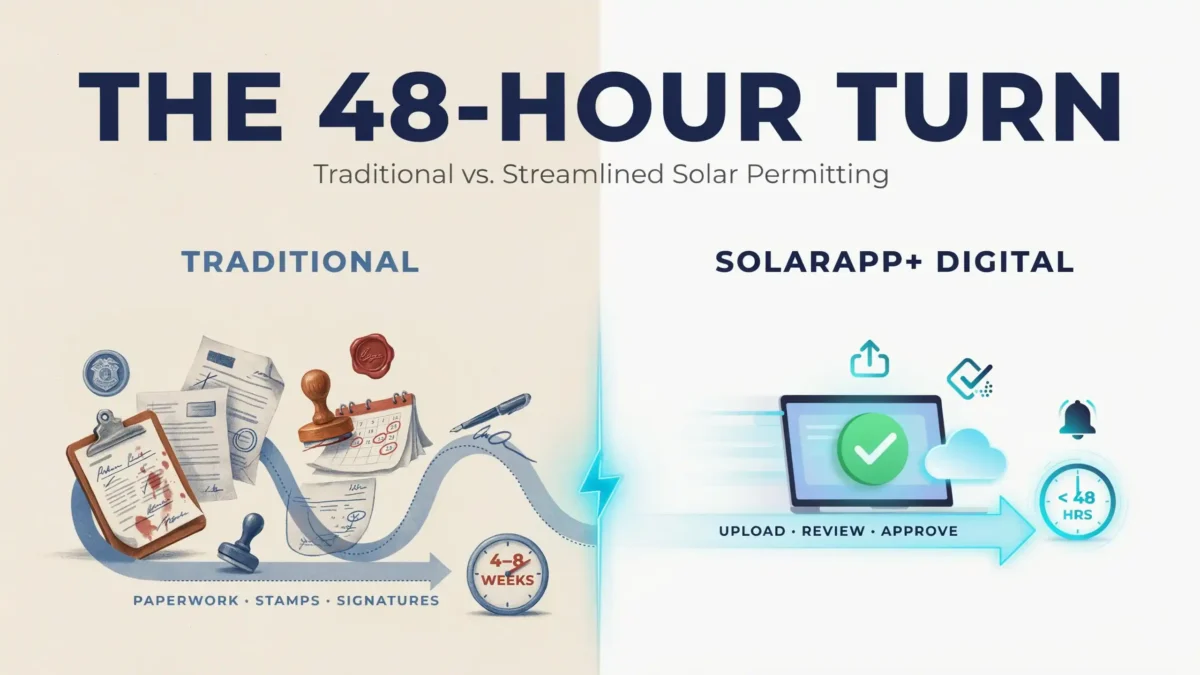
California’s SolarAPP+ program, for example, allows qualifying residential systems to receive instant automated permit approval, reducing a two-week review to under 24 hours for systems that meet predefined design parameters.
Whether your jurisdiction offers a combined permit is one of the first questions worth asking your installer, because it directly affects your activation date.
Solar Panel Permit Requirements: What Documents You Need
Site Plan and Roof Layout
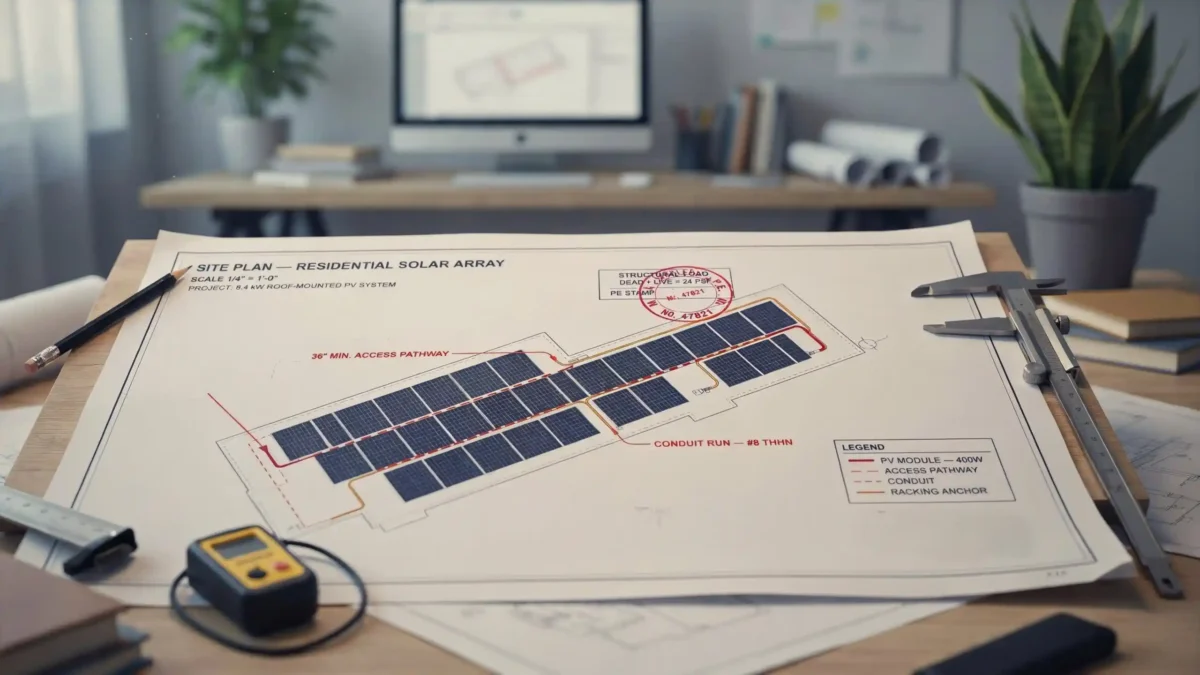
Every solar permit application begins with a site plan, a scaled drawing of your property showing the home footprint, panel placement on the roof, setbacks from roof edges, and the location of all system components, including the inverter and AC disconnect.
The fire pathway and setback requirements embedded in your site plan are non-negotiable. Most jurisdictions follow the International Fire Code, which requires a minimum 36-inch clear access pathway along ridge lines and at least one side of the roof.
Failing to show compliant fire setbacks is the single most common reason residential permit applications are rejected on first submission.
Electrical One-Line and Three-Line Diagrams
A single-line diagram (SLD) is a schematic representation of your system’s electrical flow, from panels through the inverter, combiner box, AC disconnect, and into your main service panel. Most AHJs require at a minimum a one-line diagram; some require a three-line diagram for systems above 10 kW or for commercial projects.
These diagrams must match your equipment spec sheets exactly. If your inverter model changes between design and installation, even to an equivalent model, a revised diagram must be submitted and approved before installation resumes.
Structural Load Calculations
Your installer’s engineer must calculate the dead load (panel and racking weight) and wind uplift loads specific to your roof pitch, framing type, and your local wind zone. These calculations verify that your existing rafters and sheathing can support the array without modification, or identify where reinforcement is needed.
For a standard 8 kW residential system using 400W panels, the additional dead load is typically 3 to 5 pounds per square foot, well within the capacity of most modern residential framing, but below the threshold that often surprises inspectors on older homes built before 1980.
Equipment Specification Sheets
Every major component, panels, inverter, racking hardware, rapid shutdown device, must be accompanied by the manufacturer’s specification sheet confirming UL listing or equivalent certification. Generic or unlisted equipment will result in immediate rejection.
Rapid Shutdown and Labeling Plan
Since the 2017 NEC update and continued enforcement under the 2023 code cycle, rapid shutdown compliance is mandatory for all new grid-tied rooftop systems. Your plan must show the location of the rapid shutdown initiator, all module-level power electronics (MLPEs) if used, and the required roof-level and service panel labeling.
This requirement catches many DIY-adjacent installations off guard. The labeling plan must be submitted with the permit and verified during the post-installation inspection.
Battery Storage Integration Documents (If Applicable)
Adding a battery storage system, such as the Tesla Powerwall or Enphase IQ Battery, introduces a separate set of permit requirements in most jurisdictions. You’ll need a battery-specific equipment spec sheet, updated single-line diagrams showing the battery management system, and in many AHJs, a separate electrical permit or a permit amendment for the storage component.
Some utilities also require an updated interconnection agreement when storage is added, because the battery changes the system’s export behavior. If you’re comparing whether a solar farm or residential system makes more sense for your energy goals, battery integration planning is a key variable in that analysis.
Contractor License and Insurance Proof
Most AHJs require that the permit applicant be a licensed electrical or general contractor. In most states, a homeowner cannot pull an electrical permit for a grid-tied solar installation, even if they are doing the physical work. The contractor’s state license number, general liability insurance certificate, and workers’ compensation documentation must be included in the application package.
Additional Documents Some AHJs Require
Some jurisdictions add requirements that aren’t listed in the standard solar permit application guide:
- HOA approval letter: required before permit review in some counties
- Utility pre-application confirmation number: required by certain utilities before the building permit is issued
- Geotechnical report: for ground-mount systems on expansive clay soils
- Shading analysis: occasionally required for systems near protected trees
How Much Do Solar Panel Permits Cost?
Residential Solar Permit Fees
Residential solar permit fees typically range from $150 to $500 for a standard rooftop installation, though the actual cost depends heavily on how your jurisdiction calculates fees. Most use one of three methods: a flat rate per system, a valuation-based fee tied to system cost, or a per-watt fee.
Valuation-based fees can create unexpected costs. If your AHJ calculates the fee as 1% to 2% of the declared system value, and you’re declaring a $30,000 system, your permit fee alone could reach $300 to $600, separate from the inspection fee.
Commercial Solar Permit Fees
Commercial solar permit fees are substantially higher, often ranging from $1,000 to $10,000 or more depending on system size, jurisdiction, and whether third-party engineering review is required. Large ground-mount commercial projects in complex zoning districts can see permit costs that represent 3% to 5% of total project soft costs.
States With Capped Solar Permit Costs
Several states have passed legislation capping residential solar permit fees to reduce soft cost barriers:
- California caps residential solar permit fees at $500 under AB 2188 (effective January 2024)
- New York limits fees through the NY-Sun program guidelines for participating contractors
- Oregon and Virginia have enacted streamlined permitting rules that implicitly constrain fee levels
- Arizona municipalities are not allowed to charge fees that make solar economically impractical under state solar rights law
If your state isn’t on this list, your local AHJ can charge essentially whatever the market bears.
Inspection Fees: What to Budget
Most jurisdictions charge a separate inspection fee of $75 to $250, paid when you schedule the post-installation inspection. Some roll this into the permit fee; others bill it separately at time of inspection. Budget $200 to $400 total for permit and inspection combined on a standard residential project.
How Long Does Solar Permitting Take?
Typical Residential Permit Timelines
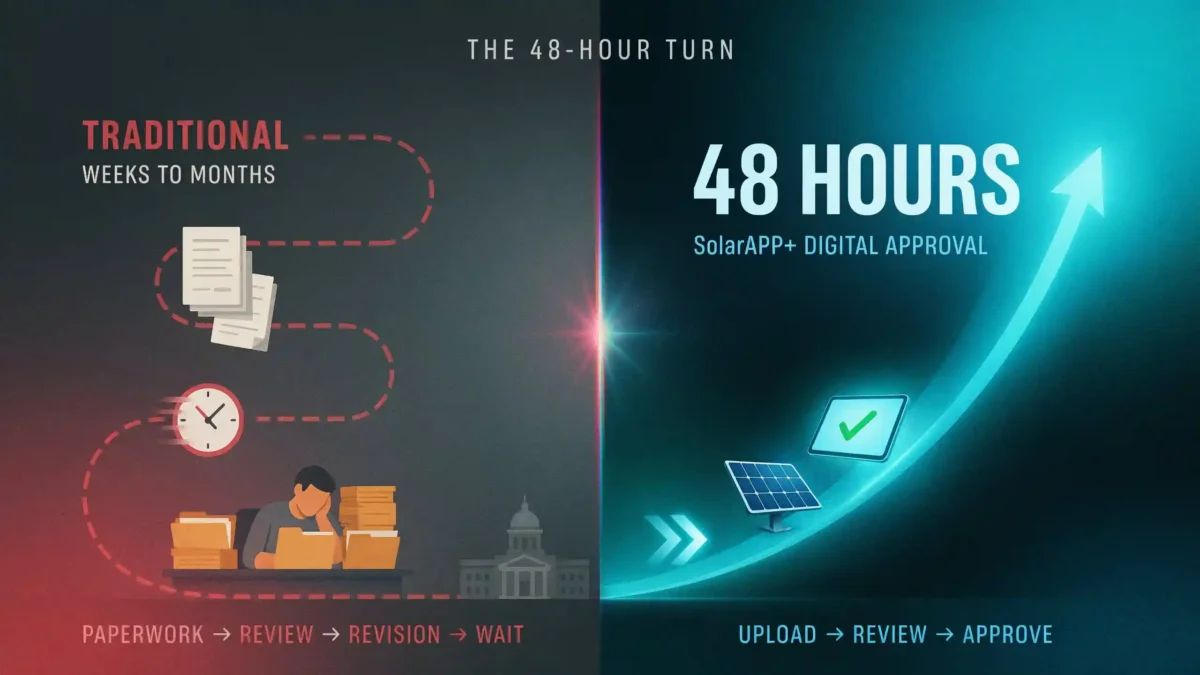
For a standard residential rooftop solar installation, permit approval typically takes 1 to 4 weeks from the date of a complete application submission. Jurisdictions using SolarAPP+ or similar automated review platforms can reduce this to 24 to 72 hours for qualifying systems. Jurisdictions with high permit volume and limited staff, common in fast-growing suburban counties, regularly run 3 to 6 weeks.
The interconnection agreement review at your utility runs in parallel but often takes longer. In 2026, several major utilities in the Southeast and Mid-Atlantic have published average interconnection review times of 45 to 75 business days for residential applications. That delay, not the permit itself, is often what’s holding your project.
Commercial and Large-Scale Project Timelines
Commercial solar permit timelines are measured in months, not weeks. A 500 kW ground-mount commercial system may require environmental review, a conditional use permit, and separate utility interconnection studies, a process that commonly takes 6 to 18 months from initial application to PTO. Understanding the full scope of utility-scale solar project requirements is essential before committing to a commercial solar investment.
What Speeds Up the Process?
Three factors consistently shorten permitting timelines:
- Complete, accurate applications on first submission, resubmissions add 2 to 4 weeks per cycle in most jurisdictions
- SolarAPP+ enrollment, jurisdictions using this automated platform process qualifying applications in under 24 hours
- Pre-application utility coordination, some utilities allow contractors to initiate the interconnection application before the building permit is filed, running both tracks simultaneously
Step-by-Step Solar Permitting Process
Step 1 – Design Your Solar System
Before any permit can be filed, your system must be fully designed: panel count, layout, inverter model, racking system, and electrical configuration. The design drives every document in the permit package. Changes after submission, even swapping to an equivalent inverter, require a design revision and potentially a permit amendment.
This is the stage where most homeowners are least involved and most vulnerable. Ask to see the design documents before your installer submits anything. Verify that the fire pathways are clearly shown, that the inverter is UL-listed, and that the system size matches what you were quoted.
Step 2 – Research Local Permit Requirements
Your installer should research your AHJ’s specific requirements before designing your system, not after. Different jurisdictions have genuinely different standards. Some require PE-stamped structural calculations for all residential systems; others require them only above 10 kW. Some require a separate fire department review; others do not.
If your installer seems uncertain about local requirements or is using a generic template, that’s worth a direct conversation. An experienced local installer will have already pulled permits with your AHJ and know exactly what reviewers look for.
Step 3 – Prepare and Submit Your Permit Application
The permit package, including the site plan, single-line diagram, structural calculations, spec sheets, rapid shutdown plan, and contractor licensing documents, is submitted to your AHJ either online or in person depending on your jurisdiction. Some AHJs now accept digital submissions through their building permit portal; others still require physical plan sets.
Plan review timelines begin from the date the application is accepted as complete, not the date it’s submitted. If a document is missing, the application is typically returned with a deficiency notice, and the clock restarts from zero.
Step 4 – Wait for AHJ and Utility Review
During the review period, your AHJ’s plan reviewer checks your documents against local code. Your utility independently reviews your interconnection application against grid capacity and technical standards. These reviews happen simultaneously but on separate tracks.
Here’s where the numbers shift: many homeowners are told their permit is approved and assume their project can move forward, but if the utility hasn’t issued interconnection approval yet, the system legally cannot be activated. Both approvals must be in hand before installation makes sense. Discuss this scenario with your installer before signing.
Step 5 – Schedule and Pass Post-Installation Inspection
After installation is complete, you must schedule a post-installation inspection with your AHJ. The inspector will physically verify that the installed system matches the approved permit documents, panel placement, rapid shutdown device location, labeling, wiring, and disconnect accessibility.
Common inspection failures include: missing or incorrectly worded labeling, rapid shutdown equipment installed but not wired to the initiator, and conduit runs that don’t match the approved diagram. A failed inspection requires a correction notice, repairs, and a reinspection appointment, which in busy jurisdictions adds another week or more.
Understanding what inspectors check for is also relevant to whether solar panels can cause damage to your roof — penetration points are specifically reviewed during the structural phase of inspection.
Step 6 – Receive Permission to Operate (PTO)
Permission to Operate (PTO) is the final authorization from your utility company confirming that your system has been inspected, approved, and cleared to export power to the grid. Your system must not be operated in grid-tied mode before PTO is issued, doing so can result in your interconnection agreement being voided.
After your AHJ inspection is signed off, your installer typically sends the inspection certificate to the utility, which then conducts its own verification and issues PTO. This final step adds anywhere from 3 business days to 4 weeks depending on the utility. Duke Energy and Pacific Gas & Electric, for example, have published 2026 PTO processing windows of 15 to 30 business days for residential customers.
Solar Permit Requirements by Installation Type
Rooftop Solar Permit Requirements
Rooftop systems represent the large majority of residential solar installations and carry the most standardized permit path. You’ll need a building permit, an electrical permit (or combined PV permit where available), and a utility interconnection agreement. Fire setbacks, rapid shutdown compliance, and structural load documentation are required in virtually every jurisdiction.
One detail inspectors consistently flag on rooftop systems: the weight distribution of the racking. Panels are not uniformly distributed, they’re mounted in rows at specific spacings. Your structural calculation must address point loads at each lag bolt anchor, not just average square footage loading.
Ground-Mounted Solar Permit Requirements
Projections vs. Reality: Ground-Mount Permitting
| Factor | Standard Installer Estimate | SolarInfoPath Investigative Data |
| Permit timeline | 4–6 weeks | 8–16 weeks (zoning + building + utility) |
| Documents required | Building + electrical permit | Also: land survey, foundation calcs, land-use/zoning approval, sometimes environmental review |
| PE stamp required | “Sometimes” | Required in 78%+ of jurisdictions for ground-mount foundations |
| Fee range | $200–$400 | $500–$2,500+ depending on acreage and jurisdiction |
| Interconnection complexity | Same as rooftop | Often more complex, ground-mount systems may require different service upgrade analysis |
Ground-mount systems require a site survey showing exact panel array location relative to property lines, setbacks from adjacent structures, and any easements. Foundation design, whether concrete piers or driven posts, must be engineered for soil conditions at your specific site.
Off-Grid Solar: Do You Still Need a Permit?
Yes, in most jurisdictions, an off-grid solar system still requires at minimum a building permit for the structural work and an electrical permit for the wiring and battery system. The only permit you avoid is the utility interconnection agreement, because you’re not connecting to the grid.
Some rural counties have minimal permit requirements for small off-grid systems, but assuming you don’t need a permit based on “off-grid” status is a mistake that has caused serious problems for homeowners who later tried to sell their properties.
An unpermitted electrical system, grid-tied or off-grid, becomes a material disclosure issue in a real estate transaction. The connection between how solar affects your home’s resale value and whether the system is properly permitted is more direct than most homeowners expect.
Battery Storage and Solar Carport Permit Needs
Battery storage systems, whether added at time of solar installation or retrofitted afterward, require their own permit amendments in most jurisdictions. Many AHJs classify battery systems above a certain capacity as “energy storage systems” under a separate code section, triggering additional fire safety and ventilation requirements.
Solar carports present a hybrid permitting challenge: they’re treated as a structure (triggering zoning and building permits), as a solar installation (triggering electrical and interconnection requirements), and sometimes as a vehicle canopy (triggering additional clearance and drainage requirements). Budget additional time and cost for any carport project.
Special Permit Situations and Challenges
HOA Restrictions and Solar Access Laws
Homeowners Associations (HOAs) do not have unlimited authority over solar installations. As of 2026, 44 states have enacted solar access laws that restrict an HOA’s ability to prohibit or substantially impair solar installations on residential properties.
However, “cannot prohibit” is not the same as “no restrictions apply.” Many state solar access laws allow HOAs to impose reasonable aesthetic requirements: panel color, placement on less visible roof faces, minimum clearances from roof edges.
An HOA requirement that your installer deems “unreasonable” must often be challenged through state administrative or judicial processes, a process that can take months.
Your installer should be aware of your state’s specific solar access law and whether your HOA’s requirements fall within its permitted restrictions. If they seem uncertain, consulting with a solar panel attorney familiar with consumer protection law before signing anything is a reasonable precaution.
Historical Buildings and Solar Installation
Installing solar on a structure in a historic district is one of the most complex solar permitting scenarios a homeowner can face. Historic preservation commissions have authority to impose design restrictions beyond those of a standard AHJ, and their review timelines are typically longer and less predictable.
Most historic commissions will not approve solar panels visible from a public right-of-way. Rear roof placement, low-profile flush-mount systems, or ground-mount installations on secondary structures may be acceptable alternatives, but each option requires its own documentation and approval pathway.
What struck me when I looked at the 2025 data from the National Trust for Historic Preservation was how many solar denial cases in historic districts were driven not by policy opposition but by incomplete applications that didn’t propose alternatives.
An applicant who proactively offers a rear-placement diagram and documentation of minimal visual impact has a materially better outcome than one who submits a standard plan and hopes for the best.
Commercial Solar Farm Zoning Requirements
Commercial solar farms, typically defined as utility-scale or community solar projects above 1 MW, face an entirely different permitting framework. Zoning permits, conditional use permits, environmental impact assessments, and public comment periods are standard.
State Public Utilities Commission (PUC) approval may be required. The interconnection process involves FERC-regulated queuing procedures that can extend 18 to 36 months for large projects.
What Happens If Your Solar Permit Is Denied?
A permit denial is not final. Most AHJs issue a correction notice identifying specific deficiencies rather than an outright denial. You have the right to resubmit a corrected application, and in most jurisdictions, you also have the right to appeal a denial to a building board of appeals or zoning board of adjustment.
The resubmission cycle, correction notice, redesign, resubmission, re-review, typically adds 3 to 6 weeks per cycle. If your application has been denied twice for the same deficiency, the problem is usually in how the design addresses the underlying code concern, not just the documentation. A different engineer’s perspective sometimes breaks the cycle.
Common Reasons Solar Permits Are Delayed or Rejected
Incomplete or Inaccurate Applications
The most common cause of permit delay is a missing document or a discrepancy between submitted documents. If your site plan shows panels in one location and your structural calculations reference a different roof section, your application will be returned for correction.
This happens more often than the industry acknowledges. In markets where a single installer submits dozens of applications per month, quality control can slip. The permit technician at your AHJ has no obligation to call your installer to flag a missing document, they can simply return the application and restart the clock.
Missing PE Stamps or Engineering Calculations
In jurisdictions requiring a licensed Professional Engineer’s stamp, an unsigned or unstamped calculation set is automatically rejected. Some installers use out-of-state engineers who are not licensed in your state, which is legally insufficient regardless of the engineer’s credentials.
Confirm that your installer’s engineering partner holds an active PE license in your state. This is a simple verification, most state engineering licensing boards have a public license lookup tool.
Fire Setback and Pathway Violations
Fire setbacks are the most technically precise element of a rooftop permit application, and they’re unforgiving. Your site plan must show clear pathways at the correct widths from the correct reference points. A pathway shown as 34 inches when 36 are required fails, even though the difference is a rounding issue in the drawing.
This is one area where experienced local installers consistently outperform national firms that rely on standardized drawings not calibrated to local fire authority interpretations.
Unlicensed Contractor Submissions
A permit application submitted by an unlicensed contractor is void from the start. Some jurisdictions will catch this at intake and return the application; others will let it proceed through review only for the inspector to flag the licensing issue at the inspection stage, after installation is complete.
Verifying your installer’s contractor license is straightforward: every state maintains an online license lookup for general contractors and electrical contractors. Run the license number before any work begins.
How to Avoid Resubmission Cycles
Three practices eliminate most resubmission cycles: a pre-application meeting with your AHJ to confirm their current requirements, a documented internal quality check of the permit package before submission, and a single point of contact between your installer and the plan reviewer who can address questions quickly.
Tips for a Smooth Solar Permit Approval
Work With a Licensed Local Installer
A licensed installer who regularly pulls permits with your specific AHJ knows what that jurisdiction’s plan reviewers look for, and what they reject. This institutional knowledge cannot be replicated by a national firm using a standardized permit package designed for a different state.
Ask any potential installer how many permits they’ve pulled in your city or county in the past 12 months. A meaningful number, 20 or more, suggests genuine local experience.
Start the Permitting Process Early
The permitting process should begin as soon as your system design is finalized, ideally before your installation date is scheduled. A realistic project timeline works backward from your desired activation date, accounts for the permit review window, and adds a buffer for one round of corrections.
If your installer is scheduling installation before the permit is approved, ask why. In most jurisdictions, installation cannot legally begin until the building permit is in hand. Starting early means starting the application before the calendar pressure arrives.
Double-Check All Documentation Before Submitting
A simple review checklist before submission prevents the majority of first-submission rejections. Confirm that every document is present, that component models match across all documents, that fire pathways are correctly dimensioned, and that the contractor’s license and insurance certificates are current.
If your installer doesn’t offer to walk you through the permit package before submission, ask for a copy. You are entitled to see the documents that will represent your property to the building department.
Leverage Streamlined Permitting Programs Like SolarAPP+
SolarAPP+, developed by the National Renewable Energy Laboratory (NREL) with DOE support, is a cloud-based platform that allows participating AHJs to provide automated permit approval for qualifying residential solar installations.
As of early 2026, over 300 jurisdictions nationwide have enrolled, including cities in California, Colorado, Florida, and Minnesota.
If your jurisdiction participates, a compliant system design can receive permit approval in under 24 hours. Confirm enrollment at the SolarAPP+ website before assuming your city offers it, the program is expanding but far from universal. For deeper context on federal solar energy research and policy, the U.S. Department of Energy’s solar energy resources provide up-to-date program information.
Solar Panel Permit Requirements by State (Overview)
States With Simplified Solar Permitting
California leads the country in permitting streamlining. AB 2188 mandates that all California cities and counties adopt instant permit issuance for qualifying residential solar installations using SolarAPP+ or equivalent automated review. Cities that have not complied cannot charge permit fees above $500 and must approve applications meeting state design standards without discretionary review.
New Jersey has one of the more standardized statewide solar permitting frameworks. The Office of Clean Energy works with installers and AHJs to maintain consistent documentation standards across the state.
Florida does not have a statewide cap on permit fees, but the combination of high solar adoption and competitive installer markets has pushed most Florida AHJs to develop streamlined workflows, particularly in Miami-Dade, Broward, and Hillsborough counties.
Texas has no statewide solar permitting law, which means requirements vary significantly by municipality. Houston, Austin, San Antonio, and Dallas each have different processes. In rural unincorporated areas of Texas, some counties have minimal permitting requirements for residential solar.
How Jurisdictions Differ: What to Expect Locally
The variation between jurisdictions is genuinely significant, not marginal. In one county, a residential solar permit might be a $150 flat fee, over-the-counter approval in 3 business days, and a single combination permit. In the neighboring county, the same system might require two separate permits, a third-party structural review, and a 6-week processing window.
Localized decision point: If your monthly utility bill is below $100, the financial case for solar weakens considerably in high-cost permitting jurisdictions, because the permit, inspection, and soft cost burden doesn’t scale down with system size. A 4 kW system carries nearly the same permitting cost as an 8 kW system, while producing half the energy offset.
Understanding Your Real Timeline: A Permitting Scenario
A homeowner in Raleigh, North Carolina, paying Duke Energy approximately $185 per month decided to install a 9 kW rooftop system. Her installer submitted the building permit to Wake County and the interconnection application to Duke Energy on the same day.
The county permit came back in 11 business days, faster than expected because the installer used the county’s preferred plan set format. Duke Energy’s interconnection review took 47 business days. The post-installation inspection was scheduled 8 days after installation was complete. Duke Energy issued PTO 19 days after receiving the inspection certificate.
Total time from permit submission to system activation: 11 weeks. Her installer had originally quoted a “6 to 8 week process.”
The 11-week reality wasn’t a failure, it was a normal outcome in a high-adoption utility territory. What would have made it worse: a single resubmission cycle at the county level would have added 3 to 4 weeks. What made it better: a complete first submission and proactive utility coordination.
Frequently Asked Questions About Solar Panel Permits
Do I need a permit to install solar panels?
Yes. In virtually every U.S. jurisdiction, a solar panel installation requires at minimum a building permit and an electrical permit before work begins. The only partial exceptions are some rural counties with minimal permitting requirements for small off-grid systems.
Can I apply for a solar permit myself?
Homeowners can pull their own building permits in some states, but electrical permits for grid-tied systems typically require a licensed electrical contractor as the applicant. Even where homeowner-pulled permits are technically possible, most AHJs require that a licensed installer certify the electrical work. Check your state’s electrical contractor licensing statutes before assuming self-permitting is an option.
What happens if I install solar panels without a permit?
Installing solar without a permit exposes you to several serious risks: fines from your local building authority, a stop-work order requiring system shutdown, a forced removal order if the system doesn’t pass after-the-fact inspection, denial of the federal Investment Tax Credit (ITC) for unpermitted work, and potential homeowner’s insurance claim denial in the event of fire or structural damage.
Real estate disclosure requirements also apply, an unpermitted solar system must be disclosed to buyers and may require costly remediation before closing.
How much does a solar panel permit cost?
Residential solar permit fees typically range from $150 to $500 in states without fee caps, and are capped at $500 in California. Commercial projects vary widely. Inspection fees add another $75 to $250 in most jurisdictions. Budget $200 to $750 total for permit and inspection on a standard residential installation.
How long does the solar permit process take?
From complete application to permit approval, residential permits typically take 1 to 4 weeks. Interconnection agreement review at the utility often adds 2 to 8 additional weeks. Post-installation inspection scheduling adds 1 to 2 weeks. PTO issuance from the utility adds 3 to 30 business days. A realistic timeline from permit submission to system activation is 6 to 14 weeks for most residential projects.
Do off-grid solar systems require a permit?
Yes, off-grid systems still require a building permit for structural work and an electrical permit for wiring and battery systems in most jurisdictions. No interconnection agreement is needed since the system doesn’t connect to the grid. Some rural areas have minimal requirements for small systems, but assuming no permit is needed is risky, particularly if you plan to sell the property in the future.
When can I start the permitting process?
You can, and should, start the permitting process as soon as your system design is finalized. The interconnection application to your utility can often be submitted simultaneously. The earlier both applications are in, the earlier your parallel review tracks can be completed. Waiting until you’re “ready to install” before starting permits guarantees a delay between completion of installation and Permission to Operate.
This article by SolarInfoPath (2026 research framework) is part of a comprehensive solar knowledge architecture covering all major high-value sectors including legal disputes (installation negligence, contracts, liability, fraud, lawsuits, liens, HOA and permitting disputes), financial structures (loans, PPA/lease agreements, DSCR financing, tax equity, investment and project finance), tax law (ITC, Section 48/25D, MACRS depreciation, bonus credits, IRS audits, recapture rules, domestic content and IRA/OBBBA compliance), insurance and risk (property damage, hail/wind/fire claims, bad faith insurance disputes, warranty coverage), policy and regulation (net metering, FERC interconnection, state utility rules, incentive programs and regulatory changes), commercial and utility-scale development (EPC contracts, construction delays, performance bonds, receivership, bankruptcy, asset sale and restructuring), real estate impacts (home value, solar leases, liens, title issues, HOA restrictions, easements), and emerging market structures such as battery storage, community solar, agrivoltaics, SRECs, yieldcos, and institutional investment funds. All content is based on publicly available regulatory, financial, and legal sources and is intended strictly for educational and informational purposes, not legal, tax, or financial advice. Readers should always verify current laws, utility policies, tax regulations, and contract terms with qualified licensed professionals before making decisions, as solar regulations, incentives, and financial structures frequently change across jurisdictions and time.

Solar Legal Analyst· Policy Researcher· Investigative Finance Writer Lead Analyst & Founder of SolarInfoPath
Morgan Lee is a solar legal analyst, policy researcher, and investigative finance writer with 12+ years of experience in U.S. renewable energy law, IRS tax credit compliance, and solar litigation. He is the founder of SolarInfoPath, a research-driven platform focused on primary-source analysis of solar contracts, tax law, regulatory policy, and industry disputes affecting homeowners and commercial developers.
His work is grounded in original legal and regulatory sources, including IRS notices, FERC and CPUC rulings, state court filings, PACER records, and UCC lien databases. He specializes in solar contract disputes, injury and workers’ compensation claims, PACE financing issues, tax equity structures, ITC recapture rules, MACRS depreciation, and federal and state solar policy frameworks.
Morgan’s analysis spans solar litigation, finance structures, and regulatory developments such as the IRA and OBBBA, interconnection reform, domestic content rules, and battery storage incentives. He also covers EPC contracts, PPAs, project financing, and utility-scale solar investment structures.