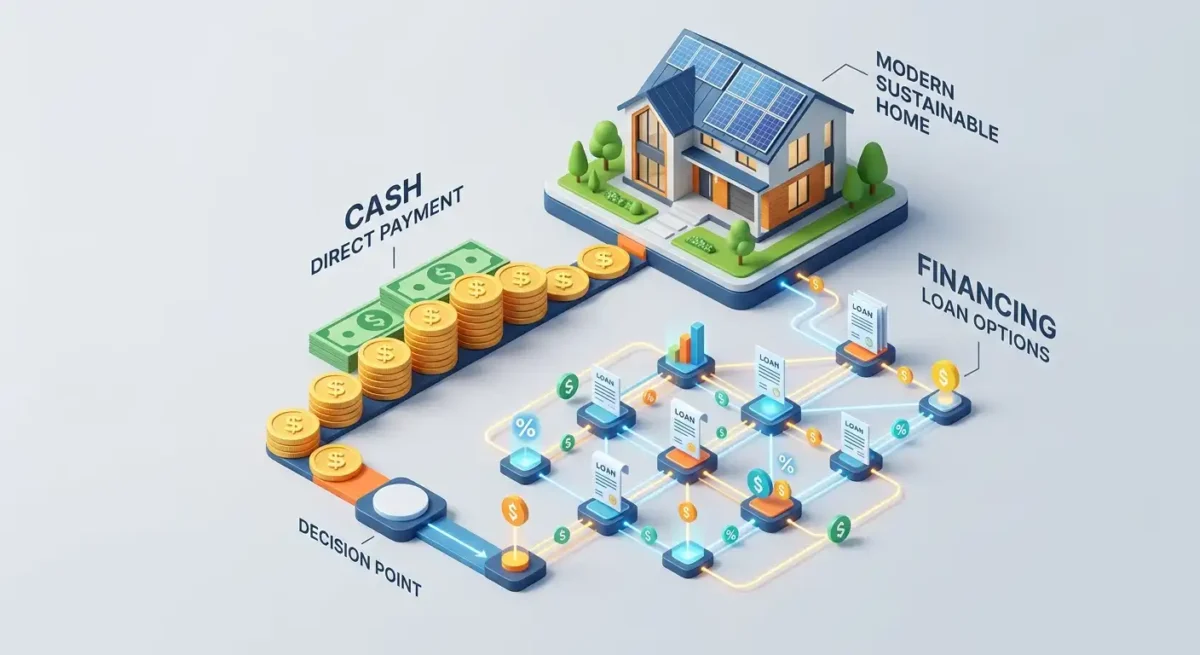
Homeowners pay for solar in one of four ways: cash, a loan, a lease, or a power purchase agreement. Each changes who owns the system, what the monthly payment looks like, and how much the project costs over time.
Comparing solar financing options really means comparing ownership, monthly payments, total costs, and contract terms side by side, not looking for a single answer that works for everyone. This guide walks through loans, leases, PPAs, and the cost comparisons that matter before signing anything.
Understanding the Main Ways to Pay for Solar
Before comparing numbers, it helps to know what each financing structure actually means.
What Does Solar Financing Mean?
Financing lets a homeowner install solar without necessarily paying the full system price upfront. Paying cash is different from borrowing money, and both are different from entering a third-party ownership agreement like a lease or PPA. The choice affects who owns the equipment, what the monthly payment looks like, and how much a homeowner ultimately saves.
The Four Main Ways to Finance Residential Solar
A cash purchase, a solar loan, a solar lease, and a power purchase agreement cover nearly every residential solar financing arrangement in the U.S. Each model differs in ownership, payment structure, and who is responsible for the system once it is installed.
What Determines the Cost of Solar Financing?
System price and size, loan interest rate and repayment period, down payment and fees, lease or PPA payment structure, and electricity production all factor into the final cost. Two homeowners with identical panels can end up with very different totals depending on which of these variables applies to their agreement. Cost scales differently once a project moves beyond a typical residential rooftop, as this breakdown of utility-scale solar cost and land rules shows.
What Are the Best Financing Options for Going Solar?
There is no single answer to what the best financing options are for going solar, since the right fit depends on cash flow, credit, and how long a homeowner plans to stay in the home.
Cash Purchase: Paying for Solar Upfront
A cash purchase means paying the full system price at installation. The homeowner owns the system outright immediately and takes on ongoing maintenance responsibilities in exchange for no financing charges. Comparing this path against financed alternatives starts with knowing the baseline system price, which this average solar panel cost breakdown lays out before any financing is added.
Solar Loans: Financing a System Through Borrowing
A solar loan can be secured or unsecured, and terms typically include an interest rate, a repayment period, monthly payments, and sometimes origination fees. Longer or shorter loan terms change the total amount repaid even when the monthly payment looks similar on paper.
Solar Leases and Power Purchase Agreements
Under a lease, a third party owns the equipment, and the homeowner pays a monthly fee to use it. A PPA works differently: the homeowner pays for the electricity the system generates rather than for the equipment itself. Contract duration, payment escalation clauses, and ownership all differ between the two, which is why they shouldn’t be treated as interchangeable.
Revisiting What Are the Best Financing Options for Going Solar
Answering what the best financing options for going solar are again, after reviewing all three structures usually narrows the choice to two realistic candidates rather than four.
How to Find Top Solar Loans? Comparing Loan Terms and Costs
Knowing how to find top solar loans starts with understanding which loan terms actually drive the total cost.
What to Check Before Choosing a Solar Loan
The annual percentage rate, whether the interest rate is fixed or variable, the loan term, monthly payment, origination fees, and prepayment conditions all belong on a checklist before signing anything.
How Solar Loan Down Payments Affect Monthly Costs
A larger down payment reduces the amount borrowed and, in turn, the monthly payment. As a simple illustration, a $5,000 down payment on a $25,000 system leaves $20,000 to finance instead of the full amount, which lowers monthly interest costs. A lower monthly payment does not automatically mean a lower total cost, since loan term length affects that separately.
How to Evaluate Solar Loan Offers
Comparing the same system price across offers, reviewing the APR, fees, and repayment schedule, and checking whether a quoted payment depends on a future tax benefit all matter here. The advertised monthly payment and the total amount repaid over the life of the loan are two different numbers, and only one of them tells the full story.
How to Find Top Solar Loans Without Overpaying
Learning how to find top solar loans without overpaying usually means comparing at least three offers on the same system before signing. A single quote, no matter how competitive it looks, isn’t a comparison.
Best Financing Options: Comparing Ownership Models
Best financing options really means comparing ownership models side by side rather than picking a single winner.
Solar Loan vs. Solar Lease
A loan results in homeowner ownership once the balance is repaid, while a lease keeps ownership with the third-party provider for the length of the agreement. Maintenance responsibilities, warranties, and transfer conditions differ between the two in ways that matter if the home is ever sold.
Solar Loan vs. Power Purchase Agreement
Borrowing to own a system is a fundamentally different arrangement than purchasing electricity from a third party under a PPA. Payment structures and responsibility for the equipment differ, and utility bill savings can look different between the two as a result.
Cash Purchase vs. Financing
Upfront cost and ongoing payments trade off directly against each other. Financing charges add to the total cost of a system, while ownership and potential long-term financial benefits still remain with the homeowner under most loan structures, unlike a lease or PPA.
Ranking Best Solar Financing by Priority
There isn’t one universal ranking of best financing options in solar, since a homeowner prioritizing the lowest monthly payment will land on a different answer than one prioritizing full ownership.
Which Solar Financing Option Makes More Sense, a Lease or a Loan?
Which solar financing option makes more sense, a lease or a loan, usually comes down to ownership priorities and how long the homeowner plans to keep the home.
How Solar Loans and Leases Differ in Ownership
A loan gives the homeowner ownership of the equipment, subject to the loan terms, while a lease keeps the equipment under the provider’s ownership. This distinction affects what happens if the homeowner later wants to modify the system or sell the property.
Comparing Monthly Payments Under a Lease and a Loan
Loan payments are calculated from principal, interest, and term length. Lease payments are typically a fixed monthly fee, sometimes with a scheduled annual increase written into the contract. Reviewing any escalator clause matters as much as comparing the starting payment.
Comparing Long-Term Costs of a Solar Lease and a Loan
Total payments over the full contract period, not just the first year, determine which option actually costs less. Maintenance obligations and contract terms shift that comparison further, since owning equipment under a loan carries different long-term costs than paying for electricity under a lease.
Revisiting Which Solar Financing Option Makes More Sense, a Lease or a Loan
After comparing ownership, monthly payments, and long-term costs, which solar financing option makes more sense, a lease or a loan, usually depends on how long the homeowner plans to stay put.
How Monthly Payments and Total Costs Compare
These four ways to pay for solar differ most clearly once the monthly payment and total cost are laid side by side.
How to Calculate a Solar Loan’s Monthly Payment
Principal, interest rate, and loan term together determine the monthly payment, and fees can increase the amount actually financed. As a simple illustrative example, a $20,000 loan at a moderate fixed rate over 15 years produces a very different monthly figure than the same balance spread over 10 years. Monthly payment aside, it’s worth checking how solar payback periods work across the USA, since a lower monthly payment and a shorter payback period don’t always point to the same loan.
How Solar Lease Payments Are Calculated
Lease payments are typically fixed each month, sometimes with a built-in annual increase. Contract length affects the total paid over time, and lease payments should always be weighed alongside whatever utility bill remains after the system is installed.
How PPA Payments Are Calculated
A PPA charges a price per kilowatt-hour for the electricity the system actually produces, so monthly costs vary with production. Utility rates and contract terms both play into what a homeowner ultimately pays. Production estimates behind these calculations often trace back to modeling from the National Renewable Energy Laboratory (NREL, U.S. Department of Energy).
Example: Comparing Solar Financing Costs
| Financing Method | Illustrative Payment Structure |
| Cash purchase | One-time upfront payment |
| Solar loan | Fixed monthly principal and interest |
| Solar lease | Contractual monthly payment |
| PPA | Payment based on solar electricity produced |
Actual costs depend on system price, contract terms, interest rates, and electricity production, so this table is a starting framework rather than a prediction.
How to Compare Solar Loan Options? A Step-by-Step Guide
Learning how to compare solar loan options is easier with a consistent four-step process.
Step 1: Compare the Same System Price
Use the same system size and equipment assumptions across every quote, and separate equipment and installation costs from financing charges. Confirm each quote covers the same scope of work before comparing numbers.
Step 2: Compare APR, Loan Term, and Fees
The annual percentage rate, the repayment period, total interest, and any origination fees all belong in a side-by-side comparison. A lower headline rate with higher fees can end up costing more than a slightly higher rate with none.
Step 3: Calculate Total Repayment
Compare the total amount paid over the full loan term, including any upfront payment. Early repayment can change total interest, so it’s worth checking how that scenario is handled before assuming a fixed number.
Step 4: Review Contract Conditions
Prepayment terms, collateral or security requirements, transferability if the home is sold, and default provisions round out what a homeowner should confirm before signing. Anyone comparing loan documents against installer-provided estimates might also want to check solar panel permit requirements, since permitting timelines can affect when financing actually begins.
A Simple Way to Remember How to Compare Solar Loan Options
Reducing how to compare solar loan options to four repeatable steps makes it far less likely that a fee or clause gets overlooked between offers.
Leading Options for Homeowners? Understanding Eligibility and Terms
Leading financing options in solar for homeowners depend heavily on credit, income, and property eligibility before any comparison of rates even begins.
What Determines Eligibility for Solar Financing?
Credit and income requirements, the loan amount relative to system cost, property ownership, and provider-specific underwriting rules all affect eligibility. Two homeowners with similar systems can qualify for very different terms based on these factors alone.
How Homeowners Can Compare Financing Structures
Comparing cash, loan, lease, and PPA arrangements side by side means looking at ownership and contract obligations together, not payment amount alone. The financial assumptions behind any projected savings figure deserve a close look before relying on them.
What to Review Before Signing a Solar Financing Agreement
Total cost and payment schedule, warranty and maintenance responsibilities, cancellation and transfer conditions, and any escalation clauses should all be reviewed line by line. A homeowner uncertain whether a contract’s language was presented accurately can consult this directory of solar scam consumer protection attorneys before signing.
Are Leading Solar Financing for Homeowners Getting More Competitive?
Leading solar financing for homeowners have generally become more varied over the past few years, which is good for shoppers willing to compare more than one offer.
Solar Financing: Interest Rates, Loan Terms, and Fees
Interest rates and fees drive more of the total cost difference between offers than most homeowners expect.
How Solar Loan Interest Rates Affect Total Cost
Interest rates influence both the monthly payment and the total amount repaid over the life of the loan. The stated interest rate and the APR are not the same number, and fees can make two loans with similar interest rates cost noticeably different amounts.
Short-Term vs. Long-Term Solar Loans
A shorter repayment period tends to increase the monthly payment while reducing the total repayment period. A longer term does the opposite, lowering the monthly payment while increasing total interest paid over time.
Solar Loan Fees and Hidden Costs to Review
Origination fees, dealer or financing fees where applicable, late-payment charges, prepayment conditions, and other disclosed charges should all be identified before comparing two offers as if fees didn’t exist.
How Tax Benefits and Incentives Affect Solar Costs
The numbers can look meaningfully different once tax benefits and incentives are factored in correctly, rather than assumed.
How Solar Tax Benefits May Affect Financing Calculations
A tax credit and a loan discount are not the same mechanism, and eligibility for either depends on applicable law and individual circumstances. A homeowner should not assume they will receive a particular tax benefit just because a quote assumes one. Anyone financing a system that relies on a commercial-style structure may also want to see how solar tax equity partnerships work for background on how larger projects use these mechanisms.
Solar Loans That Assume a Future Lump-Sum Payment
Some financing arrangements assume the borrower will make an additional payment after a set period, often tied to an expected tax benefit. If that anticipated payment isn’t made, the loan terms usually adjust the ongoing payment upward. Reviewing the full repayment schedule, not just the advertised monthly figure, matters here.
How State and Utility Incentives Affect Solar Costs
Eligible incentives can change the overall project cost, but upfront incentives are not the same as bill credits or other ongoing benefits. Program-specific requirements should be verified directly, and readers should confirm current eligibility against what’s changing as the solar tax credit ends in 2026 rather than assuming last year’s rules still apply.
Understanding Ownership, Warranties, and Home Sales
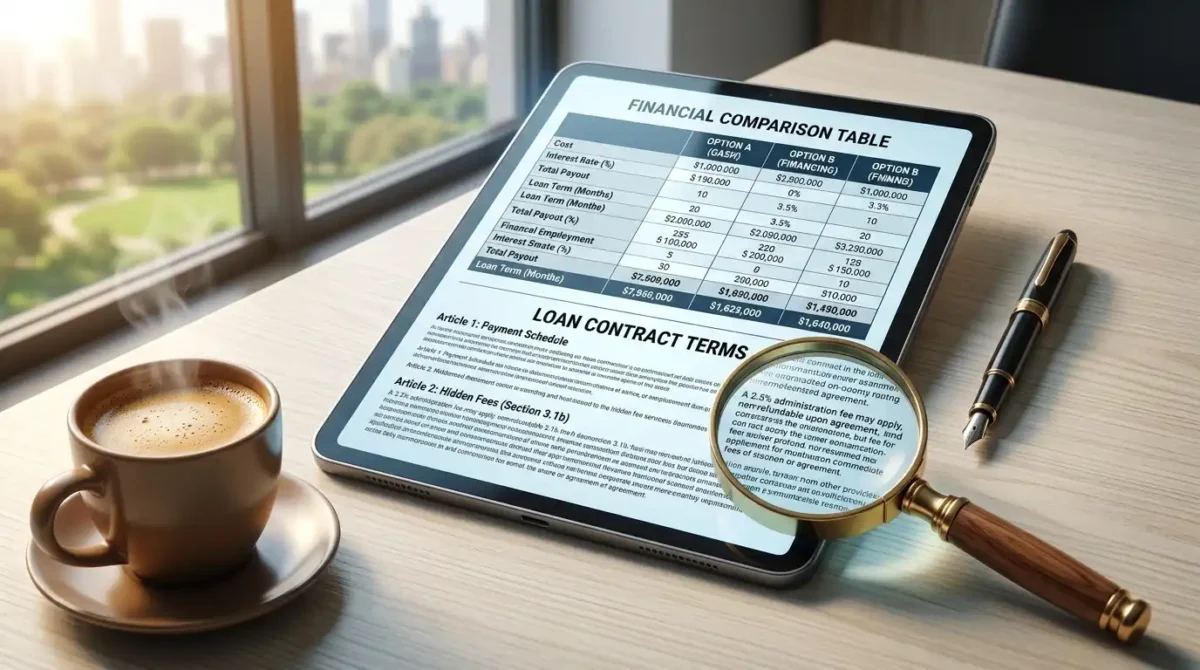
Each financing choice carries different ownership consequences once a home sale enters the picture.
Who Owns the Solar System Under Each Financing Model?
A cash purchase and a solar loan both result in homeowner ownership, though a loan keeps that ownership subject to the loan terms until paid off. A lease and a PPA typically involve third-party ownership throughout the contract.
Who Is Responsible for Maintenance and Repairs?
Maintenance obligations differ across ownership models, and warranties and equipment service terms vary by provider and contract type. Readers should verify these responsibilities directly in the signed agreement rather than assume they match a neighbor’s experience. Someone dealing with unresolved installation damage may find a solar panel property damage attorney useful in that specific situation.
What Happens to Solar Financing When Selling a Home?
Loan payoff and transfer considerations matter for owned systems, while lease and PPA agreements typically require formal transfer approval to the new buyer. Contract approval and buyer eligibility can both affect how smoothly a sale closes. Homeowners looking to exit a lease early, particularly in California, may want to review how a solar lease buyout attorney can help in California before assuming a straightforward payoff.
Solar Financing: Common Risks and Contract Terms to Understand
A few contract terms cause more disputes than anything else in solar financing agreements.
Payment Escalators and Increasing Contract Costs
A lease or PPA may include a scheduled price increase written into the contract. As a hypothetical example, a 2.9 percent annual escalator on a $150 monthly payment adds up meaningfully over a 20-year term, even though the year-one increase looks small.
Solar Loan Default and Collateral Considerations
Secured and unsecured borrowing carry different risks if a payment is missed. Default provisions and collateral terms vary by lender, and not every solar loan uses the same security structure, so this should be confirmed rather than assumed.
Contract Cancellation, Transfer, and Early Payoff
Cancellation terms, potential fees, early payoff conditions, and transfer requirements should all be read directly in the signed contract. The actual contract terms matter more than a headline payment estimate quoted during a sales conversation. Larger or commercial-scale projects face similar scrutiny, and commercial solar panel installation cost is a good example of how contract complexity tends to scale with project size.
Frequently Asked Questions
What are the main financing options in solar for homeowners? Cash purchases, solar loans, solar leases, and power purchase agreements cover nearly every residential arrangement, each with different ownership and payment structures.
Can homeowners finance solar panels with no money down? Some financing arrangements may require little or no upfront payment, though eligibility and total costs still vary by lender and program.
Is a solar loan or lease easier to transfer when selling a home? Transfer conditions differ by contract and financing structure, so this should be confirmed directly with the loan or lease provider rather than assumed. This is one more reason best solar financing options should be judged on contract terms, not just the monthly rate.
How to Find Top Solar Loans? Frequently Asked Questions
What is the difference between APR and interest rate? The interest rate reflects the cost of borrowing alone, while APR includes certain fees, giving a fuller picture of a loan’s actual cost.
Does a longer solar loan always cost less per month? A longer repayment period typically reduces the monthly payment but increases the total interest paid over the life of the loan.
What should be included in a solar loan comparison? APR, fees, loan term, monthly payment, total repayment, and contract conditions should all be compared side by side rather than monthly payment alone. Anyone still working out how to find top solar loans should start with this exact list.
What Are the Best Financing Options for Going Solar? Final Comparison Checklist
Compare Ownership and Payment Structure
Identify who owns the system, compare upfront and recurring payments, and review maintenance and warranty responsibilities before deciding.
Compare Total Costs Over the Same Period
Use consistent system assumptions, include financing charges and any contract escalators, and account for incentives only once eligibility is actually established. Homeowners weighing whether solar makes financial sense in their specific state can look at why solar panels are worth it in Colorado for a sense of how regional factors shift the math.
Review Contract and Home-Sale Conditions
Check transfer and cancellation terms, review payoff conditions, and understand the obligations that remain throughout the agreement, not just at signing. This full checklist is really what the best financing options for going solar boil down to in practice.
Which Solar Financing Option Makes More Sense, a Lease or a Loan? Final Considerations
When Comparing a Loan and Lease, Review Ownership First
Ownership affects both responsibilities and the underlying financial structure, so it’s worth settling before comparing payment amounts.
Compare Monthly Payments With Total Contract Costs
A lower monthly payment does not necessarily mean a lower overall cost once the full contract term is factored in.
Review the Agreement Before Evaluating Potential Savings
Payment terms, contract duration, transfer conditions, and the assumptions behind any projected savings figure all deserve a careful read before treating those numbers as guaranteed. At that point, which solar financing option makes more sense, a lease or a loan, should be clear from the numbers rather than the sales pitch.
How to Compare Solar Loan Options? Final Checklist
Verify the Loan’s Full Cost
- APR, fees, total repayment, and monthly payment.
Review Repayment and Early Payoff Conditions
- Loan term, extra payments, and early repayment provisions.
Compare Financing Terms With the Same Solar System
- Keep system price, capacity, and assumptions consistent across offers. Homeowners in newer solar markets may also find solar panels explained simply for Washington useful for understanding regional baseline costs before comparing financing quotes.
Working through these three checklist items is, in practice, how to compare solar loan options without missing a hidden cost.
Final Thoughts
There is no single best answer among the available solar financing options. A cash purchase avoids financing charges entirely but requires the full amount upfront. A loan builds ownership over time but adds interest.
A lease or PPA lowers the barrier to entry but keeps the equipment, and often the tax benefits, with a third party. The right fit depends on cash available today, how long the home will be owned, and how much risk a homeowner is comfortable carrying.
A fair comparison means lining up the same system price, the same contract length, and the same assumptions across every offer, not just comparing monthly payments in isolation. A lower payment can hide a longer term or a higher total cost, and a lease that looks simple upfront can carry escalators that add up over twenty years.
Reading the full agreement, asking direct questions about ownership and transfer terms, and checking the math independently before signing is what separates a good financing decision from a costly one.
Frequently Asked Questions
Can homeowners finance solar panels without owning the system?
Yes. Leases and PPAs typically involve third-party ownership, so the homeowner pays for use of the system or its electricity output rather than owning the equipment.
What documents may be needed for solar financing?
Requirements vary but may include identification, income information, property details, and project documentation specific to the financing provider.
Can solar financing terms change after installation?
This depends on whether the agreement uses fixed or variable terms. The signed agreement, not a verbal estimate, governs what can change later, which is exactly why leading financing options for homeowners should always be judged by contract language.
This article by SolarInfoPath (2026 research framework) is part of a comprehensive solar knowledge architecture covering all major high-value sectors including legal disputes (installation negligence, contracts, liability, fraud, lawsuits, liens, HOA and permitting disputes), financial structures (loans, PPA/lease agreements, DSCR financing, tax equity, investment and project finance), tax law (ITC, Section 48/25D, MACRS depreciation, bonus credits, IRS audits, recapture rules, domestic content and IRA/OBBBA compliance), insurance and risk (property damage, hail/wind/fire claims, bad faith insurance disputes, warranty coverage), policy and regulation (net metering, FERC interconnection, state utility rules, incentive programs and regulatory changes), commercial and utility-scale development (EPC contracts, construction delays, performance bonds, receivership, bankruptcy, asset sale and restructuring), real estate impacts (home value, solar leases, liens, title issues, HOA restrictions, easements), and emerging market structures such as battery storage, community solar, agrivoltaics, SRECs, yieldcos, and institutional investment funds. All content is based on publicly available regulatory, financial, and legal sources and is intended strictly for educational and informational purposes, not legal, tax, or financial advice. Readers should always verify current laws, utility policies, tax regulations, and contract terms with qualified licensed professionals before making decisions, as solar regulations, incentives, and financial structures frequently change across jurisdictions and time.

Solar Legal Analyst· Policy Researcher· Investigative Finance Writer Lead Analyst & Founder of SolarInfoPath
Morgan Lee is a solar legal analyst, policy researcher, and investigative finance writer with 12+ years of experience in U.S. renewable energy law, IRS tax credit compliance, and solar litigation. He is the founder of SolarInfoPath, a research-driven platform focused on primary-source analysis of solar contracts, tax law, regulatory policy, and industry disputes affecting homeowners and commercial developers.
His work is grounded in original legal and regulatory sources, including IRS notices, FERC and CPUC rulings, state court filings, PACER records, and UCC lien databases. He specializes in solar contract disputes, injury and workers’ compensation claims, PACE financing issues, tax equity structures, ITC recapture rules, MACRS depreciation, and federal and state solar policy frameworks.
Morgan’s analysis spans solar litigation, finance structures, and regulatory developments such as the IRA and OBBBA, interconnection reform, domestic content rules, and battery storage incentives. He also covers EPC contracts, PPAs, project financing, and utility-scale solar investment structures.